


 Share
Share

Editor’s note: This article introduces The Eight-Minute Kitchen, an eight-part Slurrp series by Avinash Mudaliar about the systems behind modern Indian eating. Each chapter can be read independently; the index below will be updated with live links as the series is published.
***
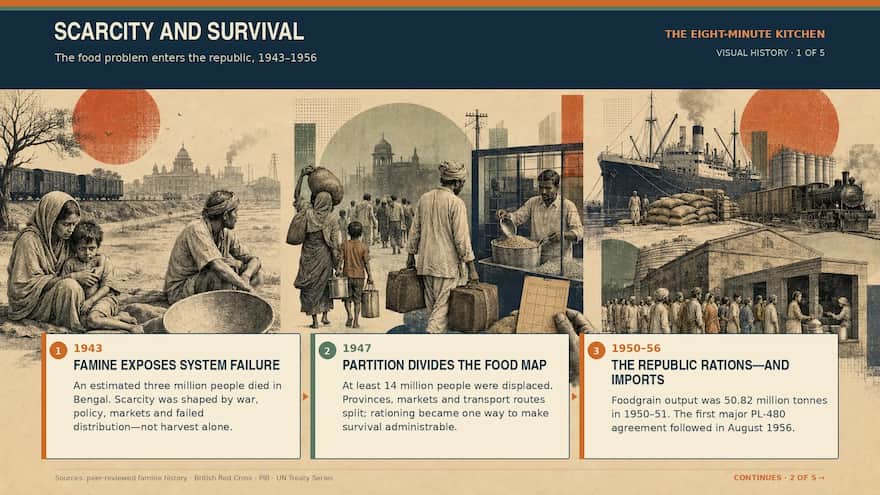
INDIA ENTERED INDEPENDENCE with a map newly drawn and a food system already under exceptional strain. Wartime shortages had produced a central Food Department; Partition then cut through fields, markets, railway routes and households. For millions, the question of food was not culinary. It was whether grain existed, whether it could be moved and whether a ration shop would have enough to distribute. The official history of India’s food department begins, tellingly, with scarcity.
Nearly eight decades later, the distance between wanting groceries and receiving them can be measured on a phone. The sector’s most aggressive slogan — “10-minute delivery” — became so familiar that, in January 2026, the government asked major platforms to stop promoting it, Reuters reported, amid concern about rider safety and pay. The advertising changed. The machinery did not disappear: dark stores, route algorithms, digital payments, riders and a city’s density can still compress the last mile into a handful of minutes.
The speed is dazzling. The historical distance behind it is larger.
The long way to a short delivery
This series follows that distance. It begins not with an app but with a state trying to prevent hunger: procuring grain, building buffer stocks, extending irrigation and making distribution a matter of public policy. It then moves through fields, dairy cooperatives, factory floors, television commercials, restaurant kitchens and smartphones. The modern Indian plate was not produced by one revolution. It required several, and they did not arrive everywhere at once.
The broad production curve is remarkable. India produced 50.82 million tonnes of foodgrain in 1950–51, according to a Press Information Bureau historical series. The government’s third advance estimate for 2025–26 puts the figure at 376.56 million tonnes — more than seven times as much. Milk production reached 239.3 million tonnes in 2023–24, up from 55.6 million in 1991–92.
Three numbers before we begin
50.82 → 376.56 million tonnes | India’s foodgrain output in 1950–51, compared with the third advance estimate for 2025–26: a rise of more than sevenfold.
700+ towns and cities | The reach of the National Milk Grid described by the National Dairy Development Board.
13 minutes, not 10 | In 2023, Zepto’s chief executive told Reuters that the company’s average delivery time was 13 minutes even as it promised groceries in 10 — a useful reminder that the slogan was not a universal measured average.
Totals, however, have a way of tidying up a disorderly story. They do not show the farmer learning a new seed, the woman carrying milk to a village collection point, the factory shift sealing packets, the cook modifying a foreign format for an Indian palate, or the rider waiting outside a dark store while a timer runs. They do not show who absorbed the risk, who saved time and whose time became newly measurable.
Not one revolution, but several
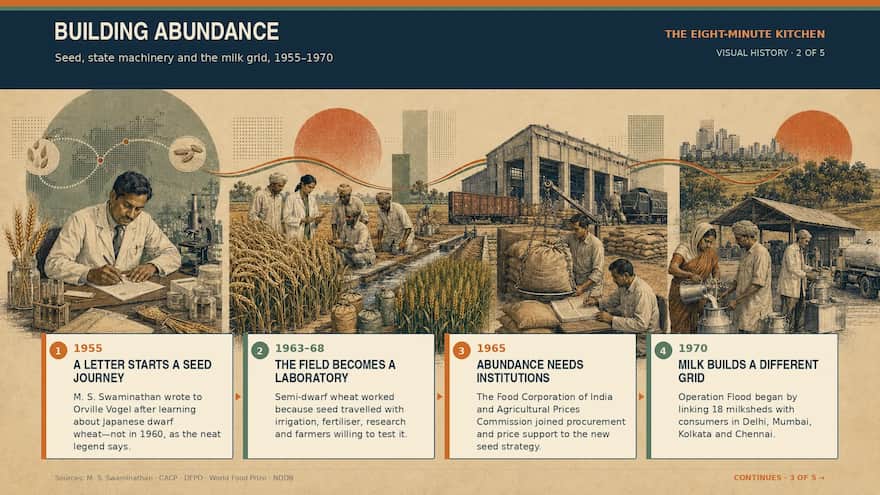
First came the institutional revolution. The Food Corporation of India was created in 1965, in the midst of foodgrain shortage, to make procurement, storage and distribution durable functions of the state. Alongside it came the high-yielding wheat and rice varieties, fertiliser, irrigation and price support associated with the Green Revolution. India’s old fear — that a failed monsoon might become a national famine — began to loosen its grip. The gains were immense; the environmental costs of input-intensive agriculture, including pressure on water and biodiversity, would become clearer much later.
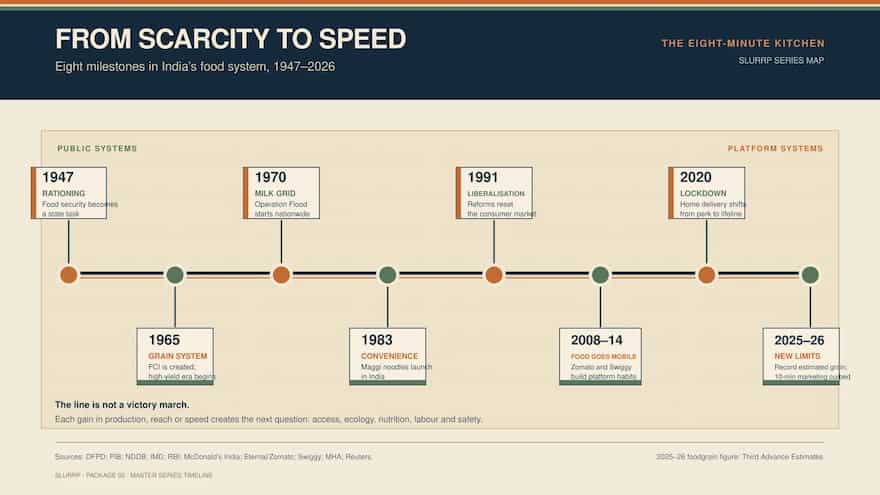
Then came milk. Operation Flood, launched in 1970, linked village producer cooperatives to a National Milk Grid serving consumers in more than 700 towns and cities. It was a logistical system, a technology programme and a rearrangement of bargaining power disguised as the morning milk supply. In its most successful form, the cooperative was not charity delivered to a farmer but infrastructure owned through her membership.
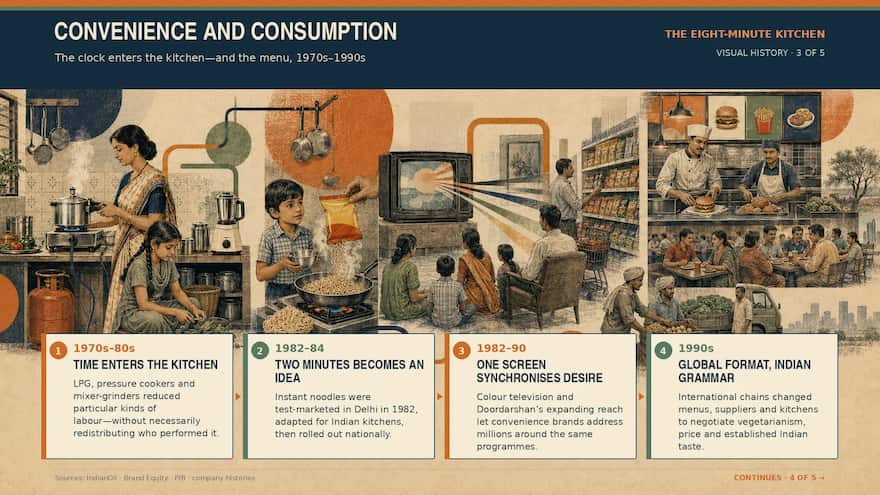
Next, time entered the kitchen as a commercial problem. Pressure cookers and mixer-grinders reduced labour; packaged foods turned minutes into a selling point. In 1983, Nestlé launched Maggi instant noodles into a market in which noodles were still unfamiliar to many home cooks. An IMD case study of the launch describes how the company adapted the product and built the category. The crucial innovation was cultural as much as technical: a foreign form made familiar by masala, a mother addressed through a child, and “two minutes” offered as a small domestic liberation.
The market changed again after the 1991 balance-of-payments crisis. The Reserve Bank of India’s history describes the reforms that followed as the beginning of a new era of liberalisation. Imported brands, new retail formats, cable television and rising consumer ambition did not erase Indian tastes; they made companies negotiate with them. McDonald’s, whose first western and southern India restaurant opened in Mumbai in 1996, became a particularly visible example of a global system learning that the Indian market could not simply be served a global menu.
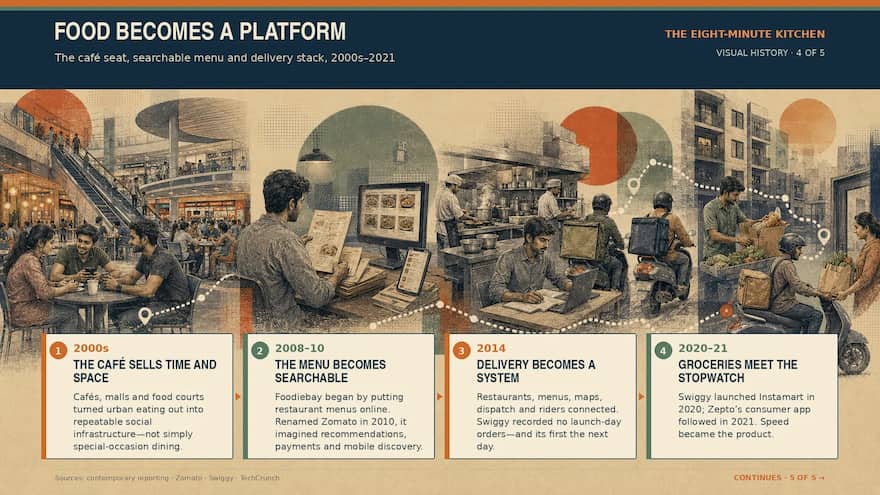
Finally, the restaurant moved into the phone. Zomato, founded in 2008, began as a search-and-discovery platform. Swiggy, founded in 2014, built delivery into the transaction itself. When the nationwide Covid-19 restrictions began in March 2020, the government’s own guidelines encouraged home delivery to reduce movement. What had been convenience acquired the air of infrastructure. Quick commerce then applied the same logic to groceries: put inventory closer, predict demand more accurately and make waiting feel obsolete.
***
***
***
***
***
***
What abundance does not settle
It is tempting to tell this as a straight ascent: from shortage to plenty, from queue to click. History is less obliging. Higher yields can coexist with depleted aquifers. A full supermarket can coexist with anaemia. Cheap convenience can transfer pressure from the customer to the worker. A country that has become exceptionally good at producing calories can still struggle with the quality and distribution of nutrition.
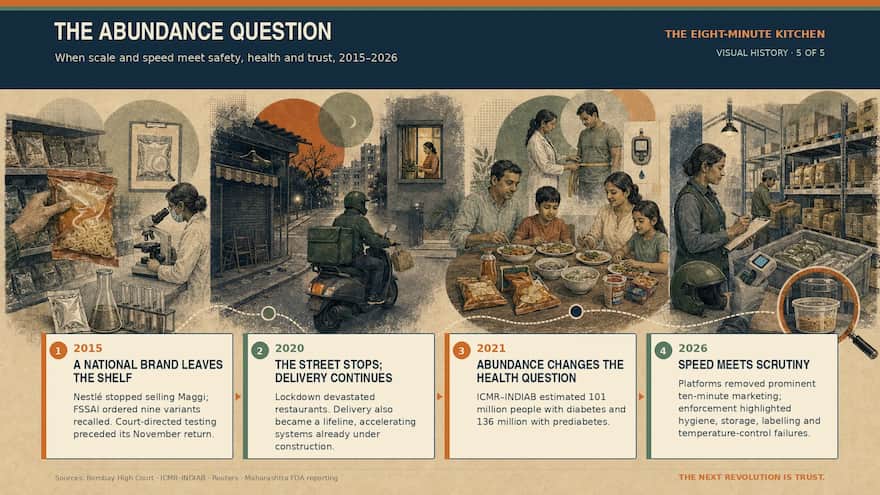
The scale of that unfinished work is visible in the ICMR-INDIAB national study, which estimated that 101 million people in India were living with diabetes and 136 million with prediabetes in 2021. Those numbers do not cancel the triumph over scarcity. They change the question. The republic once asked: Can we produce enough? The harder question now is: What kind of abundance have we produced, for whom, and at whose cost?
That is the story of The Eight-Minute Kitchen: not a victory lap for speed, and not nostalgia for the ration line, but a history of the systems between them.
The Eight-Minute Kitchen: Series Index
Chapter 1 | 1947–1959: A Hungry Republic
Partition, rationing, refugee enterprise and the institutions a new country began building against hunger. Read it here.
Chapter 2 | 1960–1969: The Laboratory Moves To The Field
Drought, imported grain, high-yielding seeds and the concentrated scientific gamble that became the Green Revolution. Read it here.
Chapter 3 | 1970–1979: The Milk Revolution
How Verghese Kurien, village cooperatives, buffalo-milk technology and a national cold chain made Operation Flood possible. Read it here.
Chapter 4 | 1980–1989: The Convenience Decade
Time-saving appliances, television advertising, packaged food and the two-minute noodle that taught a market a new habit. Read it here.
Chapter 5 | 1990–1999: Liberalisation Eats Lunch
Economic reforms, global brands, Indianised menus and the arrival of a more visibly consumerist food culture. Read it here.
Chapter 6 | 2000–2009: India Starts Eating Out
Restaurants, cafés, malls, travel and a middle class increasingly willing to pay for food beyond the home. Read it here.
Chapter 7 | 2010–2019: Your Restaurant Moves Into Your Phone
Search, ratings, cloud kitchens and delivery platforms redraw the relationship between diner, restaurant and worker. Read it here.
Chapter 8 | 2020–2026: The Eight-Minute Kitchen
Lockdown, dark stores, quick commerce and the labour, safety, nutrition and sustainability questions hidden inside instant fulfilment. Read it here.
Series index: You are here — Introduction | Next: Chapter 1 — A Hungry Republic




