


 Share
Share

Editor’s note: This is Chapter 6 of The Eight-Minute Kitchen, Avinash Mudaliar’s eight-part history of the systems behind modern Indian eating. It covers 2000–2009 and, more precisely, the metropolitan and aspirational slice of that decade in which chain cafés, malls, food courts, organised retail and delivery networks became more visible. It does not suggest that eating out became routine or affordable for India as a whole.
***
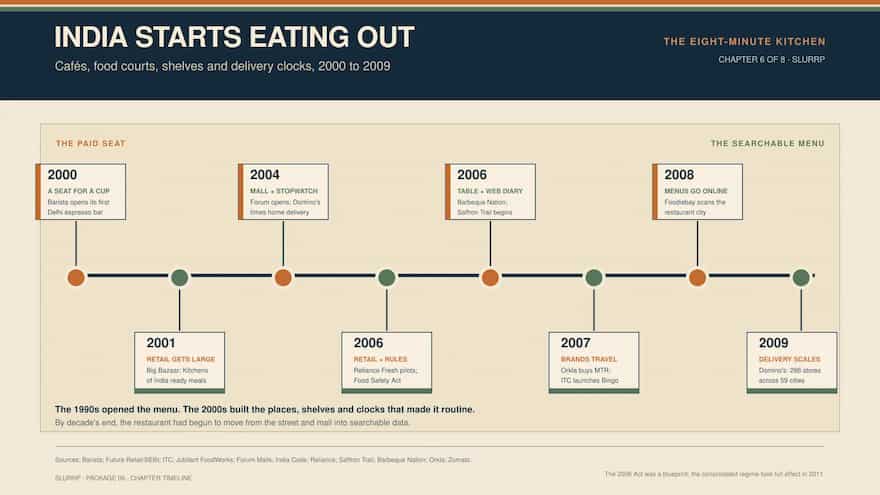
IN 2002, a cappuccino at Barista cost ₹40. The chain had 105 cafés and said 30,000 people came through them each day. Those numbers, recorded in a contemporary Business Today profile, describe more than a taste for espresso. They describe a new transaction.
The customer bought coffee. The cup bought time.
For the price of one drink, it was possible to occupy a table without ordering a full meal: to meet a friend, postpone going home, conduct a tentative interview or simply be elsewhere. The café sold caffeine, certainly. It also rented out a small patch of urban permission.
The price of an hour
Barista opened its first outlet in Delhi in 2000. Four years later it had more than 120 outlets, while a company executive told The Economic Times that what it sold was a “coffee experience”: ambience and a break from routine. Café Coffee Day had opened its first café in Bengaluru in 1996; after expanding through the 2000s, it had 810 outlets in more than 100 cities by May 2010, according to a US Department of Agriculture market report.
This was the decade in which the branded café became legible as an everyday urban category. The signs, menus and sofa arrangements were repeatable. A customer who understood the ritual in Bengaluru could perform it again in Delhi. Espresso vocabulary became a mild form of social equipment.
Yet “India discovered café culture” would be nonsense. Coffee houses, Irani cafés and other public eating rooms long predated these chains. After the Coffee Board closed several establishments in the 1950s, workers formed co-operative societies; the first of the new worker-run Indian Coffee Houses opened in Delhi in December 1957, according to the co-operative’s history.
The new chains did not invent conversation over coffee. They repackaged it for another cohort: brighter branding, standardised service, aspirational pricing and aggressive multiplication. The novelty was not the right to linger. It was the attempt to franchise lingering.
That distinction also establishes the chapter’s limits. This was a metropolitan, middle-class and unevenly affordable change. It did not sweep the country clean of canteens, tea stalls, darshinis, dhabas, street vendors or home meals. “Urban India” is not a synonym for India, and even within a city, ₹40 could be a minor indulgence to one person and an absurd price for coffee to another.
The mall builds an indoor street
The café’s natural habitat was not only the high street. It was the mall: a privately managed indoor street where shopping, cinema, air-conditioning and dinner could be purchased in one excursion.
The food court was the mall’s most democratic-looking room. One table could hold a dosa, a burger, noodles and a chaat plate bought from different counters. Families and groups no longer had to agree on a restaurant before sitting down. Choice became architecture: queue first, reunite later.
Bengaluru’s Forum Koramangala, established in 2004, included a multiplex and a large food court in the retail mix, as the developer’s history of its mall business records. The significant invention was not any dish. It was adjacency. A film could be followed by a snack; shopping could turn into dinner; an afternoon could remain under one roof.
At the same time, modern retail rehearsed a similar promise for food bought to take home. Future Retail says its first Big Bazaar opened in Kolkata in October 2001, designed as an “agglomeration of bazaars”; Food Bazaar followed in July 2002 with fresh produce, staples, processed food and ready-to-cook products. Those dates and descriptions appear in the company’s 2014 disclosure to SEBI.
Not every name in this story was new. Foodworld had been launched in 1995; when its joint venture ended in 2006, RPG retained 48 stores and relaunched them as Spencer’s, according to Spencer’s corporate history. Reliance Fresh opened its first 11 pilot stores in Hyderabad on 3 November 2006, selling fruit, vegetables, staples, dairy and processed food. By the end of that quarter there were 22 stores, as Reliance Industries reported at the time.
The supermarket shelf and the food-court counter shared a grammar: range, display, recognisable brands and the promise of convenience. But they did not replace the older city. An ICRIER report estimated that modern retail made up only 7 per cent of India’s retail market in 2010 and found that shoppers still preferred neighbourhood kiranas for proximity, price and frequent purchases. Its conclusion was coexistence, not conquest.
Delivery learns the clock
The mall gathered the diner into one building. Domino’s worked on the opposite problem: how to move the restaurant to the diner.
The chain launched its “30 minutes or free” campaign in India in 2004. By 30 November 2009, it operated 286 stores across 59 cities, according to the company’s 2010 red-herring prospectus. A pizza ordered by telephone looked simple only from the sofa.
Behind it sat a system of store catchments, mapped addresses, dough and topping supply, order-taking, ovens, dispatch and riders racing both traffic and a public promise. The app age is often credited with making dinner a logistics problem. The 2000s had already put the meal on a stopwatch.
The promise changed expectation even for people who never ordered a pizza. Delivery was no longer merely a restaurant’s helpful extra; speed could be the product, nationally advertised and operationally measured. The kitchen had acquired a deadline visible from the dining room.
Three things an urban meal bought besides food
A seat | In 2002, Barista’s cappuccino cost ₹40; the chain reported 105 cafés and 30,000 customers a day. Business Today recorded the figures.
A countdown | Domino’s introduced its “30 minutes or free” campaign in 2004 and reached 286 Indian stores in 59 cities by November 2009. The dates appear in the company history and offer document.
A searchable menu | The site that became Zomato began in 2008 with paper menus collected, scanned and put online. Founder Deepinder Goyal later reconstructed its first months.
Dinner adds theatre
Eating out also had to offer what the home kitchen could not easily reproduce: spectacle, abundance and a reason to make dinner an occasion.
Barbeque Nation, which its company history dates to 2006, made an embedded grill part of the table. Diners cooked appetisers over live heat before moving to a buffet. The company’s description of the format is corporate, but the mechanism is revealing. Dinner had become participatory theatre, useful for birthdays, office groups and families negotiating different appetites.
Indian brands were not bystanders. Haldiram’s counter-and-retail model placed chaat, sweets, meals and packaged namkeen in the same branded world. MTR carried another kind of continuity: a familiar regional food name extending through ready meals, mixes, spices and condiments. In April 2007, Norwegian group Orkla completed its purchase of the Bengaluru company, as Orkla announced.
This was globalisation with the arrow reversed. In the previous decade, international restaurant companies had come to India and adapted. Now foreign capital was buying an Indian packaged-food vocabulary already capable of travelling.
The shelf becomes a second kitchen
The 2000s did not separate eating out neatly from eating in. The same urban appetite for dependable brands, speed and variety crossed the restaurant door and entered the cupboard.
ITC began its food business with Kitchens of India ready-to-eat dishes in August 2001. Aashirvaad atta followed in 2002, Sunfeast biscuits in 2003 and Bingo snacks in 2007. ITC’s own corporate chronology makes the sequence unusually clear. A company associated with tobacco, hotels, paper and agriculture was assembling a portfolio that could appear at breakfast, tea and between meals.
The larger change was infrastructural. Organised shops offered more display space; packaged-food companies offered more reasons to use it; restaurant chains taught consumers to expect consistency between outlets. None of this made the food system uniformly modern, safe or accessible. It made scale more visible — and made the consequences of failure larger.
Parliament passed the Food Safety and Standards Act in August 2006. The law aimed to consolidate food laws and establish a single authority for science-based standards across manufacture, storage, distribution, sale and import, as the Act itself states. The chronology needs care: the new rules and regulations were fully implemented only in August 2011. The 2006 Act belongs here as a blueprint; its harder tests belong to the next chapter.
The diner begins to publish
Near the decade’s end, the eater acquired a second identity: publisher.
On 12 March 2006, Mumbai doctor Nandita Iyer began Saffron Trail as an online diary of what she cooked, so she could remember how to make a dish again. Her account of the blog’s origin is modest, but it catches a transition. Recipes, kitchen experiments and opinions no longer needed a newspaper column, cookbook contract or television slot before they could travel.
Then the restaurant menu itself moved online. In January 2008, Deepinder Goyal put live a small site that soon became Foodiebay. He and family members drove around collecting menus, scanned them and uploaded them; Pankaj Chaddah joined the project in July. Goyal’s retrospective recalls roughly 25 visitors a day at first. The service that would become Zomato was not yet a delivery empire. It solved a smaller problem: what can we order, and from where?
That question is the hinge between decades. In the 1990s, the global franchise had adapted its menu to India. In the 2000s, cafés, food courts, supermarkets and delivery chains turned urban eating into a repeatable system of places, shelves and clocks. By 2008, the system had begun to generate data.
The next decade would put that data in a pocket, add maps, ratings, payments and fleets of riders, then ask the most consequential question of all: how little time could a meal be made to take?
This is Chapter 6 of The Eight-Minute Kitchen, Slurrp’s eight-part history of independent India’s food system. Return to Chapter 5: Liberalisation Eats Lunch, browse the series introduction and index, or continue to Chapter 7: Your Restaurant Moves Into Your Phone.
Previous: Chapter 5 — Liberalisation Eats Lunch | Series index: The Eight-Minute Kitchen | Next: Chapter 7 — Your Restaurant Moves Into Your Phone




