


 Share
Share

Editor’s note: This is Chapter 7 of The Eight-Minute Kitchen, Avinash Mudaliar’s eight-part history of the systems behind modern Indian eating. It covers 2010–2019 and, more precisely, the smartphone-connected urban market in which discovery, ordering, payment and delivery were assembled into a single interface. It does not suggest that app ordering was universal, or that software made the physical work of cooking and delivery disappear.
***
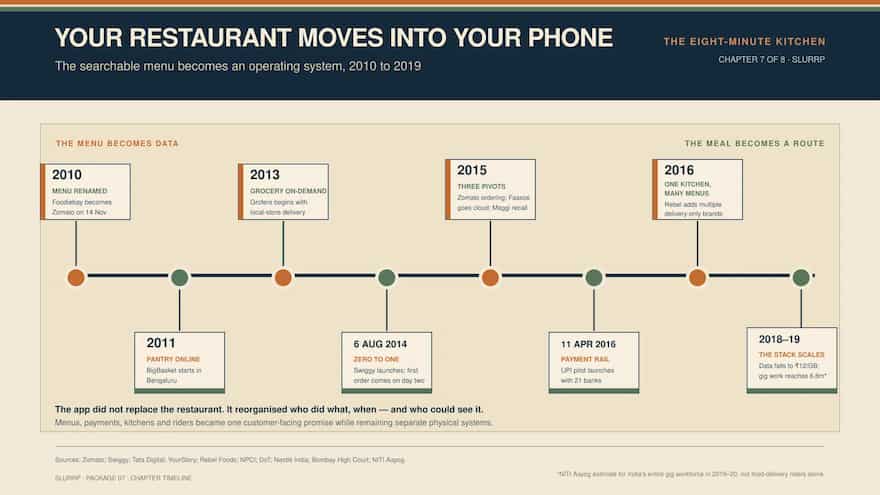
AT MIDNIGHT ON 14 November 2010, Foodiebay was due to become Zomato. The announcement promised that its “life saving services” — restaurant menus — would continue working on both domains while the change took effect. It was not the most cinematic revolution. There was no ribbon to cut, only a redirect.
Yet the company’s own change-of-name post contained the decade in miniature. Foodiebay already listed more than 8,000 restaurants in five Indian cities. It wanted to become a recommendation engine, accept payments and build geolocation-based mobile apps. A restaurant, once found by signboard, newspaper listing or a number saved on the fridge, was becoming searchable data.
The previous decade had put delivery on a clock. This one put the restaurant’s front door inside a phone.
The menu becomes a database
Zomato’s precursor had begun in 2008 with a beautifully ordinary task: collect paper menus, scan them and put them online. Founder Deepinder Goyal later recalled that the earliest version drew roughly 25 visitors a day; Pankaj Chaddah joined in July 2008, according to Goyal’s account of the project’s first months.
Once digitised, the menu could do things paper could not. It could be searched by neighbourhood and cuisine, paired with maps and opening hours, corrected, photographed, reviewed and ranked. The diner did not merely choose from a restaurant’s dishes. Increasingly, the diner chose among restaurants inside a privately designed feed.
That altered reputation as well as convenience. A bad evening no longer ended when the bill was paid; it could become a review visible to the next customer. A good-looking plate could travel farther than its aroma. By 2016, Zomato said most Indian restaurants on its service used a business app to respond to reviews and update information in real time. The phone had become menu, guidebook, noticeboard and complaints desk.
Ordering was a later turn, not Zomato’s original purpose. The company says it remained primarily a content-and-media product until it launched online ordering in mid-2015. By April 2016 it reported two million orders, while still stressing that its advantage came from years of search traffic. Its own retrospective makes the pivot explicit: discovery had become transaction.
The rider joins the order
Swiggy began from the other end of the problem. When the service launched in Bengaluru on 6 August 2014, it received no orders at all. The first came the following day. Co-founder Sriharsha Majety supplied that less burnished version of events in a tenth-anniversary recollection; one early restaurant partner, he wrote, began with two orders a day.
The zero is more useful than a startup myth. It shows how much behaviour had to be invented. A customer had to trust an unfamiliar interface, a restaurant had to surrender part of its customer relationship, and a rider had to be matched to a kitchen, an address and a deadline. None of those parties controlled the whole meal. The platform’s product was coordination.
Its operating loop joined search, menu, order, preparation estimate, rider allocation, route and tracking. A later Swiggy prospectus describes the mechanics: restaurant partners prepare the food; delivery partners carry it; the platform connects both to the customer and continually refines demand prediction, preparation times, routing and batching.
Not every app owned the last mile at once. In March 2017, Zomato reported that close to 90 per cent of its online orders were still being delivered by the restaurants themselves, with an average delivery time of about 38 minutes. The company-published figures are a useful snapshot of a market still assembling itself. “Food delivery app” was not one settled machine. It was a contest between different ways of dividing the work.
The stack arrives in instalments
It is tempting to say four technologies — smartphones, GPS, digital payments and gig labour — arrived together and made delivery inevitable. The chronology is less tidy and more interesting.
Swiggy was already operating before India’s great cheap-data shock and almost two years before UPI. Government figures put average mobile data use at just 62 MB per subscriber per month in 2014, at roughly ₹300 per GB. By June 2018, usage had risen to 3.2 GB and the price had fallen to about ₹12 per GB. The Department of Telecommunications recorded the fifty-one-fold jump in use. That fall made maps, photographs, live status updates and habitual app-browsing cheaper to carry in a pocket.
UPI’s pilot launch came on 11 April 2016, led by the Reserve Bank of India governor and initially involving 21 member banks, according to the National Payments Corporation of India. It did not abolish cash on delivery. It made a growing share of transactions less awkward: no card number, no hunt for change, no separate wallet balance. By FY2018–19, UPI payments were worth about ₹9 lakh crore, rising to ₹21 lakh crore in FY2019–20, official figures later reported to Parliament show.
The app economy therefore did not spring from one invention. It accumulated: better phones, cheaper data, usable maps, payment rails, dense restaurant supply and people willing to move through traffic for each order. Remove the rider and the elegant interface becomes a picture of dinner.
Three myths the app timeline punctures
Zomato was born as a delivery app | It was not. Its precursor catalogued menus from 2008, became Zomato in 2010 and remained primarily a discovery-and-media product until online ordering arrived in 2015. Zomato’s own history records the pivot.
Swiggy took 35 orders on launch day | Its co-founder says the total on 6 August 2014 was zero; the first order arrived the next day. Sriharsha Majety recalled it a decade later.
UPI made Swiggy’s launch possible | UPI’s pilot began on 11 April 2016, twenty months after Swiggy launched. It reduced payment friction later; it was not a precondition for day one. NPCI dates the launch.
The restaurant loses the dining room
Once demand lived in a feed, a restaurant could exist without a street-facing room at all. The cloud kitchen removed tables, waiters and expensive frontage from the proposition. What remained was production, packaging, a discoverable brand and a delivery radius.
Faasos provides a particularly clean timeline. Rebel Foods says it launched in 2011 as a physical quick-service chain with online ordering, adapted Faasos into a single-brand cloud-kitchen prototype in 2015, then opened multi-brand cloud kitchens in 2016 with names including Behrouz Biryani and Oven Story. The company’s chronology is self-published, but the structural change is plain: one cooking site could present several restaurant identities on the same screen.
That was not simply a cheaper restaurant. It was a different object. A brand could be tested without securing a dining room; a kitchen could alter its menu by neighbourhood; several cuisines could share equipment and dispatch. The restaurant façade — previously architecture — became thumbnail, name, rating and packaging.
The pantry was moving online too. BigBasket was founded in Bengaluru in 2011 and built grocery delivery around chosen dates and time slots, as Tata Digital’s later company history records. Grofers followed in December 2013 as an on-demand service working with local stores, according to a founder-history account. These were not yet the ten-minute businesses of the 2020s. They taught customers that the weekly shop, like dinner, could begin with a search box.
Convenience has a workforce
The phrase “the restaurant moved into your phone” is useful only if we remember what did not. The cook stayed beside heat. The rider stayed in weather and traffic. The customer saw a dot glide across a map; the dot was a person carrying a meal.
Platforms turned that movement into a sequence of measurable decisions: accept, collect, wait, route, deliver, rate. The model offered flexible entry to work, but it also placed earnings, incentives and allocation inside systems workers did not design. Swiggy’s own prospectus calls delivery partners gig workers, says attracting and retaining them is critical, and lists pay, incentives, strikes and working conditions among material business risks.
An official estimate published later by NITI Aayog put India’s entire gig workforce — not food-delivery riders alone — at 6.8 million in 2019–20. More than 82.5 per cent of gig workers were informal workers, and about half were concentrated in retail trade and transportation. The report’s boundaries matter: apps did not create informal labour, but they made a portion of it newly visible, scored and routed.
A packet puts trust on trial
The decade’s largest food story concerned neither an app nor a restaurant. It concerned whether a familiar packet could be trusted.
On 5 June 2015, amid disputes over test results and concerns about lead, Nestlé India stopped selling Maggi noodles; FSSAI ordered nine variants recalled and production halted. Nestlé challenged the order and says it destroyed more than 35,000 tonnes while the case proceeded. The company’s detailed timeline gives its side; the Bombay High Court judgment supplies the legal record.
On 13 August, the court set aside the ban because due process had not been followed and questions remained about the laboratories used. That was not permission simply to resume. It ordered fresh tests at three accredited laboratories. Nestlé later reported that all 90 samples covering six variants met permissible lead limits; Maggi returned to sale on 9 November.
The careful version matters. The court did not prove that every earlier concern was imaginary; it ruled the regulator’s process legally defective and required better testing. Nor was there a meaningful “permissible MSG limit” to exceed in the way the story was often repeated. The crisis exposed a new scale of food risk and reputation: one disputed set of samples could empty shelves across India, send a company to court and turn a regulator’s initials into household vocabulary.
That is the other side of the phone-fed food system. Search, ratings and social media accelerated trust, but they accelerated alarm too. The same networks that could make a restaurant famous over a weekend could make a packet suspect by Monday.
By the end of the 2010s, the urban diner could discover a restaurant, inspect its photographs, read strangers’ judgments, pay, track a rider and complain without speaking to the restaurant once. A kitchen no longer needed a dining room; a grocery order no longer needed an aisle. The meal had become a chain of software-mediated promises, each resting on stubbornly physical work.
Then came 2020. Restaurants closed, streets emptied and delivery stopped being a lifestyle convenience long enough to reveal itself as infrastructure. The next contest would not be over whether food could move through a phone, but how close to zero the waiting time could be pushed.
This is Chapter 7 of The Eight-Minute Kitchen, Slurrp’s eight-part history of independent India’s food system. Return to Chapter 6: India Starts Eating Out, browse the series introduction and index, or continue to Chapter 8: The Eight-Minute Kitchen.
Previous: Chapter 6 — India Starts Eating Out | Series index: The Eight-Minute Kitchen | Next: Chapter 8 — The Eight-Minute Kitchen




