


 Share
Share

Editor’s note: This is Chapter 3 of The Eight-Minute Kitchen, Avinash Mudaliar’s eight-part history of the systems behind modern Indian eating. It covers 1970–1979, with a short prehistory of the Anand co-operative model. Later achievements are identified as such; the chapter does not fold all three phases of Operation Flood into its first decade.
***
MILK has a clock inside it.
Long before the customer decides whether it will become tea, curd or kheer, the producer has begun an argument with heat. In the Kaira district of Gujarat, a farmer with a buffalo and a small pail did not have the luxury of waiting for a better offer. The milk had to be sold, boiled, turned into ghee — or lost.
That urgency gave the buyer power. Amul’s own history of the Kaira milk economy describes a trade controlled by contractors and middlemen: because the product was perishable, farmers often accepted whatever price was offered. The first task of India’s milk revolution was therefore not to produce an ocean. It was to stop one morning’s milk becoming a distress sale by afternoon.
The clock inside the can
The answer began before independence. In 1946, Kaira’s producers organised village societies and a district union so that they could collect and market their own milk. The movement is often reduced to one celebrated name, Verghese Kurien, but its original cast was broader: the farmer-organiser Tribhuvandas Patel built the institution; Kurien supplied professional management and national ambition; and the dairy technologist Harichand Megha Dalaya solved the stubborn physical problem underneath it.
Winter brought surplus milk, weak demand and what Amul called “milk holidays”, when farmers could not deposit their supply. Buffalo milk, richer in fat and solids than cow’s milk, was widely considered unsuitable for spray-drying. Dalaya developed a buffalo-milk spray-dryer with the support of Kurien and Patel; Amul dates its installation to 1955. Powder did not make milk immortal, but it released the co-operative from the tyranny of the same-day sale. Seasonal surplus could be stored, transported and sold as a product rather than poured away as a problem.
This distinction matters. Kurien was the architect of the larger system. Dalaya gave that architecture a technical backbone. The White Revolution required both — and rather more plumbing than the heroic version usually admits.
A co-operative in three storeys
The Anand Pattern looked less like a single dairy than a building with three occupied floors.
At village level, producers brought milk to a collection centre each day. It was tested for fat and solids-not-fat, and payment was based on quality. The village societies owned a district union, which bought and processed their milk and could provide feed, veterinary care, artificial insemination and training. District unions, in turn, formed a state federation to market the products. The National Dairy Development Board’s description of the three-tier pattern makes the intended line of accountability clear: professionals worked for institutions owned by producers, rather than producers supplying an institution owned by somebody else.
The unglamorous routines were the point. A measured can, a recorded fat percentage and a dependable payment converted a product that vanished quickly into income that could be counted. A later World Bank evaluation of the programme described its purpose as enabling farmer-controlled co-operatives to pay an attractive price for deliveries as small as one or two litres. Industrial scale was assembled from quantities that industry would normally find inconvenient.
The clever thing to do with a gift
In 1965, the National Dairy Development Board was established at Anand to replicate the model. Five years later, Operation Flood began.
Its financing was almost mischievously counter-intuitive. The European Economic Community sent skimmed milk powder and butter oil through the World Food Programme. Simply releasing cheap imported dairy products could have weakened the very farmers the project was meant to help. Instead, the commodities were sold in India and the proceeds invested in domestic dairy development. The NDDB’s account of Phase I records the mechanism; the World Bank’s retrospective evaluation adds an important detail: the food aid was sold at commercial prices, with the proceeds earmarked for Operation Flood.
In other words, imported surplus was used as temporary capital for reducing import dependence. The gift did not become the revolution. It helped pay for the system that was meant to make the gift unnecessary.
Phase I ran from 1970 to 1980. It linked 18 established milksheds with consumers in Delhi, Mumbai, Kolkata and Chennai. The much-repeated figure of more than 700 towns and cities describes the National Milk Grid in its later, mature form; it should not be squeezed into the programme’s first decade. The original objectives were plainer: increase milk production, raise rural incomes and provide milk to consumers at reasonable prices.
Three curious turns in the White Revolution
Milk could take a holiday | Before buffalo milk could be dried, winter surpluses led to “milk holidays”, when Amul stopped accepting deposits. H. M. Dalaya’s 1955 spray-drying breakthrough helped the co-operative buy throughout the year.
Aid was sold, not handed out by the glass | The skimmed milk powder and butter oil supplied through the World Food Programme were sold at commercial prices; the proceeds financed dairy development, the World Bank evaluation records.
Half a million farmers bought a film | For Manthan in 1976, 500,000 dairy farmers paid ₹2 apiece. The Film Heritage Foundation calls it India’s first crowdfunded film.
The city at the other end
A rural co-operative works only if there is a customer at the far end of the route. During the 1970s, that customer became visible in the institutions and brands of the city.
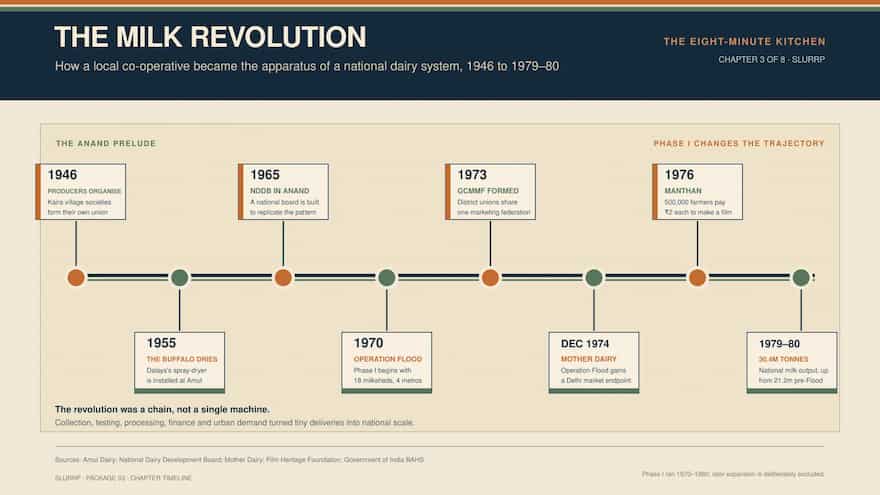
In Gujarat, district unions formed the Gujarat Co-operative Milk Marketing Federation in 1973 to market under the Amul umbrella. In Delhi, Mother Dairy was commissioned under Operation Flood in December 1974. These were not merely logos attached to milk. They were the metropolitan end of a chain that began with a small producer’s morning delivery.
The National Milk Grid was designed to connect surplus regions to deficit markets and reduce seasonal and regional price swings. That did not mean milk could be dispatched from anywhere to everywhere without friction. It meant the city no longer had to treat its supply as a local accident, while the village gained access to demand beyond the nearest trader.
Marketing, in this story, was not the frivolous part added after development. It was development. Without an urban buyer, extra production could become another milk holiday.
Who owned the revolution?
The Anand ideal put producers in control, but a national programme could not reproduce local history by stencil.
At village level, many societies did give members a direct stake and a daily, transparent transaction. Above the village, however, autonomy varied. The World Bank’s later evaluation found that farmer control at union and federation level was mixed across states, sometimes diluted by political or bureaucratic appointments. A movement designed from the ground up was also expanded from the top down. Both statements can be true.
There was a second gap between work and recognition. Women often cared for the animals and managed the household economy around milk, yet the original design’s formally gender-neutral societies produced male-dominated committees and extension channels, the same evaluation found. Women-only dairy societies grew substantially in later phases; in the first decade, the person doing much of the dairying was not necessarily the person named on the co-operative register.
This does not undo the model’s achievement. It locates it. Co-operation altered bargaining power, but it did not float above caste, gender, local politics or the uneven capacity of Indian states.
The revolution watches itself
In 1976, the co-operative movement acquired a feature film.
Shyam Benegal’s Manthan dramatised the arrival of a milk co-operative amid conflicts of caste, class, gender and village authority. Its financing was as remarkable as its subject: 500,000 dairy farmers contributed ₹2 each, making them the producers of a film about becoming producers.
That neatness should not disguise the film’s argument. A co-operative was not a dairy plant descending upon a grateful village. It was a renegotiation of who tested the milk, who fixed its value, who spoke at the meeting and who could obstruct the change. Manthan gave the White Revolution something its official diagrams could not: friction.
A revolution still in Phase I
The national numbers began to move. India produced 21.2 million tonnes of milk in 1968–69, when per-capita availability was 112 grams a day, according to NDDB’s historical figures. By 1979–80, output had reached 30.4 million tonnes — an increase of about 43 per cent — in the Government of India’s Basic Animal Husbandry Statistics series.
It is tempting to pour every additional litre into Operation Flood’s account. The evidence asks for more care. The World Bank evaluation found that the programme directly procured only part of India’s milk and argued that the wider policy change mattered too: stable commercial demand, reduced price risk, technical services and a credible co-operative alternative encouraged production beyond the milk physically handled by the project.
Nor was the work finished when the calendar reached 1980. Phase II would expand the network dramatically; the 43,000 village co-operatives and 4.25 million producers often quoted as proof of Operation Flood’s scale belong to 1985, not the 1970s. India’s eventual position as the world’s largest milk producer was still years away.
What the decade built was an apparatus for abundance: a habit of daily collection, a method of testing and payment, processing capacity, urban demand and the proposition that a tiny producer did not have to remain tiny in the market.
Grain had bought the republic breathing room. Milk taught it how to connect a village morning to a city breakfast. The next decade would bring the argument closer to the stove: if food could be made dependable, could the kitchen itself be made faster?
This is Chapter 3 of The Eight-Minute Kitchen, Slurrp’s eight-part history of independent India’s food system. Return to Chapter 2: The Laboratory Moves To The Field, browse the series introduction and index, or continue to Chapter 4: The Convenience Decade.
Previous: Chapter 2 — The Laboratory Moves To The Field | Series index: The Eight-Minute Kitchen | Next: Chapter 4 — The Convenience Decade




