


 Share
Share

Editor’s note: This is Chapter 2 of The Eight-Minute Kitchen, Avinash Mudaliar's eight-part history of the systems behind modern Indian eating. It covers 1960–1969. Contemporary American accounts are identified as such; the chapter separates the Green Revolution’s immediate achievement from the environmental and dietary costs that accumulated over later decades.
***
IN 1965, Lal Bahadur Shastri asked India to alter dinner.
One day a week — Monday — citizens were asked to eat once rather than twice. A later Press Information Bureau account of the appeal ties it to the Indo-Pak war and the need to conserve food supplies. The gesture turned an ordinary meal into a public declaration: the country was short, and everybody had been invited to feel the shortage at the table.
An empty plate could be patriotic. It could not be agricultural policy.
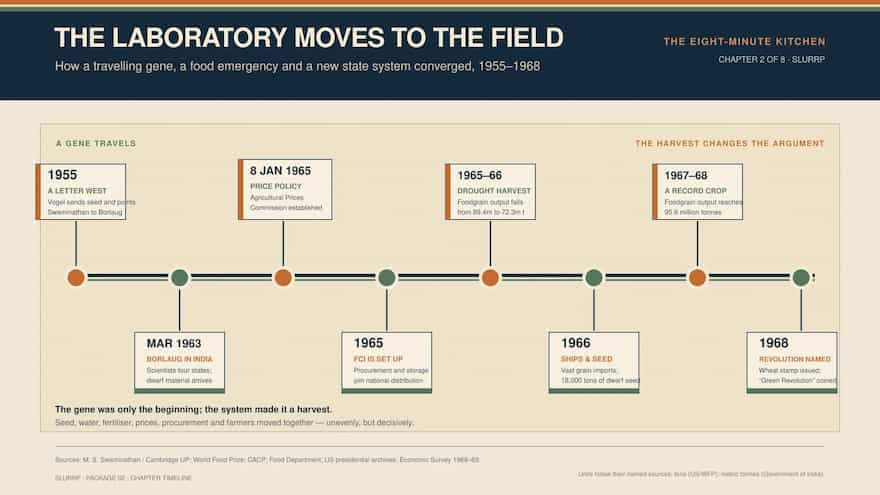
The numbers underneath the symbolism were savage. After foodgrain output of roughly 89.4 million tonnes in 1964–65, the drought-hit 1965–66 harvest fell to 72.3 million tonnes — about a fifth lower — according to a historical study of Indian food production. Population was still rising. The buffer between a failed monsoon and a hungry household was frighteningly thin.
The country at the end of a pipeline
Imports kept the crisis from becoming still worse, but they exposed a different vulnerability. In February 1966, Lyndon B. Johnson told the US Congress that India would need at least 11 to 12 million tons of imported grain that calendar year. The previous year, he said, American grain for India had required the equivalent of two fully loaded Liberty ships arriving at an Indian port every day. His emergency food-aid message was an American political document, not a neutral audit; it nevertheless conveys the physical scale of the dependence.
A year later, Johnson reported that India had imported almost 11 million tons of grain in 1966 and drawn down several million more from emergency reserves. He celebrated the fact that famine had been averted, while conceding that the response had been improvised; those figures come from his January 1967 message on food for India. Averted famine did not mean averted hunger. It meant that relief, distribution and imports had held a disaster short of its most catastrophic form.
The condition acquired a phrase: “ship to mouth”. The seed entrepreneur B. R. Barwale later remembered food moving so urgently that ships bound elsewhere were diverted to India; his World Food Prize recollection uses the phrase as lived memory rather than an official category. Imports were not merely a reserve. They had become a timetable.
The useful business of being short
Scientists did not set out to find a national symbol. They were trying to stop a wheat plant falling over.
The wheat then common in India was tall and thin-strawed. M. S. Swaminathan later wrote that average wheat and rice yields were below one tonne per hectare, and that the existing tall varieties responded poorly to fertiliser and irrigation. Give them more nourishment and they could grow more stem, then lodge — the agronomist’s polite word for collapsing under the weight of the crop. Swaminathan’s account published by Cambridge University Press describes the problem as one of plant architecture.
The answer had travelled a long way before reaching Delhi. Japanese breeders had developed semi-dwarf wheat carrying the Norin genes. In the United States, Orville Vogel worked with dwarf material in winter wheat. In Mexico, Norman Borlaug incorporated the dwarfing genes into spring wheat suited to warmer regions. Shorter, stiffer plants could take fertiliser and irrigation without spending the entire dividend on a stalk that then toppled.
The paper trail matters because it corrects a tidy version of the story. In his own later account, Swaminathan said that he learnt about the Japanese material from the wheat scientist Hitoshi Kihara in 1955, wrote to Vogel, received seed of the variety Gaines, and was then advised to approach Borlaug because the American winter wheat might not flower in Delhi. The breakthrough was not a single letter sent in 1960. It was a chain of scientists passing a problem — and seed — across Japan, the United States, Mexico and India.
In March 1963, Swaminathan and Borlaug travelled through several Indian states to study conditions and identify promising material, according to an account from the M. S. Swaminathan Research Foundation published by the World Food Prize. Borlaug supplied the original breeding material carrying the Norin dwarfing genes that year. The laboratory had begun to move, literally, into the field.
A wheat India would eat
There was one awkward detail. The Mexican semi-dwarf grain was red.
It is often said that Indian consumers “rejected” it. Swaminathan’s more exact account is gentler and more revealing: red grain was not preferred for making chapatis. Through selection and breeding, Indian scientists developed high-yielding amber-grained wheat with better chapati-making quality; Swaminathan summarised that work in a peer-reviewed 2013 commentary. Among the varieties that followed were Kalyan Sona and Sonalika, developed from Mexican breeding material and multiplied through Indian seed systems, as a review of the Jaunti seed-village experiment recounts.
This was more than cosmetic localisation. Seed is eaten at the end of the experiment. A wheat that performed brilliantly on a trial plot but poorly as roti was not, in any useful sense, a successful Indian wheat. The revolution had to pass through the kitchen before it could pass into history.
Three small facts inside a very large harvest
18,000 tons of seed
In 1966, India imported 18,000 tons of dwarf-wheat seed from Mexico, according to the World Food Prize account. The source’s unit is retained here.
A stamp for wheat
In 1968, Prime Minister Indira Gandhi released a special “Wheat Revolution” stamp after the production jump, Swaminathan recorded.
The name came after the work
William S. Gaud coined the term “Green Revolution” in 1968, by which point India’s dwarf-wheat programme was already under way, the World Food Prize account notes.
A gene is not a revolution
The seed has become the celebrity of this story because genes make cleaner protagonists than procurement rules. But no gene irrigated a field, supplied nitrogen, extended credit, bought a harvest or persuaded a farmer to risk a season.
The new wheat was a package. It needed controlled water, fertiliser, plant protection, seed multiplication, extension work and a buyer at the other end. Those requirements favoured places that already had, or could quickly build, irrigation and market access. A peer-reviewed study of the technology’s political effects finds that high-yielding crops spread overwhelmingly in districts with pre-existing irrigation or the capacity to develop it.
Policy therefore had to make the farmer’s risk legible. The Agricultural Prices Commission was established by resolution on 8 January 1965 to advise on price policy; today’s Commission for Agricultural Costs and Prices records that institutional origin. The Food Corporation of India was also set up in 1965 under the Food Corporations Act, 1964, while the country faced a foodgrain shortage, according to the Department of Food and Public Distribution. Price support, procurement, storage and national distribution were becoming one connected machine.
C. Subramaniam, the Union minister responsible for food and agriculture from 1964 to 1967, supplied the political force behind the new strategy. An official biographical account from Maharashtra Raj Bhavan credits him with the decisive introduction of high-yielding seed and more intensive fertiliser use. Swaminathan’s own formulation is better than the hero-making versions: the 1968 jump came from a synergy of scientific skill, political action and farmers’ enthusiasm. Science supplied possibility. Institutions made it plantable. Farmers made it real.
The harvest that changed the argument
India imported 18,000 tons of dwarf-wheat seed from Mexico in 1966. The World Food Prize account puts wheat production at 12 million tons in 1965 and 17 million in 1968. A contemporary Government of India Economic Survey recorded total foodgrain output of 95.6 million tonnes in 1967–68, then a national record.
The contrast with the Monday fast was almost indecently neat. Within a few seasons, the political image of food had shifted from voluntary absence at dinner to wheat celebrated on a postage stamp. In 1968, Indira Gandhi issued the “Wheat Revolution” stamp. That same year, the American official William S. Gaud gave the larger transformation its durable name: the Green Revolution.
The phrase can make the change sound instantaneous and complete. It was neither. India did not stop importing grain the moment the first amber heads were cut, and food security was not evenly distributed simply because national output rose. What changed by the decade’s end was the direction of travel: dependence had been decisively reduced, domestic wheat production had proved capable of a step-change, and the state now possessed a procurement-and-price architecture with which to turn harvest into supply.
The bill that arrived later
The emergency also locked in a particular agricultural bargain. High-yielding wheat and rice flourished with dependable irrigation and manufactured inputs. The gains therefore concentrated first in better-endowed regions and crops, while rain-fed areas and older cereals received less of the new system’s attention.
Over subsequent decades, the bargain’s costs became visible: intensive irrigation drew down groundwater; repeated chemical use damaged soils in some areas; and the policy focus on rice and wheat helped push millets and pulses towards the edge of both fields and diets. A peer-reviewed review of the Green Revolution’s effects on indigenous crops documents the shift in availability towards rice and wheat, the decline of millets and pulses, and the ecological pressure associated with intensive irrigation and fertiliser use.
Those later costs do not cancel the peril of 1965. Nor does the peril excuse everything that followed. The honest history must hold both facts at once: a technology-and-policy coalition helped India avoid a predicted catastrophe, and its success encouraged a narrow, input-heavy model whose repair is still under way.
By the end of the 1960s, grain had bought the republic breathing room. The next experiment would ask whether abundance could be built differently — not around a crop and a procurement machine, but around millions of milk producers, each owning a buffalo or two.
This is Chapter 2 of The Eight-Minute Kitchen, Slurrp’s eight-part history of independent India’s food system. Return to Chapter 1: A Hungry Republic, browse the series introduction and index, or continue to Chapter 3: The Milk Revolution.
Previous: Chapter 1 — A Hungry Republic | Series index: The Eight-Minute Kitchen | Next: Chapter 3 — The Milk Revolution




