


 Share
Share

Editor’s note: This is Chapter 1 of The Eight-Minute Kitchen, Avinash Mudaliar’s eight-part history of the systems behind modern Indian eating. It covers 1947–1959. Links sit beside the claims they support; where culinary origin stories remain contested, the disagreement is part of the story rather than a footnote tidied away.
***
ON PAPER, 15 AUGUST 1947 was a beginning. In the grain market, it was the middle of an emergency.
The new republic inherited the administrative machinery of wartime scarcity. Bombay had introduced cereal rationing in 1939; by the end of 1943, 13 cities were covered, and by 1946 the network had reached 771 cities and towns, according to the Food and Agriculture Organization’s history of India’s public distribution system. A central Food Department had been established on 1 December 1942 as shortages sharpened during the Second World War, the department’s own history records.
Then came the Bengal famine. An estimated three million people died in 1943, although any single death toll must be read as an estimate rather than a final count; contemporary records were incomplete and historians continue to debate the causes and scale. A peer-reviewed historical analysis uses the three-million estimate. The political lesson was less ambiguous: a food crisis could not be left to price, weather and private trade alone.
Partition made that lesson immediate. It divided provinces, markets, transport routes and families. At least 14 million people were displaced across the new borders, according to the British Red Cross account of the refugee crisis. They travelled with what they could carry, and arrived in places that had to find room, work and food for them. The ration card was not the republic’s birth certificate. It was, however, one of the instruments through which the state tried to make survival administrable.
The machinery of scarcity
A ration queue is a brutally honest piece of infrastructure. It displays both the state’s promise and its shortfall: somebody has counted the grain, somebody has decided the entitlement, and everybody can see when the shop runs out.
India produced 50.82 million tonnes of foodgrain in 1950–51, according to a Press Information Bureau historical series. Production alone did not meet demand. An official American assessment recorded 2.2 million tons of Indian foodgrain imports in 1950 and warned that the following year’s requirement could be far larger; the document is preserved in the US State Department’s historical archive.
After a post-war retreat from controls, renewed inflation pushed India to reintroduce rationing in 1950. In 1951, the First Five-Year Plan retained public distribution as a deliberate social policy and extended it to rural areas with chronic shortages, although the system remained substantially urban. This was not yet the later Public Distribution System in its mature form. It was an improvised state learning how to buy, move and sell grain while harvests and prices refused to hold still. The FAO’s institutional history captures the stop-start quality: controls loosened when supplies improved, then returned when output fell.
Three surprises from the hungry republic
771 cities and towns
By 1946, wartime rationing had expanded from 13 cities in 1943 to 771 cities and towns, according to the FAO’s PDS history.
Eight months early
The Kaira milk union that became Amul was registered on 14 December 1946, roughly eight months before Indian Independence.
250 litres a day
When the union began pasteurising milk in June 1948, it handled about 250 litres daily from two village cooperatives. By year’s end, its official history says that figure was 5,000 litres.
A border enters the kitchen
A border does not stop at customs. It enters the pantry.
Partition scattered cooks, customers, recipes and businesses in both directions. Muslim families left Indian towns for Pakistan; Hindu and Sikh families crossed the other way. Some kitchens vanished from one city and reappeared in another. Others did not reopen at all. Food became portable memory, but it also became work: a skill that could be sold when land, property and professional networks had been left behind.
Delhi offers the most visible example. Punjabi refugees changed the capital’s restaurant culture, bringing tandoor cooking, naan and a richer repertoire of meat dishes into its everyday eating-out life, as a Hindustan Times history of post-Partition Delhi food recounts. The result is now so thoroughly labelled “Delhi food” that its journey can disappear inside the menu.
Moti Mahal in Daryaganj became the emblematic restaurant of that migration. Its story ran through Peshawar and into post-Partition Delhi; its association with tandoori chicken, butter chicken and dal makhani turned a refugee business into an international shorthand for North Indian restaurant food. The neat version says that drying tandoori chicken was rescued with a buttery tomato gravy because the kitchen lacked refrigeration. It is a superb restaurant legend. It is not a settled historical finding.
History’s disputed recipe:
One family associated with Moti Mahal says Kundan Lal Gujral created butter chicken in Peshawar in the 1930s. The rival Daryaganj group says Kundan Lal Jaggi created it while running the Delhi kitchen after Partition. Reuters reported the competing claims and evidence. As recently as March 2026, a Delhi High Court order was still listing connected proceedings; it did not decide culinary authorship. The responsible version is therefore less satisfying but more accurate: butter chicken is inseparable from the Peshawar-to-Delhi Moti Mahal story, while its sole inventor, date and place remain contested.
That uncertainty is useful. Recipes rarely arrive with laboratory notebooks. They are adapted through service, shortage, memory and repetition. Partition did not “invent” the food of North India. It altered where particular techniques were cooked, who paid for them and which dishes became visible to a mass urban public.
The cooperative before the revolution
While Delhi’s refugee restaurants translated displacement into a new public cuisine, a different food institution was taking shape in Anand, Gujarat.
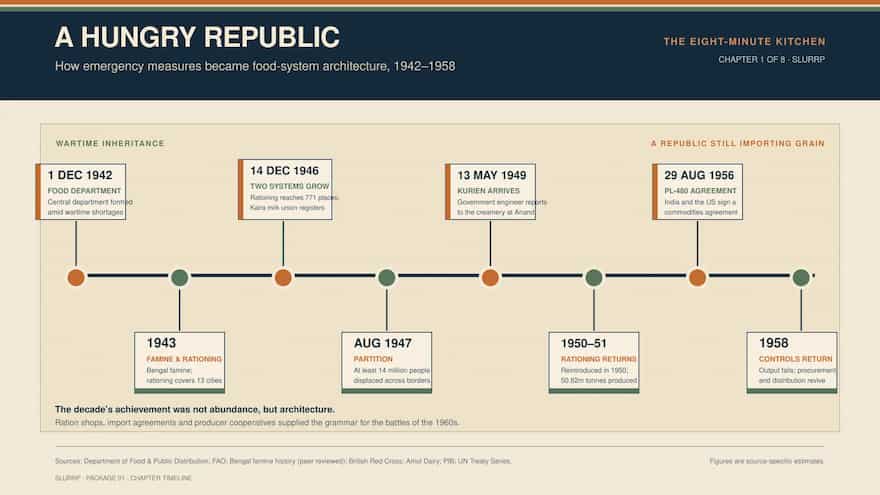
The Kaira District Co-operative Milk Producers’ Union was formally registered on 14 December 1946 — eight months before Independence. Its official history describes farmers trapped between the perishability of milk and a system of contractors supplying Polson under the Bombay Milk Scheme. On the advice of Sardar Vallabhbhai Patel, they organised village societies and undertook a 15-day milk strike. The point was not simply to secure a better price. It was to own the route between producer and market.
The beginning was tiny. The union started pasteurising milk in June 1948 with two village societies and about 250 litres a day. By the end of that year, its official account says, 432 farmers were participating and daily handling had reached 5,000 litres. The numbers matter because they strip away the inevitability that later attaches to famous institutions. Amul did not begin as a national brand. It began as a bargaining arrangement with milk cans.
On 13 May 1949, a young government engineer named Verghese Kurien arrived in Anand to serve the bond attached to his overseas training. He wanted to leave. Amul Dairy’s biographical account says that after he secured release from the government creamery, Tribhuvandas Patel asked him to stay and help the cooperative assemble its equipment. He did. The partnership between an elected farmer-leader and a technically minded manager would eventually become central to India’s White Revolution, but in the 1950s it was still a local experiment solving practical problems one plant at a time.
The cooperative did not fill ration shops or cure the grain deficit. It offered a parallel answer to the same foundational question: who should control the food system? In one case, the state took responsibility for distribution. In the other, producers organised to control procurement, processing and sale. Both were institutional answers to hunger and insecurity, not merely stories about a government scheme or a beloved packet of butter.
The decade that did not end hunger
The 1950s closed without the comfort of self-sufficiency. India and the United States signed their first major agricultural commodities agreement under Public Law 480 in New Delhi on 29 August 1956; the United Nations Treaty Series record fixes the date, while the agreement covered surplus commodities shipped over several years. Imported grain bought time. It also made dependency part of the next decade’s political anxiety.
Nor did the domestic system move in a straight line. Foodgrain availability improved in the middle of the decade, controls eased, and then production fell again to 58.3 million tonnes in 1958. Procurement and trading controls returned; the number of fair-price shops, 18,000 in 1957, began to rise rapidly. The Food Corporation of India — the institution that would consolidate large-scale procurement, storage and distribution — would not be created until 1965, as the Department of Food and Public Distribution notes.
The first post-Independence decade did not solve hunger. It established the grammar in which the problem would be argued: entitlement, procurement, price, storage, imports, planning and cooperative ownership. It also showed that the national food story would never be made by policy alone. It would be made by people moving across borders with recipes, by farmers refusing the price offered for their milk, and by a state repeatedly discovering that grain on paper is not the same as food on a plate.
In the 1960s, that discovery would move from the ministry file to the laboratory — and then into the field.
This is Chapter 1 of The Eight-Minute Kitchen, Slurrp’s eight-part history of independent India’s food system. Read the series introduction and index, or continue to Chapter 2: The Laboratory Moves To The Field.
Previous: Series Introduction & Index | Next: Chapter 2 — The Laboratory Moves To The Field




