


 Share
Share

Editor’s note: This is Chapter 4 of The Eight-Minute Kitchen, Avinash Mudaliar’s eight-part history of the systems behind modern Indian eating. It covers 1980–1989, with a short prehistory of the appliances and convenience foods that came of age in that decade. Where launch dates differ, the distinction between a city test and a national rollout is made explicit.
***
THE DECADE sounded different.
First came the controlled roar of an LPG flame. Then the pressure cooker began its small domestic countdown. The mixer-grinder answered with a noise capable of interrupting conversation in the next room. From a television set came a child’s hunger, neatly resolved before the advertisement was over.
The Indian kitchen had always been a place of sophisticated technology: fermentation, grinding, steaming, tempering, preserving. What changed in the 1980s was the unit in which modernity announced itself. Not horsepower or megawatts, but minutes.
Convenience arrived before the decade
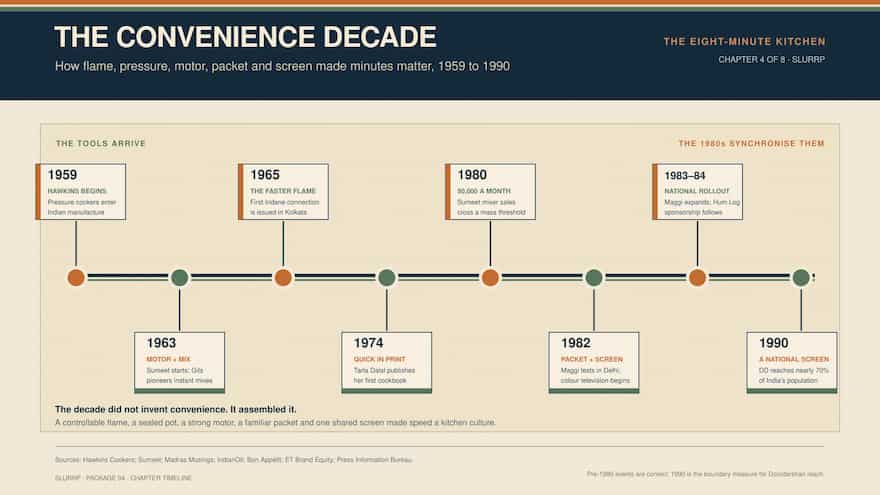
No single invention made the 1980s kitchen. Most of its useful machines were older. Hawkins began making pressure cookers in 1959. Sumeet started building mixer-grinders for Indian cooking in 1963. Indane released its first LPG connection in 1965. Gits was selling instant mixes, and Tarla Dalal was writing quick, reproducible recipes, before anybody in Delhi had been asked to consider a packet of noodles.
The decade’s achievement was to bring these things into the same story. India’s urban population rose from 159.5 million in 1981 to 217.6 million in 1991, according to a government table based on census data. More people were living inside schedules organised by offices, schools, commutes and television programmes. Convenience did not replace Indian cooking. It began reorganising the labour around it.
A faster flame
The first transformation sat beneath the pot. IndianOil says the Indane brand was conceived in 1964 and its first LPG connection was released in Kolkata on 22 October 1965, when its customer base was about 2,000.
That beginning should not be mistaken for an instant national conversion. Through the 1980s, cooking fuel still varied sharply by place and income; kerosene, coal, firewood and other fuels did not obligingly leave the scene. LPG’s importance to this chapter is narrower and more urban: for households able to obtain a cylinder, it offered a controllable flame without the preparation and soot of solid fuel.
The cylinder did not cook dinner by itself. It made heat easier to start, stop and regulate. Convenience, at first, was less a meal than an infrastructure.
The whistle becomes a clock
Hawkins Cookers was founded by H. D. Vasudeva in 1959, in technical collaboration with L. G. Hawkins of England. By the 1980s, the pressure cooker had become one of the most recognisable machines of the urban Indian kitchen — though there is no sound basis for calling it universal.
Its speed was not advertising magic. A sealed cooker traps steam, raises pressure and lifts the boiling point of water. Hawkins specifies an operating temperature of 121°C at 15 pounds per square inch and, in its own comparative studies, reports an average cooking-time reduction of 53 per cent against an open pot. That is a manufacturer’s figure, not a law for every dal and every stove, but the underlying physics is straightforward: hotter water softens pulses, rice and meat faster.
The appliance also turned time into a kitchen instruction. Bring to pressure. Lower the flame. Count the minutes — or, in many homes, the whistles. A long simmer could now be fitted between school return and dinner.
Yet the most famous cooker advertising of the period preserved the household’s old job description. A history of Prestige’s 1980s campaign notes that its celebrated line addressed a husband buying safety and convenience for his wife. The machine might shorten the task; the advertisement had little doubt about whose task it remained.
The machine that swallowed the grinding stone
If the cooker accelerated heat, the mixer-grinder attacked preparation. Indian cooking asks an appliance to do difficult things: reduce dry spices to powder, wet ingredients to paste, coconut and lentils to batter — often in small quantities and for longer than a Western blender expects.
Sumeet’s founders, S. P. and Madhuri Mathur, said they started in 1963 to build a machine for the demands of Indian curries and spice pastes. The design matured in the mid-1970s, when a single jar could handle dry and wet grinding as well as liquidising, and the price fell from ₹960 to ₹740. Sales rose from 2,000 mixers a month in 1976 to 17,000 the following year and 50,000 a month in 1980.
That last number is more than one mixer leaving production for every minute of an average month. It does not mean the sil-batta vanished. Stones endured because they were affordable, durable and believed by many cooks to give a different texture. What the electric motor offered was a choice: the chutney no longer had to begin with a session of upper-body exercise.
Convenience was already learning Indian
The packet arrived before the noodle. Gits, founded in 1963, worked with the Central Food Technological Research Institute on convenience foods; after an early soup mix confused shopkeepers, the company turned to familiar formats including idli, dosa and gulab jamun mixes, according to an account based on the founding family’s recollections.
This was an important principle: saving time was easier to sell when the result still knew where it lived. An instant mix could remove measuring and grinding without demanding that breakfast cease to look like breakfast.
Tarla Dalal performed a related translation in print. Her first book, The Pleasures of Vegetarian Cooking, appeared in 1974. Its rules were that recipes should be simple, quick, reproducible and economical; its international dishes were adjusted to ingredients an Indian shopper could actually find. A retrospective on Dalal’s books describes lasagne made with ketchup in place of tomato paste and risotto cooked in ghee. Her influence in the 1980s came through books and classes, not television: her website and television programmes arrived later.
The modern kitchen was therefore not merely importing shortcuts. It was domesticating them.
Two minutes, but not all at once
Maggi’s Indian arrival is often dated to 1983. The fuller account is more interesting. Sangeeta Talwar, the Nestlé product manager associated with the launch, recalled that the company test-marketed the noodles in Delhi in January 1982, then moved through Kolkata, Mumbai and Chennai before completing a national rollout in 1983 or early 1984. The 100-gram packet cost ₹2.10 plus tax — close to two rupees, but not quite the round-number legend.
The product itself had to be translated. An IMD case study of the launch says Nestlé adapted a soupy noodle into a dry cake and developed a flavour intended to travel across the country. Noodles were fairly alien to many home consumers, not unknown to India: Chinese communities and restaurants had long made that larger claim impossible.
The more consequential translation was social. Children were treated as the adventurous eaters; mothers remained the nutritional gatekeepers because the snack still had to be cooked. Early advertising even showed vegetables being added, turning the packet into evidence of care rather than an abdication of it. “Two-minute” was chosen because, unlike “instant”, it promised speed without suggesting that the food required no cooking at all.
Maggi sold a new category by placing it inside a familiar scene: the child asks, the mother answers, the pan appears. The food was novel. The distribution of responsibility was not.
Three small measures of a faster kitchen
₹2.10, not ₹2 | Maggi’s 100-gram launch packet was priced at ₹2.10 plus tax, according to Sangeeta Talwar’s account of the rollout.
More than one mixer a minute | Sumeet’s production reached 50,000 mixers a month in 1980 — roughly 1.16 for every minute in a 30-day month — after a single multipurpose jar and a price cut accelerated demand. Madras Musings traces the figures.
A serial helped sell a snack | Nestlé sponsored Hum Log in 1984, giving Maggi’s advertising valuable exposure as the brand completed its national rollout, Talwar recalled.
The second ingredient was a screen
In 1982, the Asian Games coincided with the introduction of colour television in India and the expansion of Doordarshan’s national coverage. By 1990, the public broadcaster reached nearly 70 per cent of the population and 80 per cent of the country’s geographical area, according to the Press Information Bureau’s history of Indian television.
For a convenience product, one national screen did more than display an advertisement. It synchronised desire. A brand could address families in many cities around the same programme, then adapt its print, radio and point-of-sale material into local languages. Nestlé sponsored Hum Log in 1984; Talwar recalled that the association gave Maggi’s commercials more exposure during the national rollout.
The packet and the television belonged together. One standardised the snack; the other standardised the hungry moment.
Who got the minutes back?
It is tempting to treat every labour-saving device as a small liberation. The claim needs a question attached: liberation for whom?
The pressure cooker compressed simmering. The mixer compressed grinding. LPG compressed the work of making and managing a fire. Instant mixes compressed preparation, and noodles compressed the interval between a child’s request and a hot bowl. None of those minutes was imaginary.
But the era’s advertisements repeatedly returned the saved time to the same woman. Prestige’s husband bought the cooker; Maggi’s mother supplied the answer. The convenience industry recognised domestic labour clearly enough to monetise its burdens, while rarely imagining that the labour itself might be redistributed.
That contradiction is the decade’s real inheritance. The 1980s did not abolish the long Indian meal or turn every household into a factory for speed. It assembled a stack of flame, pressure, motor, packet and screen that made quick cooking legible, desirable and increasingly repeatable.
When global restaurant brands arrived after 1991, they would find an audience already trained in the essential bargain of modern Indian convenience: make it faster, certainly — but first make it taste as though it belongs here.
This is Chapter 4 of The Eight-Minute Kitchen, Slurrp’s eight-part history of independent India’s food system. Return to Chapter 3: The Milk Revolution, browse the series introduction and index, or continue to Chapter 5: Liberalisation Eats Lunch.
Previous: Chapter 3 — The Milk Revolution | Series index: The Eight-Minute Kitchen | Next: Chapter 5 — Liberalisation Eats Lunch




