


 Share
Share

If you find yourself hungry while wandering the streets of Beirut, Amman, or Jerusalem, you need only wait a few minutes before one of the many roaming food carts appears. Street vendors sell a distinctive sesame-encrusted flatbread that seems to be everywhere - ka'ak, a beloved Middle Eastern bread. The vendors cheerfully slice it open and fill it with creamy local cheese or fragrant za'atar. Despite its popularity, ka'ak is remarkably simple to make at home, producing a light, airy crumb encased in a golden, slightly crisp exterior.
The word ‘ka'ak’, which comes from the classical Arabic word ‘kaak’, which means cake, actually refers to a broad category of baked products. The term also describes a particular kind of bread that has a sesame coating and a hole in the centre. Though it may take slightly diverse forms, it is well-liked throughout. In Jordan and Lebanon, the bread is shaped like a teardrop and has a hole close to the narrow end, giving it the appearance of a pocketbook. The Israeli variety, called ‘ka'ak al quds,’ or Jerusalem bread, is formed like a bagel and occasionally has an extended shape. The Lebanese type can occasionally be filled with a wide range of ingredients; typical examples include za'atar, a spice mixture made with sumac, thyme, and more sesame seeds, and picon cheese. Cheese and yoghurt are typical accompaniments, according to Taste Atlas.
Tracing The Roots Of Ka’ak Through The Middle East
In the 13th-century Arabic cookbook Kitab al Wusla ila al Habib, one of the world's oldest cookbooks, the mention of ka’ak starts with, "We begin with several kinds of simple bread, the accompaniment to every meal. First, ka'ak, which are of several varieties.” It ends by saying, “plain ka'ak are too well known to need describing.” This suggests that these loaves were not only widely consumed but also that they had been produced for a very long time and were therefore so well-known that they didn't require an explanation. In fact, ka'ak is mentioned as a mainstay of the cuisine in the 10th-century Kitab al Tabikh, the oldest Arabic cookbook known to exist, with little explanation.
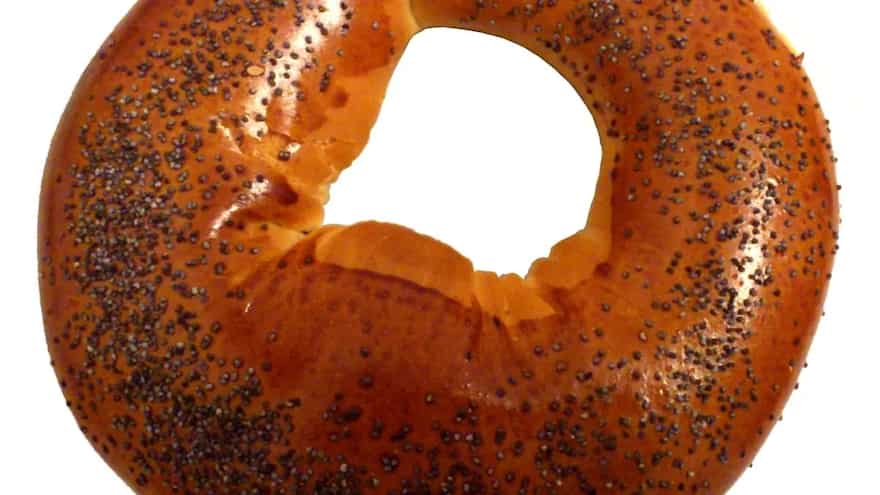
Image Credit: Wikimedia Commons
Arabs seized control of the whole southern Mediterranean coast between the sixth and ninth centuries. Off the coast of Alexandria in 652 AD, an Arab fleet routed the Byzantine navy and set up bases for their invasions of Sicily and the Italian mainland. The Arabs established an empire in southern Italy that lasted for almost 200 years after conquering Bari on the Adriatic coast in 841 AD. From there, they seized control of the Alpine passes that connected Italy to the rest of Western Europe. The main Arab stronghold was Bari, from which the Arabs affected not just local food but also the cuisine of the regions along their vast trade routes. It should come as no surprise that the Italian area of Puglia, whose city is Bari and from whence Queen Bona Sforz of Poland originated, is the birthplace of the ring-shaped bread known as tarallo, which is boiled and then baked.
Along with this hint as to how the ring-shaped bread may have made its way into Polish kitchens, it's important to remember that rye was formerly the most common grain or flour in eastern Europe. However, the grain used to make Polish obwarzanek was wheat flour, which is indigenous to the Eastern Mediterranean and was likely originally grown in the southern Levant, according to archaeological evidence. According to the book from Stanford Library, titled The Origins and Spread of Domestic Plants in Southwest Asia and Europe, during the growth of their empire, Arabs were in charge of bringing wheat to the regions they conquered or traded with. The most popular ka'ak in the Middle East today isn't made by boiling and then baking the dough, as the ancient recipes called for kneading seeds and flavourings into the dough. Instead, modern ka'ak al quds uses a sugar water solution to attach the sesame seeds, which are the most common seasoning.
The Symbolic Role Of Ka’ak
Because of the integrated handle, some people compare it to a purse or handbag. On the busy streets of Beirut, street sellers on bicycles sell the bread. Why would a loaf have a hole in it, you ask? What's the goal? The hole serves a utilitarian purpose. It allows street vendors to hang their wares on a peg and cool down before selling. Ka'ak is a symbol of how food unites people from different places and generations and may be found in bakeries, homes, and street carts throughout nations, including Lebanon, Palestine, Jordan, Syria, and Egypt. It has historically been linked to travel, trade, and street food culture because of its ring-shaped ease of sharing and carrying.
Ka'ak is associated with early recollections of school snacks, breakfasts, and trips to neighbourhood bakeries for a lot of families. A basic loaf is transformed into a potent cultural symbol by these minor customs. Arab cuisine's ideals of simplicity and hospitality are also reflected in ka'ak. It is considered a generous gesture to offer bread to a guest, and Ka'ak is frequently included in this act. The essence of Ka'ak has not changed over time, even in the face of modernisation and shifting dietary preferences. It is a living connection to legacy, identity, and the timeless rhythms of Arab culinary culture because it is still a part of everyday life.
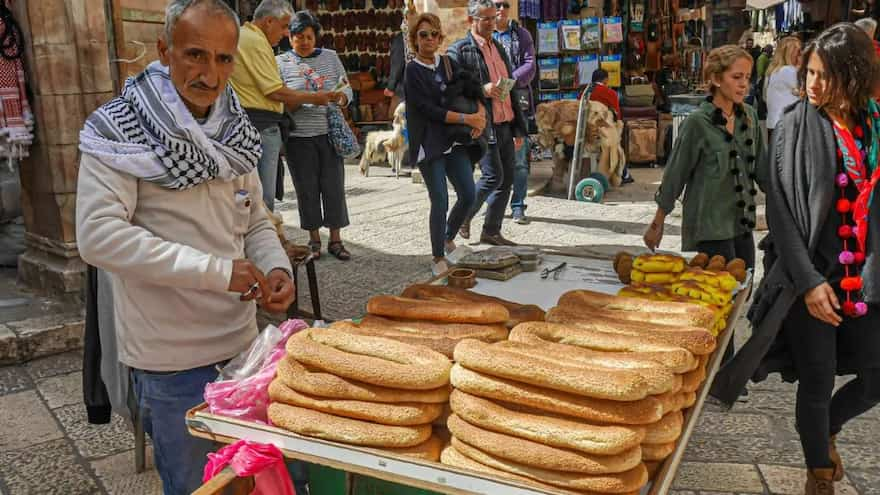
Image Credit: Wikimedia Commons
The Anantomy Of Baking Arabian Ka’ak Traditionally
In a few places of the Middle East, traditional ka'ak is produced using different ingredients and techniques, but the fundamental concept of ring-shaped bread is always the same. Fundamentally, ka'ak is typically made using basic ingredients, including water, salt, olive oil, wheat flour, and yeast. After being kneaded, the dough is formed into rings, or long loops, sprinkled with sesame seeds, and cooked in hot ovens until the outside is crisp and brown. Ka'ak is frequently offered for sale as street bread in the Levant, particularly in Lebanon, Palestine, and Jordan. It is typically filled with cheese, falafel, or za'atar and is hollow and slightly crisp. Ka'ak al-quds is well-known in Jerusalem for its lengthy oval shape and thick sesame seed coating.
In Egypt, ka’ak refers to a different version altogether. Ka’ak el-eid is a soft, buttery biscuit-like bread made with ghee, sugar, and sometimes stuffed with dates or nuts, traditionally prepared during festivals. Ka'ak can be seasoned with mahleb, fennel, anise, or black cumin in the Gulf and some regions of Iraq, giving it a flavourful, almost sweet taste. These regional variations demonstrate how one basic bread is modified to suit regional customs, tastes, and ingredients throughout the Middle East.
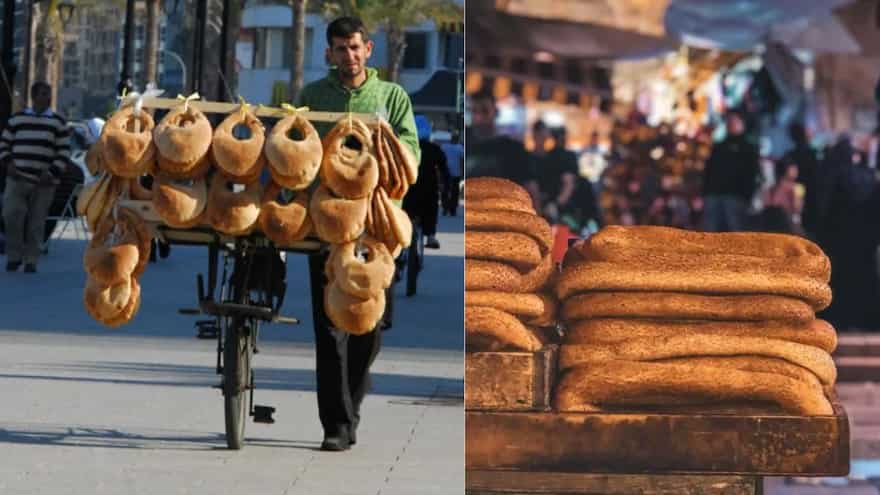
Image Credit: Wikimedia Commons
Ka’ak In The Modern World Of Breads
Due to migration and the globalisation of Arab communities, Ka'ak is now found around the world and is no longer restricted to the Middle East. Ka'ak is now a staple of street food cultures around the world, from bakeries in New York, London, and Paris to food markets in Australia and Southeast Asia. Traditional varieties are frequently served alongside contemporary variations, including whole wheat, vegan, or cheese-stuffed Ka'ak at Middle Eastern cafés and diaspora bakeries.
It is gradually gaining popularity among international bakeries, hotel kitchens, and Middle Eastern eateries, particularly in India. Ka'ak is now occasionally baked at cafés and cloud kitchens that serve inquisitive Indian diners due to the rising appeal of international cuisine and Middle Eastern flavours like hummus, shawarma, and pita. This once-local bread has become a symbol of cross-cultural interaction thanks to social media and food blogs, which have also assisted in introducing ka'ak to a new generation of international audiences.




