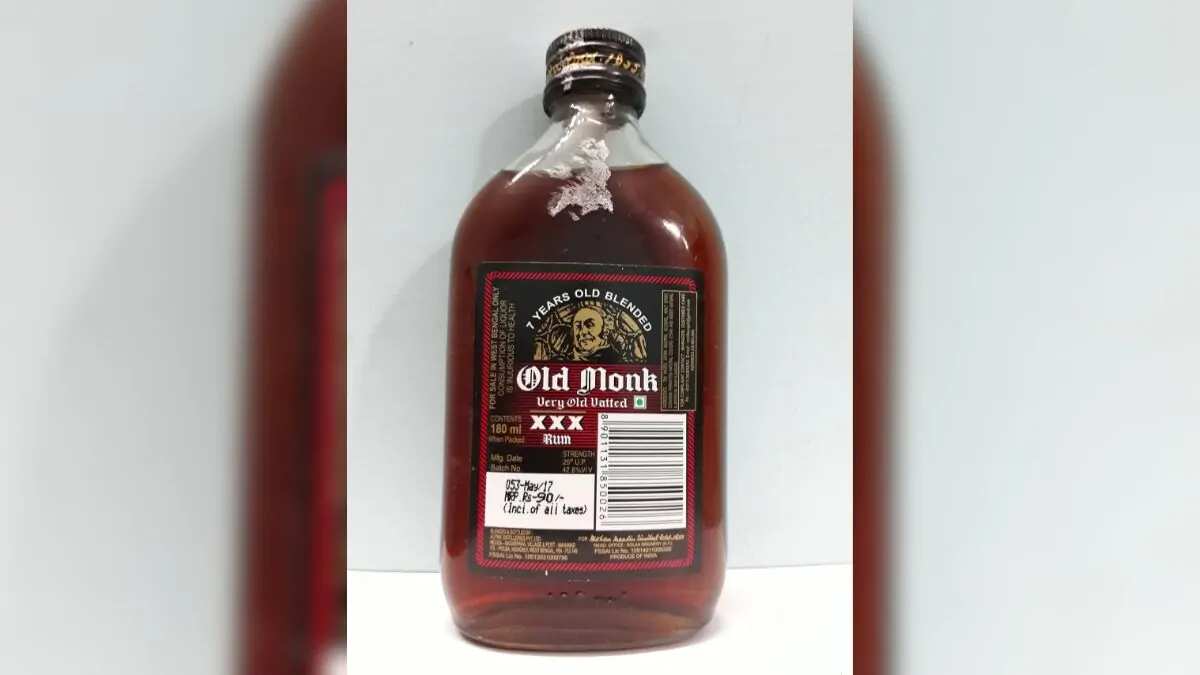
I should declare an interest before I declare anything else: I am not a neutral party to this story. I have defended Old Monk to French friends who wanted Martinique rhum agricole, to Barbadian colleagues who wanted their own island's word for the drink taken seriously, to bartenders in three countries who looked at my rum and Coke with the pity reserved for people who have never known better. I have carried bottles through customs I probably shouldn't have. I own, unreasonably, a T-shirt. So when I tell you the last few weeks have been unsettling, understand I am not a journalist encountering an interesting regulatory dispute. I am a man finding out, well into middle age, that the word on the label of my oldest and steadiest vice has spent several sessions in the Bombay High Court being argued over by senior counsel — and that the company that makes it has told the court, in effect, that the alternative to fighting is admitting it misdescribed its own rum for fifty years.
Here is what actually happened, stripped of the noise. Following an enforcement drive across Maharashtra, Goa and Madhya Pradesh, the Food Safety and Standards Authority of India inspected several liquor units — among them Mohan Rocky Springwater Breweries' facility at Khopoli, Maharashtra — and had samples lab-tested. The results, FSSAI told the press and later the court, showed three Old Monk variants — The Legend, Gold Reserve, and XXX Matured Rum — relied overwhelmingly on neutral, unmatured spirit as their base, with matured rum spirit making up, by the regulator's own investigation, less than five per cent of the blend. FSSAI further flagged the ‘7 Years Old Blended’ claim on Old Monk XXX as misleading, since India's Food Safety and Standards (Alcoholic Beverages) Regulations, 2018 require an age statement on a blend to reflect its youngest component — not one that might account for a twentieth of the bottle. FSSAI prohibited sale of the affected variants, along with United Spirits' McDowell's No. 1 Rum, Antiquity Blue and Royal Challenge whiskies, and Inbrew Beverages' Bagpiper Deluxe and Old Cask Deluxe XXX Rum, issuing notices to half a dozen other Maharashtra manufacturers besides.
Image credit: Dude Gimme Food on IG
Mohan Rocky Springwater Breweries did not go quietly. Represented by senior counsel Navroz H. Seervai, the company petitioned the Bombay High Court, its case clubbed with a parallel United Spirits petition before a division bench of Acting Chief Justice Ravindra V. Ghuge and Justice Gautam A. Ankhad. Seervai argued that Old Monk had been sold under materially the same formulation for more than five decades without a single reported health complaint, and that FSSAI's own findings alleged mis-description, not unsafety — and, more pointedly, that accepting the regulator's relabelling would mean publicly conceding the company had misdescribed its most iconic product for fifty years. The company told the court the ban was costing it close to a crore of rupees a day. United Spirits chose differently — withdrawing its own challenge in late August and agreeing to strip the flavouring or amend labels without touching the formulation. Old Monk's maker did not follow. It offered to drop ‘7 Years Old Blended’ and enlarge the flavour-disclosure font — concessions on presentation, not composition — while continuing to press the legal fight. As of the most recent reporting available to me, the High Court has declined interim relief against the Maharashtra sales ban, and the matter continues. I want to be precise about what that does and doesn't mean: no final judicial determination exists that Old Monk is not, legally, rum. What exists is a regulatory finding, a formal objection to it, and a court not yet persuaded to pause the order. Anyone telling you with total confidence how this ends is guessing, myself included.
So let me do the thing the court is effectively being asked to do, and the thing I have personally been avoiding for a fortnight: find out what rum actually is.
Properly made rum begins with sugarcane juice or its byproduct molasses, fermented by yeast into a low-alcohol ‘wash,’ then distilled — pot stills for heavier, more characterful styles, column stills for something lighter — into a raw spirit carrying congeners: the esters and fusel oils that survive distillation and give a spirit its fingerprint. What turns that into rum in the fullest sense is what happens next — months or years in oak, extracting colour and flavour from the wood, breathing through it in slow exchange with the air, then blended into something consistent enough to bottle. Every step leaves a chemical signature a good laboratory, and an unlucky company, can find.
Now set that against Extra Neutral Alcohol, or ENA — the workhorse of the Indian spirits industry, and the base FSSAI's investigation found dominating the disputed Old Monk variants. ENA comes from fermenting molasses or grain and rectifying it through repeated column distillation to extreme purity, with almost none of the congeners that give a spirit character. This is not inherently a shortcut invented to deceive — ENA is the honest base for vodka everywhere. It is also, thanks to India's patchwork state duty structures that long made fully-aged cane rum expensive at mass-market prices, the base for much of what India has drunk as rum and whisky for decades, flavoured to approximate what fermentation and ageing would otherwise have produced. ‘Tastes like rum’ and ‘is rum’ are not the same exercise, even when a skilled flavourist makes the first hard to distinguish from the second by tongue alone.
Which brings me to the question I've been most reluctant to ask, because I suspect I know an uncomfortable version of the answer: if barely one-twentieth of the liquid is actually matured rum spirit, what does an ordinary drinker — me, at nineteen, in a hostel room I won't describe to my mother — believe he is buying when he reads ‘rum’ on the label? He believes he is buying a spirit that came, in meaningful proportion, from sugarcane fermented, distilled and aged in a barrel for some meaningful stretch of time, because that is what the word has meant in every dictionary and every argument with a whisky snob. Whether that belief is legally required or simply the residue of never having had cause to ask, is what a Bombay courtroom is now sorting out on his behalf.
Image credit: Pexels
Indian law's own position is not as simple as either side's public rhetoric suggests. The 2018 regulations permit a molasses- or cane-derived base and permit blending; they do not, on any reading I can find, categorically forbid neutral spirit as a component. What they require is that a standardised product retain the characteristic taste and aroma of its category — developed through the traditional process — rather than having that taste manufactured through flavouring standing in for a process that never happened. The dispute is not really whether Indian law permits blended rum. It is whether flavour arriving from a bottle of nature-identical essence can honestly claim to be the ‘characteristic taste’ the law has in mind, and whether an age statement can honestly describe a blend when the aged component is a rounding error within it.
Briefly: other jurisdictions handle this more strictly. The EU's spirit drinks regulation requires rum exclusively from sugarcane products, fermented and distilled, with no neutral-spirit base provision at all; American TTB standards are similarly cane-anchored; Jamaica and Barbados go further, with protected definitions specifying stills, minimum ageing and narrow additive lists. Judged against any of those, a product built primarily on ENA with rum flavouring would very plausibly not be sold as rum at all. India's tradition has been more permissive on base spirit — which is exactly why this is a live legal question here rather than a settled non-issue elsewhere. The word was never global. It was always somebody's to set.
Which is a good place to go back much further than 2026, because this is not the first time changing what was in the cup required an argument about what to call it.
On 21 August 1740, from Port Royal, Jamaica, Vice-Admiral Edward Vernon issued Captain's Order No. 349. His sailors had been receiving a daily half-pint of neat rum and had developed a habit of hoarding it and drinking it all at once, with predictable consequences for discipline and, per the surgeons' returns Vernon cited, for their health. His solution: the half-pint mixed with a full quart of water, issued in two servings, mixed on deck before the Lieutenant of the Watch so nobody could quietly undo it. Sailors could buy sugar and lime to make it palatable — the lime, contrary to a tidy legend I've repeated at parties, was not yet understood to fight scurvy; that discovery came later and got retrofitted onto the story. Vernon was known to his men as ‘Old Grogram,’ or ‘Old Grog,’ after the coarse waterproof cloak he favoured. The diluted ration promptly inherited his nickname: grog.
Vice-Admiral Edward Vernon. Image credit: Wikimedia Commons
I find something consoling in what the sailors did next, which was nothing clever at all. They did not call the watered-down mixture rum. They coined an entirely new word for it, on the spot, out of an insult aimed at the man who'd ordered the change — and that word survives three centuries later, in ‘groggy,’ in the tradition of ‘splicing the mainbrace,’ in 31 July 1970 — Black Tot Day — when the Royal Navy finally abolished the daily rum ration after 230-odd years. (The story of sailors testing rum's strength by dousing gunpowder with it — the likely origin of ‘proof,’ ancestor of the modern 57%-ABV ‘Navy strength’ — is old and widely repeated enough that I'm inclined to believe some version happened, though I wouldn't call it rigorously documented.) The honesty of 1740 strikes me as the one thing Vernon's sailors had that today's rum drinker doesn't: nobody on that quarterdeck pretended the ration hadn't changed. The word changed because the liquid changed, immediately, because everyone present watched it happen.
Sixty-eight years later, rum did something more consequential than acquire a sailor's slang term: it helped a colony overthrow its government.
New South Wales in 1808 was a penal settlement chronically short of coined currency, and into that vacuum the New South Wales Corps — nicknamed the Rum Corps — had built an extraordinarily lucrative position as the colony's de facto import monopolists, using spirits as both commodity and currency to acquire land, labour and influence. Governor William Bligh — yes, that Bligh, of the Bounty, sent out in 1806 with an explicit mandate to break the Corps' grip on trade — clashed escalatingly with the settlement's wealthiest landowner, John Macarthur, over a land grant and a trading ship, until Bligh threatened to try Macarthur's own jury for treason. On the evening of 26 January 1808, some four hundred Corps soldiers under Major George Johnston marched to Government House and arrested the Governor — the only successful military coup in Australian history. The detail everyone remembers, that Bligh was found hiding under his bed, is, per the National Museum of Australia, a story ‘almost certainly started by the Corps’ for its propaganda value; other accounts have him upstairs, reportedly destroying papers rather than hiding. Bligh was eventually exonerated, more or less; Johnston was court-martialled and cashiered; Macarthur spent nearly a decade banned from the colony before returning in 1817.
Here is the correction worth making, because I got it wrong myself before reading the historians rather than the folklore: this was not really a rebellion about rum. Modern Australian scholarship largely agrees the coup's real subject was the political economy the Corps had built — land, patronage, legal authority — for which rum was the most visible currency, not the underlying cause. Tellingly, the phrase ‘Rum Rebellion’ didn't enter common use until 1855, nearly half a century later, once a catchier name for a fairly dry constitutional crisis had time to take hold. A very Old Monk irony: even the name of the argument was doing more branding work than the facts justified.
Lay these three moments side by side — 1740, 1808, 2026 — and one question recurs in different costumes: who gets to decide what a drink is called? In 1740 it was an admiral, and his sailors answered with a word of their own. In 1808 it was a governor trying to wrest that authority from a garrison that had treated it as theirs by informal right, and the garrison answered with bayonets. In 2026 it is a regulator, a statute, and a court — slower, better-lawyered, mercifully bloodless — but the shape is the same: somebody with institutional power telling somebody else that the liquid they've been calling by a familiar name doesn't fully earn it.
Which returns me to the bottle, and to the words on it, each of which I'm now obliged to read the way a lawyer reads a contract rather than the way a nineteen-year-old reads a bottle by hostel candlelight. RUM: a standardised legal category, not a vibe. 7 YEARS OLD: an age statement that, under the regulations FSSAI is invoking, must reflect the youngest spirit in the blend — precisely the ground on which the regulator has objected, since seven years sitting atop a blend that is, by the regulator's own finding, well over ninety per cent unaged neutral spirit is not a rounding error. BLENDED: technically accurate, and doing an enormous amount of quiet work to sound more traditional than the process necessarily was. ADDED FLAVOUR: the phrase FSSAI wants foregrounded, in a typeface a human can read without holding the bottle to a window, rather than whatever font size persuaded a division bench to comment, unprompted, on how illegible it was. Each word is a small promise. Collectively, they add up to a larger promise than the lab results support — not one anyone necessarily set out to break, but one built gradually, the way a shortcut becomes a path becomes a road nobody remembers not being there.
Image credit: Wikimedia Commons
Does dropping ‘7 Years Old Blended’ and enlarging the disclosure actually solve this? Legally, it may well be enough — that negotiation is essentially what's under way before the Bombay High Court, and it isn't my place to pre-judge where the bench lands. But legal compliance and restored trust aren't automatically the same transaction. A technically compliant label can still leave a bottle that looks, on the shelf, exactly as venerable and cask-aged as it always did, to a customer who has better things to do on a Tuesday evening than parse an ingredients panel against a 2018 statutory instrument. Compliance is what the law requires. Transparency is what the label actually says, in language a normal person reads normally. Trust is what fifty years of a customer believing both were true, without ever checking, was actually built on. You can restore the first two in a single relabelling cycle. The third, once a courtroom has put on record that it wasn't quite warranted, doesn't reset itself just because the font got bigger.
And here is the part I can't write about from any distance, however hard I've tried to sound like a disinterested correspondent. The Old Monk drinker was never in it for connoisseurship. Nobody ordered it to impress a date or a client. Its entire cultural position rested on being the opposite of a status symbol: cheap enough for a college student, consistent enough for a soldier a thousand kilometres from home, unpretentious enough that preferring imported rum instead was, in rooms I have sat in, treated as a mild character flaw. Kapil Mohan, who ran the company for four decades after his brother Ved Rattan Mohan actually created the rum in 1954 — inspired, family accounts agree, by Benedictine monks he'd encountered in Europe, the bottle's tubby, contented face reportedly modelled instead on H.G. Meakin, who'd expanded the Kasauli brewery a century earlier — built the entire brand on refusing to advertise it. ‘We do not advertise,’ he told an interviewer in 2012, not long before his death. ‘The best way of my advertising is the product: when it comes to you and you taste it, you look at the difference and ask what is it.’ That line only works as strategy if the taste is doing all the work a marketing budget usually would — meaning the Old Monk drinker was never sold an idea by anyone else. He arrived at his own conviction, unassisted, and spent years passing it down to whoever drank with him next. That is a far more personal kind of belief to have questioned than anything a campaign could have implanted, and exactly what a laboratory report cannot be expected to be gentle with.
Image credit: Wikimedia Commons
There's a stray footnote in all this I only found because I went looking for reasons to dislike the brand less, not more: the original Kasauli brewery that became Mohan Meakin was founded in 1855 by Edward Dyer — whose son, Colonel Reginald Edward Harry Dyer, ordered the massacre at Jallianwala Bagh in 1919. The connection is real and documented, and, per an account from the family of a former company director, is the actual reason the business dropped ‘Dyer’ from its name in 1966: Jawaharlal Nehru reportedly refused to visit the Solan brewery on a 1960 trip because of whose name was on the gate. I mention it not to indict Old Monk by association with a man who has nothing to do with the rum in question, but because this company has navigated one uncomfortable inherited name before, and survived it simply by changing the name rather than the business underneath it — a precedent, in its own strange way, for exactly the choice in front of it now.
The controversy has, in one of those coincidences too neat for fiction, unfolded around Teachers' Day. I promised myself I would not make the obvious joke about a whisky called Teacher's — founded by William Teacher in Glasgow in the 1830s, still sold in India as an imported blended Scotch built around Ardmore single malt — without checking whether it survives contact with the facts, and having checked, I don't think it earns its place here; the two brands share nothing but a coincidence of syllables. The truer, quieter version: on the one day India sets aside to honour the people who taught us things, Old Monk has unexpectedly become one itself — teaching several million loyal drinkers, myself included, that brand loyalty and technical literacy about what's in the glass are not the same education, and it's possible to have completed only one of them.
Image credit: Pexels
So what should the company do, once the litigation runs its course? The options aren't mutually exclusive. It can win the narrow, technical argument that Indian regulation has historically permitted this kind of blend, and comply with whatever labelling the court settles on. It can go further and voluntarily disclose the actual proportion of matured rum spirit, the way some premium spirits now do as a point of pride, turning a regulatory liability into a marketing asset for whichever competitor gets there first. It can introduce, alongside the mass-market Old Monk that built the brand, a smaller, honestly premium line — properly fermented, distilled, aged for the years the label claims — for the growing number of Indian rum drinkers who've discovered, via the last decade's craft-spirits boom, that the category can do more than most of us grew up believing. Or it can hold its ground and trust — not unreasonably, given fifty years of evidence — that the loyalty was never really about the fine print. I don't know which Mohan Rocky Springwater Breweries will choose. I know which one I'd want, and it is not the cheapest one to execute.
I'll finish with what I actually intend to do about all this personally: keep drinking it. Not out of denial — the chemistry clearly still matters to me, or I wouldn't have spent a fortnight reading Bombay High Court coverage and eighteenth-century naval orders back to back — but because Vernon's sailors taught me something three centuries ago that I've only just finished learning: you can be entirely clear-eyed about what's in the glass and still, quite rationally, decide to drink it anyway, so long as nobody's still pretending it's something it isn't. Grog was never rum, and nobody who drank it thought otherwise, and the Royal Navy ran on it for two hundred and thirty years regardless. I will have mine with Coke, the way God and every Indian hostel intended, and I will read the label first — all of it, in whatever font size the court eventually settles on. That, I think, is the only kind of loyalty a brand actually deserves from anyone: not the unexamined kind I gave it at nineteen, but the kind that survives being examined, and drinks it anyway.
Composed from Bombay High Court coverage (Storyboard18, Adgully, BestMediaInfo, DNA India), FSSAI enforcement findings (Telangana Today, Business Today, ThePrint), and historical research on Mohan Meakin (The Tribune, Wikipedia, The Lone Caner, mohanmeakin.com), Edward Vernon and grog (Navy Records Society, Tasting History, Wikipedia, USNI Proceedings), and the 1808 Rum Rebellion (State Library of NSW, National Museum of Australia, EBSCO Research, VinePair). Current to early September 2026; the underlying case remains contested and unresolved.