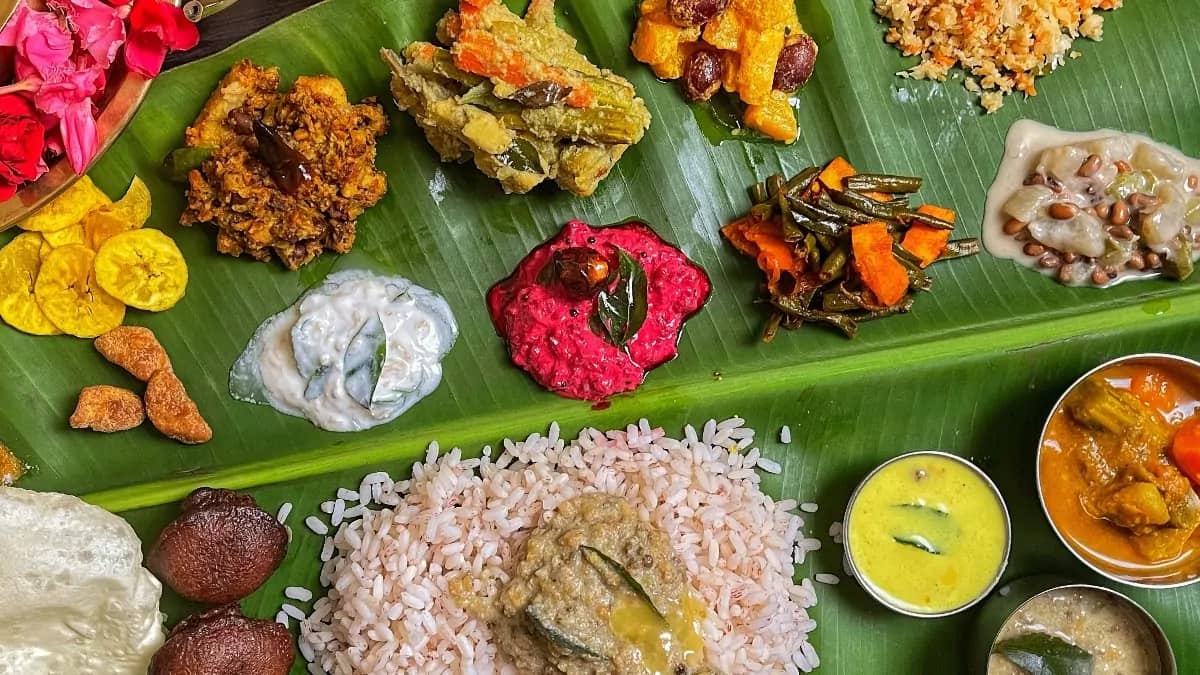
There are festive meals you sit down to eat, and then there is the Onam Sadya - the sort of feast that makes you wonder whether your appetite has been dramatically faltering all these years. A banana leaf is placed in front of you before a person arrives with parippu. Then someone else is spooning avial, thoran and olan onto carefully designated corners of your leaf. Pappadam is waiting to be crushed into rice. Pickles are quietly making everything more delicious and exciting. And before your stomach has properly registered what is happening, somebody announces, ‘ more payasam!’
The temptation is obvious: try everything, and try it immediately. But that is also the fastest route to filling up halfway through a Sadya and watching the remaining dishes pass you by with profound regret. For Onam 2026, which culminates with Thiruvonam on Wednesday, 26 August, there is a better strategy. Instead of treating Sadya as an eating competition, think of it as a carefully choreographed tasting experience. You do not need to attack the leaf. You simply need to pace yourself and savour the experience.
Onam is one of Kerala's most important festivals and has deep roots in Malayali cultural and religious traditions. The festival is associated with the legendary king Mahabali’s annual return to Kerala, along with the origin story of the renowned Vamana avatar of Lord Vishnu. Thiruvonam is regarded as the most auspicious day of the celebrations. And somewhere at the centre of all that celebration sits the Sadya.
What Exactly Is An Onam Sadya?
Sadya means a traditional banquet, and it is far more than simply a large vegetarian lunch. An Onasadya is generally served on a banana leaf, with a remarkable assortment of curries, vegetables, pickles, savouries and sweets arranged in a particular manner. A Sadya can include around 28 dishes, while some traditional descriptions put elaborate feasts at 40 or more. The exact menu changes from household to household and region to region, which is part of the charm.
Image credit: Pexels
You may encounter parippu with ghee, sambar, avial, thoran, olan, erissery, kaalan, pachadi, kichadi, kootu curry, pulissery, rasam, and various pickles, alongside banana chips, pappadam, and sharkara varatti. Then come the payasams, perhaps ada pradhaman, palada, pal payasam, parippu payasam or semiya payasam, commonly accompanied by a ripe banana. Some regional versions have their own personalities.
For example, Northern Kerala has Sadya traditions that may include non-vegetarian preparations, while those dishes and their prominence vary across southern, central and northern parts of the state. So, if one Sadya looks different from another, that does not necessarily mean somebody has forgotten the recipe book. Regional variation is part of the tradition.
A sadya feast is eaten with your hands, be it sampling various vegetable preparations, curries, fried appetisers or just mixing ghee with rice. There is both a practical as well as cultural reason behind it. A banana leaf is not suitable for using a spoon and fork; the leaf’s flat surface makes it difficult to scoop gravy while the cutlery may pierce through the plate itself.
And on a deeper level lies the basics of Ayurveda, which suggests that the human body is made up of five elements, namely air, water, fire, earth, and aether (space) or, in other ancient texts, the soul. When you touch the food you eat, Sadya meals or otherwise, a spiritual synergy is formed between the meal and your body. As a result, the Onasadya feast not only nourishes your physical self but also fortifies your soul when eaten traditionally by hand.
The First Rule: Do Not Panic When The Leaf Fills Up
The first sight of a fully loaded Sadya can induce mild culinary anxiety in some individuals. There is rice, curries, little piles of vegetables, pickles, along with things you have never perhaps tasted before. And right then the person serving you asks whether you want more. Remember, you absolutely do not have to say yes. Start by taking modest portions.
The beauty of a Sadya is that you can experience several flavours without needing a mountain-sized helping of each one. If something particularly delights you, you can always ask for more later. This is particularly useful because Sadya is traditionally served in courses, rather than a single chaotic pile of food. A general serving sequence begins with the accompaniments, followed by rice and parippu, then sambar, payasam, and later preparations such as pulissery and rasam. In other words, the meal itself gives you a pace. So, use it wisely.
Sample The Sides Before Going Heavy On Rice
One of the easiest ways to avoid the dreaded ‘I am full, and they have not even brought out the payasam yet’ situation is to resist starting the meal with an enormous mound of rice. Instead, take small bites of the vegetable and yoghurt-based preparations first. Avial brings together vegetables, coconut and green chilli. Olan is gentler, built around ingredients such as pumpkin or ash gourd along with coconut milk. Thoran offers a drier, coconutty texture, while pachadi and kichadi bring cool and tangy yoghurt-based flavours.
Image credit: Pexels
This is where you should allow yourself to be curious and explore. Try the bitter, sour, sweet, spicy, and creamy elements separately before mixing them together. You will begin to understand why a Sadya is not about one dominant flavour or theme. It is about variety and contrast. And yes, that tiny spoonful of pickle matters. You have to sample it on its own initially to understand its appeal.
Then Comes The Rice: Pace Yourself
Eventually, the rice arrives, and the proper mixing and contrasting begins. Also, this is where portion control becomes your secret weapon. For example, start with a manageable serving of rice and pair it with the first curry, traditionally parippu and ghee. Later, move on to sambar. Do not feel obliged to make every curry-rice combination in one sitting. If you loved the avial, have it again. If the olan was your surprise favourite, give it another taste. If something did not work for you, move on. Proper pacing and portion moderation will help ensure your fear of missing out (FOMO) cannot even be part of the conversation.
Save Space For The Payasam
This is perhaps the most important piece of Sadya strategy: do not fill yourself with rice simply because it is sitting in front of you. Payasam is not an optional decorative finale. It is one of the great attractions of the feast, and several varieties of it may be served. Ada pradhaman, palada, pal payasam and parippu payasam all bring different combinations of milk or coconut milk, along with jaggery, rice or lentils, spices, nuts and dried fruit.
Image credit: Pexels
So, start by taking small portions if several varieties are available. Taste each one. You may discover that the dark, jaggery-rich ada pradhaman is your favourite, while somebody at the next table is passionately defending palada. And yes, a little ripe banana with payasam is worth trying.
Once the payasam excitement settles, the meal is not necessarily finished. Rice may return with preparations such as pulissery or kaalan, followed by rasam and eventually buttermilk. Traditionally, these courses are commonly placed towards the end of the meal, though these customs may vary. This is another reason not to race through the earlier stages. If you have eaten yourself into a corner before the final courses arrive, you have effectively missed out on a part of the Sadya experience. So, focus on small servings, taste, pausing, and picking.
Your 2026 Food Sadya Strategy: Taste Everything, Worship Nothing
There is no prize for having the largest pile of rice on your banana leaf. For a genuinely enjoyable Onam Sadya, arrive hungry but not ravenous. Eat your portions slowly, taking your time to savour each bite. Take small portions initially and pay attention to the order of the meal. Explore unfamiliar dishes instead of automatically filling your leaf with the ones you already know.
Save room for the guests of honour, aka the payasams. And when a server offers another helping, remember that ‘not yet’ or ‘no, thank you’ are perfectly respectable answers. Most importantly, do not turn a deeply communal and culturally significant feast into a checklist. The magic of Sadya lies in sitting together, eating from broad banana leaf plates, discovering regional flavours and allowing the meal to unfold at its own pace.