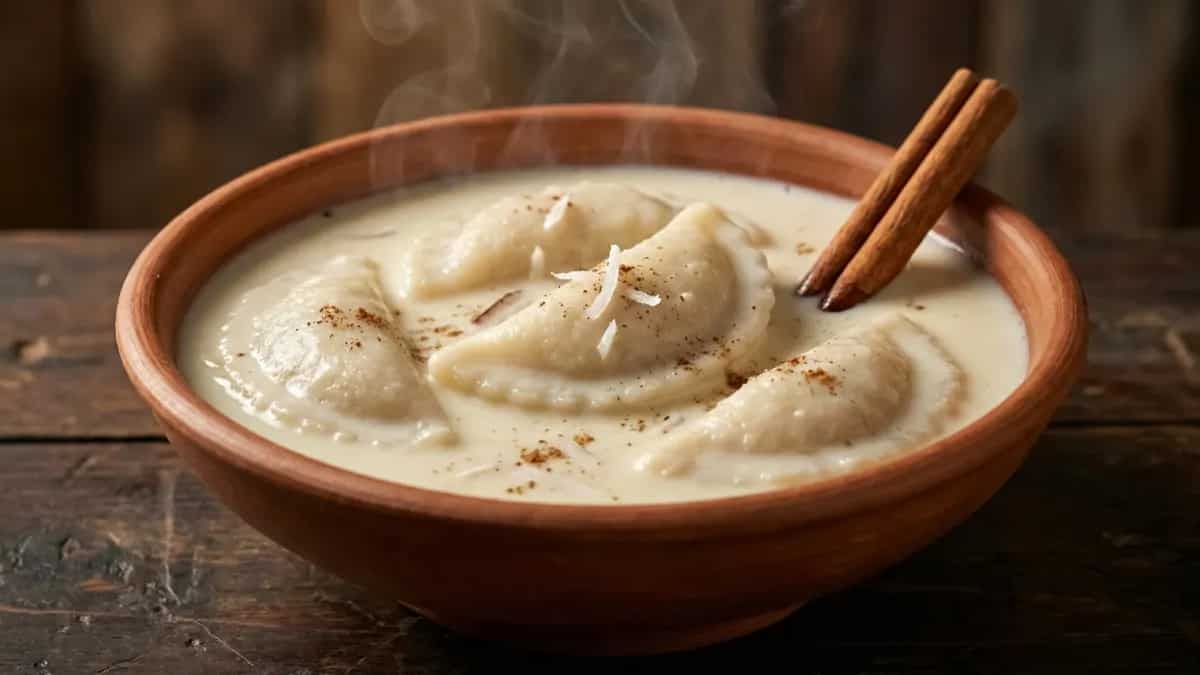
Banglar pithe puli swade o sourobhe ononno
Bangali khete jane, khawaote o besh
Poushe shuru holo Magheo hobena shesh
Bashona roshona mile mete othe nolene
Mou mou shubashe Banglar swad, pabena kono khane.
This very poem accumulates Bengalis' love for Pithe Puli, and Makar Sankranti is the ideal time to relish it. Among Bengalis’ Baro Mashe Tero Parbon, Makar Sankranti is the one that follows a sweet, smoky aroma emerging from Bengali kitchens with Nolen Gur and roasted rice flour. This is the soul of Makar Sankranti, or as Bengalis affectionately call it, Poush Parbon. Though the rhythmic sound of the dhenki (traditional wooden husker) may have faded through the ages, the love for Pithe Puli remains evergreen. Payesh, moya, gur er pithe, til er pithe, naru, patishapta, and so many other delicacies are there you can count on in a Bengali Household for Makar Sankranti.
And it’s not just about the preparation of pithe puli, there’s a belief among the elders that you should stay at the exact place on the day of Sankranti, where you were staying on the very first day of the month.
Also Read: Makar Sankranti In Bolpur: Savouring Authentic Bengali Thalis, Desserts And Shonajhuri Treasures
A steaming bowl of Dudh Puli or Dudh Chitoi speaks of the love and fervour that spans from the fertile plains of East Bengal to the bustling neighbourhoods of West Bengal. The vibe is one of shared heritage, where every bite of a coconut-stuffed Patishapta or a crunchy Gokul Pithe tells a story of the soil. The taste has a mouthfeel of earthy sweetness of date palm jaggery, the creamy richness of reduced milk, and the comforting texture of freshly harvested rice. Apart from being a culinary festival, it is a seasonal embrace that brings families together to celebrate the bounty of the earth.
From Fields to Festivity: The Sacred Transition of Poush Sankranti
Makar Sankranti marks the sun’s transition into the Makara (Capricorn) constellation, signaling the end of the winter solstice and the start of Uttarayana—the sun’s northward journey. In Bengal, this is Poush Sankranti, the ultimate harvest festival. It is a day dedicated to the Sun God, Surya, and the Goddess Lakshmi, in gratitude for a bumper crop. The significance lies in the arrival of "Aman" paddy and the extraction of liquid gold—Khejurer Gur or date palm jaggery.
While the theme of harvest is universal, the celebration nuances vary beautifully between East Bengal (Opar Bangla) and West Bengal (Epar Bangla). In East Bengal traditions, the craftsmanship of the pithe is often more intricate. As Susmita Chakravarty notes, "Choshi is a very specific craft of East Bengal women, shaped entirely by hand and palm." The rituals there involve a deep connection to the shil-nora (stone grinder), where the graininess of the rice is preserved to give the pithe a "natural bite."
In West Bengal, the festival is famously known as Poush Paron or Pithe Parbon. The rituals revolve around the Baharlaxmi Puja, where the deity is worshipped in open spaces near the granaries. Households across both regions participate in a three-day celebration starting the day before Sankranti. Whenever the mind-boggling fragrance of the pithe comes out of the Bengali kitchen, you'd better know that there will be three variants, including steamed, fried, and syrup-soaked delicacies, to replace your regular meals for the day. Whether it is the Shora Pithe cooked in earthen moulds or the Koraishutir Puli (savoury green pea dumplings), it’ truly a wonder how the festival merges the geographical difference of the two Bengals through a shared palate of these pithe puli.
The Custodian of Bengali Culinary Heritage: Chef Samita Haldar
Chef Samita Haldar is a culinary veteran whose relationship with food spans four decades. With ancestral roots stretching across Barishal, Jhalokathi, Jessore, and Dhaka, her cooking is a living map of undivided Bengal. Having spent years traveling across India due to her husband’s postings, she has preserved the most authentic, ritualistic forms of Bengali cooking.
The Ritual of Auni Bauni
For Chef Samita, the festival begins with Auni Bauni, a fundamental ritual observed the day before Sankranti. She explains:
"Auni Bauni is one of the most important and fundamental rituals observed in households on the occasion of Poush Sankranti. Leaving aside the ritual of the holy bath, Poush Sankranti is essentially a harvest festival. At its core, this celebration was a special ceremony observed in farming families to mark the bringing home of newly harvested paddy for the first time."
In this ritual, rice flour is mixed with water to create symbolic "bindings" representing the granary, cowshed, and even modern tools like bicycles.
As mentioned by the chef, "This observance usually takes place on the day before Poush Sankranti, that is, today. When new paddy is harvested in the month of Poush, rice from this grain is pounded in a dhenki and ground into flour. This rice flour is then mixed with water to create the bauni bindings. Through these, various aspects of the household and agrarian life are symbolically represented—such as the granary, cowshed, cows and calves, plough, sickle, billhook, ladder, bicycle, vehicles, the grocery market, and the vegetable market."
"Following this, worship is performed with lamps, incense, flowers, Ganga water, air, betel leaves, and betel nuts. I have seen this ritual exactly in this way since childhood. Earlier, it was my grandmother who performed it; now my mother and aunts do so. Alongside this, pithas made with new jaggery, pulis, and payesh are also prepared", she added.
Also Read: Makar Sankranti 2026: Why Khichdi Becomes Season’s Comfort Food
Samita's Secret Recipe of Patishapta
Ingredients:
1 cup all-purpose flour
½ cup Gobindobhog rice, soaked and ground
¼ cup semolina
Sugar or jaggery, as per taste
¼ cup milk (lightly warm)
Water, as required
A pinch or two of salt
Mix everything together and whisk well. The batter should be neither too thin nor too thick. Make sure there are no lumps. Cover and let it rest for 1–2 hours.
For the filling:
You can prepare anything you like—coconut, khoya kheer, jaggery, or sandesh. Cook grated coconut with jaggery in a pan; if you wish, add some thickened milk. When it thickens and dries out, the filling is ready.
Brush a non-stick pan with oil or ghee and make the patisapta. For those who are not used to making pithas, it’s better not to use an iron roti tawa. For Patisapta, Gur is the Secret ingredients; it has to be good and pure.
The Handmade Emotion: Susmita Chakravarty’s Makar Sankranti Legacy
For Susmita Chakravarty, the founder of Eastern Staple, Makar Sankranti is not merely a date on the lunar calendar; it is a sensory journey back to her roots. Being born into a Bangladeshi family, she views the festival—traditionally called Poush Sankranti—as a deeply ritualistic period that defined her childhood. She recalls that the festivities began long before the actual day: "I clearly remember that almost seven days before Sankranti, newly harvested rice would arrive at home. That itself felt like the beginning of the festival."
To talk about her childhood memories about the pithe puli and Makar Sankranti. “As a child, pithe always felt very difficult to make, and I was never really allowed to take part in the ritual. I remember the narokel kurani (traditional coconut grater) in particular—it was a very intricate part, done entirely by hand. The old-style grater required a lot of pressure and effort to extract the coconut properly, and it seemed almost impossible to manage as a child.” She further mentions, “Somehow, even as a child, I always wanted to be involved. When I grew older and finally started making pithe myself, I realised just how much effort, patience, and skill went into every step. Understanding that makes me appreciate the old traditions even more.”
The arrival of rice set off a chain of traditional processing that modern kitchens rarely see. "The rice was first soaked, then dried directly under the sun. Once properly dried, it was ground on shil-nora, and that freshly prepared rice flour was used to make pithe. The entire process was slow, seasonal, and deeply ritualistic," she explains.
The two delicacies she loves making the most are Dudh Puli and khoa–narkel patishapta. Many people find it hard to digest khoa. It tastes very different when you mix khoa with coconut, and it gives the stuffing a light crunch she loves to work with.
The difficult thing about puli is that it gets hard when it cools down. It takes years of skill and experience to keep it soft even when it's cold outside, and that's something I try to keep up with.
She highlighted the symbolism in puli pithe as well. “Larger pulis with stuffing are served as the family's elders, while the smaller ones without stuffing are served as the kids. This is just because of their sizes. In this way, puli pithe refers to being together. The older people keep the traditions alive, and the younger people follow, watch, and slowly learn.
They come together in Dudh Puli, a traditional Bengali dish that shows how generations live together and complete each other.”
Susmita emphasises that the essence of these sweets lies in the "handmade care" that commercial outlets simply cannot replicate. She shares a beautiful piece of symbolism regarding the structure of the family: "There is also a beautiful symbolism in puli pithe. The larger pulis, with stuffing, are served as the elders of the family, while the smaller ones without stuffing are served as the youngest members—purely based on their size. In that sense, puli pithe represents togetherness." Even as she scales Eastern Staple to serve thousands of meals, she insists on involving local women to maintain this 'feminine craftsmanship," ensuring that every Dudh Puli or Choshi carries the emotional weight of a home-cooked blessing.
“For 2026, I’m planning something unusual for those who enjoy more savoury and non-veg options, Mutton Patishapta. It has a patishapta coating made with nolen gur, but the filling is spiced mutton. I’ve experimented with it before, and I plan to revisit it again. In fact, I’ve already received some orders for it. Being in the business, balancing what I want to serve with what people want to eat has been a continuous learning process for me.”, Susmita adds.
Traditional Pithe of East Bengali Origin
Image Credit: Adobe Stock
Choshi Pithe & Choshir Payesh
Choshi is perhaps the most labor-intensive craft of East Bengal. These are tiny, grain-like dumplings shaped entirely by hand and palm from a dough of boiled rice flour. As Susmita notes, the aroma of these hand-rolled "seeds" simmering in slow-boiled milk and Nolen Gur is the ultimate winter scent. It requires immense patience to ensure each piece is uniform, resulting in a silky, decadent payesh that melts in the mouth.
Shora Pithe (Chitoi Pithe)
Would you believe if someone tells you that sitting with a made-up face, all puffed up and looking round, can be a secret behind the perfect Chitoi pithe? Well, ask any family from the East Bengal origin, their grandmothers must have told them the same. As a staple in Bangladesh and East Bengali households, this pithe is all about a proper steam management. A thin rice batter is poured into a clay mold called a shora. It is prized for its neutral flavour, allowing it to be versatile. Nowadays, non-stick frying pans have arrived, but the charm and the taste of the earthen shora are still there. Many of the first-timers may find similarities with the English pancake concept. While it is often soaked in jaggery-infused milk, it is equally famous as a snack, enjoyed with gur sheera during winter afternoons.
Dudh Puli
This is the ultimate representation of East Bengali indulgence. These half-moon dumplings are made from a delicate rice flour dough, stuffed with a "pur" of coconut and jaggery. The real skill lies in keeping the casing thin yet strong enough not to burst when boiled in thickened milk. When executed correctly, the puli stays soft even after cooling, symbolising the coexistence of different generations within a single, sweet dish.
Bhapa Pitha
A signature of the Opar Bangla (East Bengal) region, Bhapa Pitha is a steamed rice cake that celebrates the simplicity of ingredients. Ground rice is layered with a core of fresh coconut and chunks of Patali Gur, then wrapped in a thin cloth and steamed over a narrow-mouthed pot of boiling water. This fluffy, snowy cake is meant to be eaten hot to experience the molten jaggery center. The better quality jaggery you use, the tastier the bhapa pithe you get.
Image Credit: Adobe Stock
Gokul Pithe
Gokul Pithe is a fried delicacy that showcases the East Bengali love for rich textures. Small balls of coconut or khoya stuffing are flattened, dipped in a thick batter of flour and milk, and deep-fried until golden. They are then immediately dunked into a warm syrup of sugar or jaggery. This pithe provides a crunchy exterior that gives way to a soft, syrup-soaked heart, offering a complex mouthfeel.
Mulor Bhapa Pitha (Radish Rice Cake)
A unique variation of the traditional steamed cake, Mulor Bhapa Pitha incorporates grated radish. The radish is boiled, squeezed dry, and cooked with jaggery and coconut to create a sweet, fragrant stuffing. Encased in a rice-flour shell and steamed, the radish's pungency is completely masked by the sweetness of the gur, leaving a surprisingly light, earthy flavour that is a winter favourite.
Bengali Koraishutir Puli
This is a savoury deviation from the predominantly sweet pithe platter. It is a crispy, deep-fried dumpling where the outer shell is made of mashed potatoes or a flour-rice mix, and the core is stuffed with a spicy green pea (Koraishuti) filling. Often served with a tangy coriander chutney, it provides a crunchy, salty contrast to the sugary syrups of Poush Sankranti, making it an essential snack during the festivities.
Makar Sankranti in Bengal is a date on the calendar, along with a preservation of the art of handmade Pithe. From the ritualistic Auni Bauni to the Gokul pithe Patishapta, the harvest of the 2026 celebration brings out the magic of the truest ingredient passed down through generations.