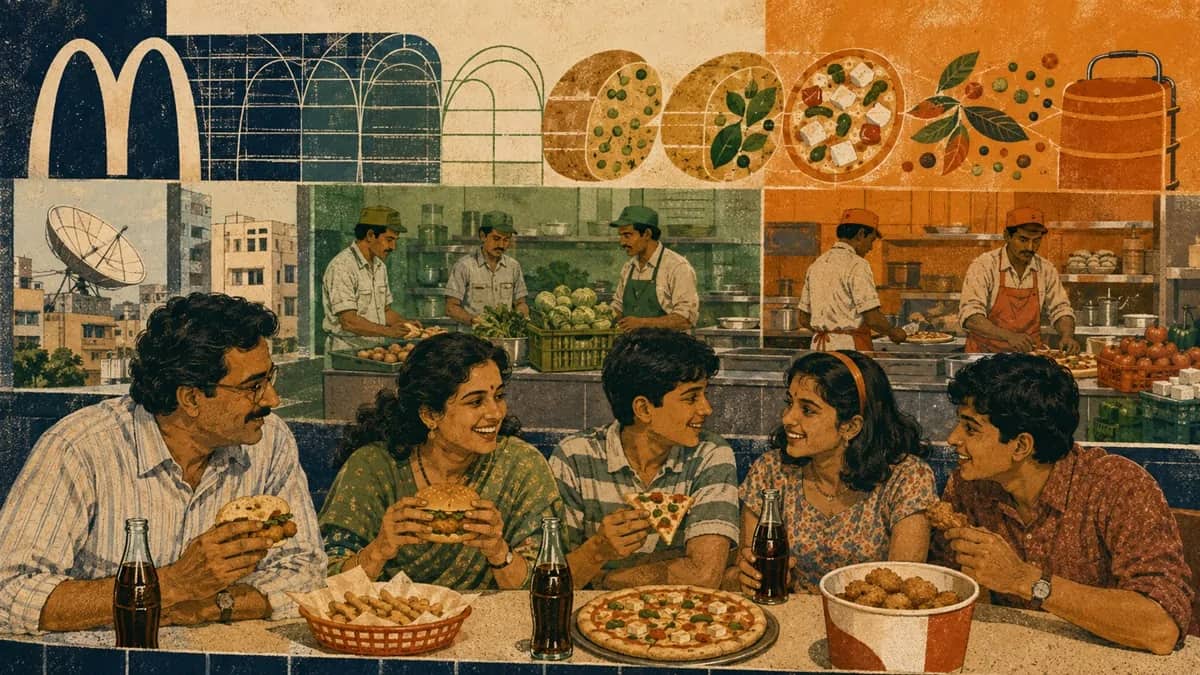
Editor’s note: This is Chapter 5 of The Eight-Minute Kitchen, Avinash Mudaliar’s eight-part history of the systems behind modern Indian eating. It covers 1990–1999, beginning with Pepsi’s pre-reform entry and following the first decade in which economic liberalisation, satellite television and global restaurant formats met an already crowded Indian food culture.
***
THE FIRST INDIAN McDonald’s did not begin with a Big Mac. It began with an omission.
When the chain entered India in 1996, beef and pork were left off the menu. Vegetarian food was not a consolation prize but a category, and vegetarian and non-vegetarian preparation went into separate cooking areas. McDonald’s own account of the decision calls it the first and largest innovation of the India launch.
The global template had arrived already edited. The franchise manual had met the kitchen’s veto.
A fortnight from empty
The change began nowhere near a restaurant counter. On 24 July 1991, Finance Minister Manmohan Singh told Parliament that India’s foreign-exchange reserves, then about ₹2,500 crore, were sufficient to finance imports for “a mere fortnight”. His Budget speech recorded two exchange-rate adjustments, on 1 and 3 July, and set out reductions in import licensing alongside a new approach to foreign investment, including up to 51 per cent foreign equity in specified high-priority industries.
This matters because 1991 is often flattened into one speech and one unlocked gate. It was a sequence: a balance-of-payments emergency, exchange-rate action, a reform Budget and changes in industrial policy. Nor did the Indian plate turn multinational overnight. Policy could alter who was permitted to invest; habit, price, distribution and trust would decide who got served.
Food is particularly poor at obeying the instant-conversion theory of economics. A factory can change ownership more quickly than a family changes breakfast.
Pepsi arrives before the door opens
Pepsi makes the chronology inconvenient in the most useful way. The company did not stroll in after July 1991. It spent years negotiating an entry under the older regime.
In 1986, PepsiCo applied with the state-owned Punjab Agro Industries Corporation and Voltas to establish a venture encompassing snack foods, tomato processing and soft-drink concentrate. The proposal provoked extensive political opposition before receiving clearance in 1988. Foreign-brand rules produced a hybrid name; the cola rolled out as Lehar Pepsi in June 1990, according to Business Standard’s history of the negotiations.
Pepsi’s pre-reform story is not a footnote. It shows what market entry then meant: an agricultural and food-processing bargain, Indian partners, export commitments, ownership limits and a brand name negotiated with the state. Liberalisation did not create multinational appetite for India. It changed the terms on which that appetite could be fed.
Coke returns to somebody else’s market
Coca-Cola returned in 1993 after leaving India in 1977. But it did not come back to a cola desert. Parle’s Thums Up had been created in the intervening years and had competed with other domestic drinks including Campa Cola, Double Seven and Duke’s.
The most revealing part of Coke’s return was therefore an acquisition. The Chauhans sold Thums Up to Coca-Cola in 1993. Business Today’s account puts Thums Up at 36 per cent of the market when Coke re-entered, ahead of Pepsi’s 26 per cent.
The precise shares have varied by source and definition, but the larger point does not need a decimal: an international giant had to buy a place beside an Indian cola people already wanted. Globalisation was not a queue of grateful consumers awaiting the authentic article. Sometimes the local brand came with the keys.
The bucket meets the barricade
KFC opened its first Indian restaurant in Bengaluru on 1 June 1995. By August, a farmers’ organisation was campaigning against it; contemporary reports framed the dispute around multinational power, agriculture, health and cultural self-reliance. A Washington Post report from the confrontation described armed police outside the restaurant and a simultaneous court battle.
The episode is often retold as quaint resistance to fried chicken. It was more serious than that. The restaurant made economic reform visible as a shopfront: foreign capital, industrial food and cultural change under one illuminated sign. A bucket could now become an argument about sovereignty.
It also exposed the limits of the phrase “the Indian consumer”. Some urban diners wanted the novelty. Some activists saw corporate agriculture. Regulators had food-safety questions. India was not one audience changing its mind in unison.
Nineteen ninety-six, served three ways
The following year supplied the canonical fast-food montage. Pizza Hut says it opened its first Indian restaurant in Bengaluru in June 1996. Jubilant Bhartia records the first Domino’s store in New Delhi in the same year. McDonald’s also began Indian operations in 1996.
The three formats carried different promises: a sit-down pizza occasion, pizza engineered for delivery, and the highly standardised burger counter. Yet the difficult work was not importing a signboard. It was building systems beneath it.
McDonald’s western and southern operator recalls starting where there was no suitable supply chain for its specifications, then developing one for ingredients including vegetables, lettuce and chicken. It also accepted the cost of separate vegetarian and non-vegetarian kitchens because separation helped build trust. That company history of the 1996 launch is self-interested, as corporate histories are, but the operating choices are concrete.
Here, localisation was not paneer scattered over a global idea. It ran backwards through procurement, equipment, kitchen design and staff practice. The menu was merely the part the customer could read.
The burger becomes aloo tikki
In 1998, the adaptation acquired its emblem. McDonald’s launched the McAloo Tikki: a potato-and-pea patty seasoned for India, placed inside the most recognisable shape in American fast food. The company dates its appearance to 1998.
The cleverness was structural. Aloo tikki was not invented in a corporate test kitchen; it belonged to India’s much older street-food repertoire. McDonald’s did not simply make a burger “spicier”. It used an Indian snack to solve several problems at once: vegetarian demand, familiarity, affordability and the need for a product that felt designed rather than apologetically substituted.
The result was neither wholly American nor traditionally Indian. It was a local food made legible to a global production system. The arch had learned to hold a potato.
Three things the franchise manual had to learn
Pepsi arrived before reform | Its joint venture won clearance in 1988 and Lehar Pepsi rolled out in June 1990 — before the July 1991 reform package. Business Standard reconstructs the negotiation.
Two kitchens built one kind of trust | McDonald’s separated vegetarian and non-vegetarian cooking areas from its 1996 India entry, alongside removing beef and pork. The company describes the decision here.
The aloo tikki joined the corporation in 1998 | The potato-and-pea burger arrived two years after McDonald’s entered India. McDonald’s dates the launch to 1998.
Breakfast declines the script
Restaurant chains were not the only companies learning that access was not acceptance. Kellogg’s launched cornflakes, wheat flakes and basmati rice flakes in India in September 1994. A widely taught ICMR business case records falling sales by April 1995 and several sources of friction: premium pricing, limited distribution, unfamiliar positioning and the loss of crispness when flakes met the warm milk many customers preferred.
The hot-milk anecdote is memorable enough to have become a parable, which is precisely why it needs restraint. No breakfast habit can stand in for a country. The case itself describes a bundle of problems rather than one national aversion to cold cereal.
Kellogg’s response was instructive. It introduced Chocos in 1996 and Frosties in 1997, then launched locally flavoured Mazza cereals in 1998 and experimented with smaller, cheaper packs. The company had arrived intending to sell a new breakfast. It stayed by learning that the old breakfasts had bargaining power.
A chef enters the living room
In 1993, while cola companies negotiated shelf space, a chef stepped into the new satellite-television world. Sanjeev Kapoor began presenting Khana Khazana on Zee TV. In a retrospective interview, Kapoor remembered that first 1993 set and the show’s address to people cooking at home; his official biography says it ran on Zee for 18 years.
The timing was exquisite. Foreign restaurant formats were making professional food newly visible outside the home, while television translated professional technique back into the domestic kitchen. Kapoor’s calm instructions made the chef a public figure and restaurant-style aspiration reproducible at home — usually with substitutions, adjustments and the sovereign phrase “to taste”.
Liberalisation therefore entered lunch through more than investment rules. It arrived through screens, celebrity, advertising and an enlarging idea of what an ordinary cook might attempt.
Fast food did not begin with a passport
There was another correction to make. India had no shortage of food served quickly, from idli counters and railway refreshment rooms to chaat, vada pav and innumerable regional snacks. Even the Western-style burger-and-pizza format had a domestic predecessor. Nirula’s says it opened Delhi’s first fast-food restaurant in 1977, serving burgers, pizzas, sundaes and ice cream; the Indian Express describes it as India’s first fast-food chain.
The 1990s multinationals did not invent Indian speed or urban novelty. They brought large franchise systems, supply standards, marketing budgets and a model designed to multiply. Their arrival widened the category and changed its scale. It did not create it from nothing.
Nor did every Indian suddenly begin eating out beneath corporate signs. The early market was metropolitan, aspirational and unevenly affordable. A pizza or burger could be a family outing, a birthday, a glimpse of an advertised world — not Tuesday’s automatic dinner.
That distinction explains the decade better than any tale of Westernisation. India did not merely absorb global brands. It tested them against vegetarianism, religious food rules, price, domestic competitors, local suppliers and the authority of existing taste. Those that remained learned a durable formula: global format, Indian grammar.
In the 2000s, malls, cafés, delivery networks and rising urban consumption would give that grammar a much larger audience. The door had opened in 1991. By the end of the decade, the menu had answered back.
This is Chapter 5 of The Eight-Minute Kitchen, Slurrp’s eight-part history of independent India’s food system. Return to Chapter 4: The Convenience Decade, browse the series introduction and index, or continue to Chapter 6: India Starts Eating Out.
Previous: Chapter 4 — The Convenience Decade | Series index: The Eight-Minute Kitchen | Next: Chapter 6 — India Starts Eating Out