Editor’s note: This is the final chapter of The Eight-Minute Kitchen, Avinash Mudaliar's eight-part history of the systems behind modern Indian eating. It covers 2020 to 15 August 2026 and, more precisely, the app-connected urban market in which groceries began arriving in minutes. Quick commerce is not presented as universal, and speed is not credited to riders alone. Company figures are dated and identified as such.
***
AT 8PM on 24 March 2020, Prime Minister Narendra Modi told India that a nationwide lockdown would begin at midnight and last 21 days. Four hours separated announcement from closure. The official address asked citizens not to cross the threshold of their homes. Hunger, inconveniently, received no such instruction.
The obvious retrospective is that delivery boomed. The first reality was closer to seizure. Restaurants shut, supply chains snagged, housing societies barred outsiders and riders were stopped even when they carried permitted goods. The Union government’s rules allowed delivery of food and other essentials through e-commerce, then the Home Ministry had to clarify those exemptions to states. Permission on paper was not the same thing as movement on a street.
Swiggy said its core food-delivery business had been “severely impacted”; in May it announced the loss of 1,100 jobs and a reduction in cloud-kitchen operations. The company’s chief executive described the contraction, while Reuters put the cut at nearly 14 per cent of staff. The screen-door food system had failed before it became essential.
Convenience becomes infrastructure
What survived learnt a new vocabulary. Restaurants devised shorter menus, family packs and contact-minimised handovers. Grocers and platforms moved staples as well as suppers. Many households cooked more because they had to; many others depended on the very delivery networks that lockdown made difficult to operate. A convenience business found itself carrying the language of emergency infrastructure.
The change outlasted the emergency. Working, paying and shopping through a phone had been rehearsed at national scale. The app no longer needed to persuade an urban customer that groceries could be ordered online. It had to persuade them that waiting until tomorrow was faintly unreasonable.
Swiggy launched Instamart in 2020, according to its filed prospectus. Zepto was founded that year; by October 2021, six months after its app launch, two 19-year-old founders were pitching ten-minute groceries from a network of optimised micro-warehouses, as TechCrunch reported at the time. The stopwatch became the product.
Ten minutes begins before the order
The trick was not simply to ask a rider to travel faster. It was to rearrange the shop.
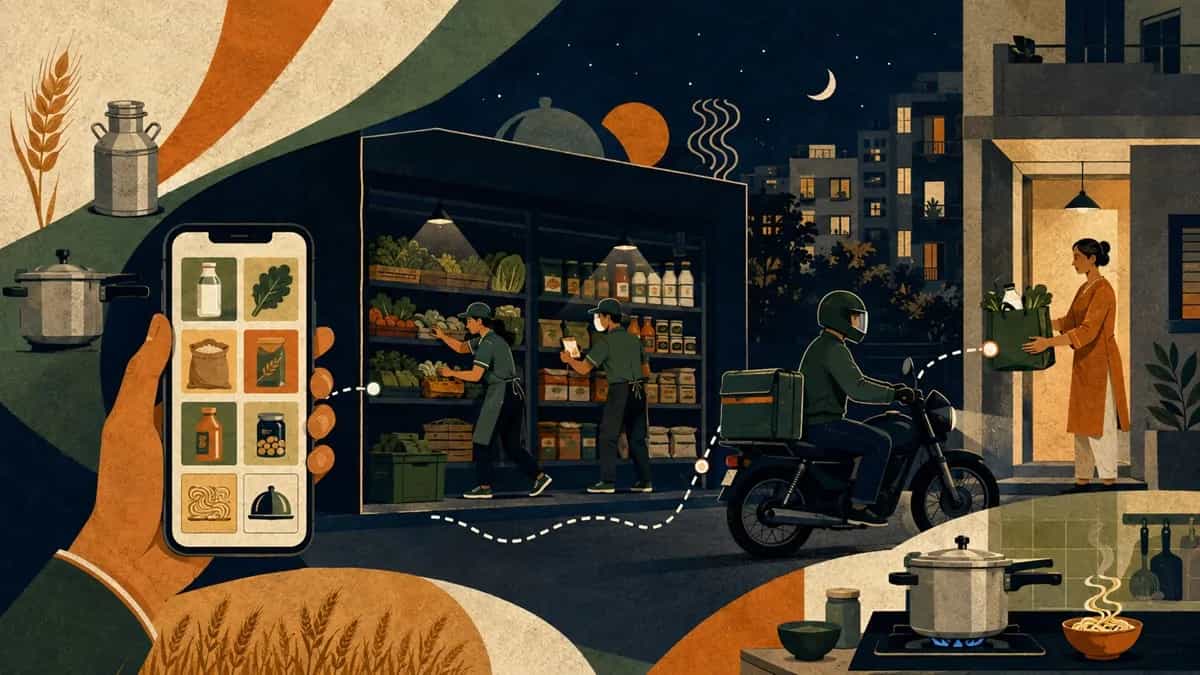
A conventional supermarket displays thousands of items to browsing customers and may serve a wide area. A dark store is closed to walk-in shoppers, located near dense demand and organised for picking rather than wandering. Demand forecasts decide what sits on its shelves. When an order arrives, a worker receives a digital list, collects and packs the items, and hands the bag to a rider covering a short radius. Swiggy’s prospectus describes dark stores as the facilities where its quick-commerce orders are fulfilled; by June 2024 it said Instamart was operating in 32 cities, offered roughly 19,000 stock-keeping units and averaged about 12.6 minutes from order to delivery.
Those figures are a dated company snapshot, not a promise about every city or every afternoon. Their more useful lesson is architectural. The service does not compress a leisurely supermarket trip after the customer taps “buy”. It has already placed milk, coriander, nappies and noodles close to where an algorithm expects them to be wanted. The clock starts before checkout.
Three things the stopwatch conceals
Lockdown did not instantly produce a delivery bonanza | Swiggy said its core food-delivery business was severely hit and cut 1,100 jobs in May 2020. Exemption from lockdown rules did not guarantee access to restaurants, riders or streets. The company described the damage itself.
The ten-minute journey begins before you order | Inventory is forecast and positioned in neighbourhood dark stores, then picked and packed for a short last mile. Speed is a property of the warehouse network, not just the rider. Swiggy’s prospectus maps the operating model.
ONDC is not another shopping app | It is an open communication protocol intended to let buyer-side and seller-side network participants transact without one company controlling the entire journey. ONDC makes that distinction explicitly.
The warehouse becomes a kitchen
Call this quick commerce and the food disappears into a retail category. In practice, the dark store has become an annex to the kitchen. It supplies tonight’s missing onion, the breakfast milk nobody remembered, the ice for unexpected guests and, increasingly, ready-to-eat meals, meat, fruit, sweets and supplements. The pantry has acquired an external buffer, available by swipe.
That changes what convenience means. Earlier chapters in this series followed technologies that reduced labour inside the home: the pressure cooker, packaged foods, refrigeration, the mixer-grinder. Quick commerce moves part of the pantry outside it. The household need not store as much or plan as far ahead; the platform holds stock, predicts desire and accepts the risk of being wrong.
But the labour has not vanished. It has been redistributed to pickers, packers, warehouse managers and riders, then hidden behind a progress bar. A customer watches “packing”, “picked up” and “arriving” advance in calm little stages. Behind them is a tightly timed chain in which a late shelf pick, an absent item, rain or a closed gate can consume the margin. The interface makes waiting visible and work abstract.
The promise is also geographically selective. Dense, affluent neighbourhoods can support nearby inventory and frequent orders; dispersed demand cannot sustain the same economics. Quick commerce can be spectacularly ordinary in one pin code and unavailable in the next. It is a powerful urban system, not a synonym for Indian grocery shopping.
An open network enters the argument
The decade also produced a different answer to digital commerce: not another vertically controlled platform, but a set of common rails. The Open Network for Digital Commerce began a closed alpha in Bengaluru in April 2022 and opened a public beta for grocery and food ordering in September, according to the government’s launch account.
ONDC is best understood as a protocol, not a consumer super-app. Buyer apps, seller apps, logistics providers and payment participants can find and transact with one another across the network. ONDC says no single entity controls the end-to-end journey. The proposition is political as much as technical: can small sellers become discoverable online without surrendering the whole customer relationship to one gatekeeper?
Scale does not settle that question, but it shows the experiment has moved beyond a demonstration. Government figures say ONDC recorded 326 million cumulative orders by October 2025, including 18.2 million that month. The network and quick-commerce platforms are not exact substitutes. One is an interoperability project; the others are inventory-and-logistics machines. Together they reveal the argument beneath the interface: who gets to set the terms of digital trade?
The stopwatch meets the regulator
For years, “ten minutes” condensed the entire business model into two words. In January 2026, after government pressure and concern about rider safety, Blinkit, Swiggy and Zepto removed prominent ten-minute language from their branding. Reuters reported that the operational models remained fast; the visible promise changed more readily than the network beneath it.
That distinction matters. No slogan can explain how an incentive is calculated, how many orders are batched, whether a rider feels free to refuse one, or how rain alters the route. The rider is the most visible moving part, but safety begins with targets, store placement, staffing and the design of the dispatch system. A stopwatch can be removed from an advert while remaining present in everybody’s work.
Food safety poses a related problem. Fast fulfilment is not proof of safe storage. On 14 August 2026, Maharashtra’s Food and Drug Administration said it had inspected 86 online-delivery establishments, issued 60 improvement notices and suspended 14 licences over compliance failures involving matters such as hygiene, temperature control, pest control and labelling. The New Indian Express reported the agency’s figures; Reuters identified 12 of the suspended sites as Blinkit, Zepto and Instamart warehouses.
These were suspensions, not a verdict on every dark store or every order. They supplied a more defensible warning than viral national adulteration numbers: the new pantry requires the old disciplines of licensing, sanitation, cold chains and inspection. The bag may arrive in eight minutes. The food law cannot.
Abundance changes the question
There is an irony in ending an eighty-year food history with a missing onion delivered at speed. Independent India began with scarcity so severe that the state rationed grain and searched abroad for supplies. In 1950–51, foodgrain production stood at 50.82 million tonnes, according to the government’s historical agricultural series. The third advance estimate for 2025–26 is 376.563 million tonnes — more than seven times as much — in the Agriculture Ministry’s latest release.
That achievement is immense. It is not the same as saying every person eats well, farmers are secure or food production is ecologically settled. Distribution, purchasing power, water, soil, crop choice and climate still decide who benefits from national abundance. The most impressive aggregate cannot pack a nutritious tiffin by itself.
The health data make the change in question unavoidable. The ICMR–INDIAB study estimated that in 2021 India had 101 million people living with diabetes and 136 million with prediabetes. Those are modelled national estimates, not diagnoses from a single screening drive, and they come from a peer-reviewed Lancet Diabetes & Endocrinology paper. A food system can defeat one form of scarcity while producing, distributing or advertising the conditions for another.
There are counter-movements. India proposed the United Nations’ International Year of Millets; the General Assembly designated 2023, and the FAO framed the year around the grains’ nutritional value and resilience. In 2024, the National Institute of Nutrition issued 17 food-based dietary guidelines, urging dietary diversity, safe food, label-reading and limits on foods high in fat, sugar and salt. Neither a millet logo nor a guideline can determine what is affordable, desirable or pushed to the top of an app. They do, however, change the terms of the argument.
Across this series, India’s kitchen has been entered by the ration card, the high-yielding seed, the milk cooperative, the pressure cooker, the television commercial, the restaurant chain, the smartphone and finally the dark store. Each promised to solve a real problem. Each redistributed time, risk, power and appetite. None arrived alone, and none reached everyone equally.
The eight-minute kitchen is therefore less a room than a system. Somewhere nearby, grain grown over months and milk collected at dawn wait in a windowless store. Software predicts the order; a picker fills it; a rider negotiates the last kilometre. Decades of public investment, private enterprise, farm labour, household work and digital infrastructure meet at the door before the cooker has built pressure.
India has shown that it can produce enough food to escape the arithmetic of the 1950s. It can now summon an astonishing range of it almost instantly — at least in the neighbourhoods the network serves. The next question is slower, harder and more consequential than delivery: what will India choose to eat, and what will that food do to it?
This is Chapter 8 — and the conclusion — of The Eight-Minute Kitchen, Slurrp’s eight-part history of independent India’s food system. Return to Chapter 7: Your Restaurant Moves Into Your Phone, browse the series introduction and index, or start again with Chapter 1: A Hungry Republic.
Previous: Chapter 7 — Your Restaurant Moves Into Your Phone | Series index: The Eight-Minute Kitchen | Start again: Chapter 1 — A Hungry Republic