Following Deepavali, Kolkata celebrates Jagadhatri Puja, a festival of devotion and divine protection. As the city welcomes the Goddess, its bright colours reflect the festival's spirit. Bengalis, especially in Krishnanagar, Chandannagar, and other parts of Hooghly and Nadia, celebrate this five-day festival with great devotion.
Image Credit: Saborni Saha
The name Jagadhatri is regarded as another form of Goddess Durga. Known as the 'Protector of the World', by the name of the goddess, 'Jagat' means 'world,' and 'Dhatri' means 'the sustainer.' She is seen riding a lion and holding various weapons in her four arms. The goddess is believed to embody the power of Bhuvaneshwari and Durga, and in other mythological descriptions, she is also named as Uma Haimavati.
Jagadhatri Puja 2025: A Blend Of Tradition And Devotion Across Bengal
Image Credit: Sreenika Moulik
Urban and rural Bengal celebrate the Raj Rajeshwary Jagadhatri Puja in Krishnanagar. In the City of Joy, South Kolkata celebrates publicly and grandly, while North Kolkata focuses mostly on family-oriented pujas. However, the citywide celebration of the goddess through music, dance, rituals, and food remains.
This year, Slurrp reached out to the Bose Family of Kolkata (celebrating 27 years of Maa er Pujo) and the Chakraborty Family of Chandannagar to explore their 49-year-old barir pujo traditions.
Image Credit: Sreenika Moulik
Slurrp had a word with the Chakraborty family, worshipping Goddess Jagadhatri for the last 50 years, almost with utmost devotion and rituals. Robin Chakraborty, one of the senior-most members in the family, shared,
“It was 1971 when we started worshipping Maa Jagadhatri. On the day of Saptami, we welcome Maa with all the rituals. For bhog, luchi and payesh are offered on Ashtami. From Noibedya to khichudi bhog, we have always been arranging things on our own. Our family members, as well as the people in the neighbourhood, have shared the responsibilities, and that’s how it became more like a family. The arrangements for bhog preparation are divided among different families for each day till Dashami. Here, we worship Maa as a member of our family and offer what we prepare at home. On Dashami, dodhikorma is offered to the goddess.”
Image Credit: Saborni Saha
The Bose family, in particular, initiated their Jagadhatri Puja in 1999, after a divine dream prompted them to start the ritual. The puja, held in the family's ancestral home, is a time of reunion and community. Every family member, regardless of caste, pitches in for the preparations, ensuring inclusivity. The primary rituals of the puja are deeply rooted in their Brahmin background, following age-old customs passed down through generations.
Sanchita describes a large puja requiring extensive preparation. She mentioned, “Historically, the senior generation handled these duties, but for the past five years, their sister and friends have taken on the primary responsibility for organising the event. Preparations begin about a month in advance, involving the purchase of numerous items from various locations. This includes visits to Notun Bajar for 'Bashon' and another specific place for 'Doshakarma.'”
Image Credit: Sreenika Moulik
Essential items like saris and fruits are typically sourced a day before the main event. The day before the puja involves running around half of the city to gather necessary items. A particularly cherished tradition is the trip to Howrah market the night before the puja to buy flowers, an activity the participants eagerly anticipate and do not wish to miss.
Cooking For Maa Jagadhatri: The Preparation Of Traditional Bhog
Image Credit: Sanchita Kushary Bose
Sanchita mentioned, “The very first step in the puja preparation begins immediately after Durga Puja or Dashami, when the protima (idol) is formally ordered from their long-standing artisan. This tradition has been maintained for many years, even with a change in household this year, with the formal ordering typically occurring after Rath Jatra.”
She further stated, “The entire family gathers, along with the devotees in the neighbourhood, to prepare the Mahanaibedya on the day of the puja. The main 'bhog' (food offering) was previously prepared by their Brahmin mother and is now handled by a Brahmin cook. Two specific food items have designated preparers: the 'navumiddin' (non-vegetarian bhog), which is a golda chingri malai curry (prawn malai curry) cooked by a family member (currently my sister), and Shada bhat for Narayan, also prepared by a Brahmin family member.”
Image Credit: Sanchita Kushary Bose
Further, Sanchita clarifies that the caste and creed embargo applies only to the specific bhog preparations mentioned. For all other aspects of the puja, including other offerings and general assistance, anyone is welcome to participate and does so, even on the morning of the discussion. The recipe for cooking the bhog has been handed down through generations, from Dida to Mama, and is now used by her and her sister for Durga Puja. They instruct the cook on the precise proportions and measurements required. Sanchita describes the typical bhog (food offerings) in a Bengali household, detailing the specific items offered on different days of the celebration, starting with Shosti. Rachanahari, a mixture of Naru, Murki, and Moa, is placed on either side of the idol before the puja begins.
Image Credit: Freepik
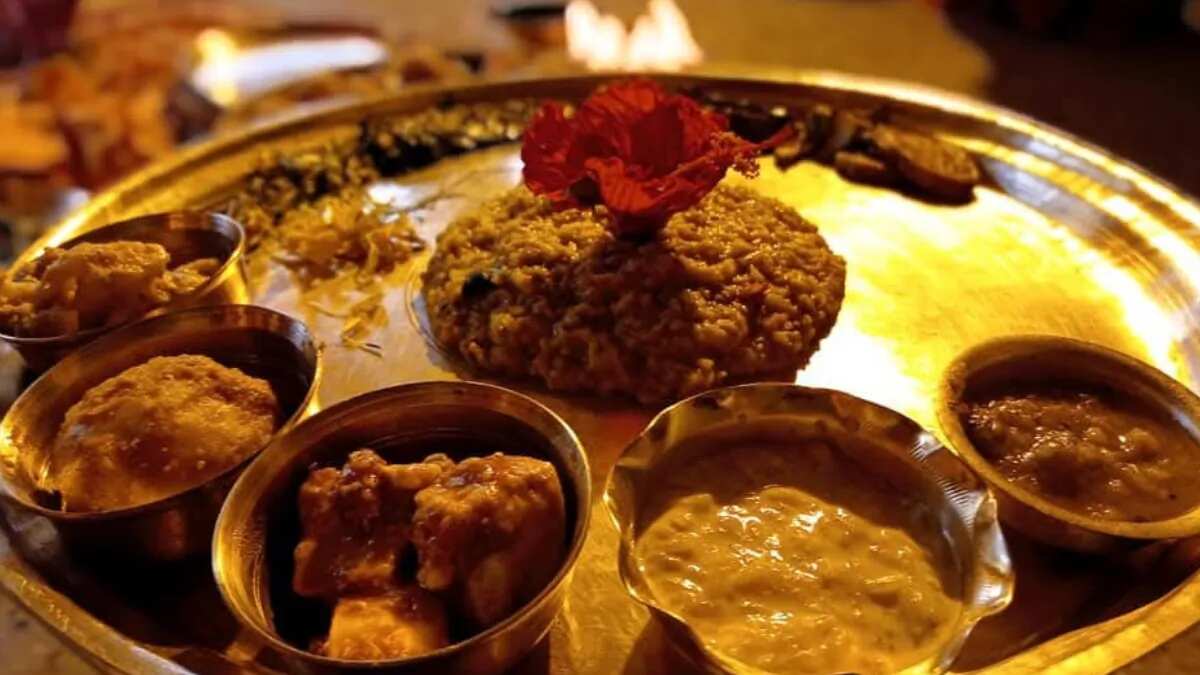
The Shosti bhog primarily consists of sweets and dry items such as chire naru, murki, various fruits, and different types of sugar like batacini (also known as lal chini or kashi chini). On Saptami, the offerings expand to include khichuri, nine types of fritters, one vegetable dish (shobji), chutney, payesh (rice pudding), sweets, and curd (curd). For Ashtami, the bhog again features khichuri, but with an additional vegetable dish (making two shobji), the nine types of fritters, chutney, payesh, sweets, and curd.
Image Credit: Sanchita Kushary Bose
Nabami begins with Sada bhat, i.e., white rice (ghee bhat) offered to Narayan, accompanied by fritters, curd, rice pudding, and sweets. This day is also notable for offering Ma Jagadhatri ghee bhat with chingri macher malaikari (prawn malai kari). For sweets, two specific types of naru are essential: coconut naru with jaggery, known as coconut naru, and sesame seed naru with jaggery, named Til er naru. Payesh is another auspicious dessert, requiring a long cooking time, to hold its form like a kheer or curd once cooked and served. On Bijaya Doshami day, the special offering of dodhi korma is provided.
Image Credit: Sreenika Moulik
Jagadhatri Puja is altogether a combination of tradition, devotion, and love towards the Almighty. The meticulous preparation of sacred offerings, from khichuri to payesh for the goddess, can also be considered an art of culinary practices. As families come together to prepare and share these divine foods, Jagadhatri Puja strengthens bonds, preserves traditions, and invokes blessings for peace and prosperity.