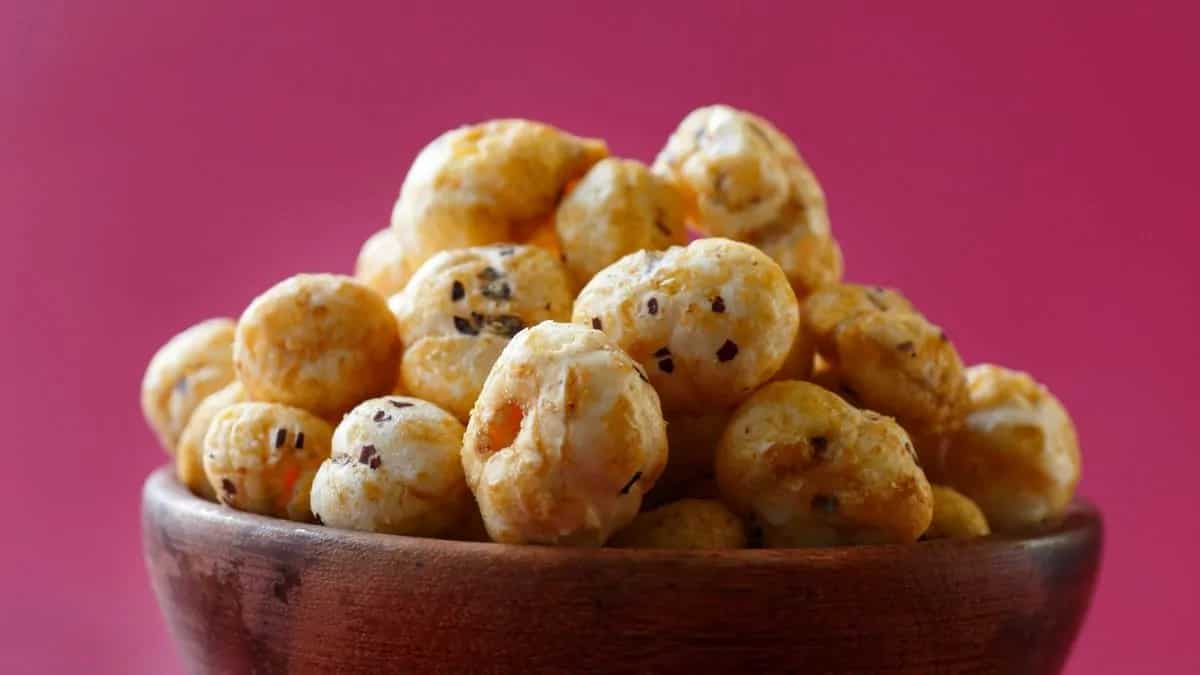
THE FIRST WEEK in which makhana reached its five-year Google Trends high began on 2 February 2025, days after Finance Minister Nirmala Sitharaman told Parliament that Bihar would get a dedicated Makhana Board. On Google Trends, that week scores the maximum 100. Three weeks later, at a rally in Bhagalpur, Prime Minister Narendra Modi declared makhana “a staple part of breakfast in cities across India” and added, for good measure, that he eats it “300 out of 365 days a year”. Search interest that week reached 91.
Makhana — the popped seed of a prickly water lily grown in north Bihar’s wetlands — had become a policy line, a campaign talking point and, in September 2026, a diplomatic gift: makhana and sattu went into the welcome kits handed to delegates and journalists at the BRICS Summit in Delhi. Bihar Chief Minister Samrat Choudhary called it “Bihar’s pride on the global stage”.
So makhana’s rise is not news. What is useful, as another festive season opens, is working out exactly how a fasting food became a Tuesday-afternoon snack — because several other Indian ingredients are now lining up to try the same hack.
THE FAST IT ESCAPED
Let's start with the data: Across the first 38 complete weekly readings of each year, India’s relative search interest in “makhana” averaged 43.7 on the Google Trends index in 2022. In 2026, it averages 77.7 — roughly 78% higher on the index. That is a measure of relative interest, not a count of searches.
The more telling number is the floor. The quietest week of 2022 scored 34. The quietest week of 2026 so far scored 64, nearly double. Makhana no longer disappears between festivals. It simply has louder weeks and quieter ones.
The festivals have not gone anywhere, though. “Makhana kheer” shows recurring peaks around Navratri and Janmashtami and, in a five-way comparison of festive and fasting terms, remains by far the strongest. Government estimates published by the Press Information Bureau in August put ordinary domestic consumption of popped makhana at 3,000 to 3,500 tonnes a month, rising to around 5,000 tonnes during festive periods. The same note says branded FMCG and organised retail now account for 1,800 to 2,000 tonnes a month — more than half the regular total.
There is one curious detail among the rising queries. “Vrat me makhana kha sakte hai” (can I eat makhana during a fast?) is up 600%; “can we eat makhana in Navratri fast” is up 170%. It is worth pausing on. One plausible reading is that a growing number of Indians now meet makhana as a snack first, and only later wonder whether it belongs in the ritual their grandmothers built around it. The vrat food has acquired an audience that has to look up its original use.
THE PLAYBOOK
Look closely at how the category was built and six lessons emerge, in roughly this order.
1. Borrow familiarity; don’t manufacture it. For many Indian consumers, makhana already came with cultural familiarity. Brands only had to give them more reasons to eat it. When Rishab Jain launched Mr Makhana in 2015, he described the product to Entrepreneur India as “a combination of purpose and pleasure”, while conceding that “concept products do take time to establish themselves”. A known ingredient shortens that time considerably. The trust was already there; the job was to move it.
2. Move the occasion, not the food. The decisive change was not a new recipe but a new moment: the office desk, the school tiffin, the 5 pm slump, the drive home. Farmley’s Healthy Snacking Report 2025, a brand-commissioned survey of roughly 6,000 respondents, found that around 65% included makhana in their diets, placing it at the top of the report’s healthy-snack choices for a second year. “This year’s report reflects a clear evolution from snacking out of habit to snacking with purpose,” co-founder Akash Sharma said at its launch. Quick commerce helped reinforce the shift, putting a 50g pouch within minutes of an impulse.
3. Change as little as possible, then flavour the familiar. Makhana already had crunch and lightness. Roasting, seasoning and moisture-barrier packaging made that texture commercially durable. Crucially, the flavours were borrowed from the chip aisle rather than the puja thali: peri-peri, pudina, cream and onion, cheese. Jain told Entrepreneur India he used popular chip flavours to “maximise reach” with an Indo-Western palate. Health gave people permission to try it; flavour gave them a reason to buy the second pack.
4. Make provenance a feature, not a footnote. Bihar produced an estimated 60,000 of India’s 80,590 tonnes of makhana in 2025-26 — roughly three-quarters of national output, according to the August PIB backgrounder. The Mithila GI tag has turned that geography into a selling point. “Mithila makhana GI tag” is labelled Breakout on Google Trends, indicating growth above 5,000% over the comparison period.
In two APEDA-facilitated export consignments, provenance and value addition were accompanied by higher reported returns. In August, 18 tonnes of GI-tagged Mithila makhana left for Australia in the first commercial sea shipment of the product from Bihar, with growers receiving nearly 18% above local market rates. A month earlier, a seven-tonne shipment of flavoured makhana to Canada was reported to have delivered farmers more than 50% higher returns through direct global market access. APEDA chairman Abhishek Dev framed the logic plainly: “Value addition, branding and market diversification are critical tools for increasing farmers’ incomes.”
5. Let institutions do some of the lifting. Few categories get a Budget announcement, a national board formally launched by the Prime Minister on 15 September 2025, a ₹476 crore central scheme running to 2030-31, a separate HS code and a slot in a summit goodie bag. Related searches reflect that policy attention: “makhana board in Bihar” is up 1,700% among rising queries. Brands cannot legislate their own tailwinds, but they can position for them. The ingredients most likely to be next are the ones already in a government’s line of sight.
6. Supply is the ceiling. This is the lesson the success stories leave out. According to the same PIB note, India’s domestic makhana market grew 17 to 18% annually between 2021-22 and 2024-25, while production grew only 4 to 5% between FY22 and FY25. Prices did what prices do: they rose from around ₹500 a kilo in 2020-22 to nearly ₹1,250 in 2025. Demand that outruns a slow, labour-intensive harvest turns a snack into a premium product whether or not the brand intended it. Output is now estimated at 80,590 tonnes in 2025-26, up from 63,910 tonnes the previous year, as a much larger institutional push comes online.
WHO’S NEXT?
Apply the six lessons to the Indian pantry and a shortlist emerges fairly quickly.
Sattu is the most commercially ready. It shared makhana’s BRICS moment, is already familiar across eastern India and walks straight into the protein conversation. Ganesh Consumer Products has signed cricketer Ravindra Jadeja to take it beyond eastern markets; director Devansh Mimani said in a company release that the aim is “reintroducing it to a new generation in a more relevant and accessible format”. In late July, ITC’s Aashirvaad launched a sand-roasted chana sattu, initially across Bihar, Jharkhand and West Bengal, billed as an “OG Protein Solution” and including a ₹10 pack delivering 10g of protein. ITC’s Anuj Rustagi described the brief as nutrition that fits “into their daily diet without requiring a change in eating habits”, which is lesson one, almost word for word. What packaged sattu still lacks at scale is lesson three: a widely adopted portable format that does not require a glass, a spoon and a stir.
Rajgira (amaranth) is makhana’s closest cultural sibling: a vrat staple that already puffs and suits cereal, bars and savoury clusters. Its problems are texture — a puffed amaranth seed is tiny and less satisfying by the handful — and a name split three ways between rajgira, ramdana and amaranth.
Roasted chana is the biggest mass-market bet: cheap, familiar, shelf-stable and high in protein. Its handicap is the reverse of makhana’s. It is perceived as too ordinary to command a premium, so the playbook must add value without pricing away its greatest advantage.
Jackfruit shows what happens when provenance and waste become the story. James Joseph, the former Microsoft executive behind Jackfruit365 green jackfruit flour, told ThePrint in 2023 that India wastes almost half its jackfruit output. “I wanted to rebrand a commodity into a high-value product,” Joseph said. “If the rich start eating something, the poor too will want to.” The hurdle is focus: chips, flour, meat substitute and ready-to-cook are four different categories, and makhana won by owning one occasion before it tried others.
Singhara is a more speculative wildcard. Water chestnut flour already has a fasting audience and a gluten-free use case, but its seasonality and flour-first format make a makhana-style snacking transition less straightforward.
Millets make a useful comparison rather than a candidate. Their makeover came with an International Year in 2023 and considerable official goodwill, and the category is still working out which everyday occasion it owns. Institutional push, in other words, is lesson five. It is not lessons one to four.
Which leaves the real test for any brand looking at the pantry this Navratri. Not “which food is next?”, but which ingredient already has the familiarity, function and format for a new occasion to be built around it — and whether the farms behind it can keep up when that occasion arrives.
***
WHY THIS MATTERS FOR BRANDS
- Look for trust you can move, not trust you must build. The fastest category creation starts with a food people already know and gives it a new time of day.
- Budget for supply before you budget for demand. Makhana’s domestic market expanded at roughly four times the rate of production, while prices more than doubled. Lock in sourcing, grading and farmer partnerships early.
- Move the occasion, not the ingredient. Makhana’s breakthrough came from fitting a familiar food into new moments — from the office desk and school tiffin to the 5 pm slump.
BY THE NUMBERS
+78%: how much higher India’s average Google Trends index for “makhana” was across the first 38 complete weeks of 2026 than in the corresponding period of 2022 (77.7 versus 43.7)
64: the quietest weekly score in 2026, against 34 in 2022
5,000 tonnes: estimated monthly consumption during festive periods, versus 3,000 to 3,500 tonnes ordinarily (PIB)
17 to 18% versus 4 to 5%: annual domestic market growth versus production growth between FY22 and FY25 (PIB)
₹500 to ₹1,250/kg: the price climb from 2020-22 to 2025 (PIB)
+600%: rise in searches for “vrat me makhana kha sakte hai”
***
This feature is part of TRENDS WITH BENEFITS, Slurrp's monthly read on what moved the food and beverage industry, across menus, glasses, and the numbers behind them. Write to slurrp@htmedialabs.com if you'd like to receive the newsletter, with "Trends With Benefits" in the subject line.