Editor’s note: This is part five of The Great Asterix Feast, a six-part series on food in Asterix, published in the centenary year of its writer, René Goscinny. The first four parts covered what the Gauls eat, at home and abroad. This instalment turns to the people who put the food on the page: the writer, the artist and the English translator.
THE FOOD NAMES: A MINIATURE DICTIONARY OF CULINARY WORDPLAY
EVERY GAULISH NAME ends in -ix, every Roman in -us, every Briton in -ax, every Egyptian in -is — and a surprising number of them are edible. A selection, giving only puns I can demonstrate:
***
***
ANTHEA BELL: THE SECRET INGREDIENT
It is worth stating plainly: English-speaking readers have never read Goscinny. They have read Anthea Bell and Derek Hockridge’s re-creation of Goscinny, and the difference is not pedantic. A pun cannot be translated, only replaced. Every -ix name, every Briton saying “I say,” every Roman slogan, every fishmonger’s insult in the English editions was invented in Cambridge and Leicester rather than Paris.
The facts of the collaboration are these. Bell (born Suffolk, 10 May 1936) was the daughter of Adrian Bell, the countryside writer who set the first Times cryptic crossword — and she credited her father with the lateral-thinking habit that makes a translator of puns. Hockridge was a lecturer in French, and an occasional television actor. Their first Asterix, Asterix the Gaul, was published by the Leicester-based Brockhampton Press in 1969, eight years after the French original. They translated together for four decades. Hockridge died in August 2013; Bell carried on alone through Asterix and the Missing Scroll (2015), then retired through illness in 2016, and died in Cambridge in October 2018. Adriana Hunter, a prize-winning translator of French fiction, took over with Asterix and the Chariot Race in 2017, and the publishers printed a note of thanks to Bell at the back of that book. Hunter has translated every album since, including the Fabcaro era.
The best description of what Bell did comes from a fellow translator. In the Guardian’s obituary coverage, Daniel Hahn — a translator himself — said he first learned her name, as so many did, because she wrote all those impossible Asterix jokes he loved, while to other readers she was the English voice of Sebald, Kafka or Freud. The word wrote is the important one. Hahn did not say translated.
HER METHOD, RECONSTRUCTED FROM THE EVIDENCE
• Replace the silly with the significant. French names are often absurd for absurdity’s sake (Ordralfabétix, Assurancetourix, Abraracourcix — ‘à bras raccourcis’, with arms flailing). Bell’s names describe the character: Unhygienix, Cacofonix, Vitalstatistix. English readers know the fishmonger’s problem, the bard’s crime and the chief’s figure before either has spoken.
• Keep the mechanism, change the material. Where Goscinny’s Spaniard is named after onion soup, Bell’s is named after eggs and bacon. The joke — a freedom fighter named after a meal — is identical; the meal is local.
• Turn foreign mockery into self-mockery. Her Britons in Asterix in Britain talk like Bertie Wooster. A French idea of the English became an English idea of the English, and the English laughed.
• Trust the reader. Bell and Hockridge did not explain jokes. If a Roman’s name is Crismus Bonus or a legionary’s is Tremensdelirius, the reader either gets it or grows into it. Much of the pleasure of re-reading Asterix as an adult is discovering the jokes that were waiting.
Whether Bell should be called a co-author is a question I will leave to the copyright lawyers. I will only say this: for every English-speaking child who laughed at the fishmonger, the joke they laughed at was hers.
GOSCINNY: THE COMEDY ENGINE
Why are Goscinny’s food jokes so good? Take a few apart, gently.
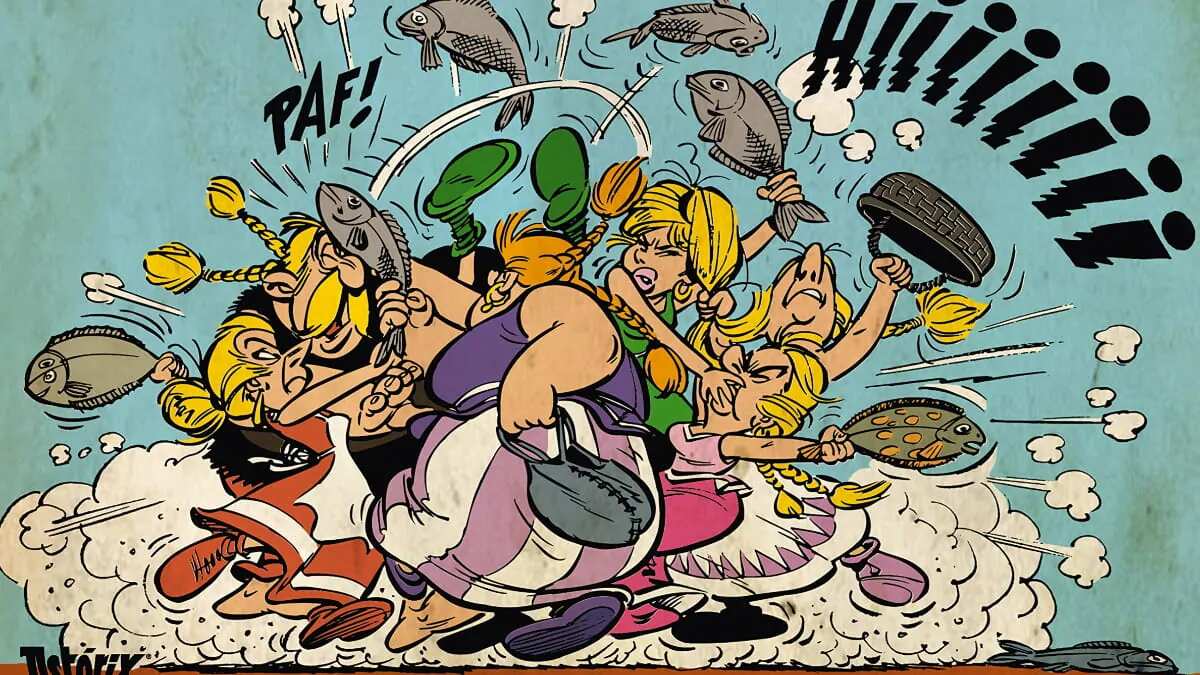
• Repetition with a twist. The fish is always not fresh. The joke is never the freshness; it is the villagers’ new pretext for pretending to have noticed for the first time. Goscinny understood that a running gag is funniest not when repeated but when varied by a hair.
• Escalation. The fondue penalties. The strawberries that must come from further and further away. The Belgian table that keeps being laid. He rarely tells a food joke once; he tells it three times, each bigger.
• Absurd specificity. Not ‘a regional dish’ but bêtises de Cambrai. Not ‘something fried’ but chips, with mussels. The precision is the comedy; the reader who knows the dish laughs twice.
• The straight face. Every anachronism is delivered without a wink. Salade niçoise in 50 BC is funny only because nobody in the panel finds it strange.
• Appetite as innocence. Obelix’s hunger is never greed. He is not grasping; he is hopeful. The poisoned cake is dangerous, the Titans’ meal is a trial, the British boar is a tragedy — and Obelix approaches each with the same open face. The joke is on the world for being so stingy.
• The double audience. The child laughs at the boar being thrown. The adult laughs at the 1960s Guide Michelin being smuggled into antiquity. The same panel, two jokes, no compromise. This — writing simultaneously for two readers who never notice each other — is the skill the centenary should honour.
Goscinny was also, it should be said, a gourmand in the French sense: a man who took the table seriously as a stage for human folly. The clue is in what he chose to mock. He never mocked hunger. He mocked pretension — the imported fish, the Roman orgy, the Swiss rules, the Briton’s mint sauce, the spa diet. The village eats simply and well, and everyone else eats badly and proudly.
UDERZO: WHY THE FOOD LOOKS DELICIOUS
Food in Asterix is not written; it is drawn, and Albert Uderzo drew it better than almost anyone in the history of the medium. His roast boar is a masterpiece of appetite engineering: the body glazed a deep amber, the skin rendered with short hatching to suggest crackling, three wavy lines of steam rising from the flank, and — always — the trotters up, so that the animal reads as complete, a whole creature converted into a whole meal. Beside it, gnawed bones lie on the table in a pattern that tells you exactly how many boars have been eaten and by whom.
Uderzo understood that cartoon food outperforms photographed food because it can show the idea of the dish rather than its evidence. Photographed roast pork is brown and specific. Uderzo’s is the Platonic boar, the one you imagined before you tasted meat. His fish are silver and stiff and slightly cross-eyed, so that you smell them. His cheeses are wedges with holes you could put a finger through. His amphorae tilt at the angle of a hand about to pour. His Roman banquets are a different grammar entirely — reclining figures, grapes held at arm’s length, low tables, a decadence drawn with just enough disgust to make you prefer the Gaulish trestle.
And then there is Obelix eating. Uderzo draws him at speed: a blur of hands, a boar reduced to skeleton between two panels, a satisfied belch drawn as a small cloud. The physical comedy depends on scale — the boar is enormous, Obelix is more enormous — but also on innocence. There is no shame in his face. He is not stuffing himself; he is simply eating at his natural pace, and the world is too slow.
DID THE FOOD CHANGE AFTER GOSCINNY?
Yes, and in an instructive way. Uderzo’s solo albums (1980–2009) are not food-poor — Black Gold is a quest for a potion ingredient; The Magic Carpet runs Obelix through the deserts on camel and caviar; All at Sea and Asterix and Son both use the potion as plot — but the density of culinary joke-per-page falls. Uderzo’s instincts were visual and mythological: he reached for aliens, Atlantis, a baby, a female warrior. Goscinny’s were social: he reached for the table.
The Ferri–Conrad era (2013–2021) consciously restored the older rhythm. Asterix and the Picts gave English readers a warrior named MacAroon and a Scottish landscape of malt and mist; Asterix and the Chariot Race is a Tour of Italy in which regional pride is, once again, edible. The Fabcaro albums push further: Asterix and the White Iris (2023) sends a Roman self-help guru into the village preaching positivity and lighter eating, so that Obelix’s appetite becomes the last redoubt of common sense against wellness culture.
Asterix in Lusitania (2025) takes the heroes to Portugal to clear the name of a garum-maker accused of poisoning Caesar — a whole plot hung on fish sauce — and feeds Obelix cod at every turn, which he cannot stand. The series has, in its seventh decade, remembered that its subject is dinner.
THE GREAT ASTERIX FEAST: THE SERIES
Previous in this series | Part 4: Exploding Cheese, Invented Tea And Asterix Vs Archaeology
Next in this series | Part 6: Obelix, The Greatest Eater In Comics