Share


Editor’s note: This is the sixth and final part of The Great Asterix Feast, a series on food in Asterix, published in the centenary year of its writer, René Goscinny. The earlier parts covered the food, the map and the makers. This one belongs to Obelix.
OBELIX’S APPETITE IS the most consistent characterisation in the series, and the most misread. He is not a glutton in the moralising sense; gluttony implies excess against a norm, and Obelix has no norm. He eats the way a river flows. The catalogue of his greatest performances — the boars mourned in Britain; the cake in Egypt; the turkey approved, pending stuffing, in America; the spa diet witnessed with horror in Arvernia; the hunger, in the Persian deserts of The Magic Carpet, that turns roast camel into a consolation — is a catalogue of a man meeting the world through his stomach and finding it, mostly, wanting.
But his masterpiece is not in the albums. It is in the film.

THE TWELVE TASKS OF ASTERIX (1976): OBELIX VERSUS MANNEKENPIX
Fifty years ago, Goscinny and Uderzo — who had founded their own animation studio, Studios Idéfix, precisely so that they could make films their own way — wrote an original story for the screen. Caesar, exasperated, offers the Gauls a deal: complete twelve tasks in the manner of Hercules and he will concede they are gods.
One of the tasks is a meal. Obelix must eat everything prepared by Mannekenpix, the cook of the Titans, a vast, moustached Belgian-coded figure whose name is a Brussels statue with a Gaulish suffix.
The courses, as the film presents them:
• A roast wild boar, to open — with frites. Obelix’s face lights up; this is home. The Belgian cook, of course, fries chips; the same joke that would close Goscinny’s career in Asterix in Belgium three years later.
• A flock of geese.
• A herd of sheep — not a joint, the herd.
• An omelette of eight dozen eggs.
• A school of fish.
• A whole roast ox.
• A cow — and a calf, because it would not be right to split up the family.
• A mountain of caviar — with, the cook’s joke, a single piece of toast.
• A roast camel.
• An elephant stuffed with olives, carried in on a platter the size of a courtyard.
Obelix eats all of it with the contented rhythm of a man at a Sunday lunch. The cook, sweating, produces course after course, each more impossible, each consumed. And the punchline — the perfect, characteristic, Asterix punchline — is that when the kitchen is finally empty and the Titans’ cook has fled in despair, Obelix looks up, wipes his mouth and wonders, politely, where everyone has gone. He is still a little hungry. As far as he is concerned, those were the starters.
Why does it work? Because the scene is constructed as a trial — a labour of Hercules — and Obelix does not experience it as one. Every other task tests the heroes’ cunning or courage. This one tests only whether the world can out-supply Obelix, and the answer, delivered with total innocence, is no. The joke is not that he ate an elephant. The joke is that he was not trying.

HOW MUCH DID OBELIX EAT? A BACK-OF-THE-ENVELOPE ESTIMATE
• Assumptions: a roast boar dressed at ~60 kg; a ‘herd’ read as ten sheep at ~20 kg edible each; 96 eggs at ~5 kg; a ‘school’ of fish taken as 30 kg; a dressed ox at ~250 kg; a camel at ~200 kg edible; an elephant at, conservatively, 2,000 kg edible. The geese, the cow, the calf and the caviar are left out, which only flatters him.
• Rough total: on those assumptions, somewhere in the region of 2.7 to 3 tonnes of food in a single sitting. The margin of error is the elephant.
• Calorie range: at roughly 2,000–2,500 kcal per kilogram of cooked meat, that is on the order of five to seven million kilocalories — the maintenance intake of an ordinary adult for about seven to nine years.
• The point of the estimate: not precision, but that the film’s escalation is built on real quantities, and the elephant is the only one nobody has tried to draw to scale.
FOOD IS HOME
Here is the argument I have been circling. Asterix is a comic about leaving. Its heroes go to Britain, Germania, Rome, Egypt, Greece, Spain, Switzerland, Belgium, Corsica, America, the Middle East, India, Scotland, Italy again, Sarmatia, Lusitania. In every place they encounter a language they must speak badly, a government they must outwit, a custom they must endure and — always, first — a meal they must eat. The foreign food is the foreign country. To be abroad, in Asterix, is to be served something you did not order.
And then they come back. And the village eats what it always eats, by the fire, with the bard tied to a tree. The banquet is not a joke about gluttony. It is a statement about home: that home is where you know what dinner will be. Rome can build camps on every side. Rome can tax and conscript and wall the village in. But the Romans never once sit at that table, and the boar keeps turning.
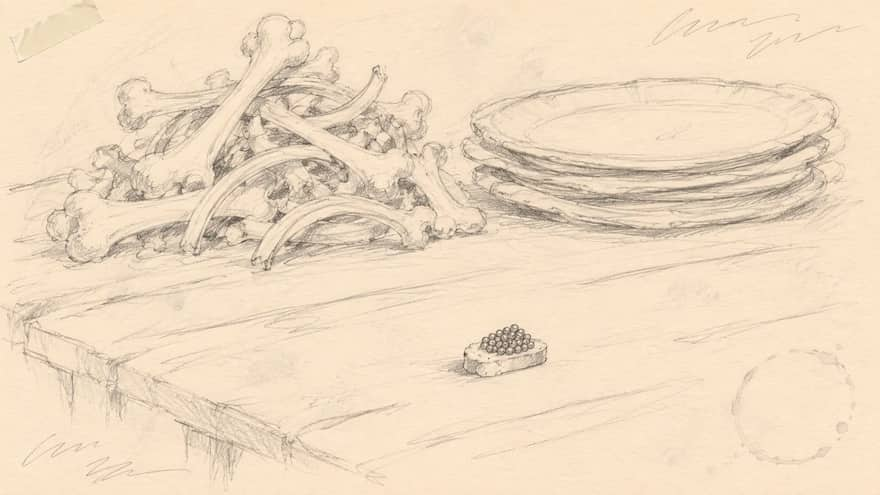
This is why the banquet is such a perfect narrative full stop, and why the exceptions land so hard — why a banquet in Belgium, painted as a Bruegel, with a rabbit weeping at a dead writer’s signature, is among the most moving single panels in European comics. The feast is the community counting itself and finding everyone present. Every Asterix album ends with a census taken in boar.
ANOTHER BOAR HAS ARRIVED
I go back, at the end, to the child in South Bangalore with the book open on the floor, looking at a drawing of a fat man carrying a wild boar and wondering what on earth it tasted like. Books teach children history, or claim to; they teach geography; occasionally, it turns out, they decide what somebody orders for dinner thirty years later. I have eaten in a great many places since, and I have eaten wild boar, and I can report that it does not taste like the drawing. Nothing does. The drawing tastes of being eight.
What I did not understand then, and understand now, is that the boar was never the point. The point was the table it was carried to. Some fictional worlds stay with us because we remember how they looked, and some because we remember how they sounded, and a very few because we remember how we imagined they tasted — and Asterix is all three, and the third is the one that gets you, years later, in a restaurant, holding a menu.
So: the Romans have been thrashed. The adventure is over. Cacofonix has, with any luck, been prevented from singing. The fire is high. Another boar has arrived. And everybody — every single one of them — is home.
Pass the mint sauce. Actually, don’t.
THE GREAT ASTERIX FEAST: THE SERIES
Previous in this series | Part 5: Anthea Bell, Goscinny, Uderzo And The Secret Ingredients
Companion piece | The 25 Greatest Gastronomic Moments In Asterix