Share


Editor’s note: This is part four of The Great Asterix Feast, a six-part series on food in Asterix, published in the centenary year of its writer, René Goscinny. Part three toured Gaul, Britain, Switzerland and Belgium. This instalment finishes the journey, from Corsica to India, and then checks the whole menu against the historical record.
CORSICA — ASTERIX IN CORSICA (1973)
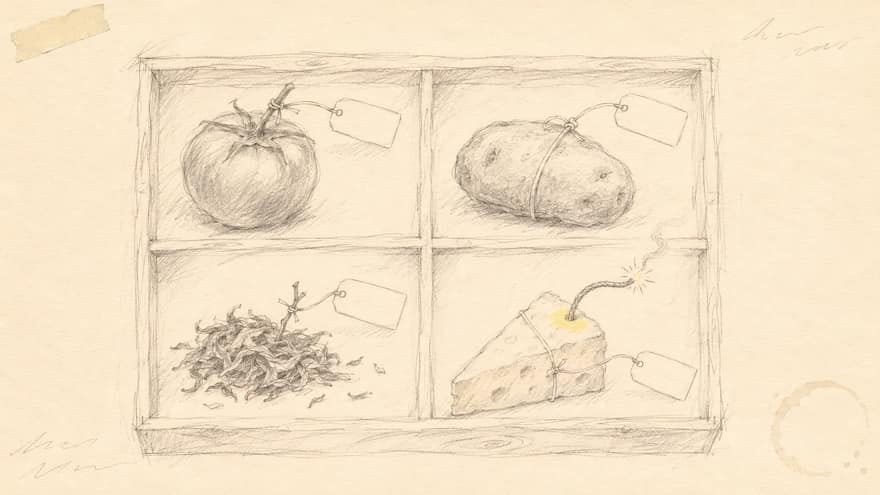
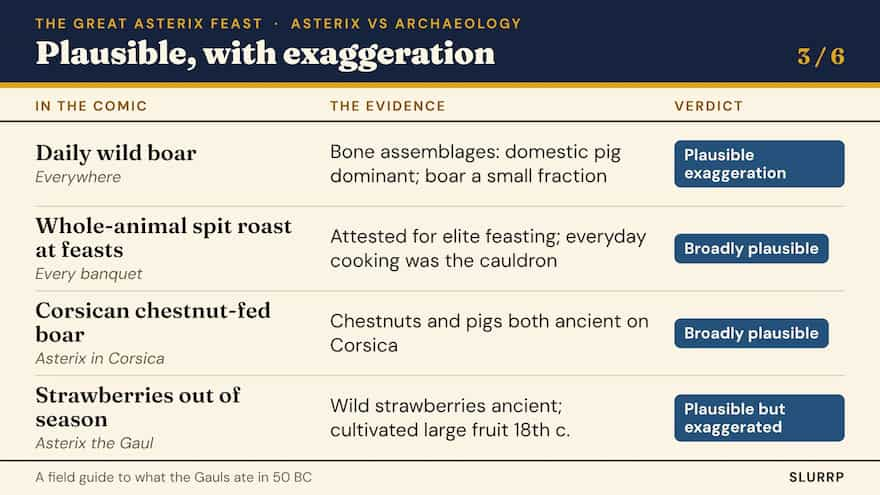
CORSICA IS THE book of the siesta, the vendetta and the cheese. The Corsican cheese is presented as a thing of such potency that its odour drives Romans from their posts, and on the crossing its fumes, meeting a naked flame aboard the pirates’ ship, blow the vessel to matchwood. Corsican boar, the locals insist, is incomparably finer than the mainland kind, being fed on chestnuts — a genuine Corsican culinary boast rendered as tribal pride. Sheep’s-milk cheese and chestnut-fed pigs are both plausible for ancient Corsica; the exploding cheese is not, though every Frenchman who has opened a ripe Corsican cheese in a hot car will feel the truth of it.
SPAIN — ASTERIX IN SPAIN (1969)
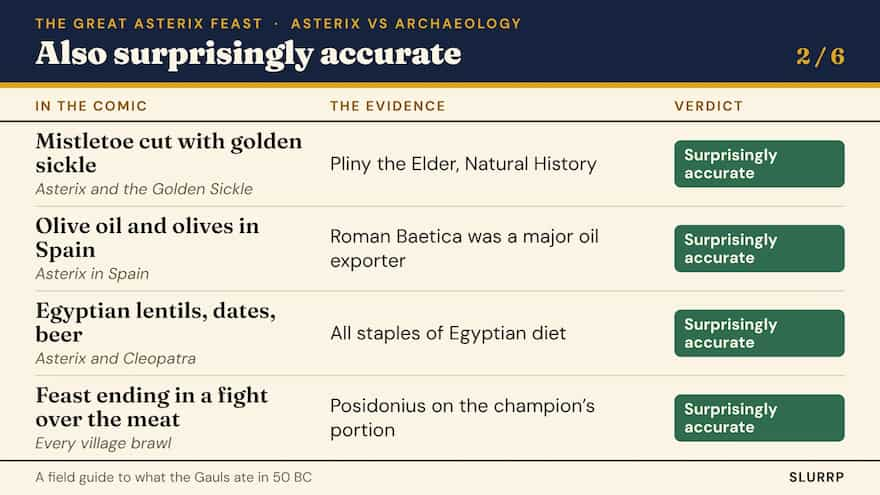
Spain gives us the greatest culinary name in the series: the Iberian chief who holds out against Caesar is called, in English, Huevos y Bacon — eggs and bacon, a Spanish freedom fighter named after an English breakfast. (In French he is Soupalognon y Crouton, after onion soup.) His son, the ferociously stubborn Pepe, protests by holding his breath — the child’s hunger strike as political weapon. Along the way the book parodies French tourists clogging the roads south in caravans, the aurochs-fight as bullfight, and the olive-oil-soaked table of the Iberians. Olive oil and olives are, for once, entirely historical; Roman Spain was one of the empire’s great oil producers.
THE NORMANS — ASTERIX AND THE NORMANS (1966)
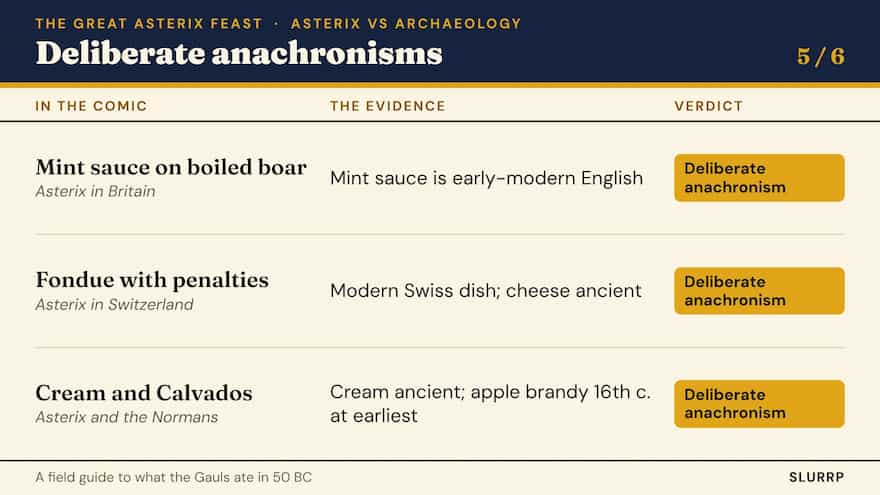
Goscinny’s Vikings are the Normans of Normandy — which is to say they cook everything à la crème and drink Calvados. Cream is ancient; the apple brandy is a product of distillation and belongs to the sixteenth century at the earliest. The joke, for a French reader, is that the terrifying seaborne raiders of the ninth century have the palate of a Rouen bistro.
EGYPT — ASTERIX AND CLEOPATRA (1965)
The food joke in Egypt is a cake. The villainous architect Artifis sends Cleopatra a poisoned cake in the Gauls’ name; accused, the Gauls prove their innocence by eating it themselves, Getafix having dosed them with an antidote. Obelix, naturally, enjoys the cake enormously and would like the recipe. It is one of the purest examples of Goscinny’s method — a plot device (poison) resolved by an appetite (Obelix) — and the book’s Egyptian tables, with their lentils, dates and beer, are among Uderzo’s most historically careful.
AMERICA — ASTERIX AND THE GREAT CROSSING (1975)
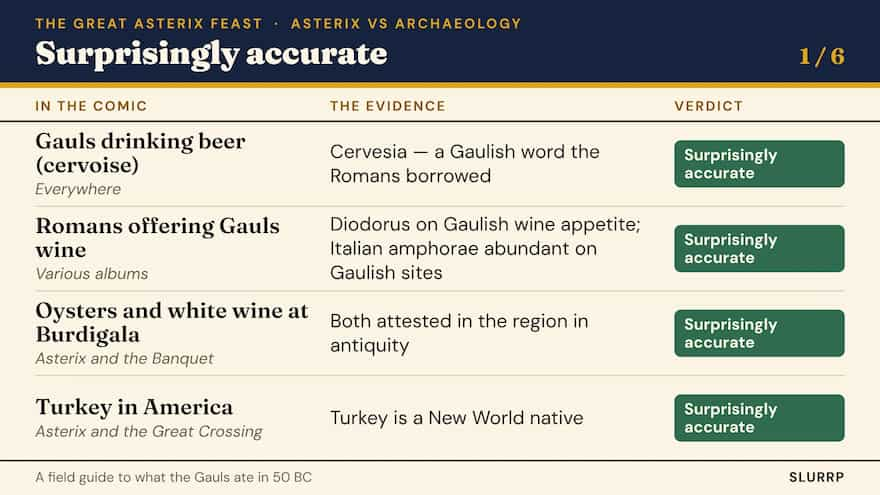
Blown across the Atlantic, the Gauls encounter a large, strutting bird unknown in Europe, roast it, and rather approve — though Obelix feels it would be better stuffed. The bird is a turkey, which is historically impeccable — the turkey is a New World native — and comically exact: the Gauls have discovered the Thanksgiving dinner fifteen centuries early and are already asking for the stuffing. Later, among the Vikings, there is a scene of Norse feasting that gives Obelix a second chance at a proper meal.
INDIA — ASTERIX AND THE MAGIC CARPET (1987)
As an Indian reader, I approached this one with a notebook and came away with a mostly empty page. Uderzo’s India — the album was his, written after Goscinny’s death — is a country of fakirs, flying carpets, elephants, tigers and a rajah’s daughter, Orinjade, who must be sacrificed unless it rains. The solution is Cacofonix, whose singing has always made it rain. It is a book about weather, not food. What culinary content there is belongs to the journey: on the way east the Gauls pass through a Persian and Arabian world where caviar and roast camel stand in for the boar Obelix cannot find, and where his suffering is the joke. India itself — the spices, the sweets, the vegetarian tables, the whole edible civilisation a Goscinny might have feasted on — barely appears. This is not offensive; it is thin. The visual stereotypes are those of a 1980s French adventure film, and the exoticism is affectionate rather than contemptuous. But it is the clearest evidence in the canon of what the series lost when it lost its writer. Goscinny would have sent Obelix into a market.
ASTERIX VS ARCHAEOLOGY: A FIELD GUIDE
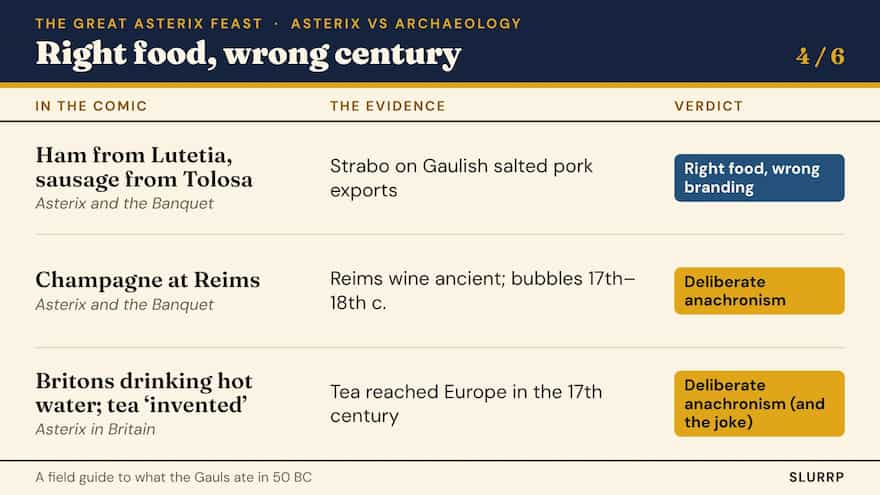
What did an ordinary Gaul actually eat in 50 BC? The evidence — animal bone, seed remains, amphora sherds, Roman authors — suggests a diet built on cereals (wheat, barley, and in the north millet and oats, eaten as bread and as porridge), legumes, pork and beef, cheese, beer, and increasingly, along the trade routes, Italian wine. Fish where there was water. Salt, which Gaul had in abundance and which made the pork trade possible. Feasting was politically central: the elite banquet, the champion’s portion, the host’s obligation to be generous. Against that background, a selection of the comic’s claims:
***
***
***
***
***
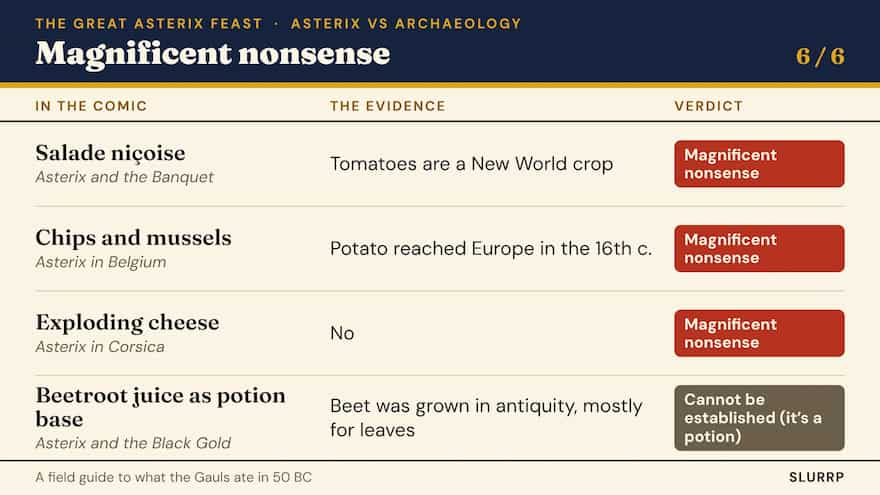
FOODS THAT SHOULDN’T BE THERE — BUT THANK TOUTATIS THEY ARE
The anachronisms in Asterix are not errors. They are the point: the whole series is a 1960s France wearing a Gaulish helmet, and the food is where the disguise slips most gloriously. My favourites, ranked by audacity:
• Chips and mussels, Belgium. Sixteen centuries early, invented by a chief looking at a pot of oil. The best food joke in the canon.
• Tea, Britain. Not merely anachronistic but inverted: the book explains how the Britons came to drink tea, and the answer is a Gaul with a bag of herbs.
• Salade niçoise, Nice. A tomato in 50 BC is as impossible as a telephone; nobody in the panel blinks.
• Champagne, Reims. The amphora of bubbly. The Gauls have discovered secondary fermentation and are keeping it quiet.
• Fondue, Switzerland. Served with a penal code.
• Calvados, the Normans. Distillation arrives in Normandy nine hundred years before the Normans do.
• Bêtises de Cambrai. A boiled sweet invented in the nineteenth century, allegedly by accident — hence the name, ‘blunders’ — travelling with Asterix in a bag.
• Caviar on toast, the Titans’ kitchen. The Romans ate sturgeon; salted roe as a luxury ‘course’ is a later Persian-Russian idea, and the toast is a joke about portion size.
• Prunes from Agen. The plum came to the Lot valley with returning Crusaders — a mere thirteen centuries late.
• The spa diet at Aquae Calidae. Vitalstatistix takes the waters at Vichy for his liver and is put on boiled vegetables. Roman spas are real; the French liver, as a national organ of complaint, is a nineteenth-century invention.
THE GREAT ASTERIX FEAST: THE SERIES
Previous in this series | Part 3: Eat Your Way Across The Roman Empire
Next in this series | Part 5: Anthea Bell, Goscinny, Uderzo And The Secret Ingredients