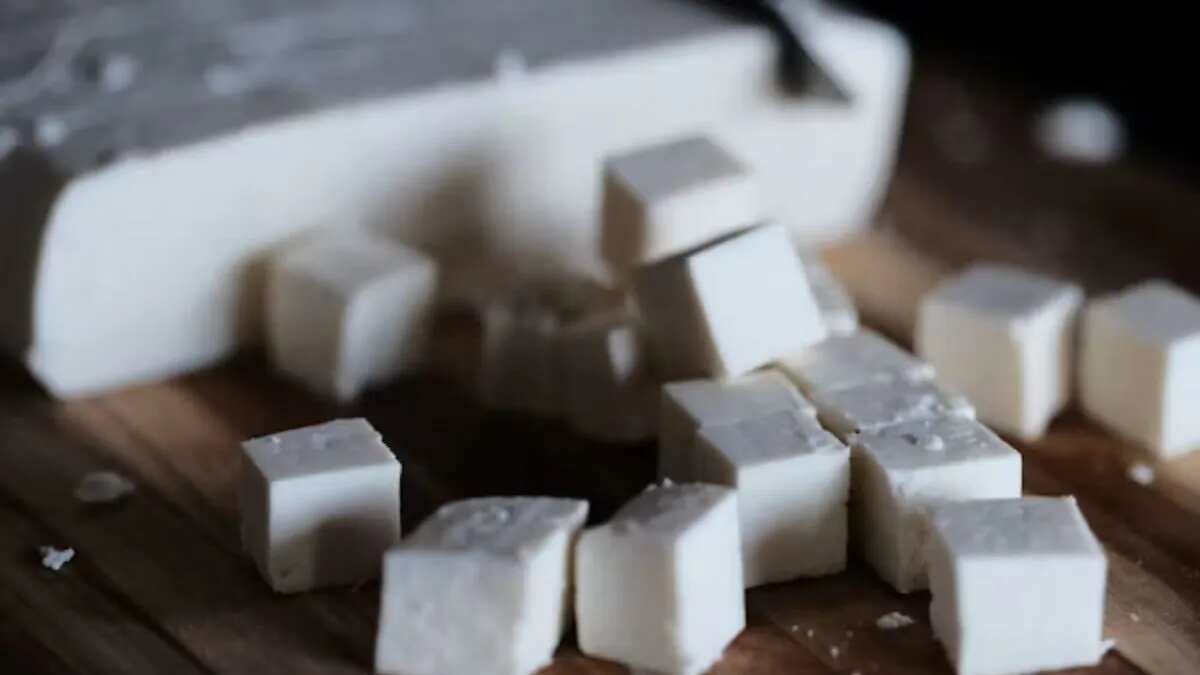
A Block of Mistaken Identity
There is a particular kind of betrayal reserved for vegetarians, and it announces itself quietly, on a plate, in a restaurant you trusted. You cut into what the menu called paneer tikka. It resists the knife slightly more than it should. It does not crumble so much as bend. And when you finally get a forkful to your mouth, there is a faint, unplaceable sheen of oil where you expected the clean, milky snap of curd. Nothing is wrong, exactly. Nothing is right either. For a food writer who has spent a career insisting on paying for every meal he reviews, on the theory that a free plate buys a compromised opinion, this particular deception feels personal. Because the thing masquerading as paneer on that plate was never milk pretending to be cheese. It was oil pretending to be milk pretending to be cheese — a food wearing another food's face, twice removed from the truth. This is analogue paneer. It has a real name, a real chemistry, and — improbably — a real inventor. None of them are secret. All of them are worth understanding, because the difference between a legitimate food-science category and a plate of food fraud turns out to be one word on a label that almost nobody bothers to print.
Image Credit: Adobe Stock
What Paneer Actually Is
To understand what is being faked, you first have to understand what is being copied, and paneer is a far more interesting molecule than its reputation as "the vegetarian's meat substitute" suggests.
Image Credit: Freepik
Milk, at rest, is a suspension of casein micelles — tiny spherical clusters of protein, each one built from smaller sub-units called submicelles, held together by bridges of calcium and phosphate. Picture a loose grape-bunch of protein, stabilised by a hairy outer layer of kappa-casein that keeps each micelle politely repelling its neighbours, the way similarly charged magnets refuse to touch. That repulsion is the only thing standing between milk and curd. Disturb it, and the whole suspension collapses into itself. Paneer-making is the deliberate, controlled destruction of that stability. Milk is heated to around 90°C, which denatures whey proteins and encourages them to latch onto the casein micelles — an act of chemical scaffolding that will later give paneer its characteristic chewy bite. Then an acid — lime juice, vinegar, citric acid, or in some traditional kitchens, a cup of yesterday's sour whey — is stirred in, and the pH of the milk drops toward 5.3. At that specific acidity, the colloidal calcium phosphate holding the micelles together dissolves back into the liquid. The micelles lose their charge, stop repelling each other, and — released from their mutual suspicion — clump together into curds, trapping fat globules, water, and a portion of salts and lactose inside a casein-whey protein mesh as they go. What you are eating, when you eat real paneer, is essentially a protein net that has been persuaded to close its fist. Buffalo milk makes a firmer, spongier paneer than cow's milk, purely because it carries more fat, more casein, and more calcium and phosphorus to begin with — denser raw material makes a denser net. None of this is folklore. It is documented, peer-reviewed dairy chemistry, and it is also, not incidentally, why paneer has no real shelf life: strain the whey, skip refrigeration, and bacterial spoilage sets in within about a day. It is also, not incidentally, an expensive way to make food. Dairy scientists put the typical yield of paneer at somewhere around a fifth of the milk's original weight — roughly five litres of milk disappear, as whey, water and heat, to leave behind one kilogram of curd. Milk is the costliest ingredient in an Indian commercial kitchen that isn't meat, and paneer is one of the least efficient possible ways to use it. That single fact, more than any villainy, is the entire economic origin story of everything that follows.
Roughly five litres of milk disappear — as whey, water and heat — to leave behind one kilogram of curd.
Building a Paneer That Isn't Paneer
Analogue paneerstarts from the opposite direction. Instead of coaxing a protein net out of five litres of milk, manufacturers build a fat-and-starch structure from a fraction of that dairy cost, and then dress it up to behave like the real thing. The typical formulation swaps out some or all of the milk fat and milk protein for a blend of refined vegetable oil (often palm oil, prized industrially for being cheap, stable, and semi-solid at room temperature), skimmed milk powder or rennet casein for a whisper of dairy credibility, modified starch for body, and emulsifying salts to force the fat and water phases to stay blended instead of separating. The mixture is heated and put through mechanical shear — essentially industrial-strength stirring — until it becomes a smooth, plastic mass that can be moulded into the familiar white block. It is worth pausing on how deliberately clever this is, in a purely technical sense, because it is not improvised kitchen trickery. It borrows the exact toolkit — heat, shear, emulsifying salts — used to make legitimate processed cheese. The end product mimics real paneer's whiteness and shape convincingly. What it cannot fully mimic is paneer's behaviour once it meets a hot pan. Milk fat has a relatively narrow, well-behaved melting range that lets real paneer hold its shape and only gently soften on the grill. Vegetable fat, especially the hydrogenated kind, has different melting kinetics and a different, often broader, melting profile — under heat, it is prone to what food scientists dryly call "oiling off," where the fat visibly separates from the solid matrix rather than staying politely bound within it, leaving a greasy sheen pooling around a curd that never quite melts and never quite holds, either.
The Reactions, Written Out
All of the above is true at the level of a kitchen description. It is more convincing at the level of an equation, because both paneer and its impostor are, underneath the ladle and the spatula, exercises in applied chemistry — one dismantling a natural structure, the other assembling an artificial one.
Real paneer's coagulation is a two-part act of protein chemistry: an acid supplying protons, and those protons dismantling the calcium-phosphate scaffolding that keeps milk liquid.
Citric acid (or lactic acid) dissociating in hot milk, releasing H⁺:
C6H8O7 ⇌ C6H7O7⁻ + H⁺
Those protons dissolve the colloidal calcium phosphate (CCP) that cements casein submicelles together:
Ca3(PO4)2 (bound, colloidal) + 4H⁺ ⇌ 3Ca²⁺ (aq) + 2H2PO4⁻ (aq)
With its calcium-phosphate bridges gone, the casein's own carboxyl groups pick up the freed protons and lose their negative charge — the repulsion that kept micelles apart vanishes, and they clump:
Casein–COO⁻ (charged, suspended) + H⁺ → Casein–COOH (neutral, aggregating)
Paneer-making stops this reaction deliberately early, around pH 5.2–5.4 — well short of casein's true isoelectric point near pH 4.6 — because the preceding 90°C heating step has already denatured whey proteins onto the casein surface, destabilising the micelle in advance. The acid only needs to finish a job the heat has already started. Push the pH lower, toward true isoelectric precipitation, and you get a harder, drier, less springy curd — a different cheese entirely, made by the same equation taken one step further. Analogue paneer's central reaction is not coagulation at all. It is calcium sequestration — the same trick, engineered in the opposite direction, that food scientists use to manufacture processed cheese. Where casein and rennet or dairy-derived casein are present in the formulation, an emulsifying salt such as trisodium citrate strips calcium off the insoluble calcium-paracaseinate network and swaps in sodium, converting an insoluble protein complex into a soluble one that can act as an emulsifier instead of a curd:
Ca-paracaseinate (insoluble) + 2Na⁺ (from trisodium citrate) ⇌ Na2-paracaseinate (soluble, emulsifying) + Ca²⁺ (sequestered as calcium citrate)
That freshly soluble sodium-paracaseinate is what allows a mostly-fat, mostly- water mixture to be coaxed, under heat and mechanical shear, into a single stable mass instead of splitting into an oil slick sitting on top of milky water — the same emulsification chemistry documented in decades of processed-cheese literature, simply borrowed for a product wearing paneer's name instead of cheddar's. Two more reactions round out the profile of a cheaper analogue block. Where the vegetable fat has been hardened for a firmer, more paneer-like bite, it has likely been partially hydrogenated — unsaturated oil, pumped with hydrogen gas over a nickel catalyst, raising its melting point by converting some of its double bonds to single ones, and inadvertently generating trans-configured fatty acids as a side effect of the process:
Unsaturated triglyceride (cis C=C) + H2 →(Ni catalyst)→ saturated / trans triglyceride (higher melting point)
And where starch is doing the structural work protein no longer can, it isn't reacting so much as unfolding: heated past roughly 60–70°C in the presence of water, the crystalline granules of amylose and amylopectin irreversibly swell, rupture, and release their tangled polymer chains into a network that thickens as it cools — the same gelatinisation chemistry that thickens a béchamel, repurposed here to fake the body of a protein curd that was never in the pot to begin with. Line all four of these up and the entire category declares itself in its own equations: real paneer is what happens when you carefully remove calcium from milk's structure until it can no longer stay liquid. Analogue paneer is what happens when you carefully remove calcium from a protein's structure until it can no longer stay solid — and then rebuild "solid" out of oil, starch, and water instead.
Did Anyone Actually Invent This?
Here is the twist that surprises almost everyone: yes. Analogue paneer's parent category, analogue cheese, has a documented birthplace, a documented decade, and a documented commercial motive, and none of it involves an Indian back-alley dhaba.
Image Credit: Magnific
Analogue cheese was developed in the United States in the early 1970s, and the single biggest force behind it was pizza. As the pizza industry exploded in scale across America through that decade, cheese — mozzarella specifically, being the standard pizza topping — became one of the single most expensive line items in a slice's cost structure. Food technologists responded with "filled" cheeses, which kept dairy casein but replaced milk fat with vegetable fat, and later with fully "imitation" cheeses, built from rennet casein or sodium caseinate combined with vegetable oils, emulsifying salts, and acids. US Patent Office filings from the era — for "imitation mozzarella" using caseinate and hydrogenated vegetable oil, for cheese analogues using modified starch as a partial or total replacement for caseinate — read like a small industrial arms race, each patent chasing a cheaper, more stretchable, more meltable slice of fake mozzarella for the next pizza chain. By the time the category matured, the United States alone was producing roughly 300,000 tonnes of analogue cheese a year, the overwhelming majority of it destined for pizza. None of this was secret or sinister at the time. It was declared, regulated, and sold as exactly what it was — an industrial cheese substitute for institutional catering and pizza kitchens, not a product masquerading as artisanal mozzarella on a delicatessen counter. It even had a formal taxonomy: dairy analogues (some milk protein retained), partial-dairy analogues, and fully non- dairy analogues, a classification scheme food scientists still use. Indian analogue paneer is, structurally, this same 1970s American food-science idea, wearing a dhoti. The Food Safety and Standards Authority of India gave it an almost identical formal definition: a product in which non-milk constituents replace milk constituents, in part or whole, while the final product still resembles and functions like the dairy product it is standing in for. Where the story quietly changes is intent and disclosure. The 1970s American pizza-cheese industry never pretended its product was real mozzarella; it built an honestly labelled substitute for a specific industrial purpose. Somewhere between a factory floor in the American Midwest and a wedding buffet in Lucknow, that honesty got lost in translation. By the time the category matured, the United States alone was producing roughly 300,000 tonnes of analogue cheese a year — nearly all of it destined for pizza.
Where It Actually Went Wrong
The controversy that put "analogue paneer" into Indian headlines broke open in October 2024, when a social media user spotted it listed for sale, quite legally and quite openly, as an ingredient on Zomato's Hyperpure supply platform — marketed, reasonably enough, as being "fit for tikka and gravy paneer dishes." Nothing about that listing broke any law. FSSAI's own rules require only that analogue dairy products be clearly labelled as such, typically as "non-dairy," to avoid deceiving the customer. The scandal was never really that analogue paneer existed. The scandal was that almost nobody serving it to a customer was bothering to say so. India's consumer affairs secretary, in the aftermath, put it about as plainly as a bureaucrat ever does: analogue paneer looks and tastes roughly like the real thing, costs considerably less to produce, and restaurants simply weren't disclosing the swap to diners who assumed they were eating dairy. The government responded by moving to force restaurants to state clearly, on the menu, whether the paneer in a dish is real or analogue — closing, at least on paper, the specific loophole that had let commercial kitchens use the cheaper ingredient while charging dairy prices and dairy trust. And that loophole matters more in India than it would almost anywhere else, because paneer is not a garnish here. For a very large population of vegetarians, it is load-bearing infrastructure — the default protein at a wedding, the thing ordered when there is genuinely nothing else on the menu, the ingredient a parent trusts blindly to be nutritionally sound for a growing child. Quietly replacing it with an oil-and-starch impostor doesn't just change a dish's flavour profile. It removes protein, calcium, and essential nutrients from a meal that someone was specifically relying on for exactly those things, without their knowledge or consent.
Why It's Actually Dangerous
Set aside, for a moment, the properly and legally labelled analogue paneer sold as such on a wholesale platform — that version is, by regulatory design, merely a nutritionally inferior product, not a dangerous one. The real danger sits one layer beneath it, in the unregulated end of the supply chain, where "analogue" quietly blurs into "adulterated."
Image Credit: Magnific
Legitimate analogue paneer's core problem is nutritional: it typically carries far less protein, calcium, and micronutrient density than real paneer, unless deliberately fortified, which raises the cost and defeats the entire economic point of substituting it in the first place. Its fat is frequently a hydrogenated or heavily refined vegetable oil, and regular, undisclosed consumption of that kind of fat load has been flagged by health experts for the same reasons any diet heavy in refined vegetable fat is flagged — elevated cholesterol and digestive discomfort chief among them, particularly for people who believe they are eating a protein-rich, comparatively lean dairy food and are structuring their diet around that belief. Then there is the darker layer that food-safety raids across India have surfaced repeatedly over the years, which is not really "analogue paneer" in the formal food-science sense at all, but old-fashioned adulteration wearing its name. Unregulated operators producing fake paneer for cost have, in documented cases, been found using starch as cheap bulking filler, and in the worst instances, contaminants as alarming as detergent or urea to fake the texture and whiteness of a fresh curd. This is the layer where "dangerous" stops being a nutritional footnote and becomes a genuine food-safety hazard — because unlike a properly declared, FSSAI-compliant vegetable-oil substitute, nobody is disclosing detergent on a menu, and nobody eating it has consented to it. There is a quieter, cumulative danger too, easy to miss because it never announces itself in a single alarming meal. A vegetarian household that leans on paneer as its default protein source, several meals a week, for years, is making a long-term nutritional bet on that block of curd doing a specific job — building muscle, maintaining bone density, supplying calcium a growing child needs on a schedule biology doesn't renegotiate. Swap even a third of those meals for an undisclosed, protein-thin analogue, and nobody notices for a long time, because the failure isn't a stomach ache. It's a slow, invisible nutritional shortfall that only shows up years later, in a bone-density scan or a blood test, by which point nobody can trace it back to a specific plate.
Nobody is disclosing detergent on a menu, and nobody eating it has consented to it.
The Kitchen-Counter Tests
The good news, in true food-science fashion, is that most of this is detectable with tools you already own. Real paneer is firm but yields under gentle pressure and crumbles cleanly if you push harder; analogue paneer, built on starch and vegetable fat rather than a protein mesh, tends to feel unusually rubbery or unnaturally smooth, and is more resistant to crumbling than it should be. Heat is the great equaliser: drop a cube into a hot pan, and real paneer softens gently at the edges without falling apart, while analogue paneer is prone to "oiling off," visibly weeping fat, or turning greasy and structurally unstable in a way milk fat rarely does. The iodine test, beloved of every viral fact-checking video on this subject, works because starch — present in most analogue formulations, absent from real paneer — turns visibly blue-black on contact with iodine tincture; boil a piece, let it cool, add a drop, and watch. A slightly stranger fold-in test involves mixing boiled, cooled paneer with a little arhar dal (pigeon pea) powder; if the mixture turns faintly red, the sample likely contains detergent or urea rather than milk protein, a genuinely useful piece of kitchen chemistry improvised, one suspects, by home cooks who got tired of waiting for the government to catch up. None of these tests require a laboratory. They require roughly ninety seconds, a stove, and the mild inconvenience of caring enough to check.
Closing
The next time a block of paneer resists your knife just slightly more than memory says it should, you now know enough chemistry to ask it a fair question before you ask for the bill: are you a protein net, patiently persuaded out of milk by heat and acid and a few thousand years of Indian kitchen practice — or are you a Wisconsin pizza topping from 1974, several thousand kilometres and one label away from home, hoping nobody asks?
Either way, you're now equipped to ask. Most people at that table won't be. That, more than the starch or the palm oil, is the part actually worth worrying about.