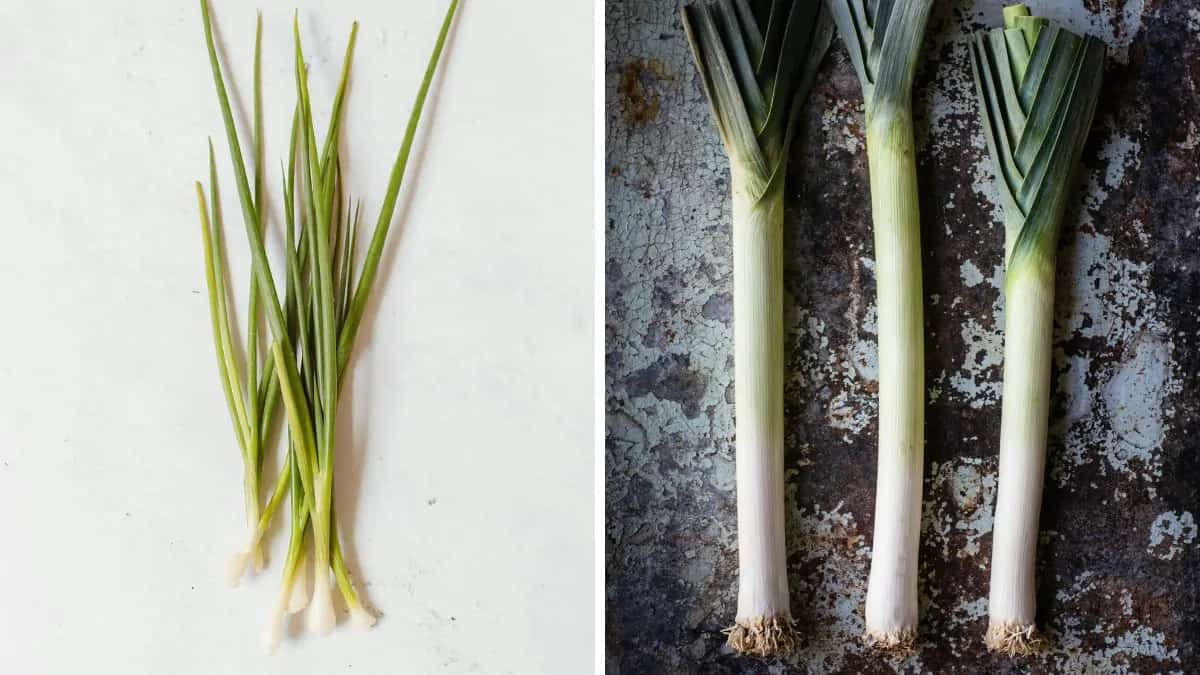
Being part of the onion family, leeks are essentially fibrous and thicker in appearance than their ingredient parallel – spring onions. The former has a milder flavour when compared to the pronounced notes of the scallions; hence, leeks are usually added to dishes that are heavier (think: soups, stews) unlike spring onions which are mostly utilised for presentation on stir fries, salads and Asian preparations. Barring the resemblance which is best described as having green sheaths and white bases, here’s how one can tell the alliums apart.
Leeks
The leafy, green sheaths – also known as stalks or stems of the leek include tightly packed leaves which get lighter in colour as one approaches the base. The darker top – which has a rougher texture is usually not included in cooking, unlike the white cylindrical base which is sliced thinly and harnessed for its flavour. With notes similar to shallots or sweet onions, leeks are relatively less pungent and best relished when cooked. Softening sliced leeks in a pan with butter or olive oil helps form a vegetal foundation for casseroles, soups, roasts and even to fry and add as a crunchy topping.
Also Read:
Spring Onions
Also known as scallions, spring onions have a darker, leafy top and a hollow white base – with a smaller bulb compared to the leek. Due to their prematurity, the tenderness of spring onions tend to make them ideal to be eaten raw in salads, garnishes, fillings, marinades and wraps. Smaller in width compared to leeks, the flavour of spring onions are punchy and prominent – with a subtle sweetness punctuating every bite. While leeks are added to the beginning of a cooking process, green onions are most commonly used to finish a dish as well as used in smaller quantities than leeks. The pop of colour that the vegetable can add is what it is most known for along with its aromatic flavour – which provides multi-sensory value.
Using As Substitutions
Although the overlap in taste is common for both alliums, using the vegetables as substitutes for one another isn’t off bounds, albeit with minor adjustments. If using spring onions instead of leeks for a recipe that requires cooking them, the quantity must be increased on an average 1:3 ratio; 3-4 spring onions for one leek since their flavour mellows when cooked and if seeking a sharper flavour is key, the adjustment delivers the desired result. However, if using leeks in place of the scallions, ensure that they’re sliced thinner than usual as their roughage can be an unpleasant mouthfeel if not processed correctly.