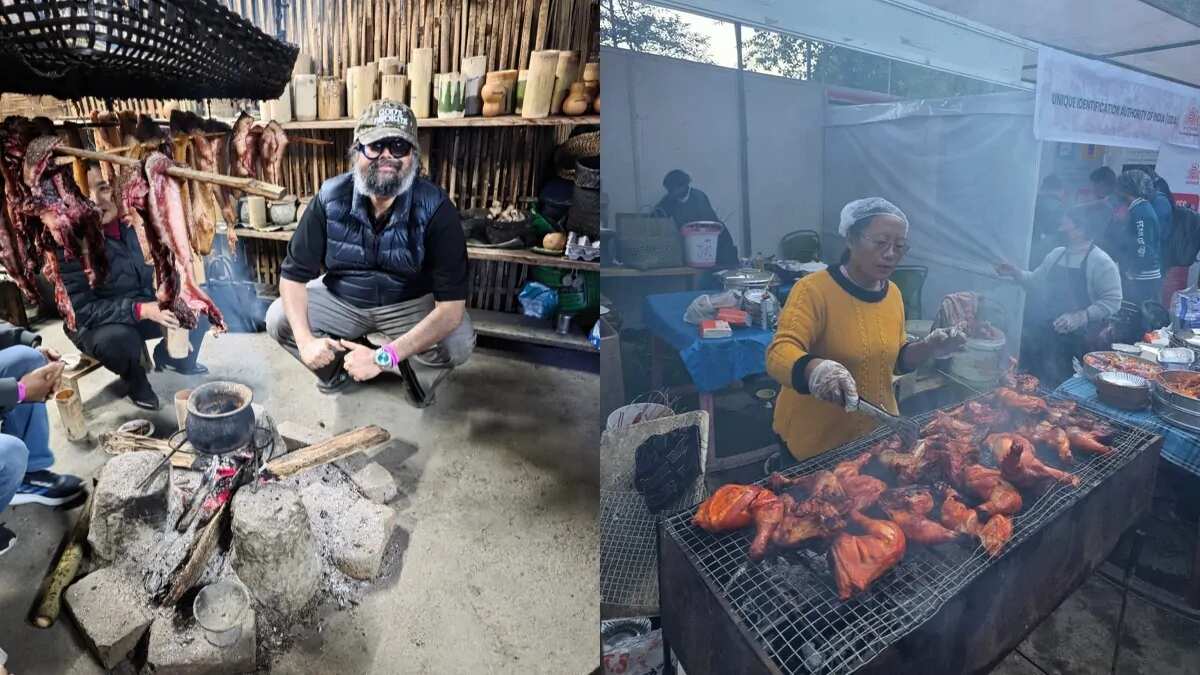
The smoke arrives first. It moves low across the ground at Kisama Heritage Village, twenty kilometres south of Kohima, and settles into clothes and skin. It does not drift away. It stays. That is how you know where you are. Nagaland in December is cold and clear. The hills stand bare and sharp. Pine and oak cut the air. The road into Kisama climbs slowly, bends tightly, and strips you of hurry. By the time the village opens up, the noise of the plains has already fallen behind. The Hornbill Festival is often introduced as “the Festival of Festivals,” a phrase coined by the Nagaland Tourism Department when the event was launched in 2000. Held annually from December 1 to 10, it was conceived as a way to bring together the state’s many tribes, at least seventeen major ones, into a single shared cultural space. But the phrase misses something essential. Hornbill is not a spectacle. It is a concentration. Music, dance, craft, sport, these draw attention. Food holds ground.
Image credit: Avinash Mudaliar
Why The Hornbill Matters
The festival is named after the Great Indian Hornbill, a bird revered across Naga tribes as a symbol of courage, prosperity, and continuity. Hornbill feathers once marked warriors and chiefs. Today, the bird survives mostly in protected forests and collective memory. The festival serves a similar function. It preserves what would otherwise thin out under modern pressure: languages, rituals, architectural forms, and food systems shaped entirely by land, season, and survival. Nowhere is this clearer than in the morungs.
The Morung: Architecture That Cooks
Each tribe builds its own morung inside Kisama. Traditionally, a morung was a youth dormitory; a place where boys learned discipline, warfare, craft, and oral history. Structurally, they are imposing: heavy timber, carved posts, bamboo lattices, steep roofs built to withstand weather and time. During Hornbill, these morungs transform into kitchens. But they are not stalls. That word suggests commerce. These are temporary embassies. Inside, meat hangs from rafters; pork bellies, ribs, slabs of fat, sometimes whole sides, blackened by smoke. Fires burn low beneath them. Smoke cures, preserves, and flavours. This is not decorative. It is functional preservation, the same method used for generations in villages where refrigeration was never an option. The smell is unmistakable. Sharp. Animal. Alive. Men tend the fire and the meat. They sit close, watching quietly. Women control everything else.
Image credit: Avinash Mudaliar
The Core of Naga Cuisine: Smoke, Ferment, Stew
Naga food is often misunderstood as simple. It is not simple, it is pared down. There is little oil, almost no turmeric, no layered masala. Spices: ginger, garlic, chillies, are used sparingly. The primary flavours come from smoke, fermentation, and time. Across the morungs, certain dishes repeat, not because of standardisation, but because of necessity.
Image credit: Avinash Mudaliar
Smoked Pork
Smoked pork is the backbone of Naga cuisine. Pork is cut thick, salted lightly, and smoked above the hearth for weeks or months. The process preserves the meat and concentrates flavour. When cooked, it is rarely rushed. It is boiled, stewed, or cooked with bamboo shoots. You encounter Aikibeye, smoked pork cooked plainly, often with local greens. You also see Rosep Aon, a spicier meat curry, and pork ribs slow-boiled until the smoke softens into sweetness. This food is not meant to impress. It is intended to endure.
Pork With Akhuni (Axone)
Akhuni, also called axone, is fermented soybean paste, central to the Ao, Sumi (Sema), and Lotha tribes. Its aroma arrives before the dish. Its flavour, once understood, is deep and anchoring. Pork cooked with akhuni becomes dark, thick, and intensely savoury. This dish does not accommodate outsiders. It waits for them to adjust.
Image credit: Avinash Mudaliar
Bamboo Shoot Preparations
Fermented bamboo shoots appear everywhere, particularly among the Angami, Chakhesang, and Zeliang tribes. Bamboo shoot adds sourness and fibre. It cuts fat and sharpens dishes. You see Bastenga, pork cooked with fermented bamboo shoot, and fish simmered with bamboo shoot until the broth turns pale and acidic. These dishes taste green, clean, and alive.
Fermentation As Knowledge
Fermentation in Nagaland is not trend-driven, it is ancient. You encounter Hinkejvu, fermented soybean chutney; Anishi, taro leaves fermented and cooked with pork among the Ao; fermented bamboo shoots; fermented fish; dried greens; and jars of preserved insects. Silkworm larvae and grasshoppers, clearly listed on handwritten menus, are traditional protein sources, especially among Ao, Phom, and Chakhesang communities. They are fried or pickled, crunchy and saline, eaten in small amounts. Visitors hesitate, locals do not. Fermentation here is not about flavour alone. It is about insurance; against winter, scarcity, and waste.
Heat That Has A Job
The heat at Hornbill does not shout. It comes from Naga mircha, also known as Bhut Jolokia or ghost pepper, once recorded among the hottest chillies in the world. Indigenous to Nagaland and Assam, it is used with restraint. The chilli is not ground into masalas or fried in oil. It is crushed lightly, smoked, or dropped whole into stews. Its heat arrives late and stays long. It sharpens the dish. It preserves it. Locals warn you once. They do not warn you twice.
Pickling: The Silent System
Pickling is not a condiment here. It is a method of survival. Across morungs, jars sit quietly at the edges; king chilli pickles, fermented bamboo shoot pickles, dry fish preserved in brine, axone-based chutneys, wild greens salted and stored. These pickles are eaten in pinches. Never spooned. They wake up rice. They correct a meal. Pickling in Nagaland is not decorative, it is deliberate.
Image credit: Avinash Mudaliar
Rice: The Quiet Centre
Rice is everywhere, always plain. Nagaland grows multiple indigenous rice varieties adapted to hill cultivation. Sticky and non-sticky rice appear side by side. Rice is served without garnish. It absorbs, not competes. Traditional rice dishes such as Samathu appear across morungs. Foxtail millet and other indigenous grains surface quietly, reminders of older agricultural systems that never disappeared. Rice does not speak loudly here, it listens.
Stews And Sustenance
One of the most revealing dishes at Hornbill is Galho. Galho is a traditional Naga stew made by cooking rice, meat, vegetables, and greens together in one pot. It resembles a thick porridge. It is nourishing, warm, and deeply comforting. Galho is not served to impress guests. It is served to keep families alive.
Snails, Eel, And The Forest Economy
Snails appear in several morungs, particularly those representing forest-adjacent communities. They are boiled or stewed, sometimes with bamboo shoot or wild greens. The flavour is mild and earthy. The texture is firm from long cooking. Smoked eel appears among tribes with strong river traditions such as the Ao and Sangtam. Cleaned, split, smoked, and then stewed, it carries smoke and fat in equal measure. These foods reflect a land-based ethic: use what the forest and river provide, without excess.
Image credit: Avinash Mudaliar
Fish, Prawns, And Restraint
Fish cooked in bamboo shoots appears across morungs. The preparation is restrained. No heavy spice. The fish remains central. Large freshwater prawns are grilled or stewed simply. Salt. Fire. Time.
Zutho: Drinking As Community
Zutho is a traditional Naga rice beer. Brewed differently by each tribe, usually by women, it is cloudy and mild. It encourages sitting, listening, and staying. It is not a drink for escape. It is a drink for arrival.
Image credit: Avinash Mudaliar
The Quiet Sweetness
After smoke, fermentation, and heat, sweetness arrives without ceremony. Nagaland’s pineapples, grown across districts like Dimapur, Peren, and Mokokchung, are small, golden, intensely fragrant. Naturally low in acid, they are eaten fresh, sometimes salted lightly with chilli. There is no dessert culture here. Fruit does the job.
Who Cooks, Who Knows
Across morungs, the division of labour is consistent. Men handle slaughter, smoking, fire, and meat. Women handle fermentation, seasoning, timing, and balance. Recipes are not written, they are inherited.
The Tribes Represented
Hornbill brings together Nagaland’s diverse tribal identities, including Angami, Ao, Konyak, Lotha, Sumi (Sema), Chakhesang, Phom, Zeliang, Rengma, Pochury, Sangtam, Chang, Yimkhiung, Zeme, Khiamniungan, and Kachari. Each morung presents food as cultural truth, not performance.
Music, But At A Distance
Music plays constantly. Rock bands. Folk troupes. Drums. Electric guitars. But food pulls you back. You eat standing, sitting, or leaning against bamboo rails. Smoke follows every movement.
Leaving Hornbill
When you leave Kisama, the smoke stays with you. In your clothes. In your hair. In your memory. You realise that what you ate was not exotic food. It was geography, climate, history preserved through fire, fermentation, and restraint. Hornbill does not soften itself for visitors. It does not translate excessively. It does not explain. It stands where it is. And if you are willing to meet it there, to eat without demand and listen without judgment, it gives you something rare. Not comfort; understanding.