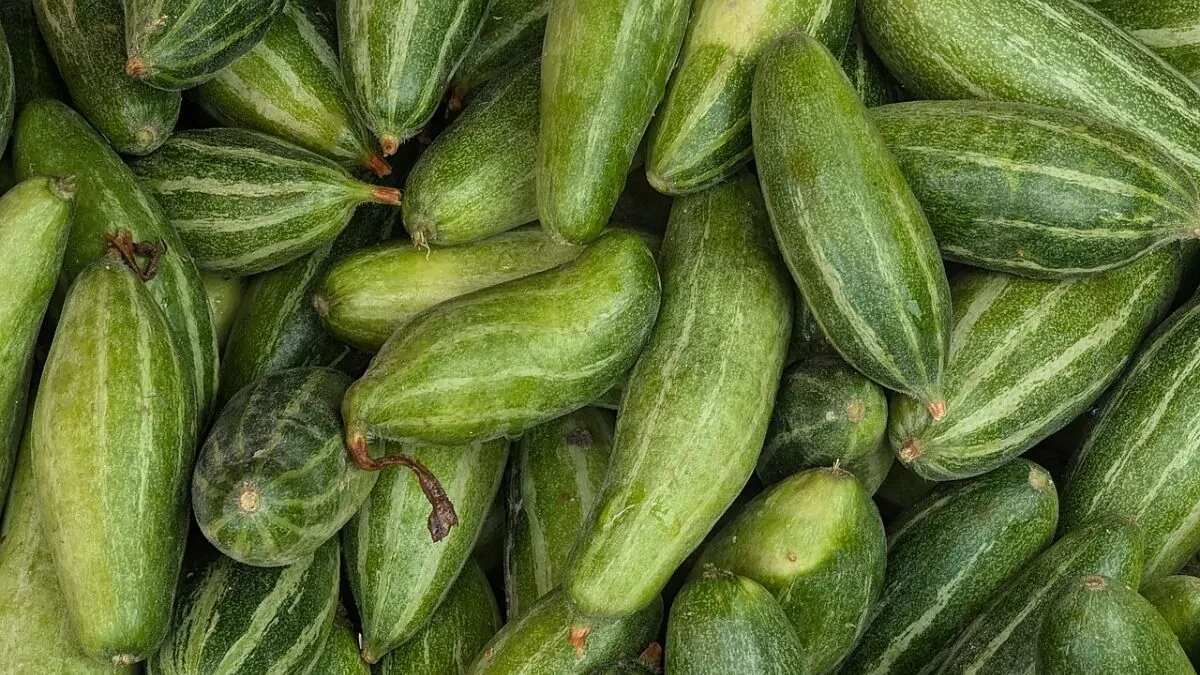
Call it pointed gourd, parwal, potol or by any other regional Indian name, but nobody can deny that this vegetable is a delicious summer staple. Ask any Indian, and you will know that these health benefits aren’t the only reason why they collectively love eating parwal dishes. The other, and sometimes more important, reason is the taste and flavour of parwal; the green, striped exterior of the veggie turns crispy very easily, and so do the seeds within. Sure, they do get stuck in your teeth occasionally, but still, everybody loves eating parwal seeds, and because it has a cylindrical or oblong shape, parwal is also very easily hollowed and stuffed.
Image Credit: Wikimedia Commons
This makes parwal or pointed gourd one of the most versatile vegetables in the world, and regional Indian cuisines prove it with the variety in which it is consumed. Numerous recipes, including bharwan parwal, parwal curry, parwal fry, and parwal chutney, can be made with it. With its mild flavour and excellent flavour-absorbing capacity, pointed gourd makes up for a diverse component in Indian cooking, particularly in the sweltering summer months.
7 Regional Indian Parwal Recipes To Try
Parwal Chokha, Bihar
Bihari cuisine boasts of many types of chokha or mashed vegetable dishes, but a prime one is parwal ka chokha, which is a mildly spiced dish, prepared by steaming scraped pointed gourd. This is then mashed and topped with green chillies, salt and coriander leaves, and this is a very simple, peasant-style dish for hot summer lunches. In chokha, when the ingredients are cooked to a pliant consistency, the mashed foundation is blended with spices and served as is; that's why individuals used to Punjab's baingan bharta find it difficult to adjust to Bihar's baingan ka chokha, and vice versa. Parwal chokha is not subject to such conditioning-induced disdain, and this dish has no other incarnation outside of the Bihar-Jharkhand-Bengal triangle. The seasonings utilised may vary; nonetheless, the template stays unchanged.
Potol Dorma, West Bengal
The potoler dorma is a fragrant Bengali meal. The pointed gourd or the potol is stuffed with coconut paste, and seasoned herbs and spices, you can also use paneer or minced meat to stuff it. Then these stuffed potol is fried or grilled, and the thick gravy is prepared using tomatoes, onions, and any number of aromatic spices, to cook the rest in it. It has a tasty, intense flavour, and the sweetness from the coconut is just a hint, though. Its a royal dish to serve with rice or pulao, which in turn can enhance the taste of the filling and dish together.
Parwal Na Ravaiya, Gujarat
This stuffed parwal recipe from Gujarat is an outstanding no-onion-no-garlic dish. The stuffing for this parwal na ravaiya is made with groundnuts, chana dal, coconut and spices like red chilli and green chilli. So, not only does this stuffed parwal recipe have a nutty flavour, but it is also very spicy. The stuffed parwal in this case are first steamed, and then a tadka is added on top. Making ravaiya is an elaborate affair, and hence some communities also call it ‘motu-shaak’ when they have any ravaiya on the menu. Ravaiya is made more frequently in the summer to make the dinner more appealing and to complement the aamras on the menu. Additionally, the stuffing masala is fairly adaptable and can be used to fill potatoes and tiny aubergines.
Parwal Kobbari Masala, Andhra Pradesh & Telangana
This spicy coconut-based parwal dish from Andhra Pradesh and Telangana is a must-have during summers. The pointed gourd is cut into long chunks and cooked with onions and a very special spice blend, which is dominated by coconut. Parwal kobbari masala is spicy and has a thick gravy that is eaten with any kind of flatbread or rice.
Image Credit: Wikimedia Commons
Potala Rasa, Odisha
Also known as Aloo potala rasa, this pointed gourd dish originates in Odisha. The parwal and potatoes are cut into large chunky pieces and fried and set aside. Then a rich and thick gravy is made with onions, tomatoes, coconut and a generous amount of spices. The parwal and potatoes are added back to the curry and cooked until done. The rasa/gravy here has a very smooth consistency; thus, the onion, ginger, garlic, and tomatoes must all be mashed into a very fine paste.
Parwal Chi Bhaji, Maharashtra
Originating in Maharashtra, this pointed gourd dish is quite spicy and a favourite in the region. Usually, the parwal are only slit a bit to make this dish instead of chopping it up, which makes this parwal chi bhaji look like a bharwa parwal dish. Traditionally made using a spice blend featuring Byadgi chillies, peanuts, coconut and sesame seeds, this dish is served with rotis and parathas.
Image Credit: Wikimedia Commons
Potol Posto, West Bengal
Posto or poppy seeds have been a staple ingredient in Bengali cuisine. It is widely used in both niramish and amish (sattvik and non-vegetarian) preparations. Bengali potol posto is a simple preparation of pointed gourds in a thick posto or poppy seeds paste. The basic recipe follows more or less similar steps in the cooking method. Potol posto is an easy recipe and tastes best with steamed rice, as the use of poppy seeds paste lends it a creamy texture. A few people also like to add coconut paste to the poppy for extra richness. It falls into the dry curry version and is served as a side dish. One can tweak the spice levels according to preference.