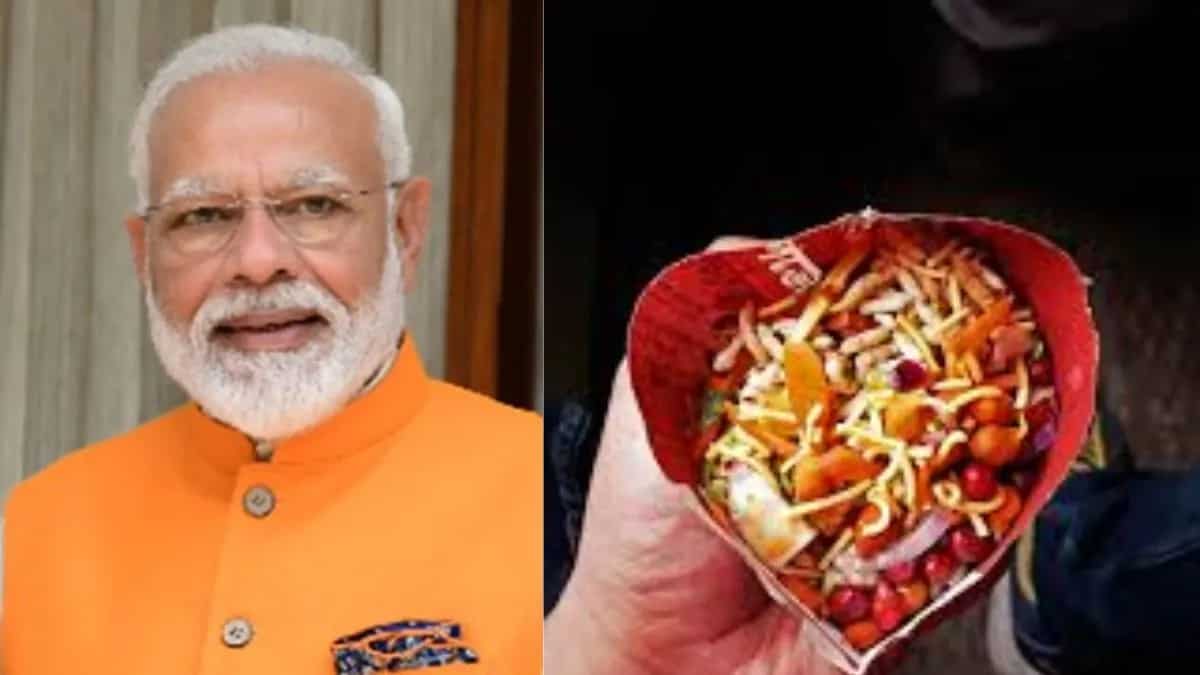
Food and politics have long been inextricably linked, but the connection becomes much more apparent around elections. In West Bengal, essentials such as fish, rice, and sweets are more than just cultural symbols; they are linked to livelihoods, pricing, and access, all of which are influenced by policy. As campaigns unfold, what people eat quietly reflects larger questions of welfare, control, and identity, turning everyday food into part of the electoral conversation. After wrapping up a power-packed schedule of four back-to-back rallies in Purulia, Jhargram, Medinipur, and Bishnupur ahead of the high-stakes West Bengal Assembly Elections, Prime Minister Narendra Modi was seen enjoying Bengal's popular street snack 'jhalmuri.' PM Modi shared a video of the moment on his official Instagram account. He is spotted outside a local business, having a brief encounter with the vendor.
The Prime Minister was also seen distributing the puffed rice-based mixture to locals gathered at the spot. The shop witnessed an unexpected surge of visitors after the Prime Minister's stopover. PM Modi, clad in his typical clothing of a white kurta, a dark blue pinstriped waistcoat, and a bright red scarf with a white BJP lotus symbol embroidered on it, can be heard stating, "Kitne ka hota hai jhalmuri? (How much does it cost?)” An eager crowd surrounded him, with most of the women in the foreground. They held up their mobile phones to capture the occasion in images or videos.
As the shopkeeper prepared the jhalmuri, he could be seen going into his Nehru jacket pocket to pay. The merchant then enquired, "Ap pyaaz khaate hain? (Do you consume onions)", to which the PM replied, "Haan, pyaaz khaate hain. Dimag ni khaate bass. (Yes, I eat onions, but I don't eat people's heads). PM Modi shared images of the event on social media, writing, "In between four rallies across West Bengal on a packed Sunday, had some delicious Jhalmuri in Jhargram."
Image Credit: Wikimedia Commons
A Brief History Of Jhalmuri & Its Many Shops Across West Bengal
Vikram Sah, a native of Bihar's Gaya district, owns the stall and has been running it for the past 12 years. The impromptu stop by the Prime Minister's motorcade became a memorable experience for both the vendor and spectators. PM Modi also tweeted images of himself with 'Jhalmuri' with his supporters who were gathering around him.
West Bengal has always been a food-lover’s paradise. From its cha (tea) served in earthen cups called ‘bhar’ to its diverse variety of vegetables, its unique Kolkata style Biryani and the most loved ‘mishti’ (sweetmeats), it has something for everyone. Its street food is not to be left behind either. The snacks, lovingly called ‘Jalkhabar’ in Bengali, include the phuchkas (pani puris or gol gappas in the rest of India), the famous egg rolls, chops, cutlets, begunis, telebhajas and singaras (made with potato, cauliflower and peanut filling). For most Bengalis jhalmuri is an emotion. It’s a snack that is connected with memories and emotions. It's also a sort of comfort food that they can go to at any point in the day. ‘jhal’ in Bengali translates to spicy and ‘muri’ means puffed rice.
You can spot a jhalmuri wala in almost any part of the city. Onions, tomatoes, boiled potatoes, chanachur, a dry spice mix, a dash of lime juice, fresh coriander, and finely chopped green chillies are thrown in with the puffed rice, and then mustard oil is drizzled for just the right amount of kick. Every Bengali has their go-to jhalmuri guy who they can swear is the best in town.
The ingredients are put into a paper cone (often made with old newspapers), and the jhalmuriwala gives it a shake with the expertise of a seasoned bartender. The fresh and flavourful snack is so easy to put together that it is made in almost every Bengali home. While it is a chai-time adda favourite, it's eaten at almost any time of the day when you feel like you need a pick-me-up but don’t want to spend too much time whipping something chatpata up.
While the ingredients are few and the technique is simple, it is balancing the flavours that needs expert judgment. Not too salty, not too sour, and certainly not too fiery where the spice overpowers all other flavours. The puffed rice needs to be crisp and not soggy. Puffed rice has been eaten in Bengal for centuries. It's been a staple for generations and is often eaten with milk and sugar or used in other traditional snacks. On many occasions, puffed rice is mixed with chopped onions, green chillies and mustard oil in a simpler preparation when made at home.
The jhalmuri in its current avatar is believed to have first made its appearance in West Bengal during the British Raj. It is said to have been brought to Bengal by migrant workers from the State of Bihar. During the Second World War, Kolkata was the capital of the British Raj. It was the time when there was an influx of migrant workers in Bengal.
Image Credit: Wikimedia Commons
What is interesting about the jhalmuri is that while it was already being consumed in Bengali homes in a particular version, it is the Bihari workers who recognised its potential to become a popular snack. That’s the time when tiny shops selling this snack mushroomed all over the city. It seemed to find popularity with both the British and the locals. While the snack was a combination of Bihari and Bengali ways of eating, it soon became Kolkata’s own and a significant part of the city’s cultural identity.