This is Part 1 of 6 in ‘80 Failures, Fractures and Food-Safety Episodes That the Celebration of Indian Food Must Also Own’, an analysis by Avinash Mudaliar.
Indian food deserves its worldwide renown. Its regional intelligence, agricultural memory, street-side inventiveness and hospitality are extraordinary achievements. Independent India has also built food-security institutions of staggering scale and, in many respects, rescued itself from chronic scarcity. Those achievements make it worth asking where the system still fails. This is a ledger that belongs beside the celebration, because Indian food deserves a food system worthy of it.
Colonial Legacy and Famine
1. The Bengal famine of 1943 shaped the food policy of independent India. The Famine Inquiry Commission put the death toll at roughly 1.5 million, while later estimates vary. Wartime disruptions, the loss of rice imports from Burma, procurement and distribution failures, and soaring prices all mattered. Historians differ over the extent of the harvest shortfall and how much weight it should carry. The famine helped shape later food policy, building on the wartime experience of rationing. Its lesson was foundational. Food can exist in an economy and still be unavailable to the people who must eat it. Cormac Ó Gráda’s historical study examines how supply, wartime pressures and access interacted.
2. Dependence on American food aid in the 1960s exposed India’s vulnerability. Wheat and other grain arrived under US Public Law 480. US diplomatic records show how much rode on decisions in Washington. During the 1965 food crisis, Prime Minister Lal Bahadur Shastri urged citizens to forgo one meal a week. For a newly independent country with deep agricultural knowledge, dependence on emergency shipments carried a political cost. The episode is often folded into the Green Revolution’s story of recovery. It also explains why the ability to feed itself mattered so much to the young republic.
3. Low foodgrain output made the pre-Green Revolution years precarious. India produced 50.82 million tonnes in 1950–51 and 51.99 million in 1951–52, according to the agriculture ministry’s historical series. Output rose over time, but the drought and import dependence of the mid-1960s made the vulnerability acute. That context explains the urgency behind high-yielding varieties, procurement and irrigation. A country can be grateful for the escape from scarcity and still examine where the gains went and which ecological costs accumulated.
Green Revolution: Miracle With Consequences
4. The early gains of the Green Revolution were geographically uneven. They were concentrated in irrigated areas such as Punjab, Haryana and western Uttar Pradesh, where high-yielding varieties, price support and procurement could be put to work quickly. The gains later spread beyond the initial wheat belt. Research on indigenous crops also documents how acreage under some traditional crops, including millets, receded as policy and investment favoured wheat and rice. A more secure supply of grain came with a narrower set of crops at the centre of national food policy.
5. Punjab’s falling water table is one of the costs of intensive irrigation. The Central Ground Water Board’s 2024 assessment put the state’s groundwater extraction at about 157% of its annual extractable groundwater resources. The picture varies across Punjab, but research on the state’s agricultural policies identifies irrigated paddy, procurement incentives and the economics of pumping water as parts of the problem. Paddy made economic sense to farmers responding to the signals they were given. The policy question is how to secure grain today while sustaining the aquifers that future harvests will depend on.
6. As fields became more uniform, some locally adapted crops receded. High-yielding varieties displaced some traditional varieties of wheat and rice. Research on wheat in Punjab traces how the mix of varieties in farmers’ fields changed. The loss of a variety from cultivation and the disappearance of its seed are different events. Both matter to a food culture shaped by varieties suited to particular soils, seasons, tastes and cooking methods. Conserving seed and keeping a crop in active cultivation are complementary ways of preserving that inheritance.
7. Higher output can conceal damage to soil. NABARD’s Punjab State Focus Paper records fertiliser use rising from 37.5 kg per hectare in 1970–71 to 242 kg per hectare in 2019–20. That is a measure of use per hectare. The effects on soil depend on the balance of nutrients, organic inputs and other cultivation practices. Long-term research in the rice–wheat system shows why those distinctions matter. Fertiliser helped raise yields. Maintaining the soil that supports those yields calls for attention to what goes back into it and in what proportions.
8. Stubble burning turns a farm residue into an air-pollution problem. The autumn fires in Punjab and Haryana are associated with paddy residue. The Commission for Air Quality Management monitors the separate wheat-residue burning season in April and May. Mechanised harvesting and a tight window to sow the next crop help explain why burning can be the practical choice for a farmer. Research on crop-residue smoke shows that its contribution to Delhi’s particulate pollution varies by day, weather and the timing of fires. Local emissions matter too. The machinery and crop calendar are part of any serious attempt to reduce burning.
Storage, Logistics and Waste
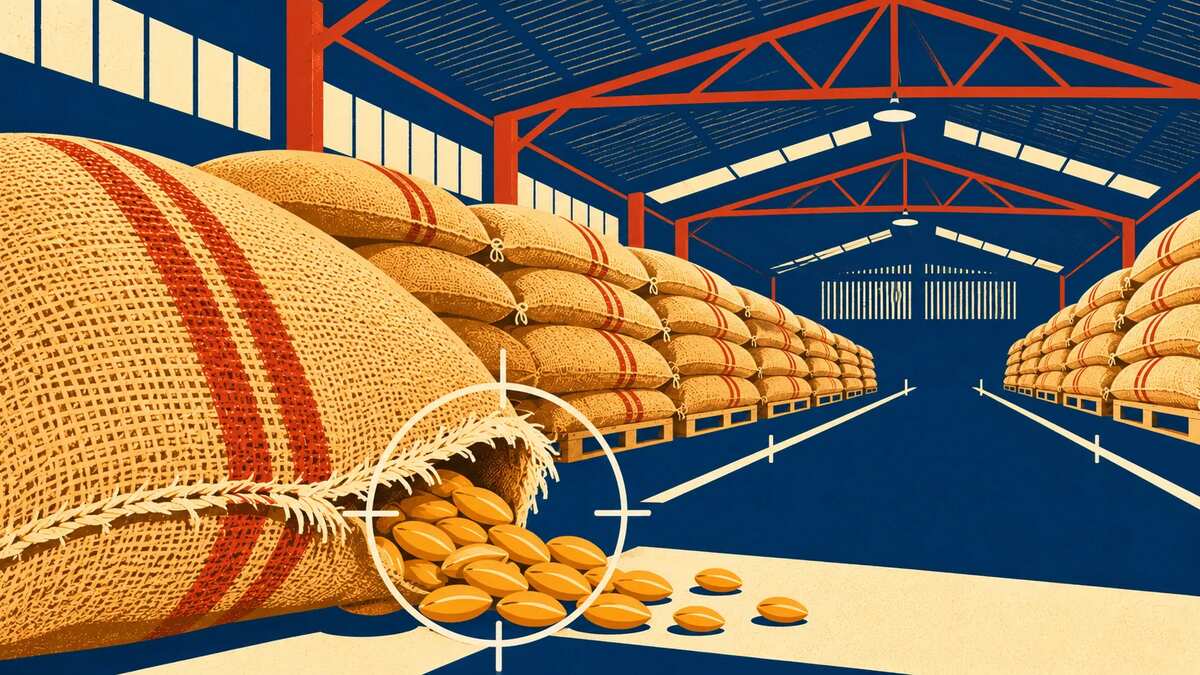
9. The Food Corporation of India’s wastage record shows the cost of procuring grain without adequate storage. FCI disclosed through a right-to-information response, later cited in Parliament, that 1,94,502 tonnes of foodgrain were damaged between 2005 and March 2013. In a separate comparison, the Comptroller and Auditor General’s 2013 audit put FCI storage capacity at about 33.6 million tonnes at the end of March 2012, against roughly 66.8 million tonnes of stock once grain procured by states under the decentralised scheme was excluded. Buying grain at scale creates a second obligation. It has to stay edible until it reaches the people it was bought to feed.
10. Storage and distribution failures can make food abundance look hollow. In 2013, the Institution of Mechanical Engineers estimated annual wheat losses in India at 21 million tonnes. That was a historical estimate. A later government-commissioned study used a different, crop-by-crop method and put losses across the cereals it studied at 3.89% to 5.92%. In 2013, minister Sharad Pawar told Parliament that annual losses had been valued at about ₹44,000 crore across several categories, including ₹13,309 crore for fruits and vegetables. The numbers depend on what and how one measures. Producing food is only the first half of feeding a country.
11. Moving older grain first is basic warehouse discipline. The CAG audit found that some older stock remained in storage even as newer wheat was issued. Stocks from the 2007–08 through 2011–12 crop years were held by state agencies in Punjab and Haryana at the end of March 2012. The audit found about 1.06 lakh tonnes of damaged wheat, valued at ₹121.93 crore, in the stock it examined there and identified failures to follow the first-in, first-out principle. When older grain stays behind, food security can turn on a basic warehouse decision.
12. Cold-chain gaps help turn horticultural plenty into loss. A 2022 government-commissioned study estimated post-harvest losses of 6.02% to 15.05% across the fruits it studied and 4.87% to 11.61% across the vegetables. The rates varied by crop. India is a leading producer of mangoes, bananas and onions, yet research on its cold chain has documented gaps in facilities such as packhouses and refrigerated transport. Weather, timing and market structure also shape prices. Better handling can keep more produce saleable and give growers more room to choose when and where they sell.
Explore the series
All instalments
Next instalment — From the Maggi Recall to the Spice Trade