What are some things you’d give up a weekend for? Don’t scoff at the sentence. I thought I’d never do that either till I said yes to experiencing the journey of an Indian single malt, from grain to glass. At the foothills of Solan, nestled against the gently flowing Gamber River, lies the whisky distillery for Gamber Valley Single Malt by Alcobrew Distilleries.
After over two decades in the business, the distillery has taken on the challenge of producing native single malts, starting with two expressions – the Private Edition and the Vault series. Over a weekend that seemingly went by in the blink of an eye, I took a look at how these expressions came to be.
Before The Bottle
Large distilleries process close to two to three lakh litres. Gamber Valley keeps things limited to 3,000 litres a day. But it’s a rigorous process to achieve that fine finish. Every whisky starts with carefully selected barley grains. There are a lot of questions between the two-row and six-row barley selection, with Gamber Valley opting for the former for its single malts. Over a period of 72 hours, the grains (with samples tested before production) go through a largely (though not completely) automated system to transform into whisky.
Image Credits: Gamber Valley Single Malt
The first step is crushing the grains and working them through hot water to extract sugar, before fermenting for about three days till the base spirit is formed. The distillery practices sustainability throughout the process, especially with respect to heat extraction and water usage. The next part of the process is where whisky earns its stripes as a slow man’s drink. It’s the maturation.
One step into the maturation unit and the heady aroma of whisky surrounds you, almost like you were steeped in the liquid. Even a novice can guess what’s happening behind the floor-to-ceiling lined casks. The distillery houses 12,000 casks in one facility and 6,000 in another. The majority of these are ex-bourbon oak casks, though virgin oak casks (never been used) also make up a very small percentage of the lot.
This is also where provenance comes into play, as the climate and high moisture content in the air speed up the maturation. When I bring this up later with Ashutosh Rajput, Chief Operating Officer, he confirms how geography plays a critical role in the whisky’s final profile.
“The altitude brings three variables - even after treating it, certain nuances in the water remain that you can’t take away. Then the crispness in the air; it works differently, and related to both these elements is the moisture content. Higher moisture content helps the maturation of the whisky. All these give whisky the unique character that Gamber Valley has.”
At the end of the maturation, what is delivered are two expressions carefully selected by the master blender.
The Debut Expressions
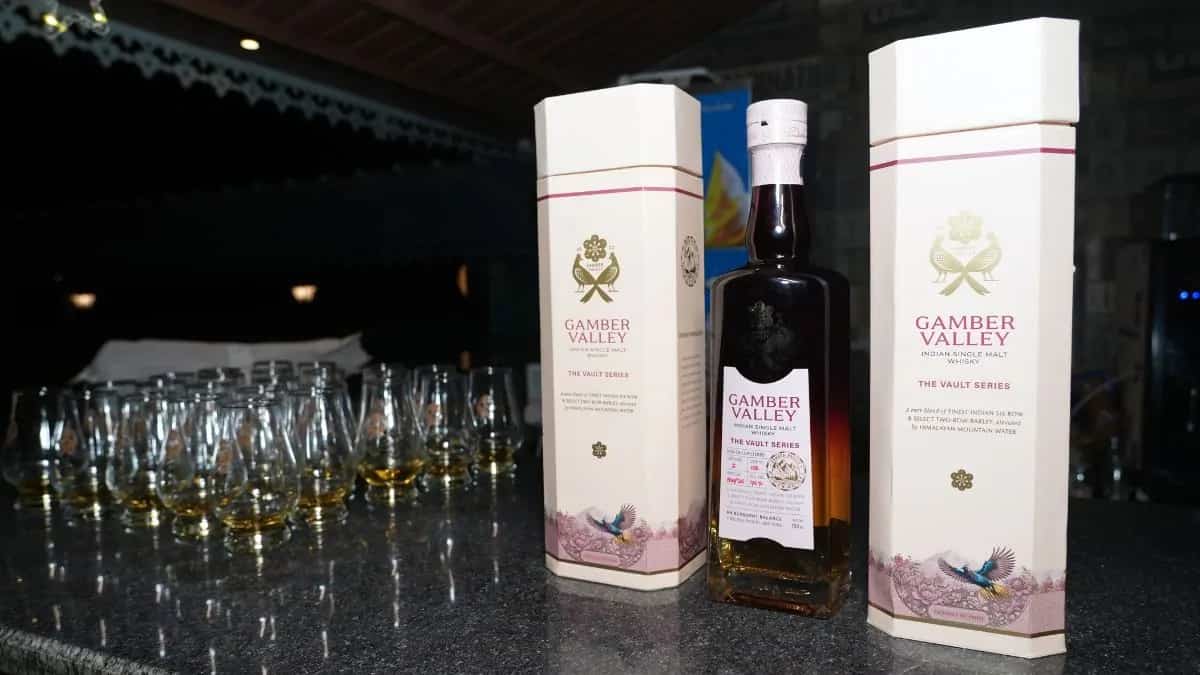
The first expression to sample is the Vault. Ashutosh remarks that it’s a name derived from the idea of “something precious enough to be kept in a vault”. The bottle is refined enough to grab your attention, but it’s the pour in the glass that everyone’s waiting to sample.
The first sniff introduces a potent aroma, giving hints of vanilla and honey. It’s an expression that reminds you of the Speyside malts, but for the touch of spice that arrives at the back of the palate. The whisky leans towards a mix of honey and chocolate, not sweet, but smooth. It’s matured in once-filled, ex-bourbon casks.
It’s bottled at 46% ABV and available across select locations in India (Haryana, Uttar Pradesh, Chandigarh, etc.) with plans for a more expansive launch. The 750ml bottle is priced at approximately INR 8,000 in Gurugram.
The second expression is even more rare, with only a limited number produced at a time. It’s the Private Edition I, and it’s a collectable in every sense of the word. The bottle, which could very well symbolise regality, arrives in a custom-made box accompanied by a private note. The note, titled “A Rare Fine”, is signed by the company’s founder, Romesh Pandita.
The core is formed by whisky matured in virgin oaks, and the single malt is described as a result of a “deliberate and uncompromising approach to whisky making”. It certainly falls in line with the tagline for their single malts: Born of Altitude, Refined by Attitude.
The first sip and you know this is a whisky meant to be savoured and sipped, through slow pauses. Bottled at 46% ABV, the 500ml expression combines notes of lavender, honey, vanilla, and dried fruit. It’s a lot smoother than the vault, with a hint of ginger and a finish of burnt raisins. What remains on the palate still has a touch of the spice that seems to go hand in hand with Indian whiskies, but the impact is a lot more muted. It’s priced at INR 15,000 in Gurugram.
“The virgin oak casks tend to give whisky a far stronger profile, whether it’s taste or colour. From within those casks, the master blender picked a few and arrived at this. Since this oak hasn’t been used, all the wood’s character- the tannins- are intact in the cask. The whisky is, thus, able to derive more from the wood,” explains Ashutosh.
There are plans to launch two more expressions, more reasonably priced (around INR 3,000), by the end of September.
A Whisky For The New Consumer
There is no doubt that this is a discerning whisky, the kind you collect, gift, savour, and enjoy. But there’s also no denying the fact that the Indian market is still fighting the established norms of fine whisky, especially when it comes to ageing. Indian whiskies mature much faster than their Scottish counterparts, making ageing a conflicting measure of quality. While there is a rising acceptance of Indian single malts, launching a new expression is certainly not without challenges.
“We know the product and what it stands for. How do I communicate that to the new user and, more importantly, make them believe that what I am saying is genuine? That’s the biggest challenge,” remarks Ashutosh.
Then there are the loyalists. Few spirits enjoy the kind of loyalty that whisky brands do in India. For Ashutosh, the counter isn’t shifting established loyalties. Rather, it’s finding a new market altogether.
“Someone who is used to buying whisky looking at the age statement – they are the more difficult user. But based on our research, the younger entrants to the market are not going by the age statement. They are going by the story. And we have a good and honest story. The young entrant is the right target audience for our product.”
Gamber Valley is certainly writing a compelling story. One that has all the markers, from its design language to its depth of taste, to create a lasting impact, if only the new user is open to experimentation. Going by the numbers at which the market is growing (the Indian single malt whisky market now accounts for roughly 59% of total domestic single malt sales by volume), this experimentation seems poised for success.