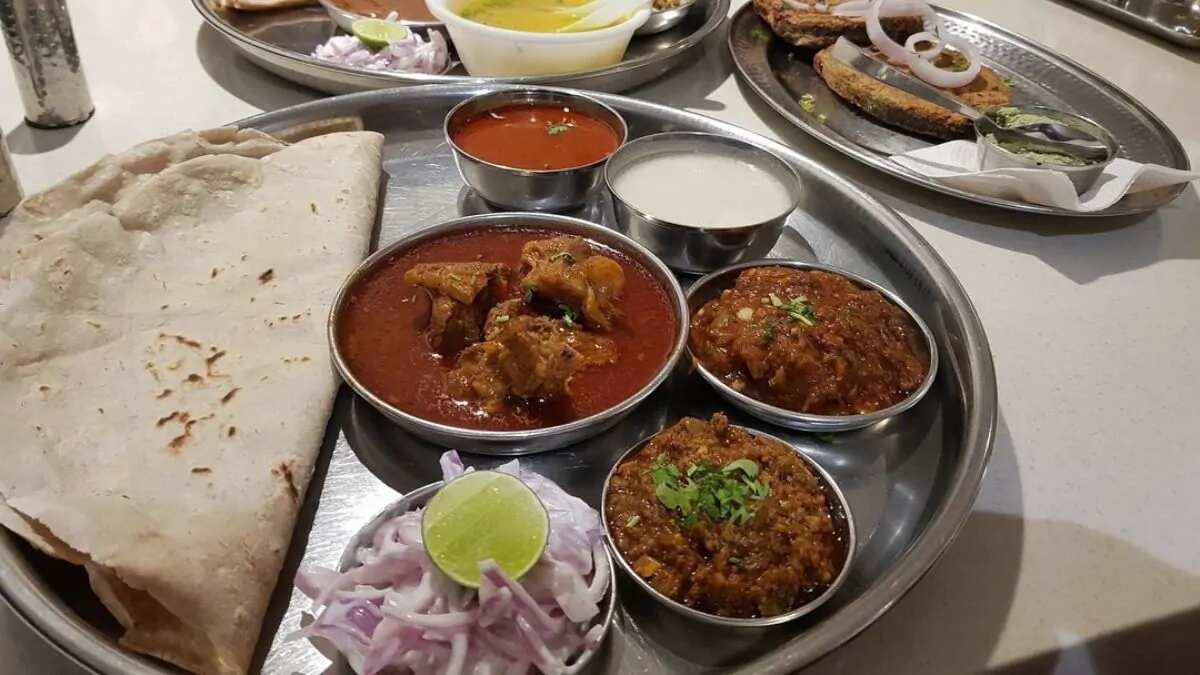
There is a particular kind of sentence that only a certain kind of official can produce with a straight face: an entire regional cuisine, built over nearly a century and a half by a specific community, sustained today by roughly a thousand restaurants and the families who run them, reduced to a single clinical prognosis. Eat this, and you will end up in hospital. For a month.
That is, more or less, what Tukaram Mundhe, the Commissioner of Maharashtra's Food and Drug Administration, is reported to have said about Saoji food at a public event in early August 2026. He did not single out one restaurant with a rancid kitchen or one supplier cutting corners on oil. He indicted the cuisine itself—Nagpur's Saoji, the fiery, oil-dark, thirty-two-spice mutton and chicken curry that Vidarbha has been eating, arguing about, and exporting in dabbas to homesick relatives for generations. If someone like him ate it, he said, he would be hospitalised for at least a month. He tied this to oil, to heart disease, to the general sinfulness of eating well in a state that apparently only recently discovered fat exists.
Image Credits: Wikimedia Commons
I want to take that sentence apart, because it deserves it, and because the way it was made — with total confidence and zero apparent curiosity—is exactly the kind of thing that happens when officialdom mistakes a press soundbite for an actual argument about food. This is not a defence of every ladle of orange-red oil sitting on a badly made plate of Saoji in a tourist-trap on the highway. It is a defence of the cuisine, its history, its craft, and the roughly one thousand kitchens in Nagpur that have spent a century and a half getting the balance right, being told by a man who has never had to make a living from a stove that they are, in effect, a public health hazard.
Who Is Doing The Talking & Why It Matters
It would be lazy to make this personal, so I won't, except to note the one fact that is actually relevant: Mundhe is, by every account of his own career, an aggressively rules-first administrator. 23 transfers in nineteen years, by some counts 25 in a slightly longer span, is not a coincidence—it's a pattern, and it is not a bad one in a country where regulatory capture is often the default setting. His tenure at the FDA has genuinely mattered. Under him the department has run hundreds of raids, pulled crores worth of banned gutkha and pan masala off shelves, gone after synthetic milk and adulterated paneer, and — in a move that made national headlines—suspended the license of Mumbai's nearly century-old K. Rustom ice cream parlour over hygiene violations, live rats included, brushing aside the argument that heritage should buy an exemption from basic food safety. On adulteration, on gutkha, on rusted machinery in an edible oil unit, Mundhe has been doing exactly the job an FDA commissioner is supposed to do, and doing it without fear of who he offends.
None of that, however, makes him a food critic. Being right about synthetic milk does not make you right about a 32-spice mutton curry cooked in linseed oil. Regulatory rigour and culinary literacy are different skill sets, and the FDA's mandate is food safety—contamination, adulteration, mislabelling, hygiene—not a moral judgement on how much oil a regional cuisine has decided, over a century and a half of trial and error, actually needs. When an officer with genuine authority on one axis starts pronouncing on another, the danger isn't that he'll be ignored. It's that he'll be believed, by people who have never eaten a proper Saoji thali and now have one more reason never to.
"People Babbling Without Knowledge" Is Not A New Problem, It's The Whole Problem
Every regional cuisine in India has had to survive a version of this. Kolhapuri mutton gets called "too oily" by people who've only had it reheated at a wedding buffet three hours after it was cooked, by which point the oil has separated and congealed exactly the way it isn't supposed to. Malvani fish curry gets called "unbearably pungent" by people whose only reference point is a diluted, sweetened version served two states away. Hyderabadi haleem gets treated every Ramzan as some kind of caloric crime scene by people who have never once asked why a dish meant to sustain a full day of fasting was built the way it was. In every one of these cases, the criticism comes from outside the tradition, delivered with total confidence, based on a bad plate at a bad restaurant, or no plate at al —just a general sense that spicy, oily, "heavy" food from the hinterland must be less sophisticated, less considered, more dangerous than a cuisine the critic already approves of.
Saoji is having its turn now, and the criticism follows the exact same template: take the worst, most commercially diluted version of a dish—usually served at a roadside joint that discovered the word 'Saoji' is good for footfall and slapped it on a signboard with no actual connection to the Halba Koshti families who built the cuisine—and present it as the definition of the whole tradition. This is, to put it plainly, people blabbing without knowledge, and it is worth saying that plainly because officialdom rarely gets called on it. A restaurant owner in Nagpur put it better than I could, in response to Mundhe's remark: if Saoji food were truly harmful, the city's hospitals would be overflowing with patients, given that it is served to thousands of people every single day, across roughly a thousand establishments. They are not. Vidarbha has been eating this food since the 1870s and has not needed a Mumbai bureaucrat to point out that it exists.
Also Read:
Where Saoji Actually Comes From
This is the part that gets skipped in every hot-take, and it's the part that actually matters, because a cuisine's history tells you why it looks the way it does — why the oil, why the thirty-two spices, why the specific heat.
Saoji is not an ancient temple cuisine or a courtly Mughlai inheritance. It is barely a hundred and fifty years old, and its origin story is, if anything, a story about resilience under economic pressure—which makes the current round of condescension particularly galling. The Halba Koshtis were a community of handloom weavers, based largely in what is now Madhya Pradesh, whose livelihood depended on spinning cotton and weaving dhotis and sarees. When Jamshedji Tata set up the Empress Mills in Nagpur in 1877, industrial weaving began undercutting handloom livelihoods across the region, and a significant number of Halba Koshti families migrated to the city looking for work in and around the mills.
Image Credits: Wikimedia Commons
Migration on those terms rarely goes smoothly, and it didn't here either. Many who moved for mill work found the employment unstable, and turned—as displaced artisan communities across India have repeatedly done—to what they already knew how to do well at home: cook. The often-told origin story credits a man named Girmaji, son of a weaver whose cloth had stopped finding buyers, who started as a waiter, then ran a tea and snacks stall that became popular enough that customers pushed him to open a proper eatery. The Collector of Nagpur is said to have given him space in the city's Cotton Market. From that one stall, and from the home kitchens of Halba Koshti women who had been perfecting a specific spice blend for their own families, an entire restaurant category was born—the Saoji bhojanalaya, no-frills, functional, focused entirely on the plate rather than the décor, exactly the kind of place where you eat on a wooden bench off a metal thali because nobody involved is interested in charging you for ambience they haven't built.
What's worth sitting with here is that this is a cuisine invented by women, out of economic necessity, using ingredients and techniques that were within a displaced community's reach — and it succeeded entirely on the strength of flavour, with zero institutional or royal patronage behind it. Compare that to how many of India's celebrated culinary traditions came out of court kitchens with unlimited ghee budgets and imperial prestige attached. Saoji had none of that. It had a spice grinder, a clay pot, and generations of women refining a formula through repetition, not R&D; grants. That it has survived a century and a half, spread from Nagpur's Cotton Market to roughly a thousand restaurants across the city, travelled to Mumbai and Pune, and — as of last year — found its way into a small Japanese chef's kitchen in Fukuoka, who trained under a Nagpur family and now serves Saoji mutton to a Japanese clientele who have never heard of Vidarbha, is not an accident. It is what happens when a cuisine actually works.
The Thirty-Two Spices & Why Nobody Will Give You The Exact List
Ask ten Saoji cooks for the exact recipe and you'll get ten different answers, and that's not evasiveness for its own sake — it's the entire business model. Each Halba Koshti family guards its own version of the masala as a closely held secret, refined and passed down, typically through the women of the household who have historically done the actual grinding and mixing even where the front-of-house and the tandoor work is run by men. What's publicly known is the broad architecture: there isn't one Saoji masala but four—two dry powders and two wet pastes — built around a base that most descriptions put at roughly thirty-two ingredients, dominated by dry red chillies, black peppercorn, cinnamon, nutmeg, and, in several accounts, roasted coconut and poppy seed for body and a background sweetness that tempers the chilli rather than fighting it. This is not a masala thrown together for maximum heat with no thought given to structure. It is a layered spice architecture—heat up front, warmth from the cinnamon and nutmeg underneath, roundness from the coconut and poppy seed holding it together—built by people who were cooking for their own families first, long before it was ever a commercial product.
Image Credits: Unsplash
That layering is precisely what gets lost when a restaurant with no lineage to the Halba Koshti tradition decides 'Saoji' is a marketable adjective and reproduces only the most legible part of it—the chilli—without the underlying architecture that makes an authentic Saoji dish taste complex rather than simply violent. This is the dilution that restaurant owners themselves pointed to in response to Mundhe's comments: the original cooking method and spice blend, they said, are distinct from the excessive oil and chilli seen at some unauthorised establishments trading on the name. That distinction is the whole ballgame, and it's exactly the distinction a blanket statement like Mundhe's erases. There is a difference between Saoji as the Halba Koshtis built it and 'Saoji' as a signboard word adopted by anyone who wants to signal spice. Judging the tradition by its worst imitators is not food safety regulation. It's just not doing the homework.
Now, The Oil—And What It's Actually For
This is where most of the outside commentary, Mundhe's included, goes wrong in the most basic, correctable way: by treating the oil as excess, as indulgence for its own sake, rather than asking what the oil is actually doing in the dish.
First, a small but real correction that keeps circulating in casual write-ups: the oil traditionally used isn't 'jute oil' in the literal sense—jute is a fibre crop, and its seed oil is a minor, largely non-culinary product. What's actually being referred to, in every account from cooks and families who've actually done this for generations, is linseed oil—alsi or jawas, from the flax plant, pressed cold and used both in the masala paste and as a finishing layer on the gravy. The confusion is an old one, likely from loose translation somewhere down the line, but it's worth fixing because it changes the nutritional conversation entirely. Linseed oil isn't some empty indulgence. It's one of the richest plant sources of alpha-linolenic acid, the plant-based omega-3 fat, and it carries a documented anti-inflammatory profile in its own right—the kind of ingredient a nutritionist would usually be recommending people eat more of, not less, if it showed up in a supplement bottle instead of a curry.
Image Credits: Pexels
Second, the oil is doing real technical work, not just adding calories. Traditional Indian gravy cooking across regions—not just Vidarbha—uses a visible layer of oil floating on top of a slow-cooked curry for a specific, practical reason: it acts as a seal. In a hot, humid climate, without refrigeration, a layer of oil sitting on top of a gravy limits air contact with the food beneath it, slowing spoilage and helping the dish hold through a long service day at a bhojanalaya that's feeding people continuously rather than in one seated dinner service. This isn't folklore—it's the same logic behind confit, behind ghee-sealed preserves, behind any number of pre-refrigeration preservation techniques across cuisines that had to solve the same problem without a fridge. The oil is also the medium carrying the fat-soluble flavour compounds out of that thirty-two-spice masala and into the meat and the gravy—a dry spice blend needs a fat carrier to actually deliver its flavour, and a dish built around whole and ground spices rather than a wet paste base needs more of that fat carrier than, say, a tomato-heavy North Indian gravy would.
None of this is an argument that a plate of badly made, oil-drenched Saoji from a place with no actual connection to the tradition is good for you if you eat it every single day. Nobody serious is arguing that. It's an argument that a technique refined over a century and a half by people cooking in a specific climate, without refrigeration, using a specific fat that happens to carry real nutritional upside, deserves to be understood on those terms before a bureaucrat with zero culinary background stands at a podium and reduces it to a punchline about hospital stays.
The Part Where Critics Have A Point & The Part Where They Very Much Don't
I'd be doing exactly what I'm criticising if I pretended there's nothing to the underlying concern. Some observers close to this controversy made a fair point: the misuse of the Saoji name by outfits with no real lineage to the tradition, serving excessively oily, one-note-spicy food purely because 'Saoji' sells, probably is contributing to real digestive complaints among people who assume they're eating the real thing. That's a legitimate food-quality and labelling issue, and if the FDA wants to look at whether restaurants advertising themselves as 'Saoji' are using anything resembling the actual four-masala method, versus just dumping chilli powder into cheap refined oil and calling it a day, that would be a genuinely useful intervention—arguably more useful than another gutkha raid, because it would protect both the consumer and the Halba Koshti families whose actual heritage is being cheapened by the imitators.
Image Credits: Wikimedia Commons
But that is a completely different statement from "Saoji food will put you in hospital for a month," delivered with no qualification, no distinction between authentic and imitation, no acknowledgment that a thousand restaurants have been serving this to a population of several million people for a century and a half without the epidemic Mundhe's framing implies should exist by now. One statement is regulatory nuance. The other is a soundbite that trades the reputation of an entire community's culinary inheritance for a quotable line at a public event. Restaurant owners have, reasonably, called for a retraction and floated the possibility of a defamation suit over the damage to what is, by any measure, both a cultural institution and a livelihood for thousands of families.
What Actually Deserves Defending Here
I keep coming back to a simple test whenever someone in a position of institutional authority pronounces on a regional cuisine they clearly haven't sat down and eaten with any curiosity: would this statement survive an actual conversation with the people who cook it? Would it survive a visit to one of the small, unglamorous bhojanalayas in Nagpur's older neighbourhoods, run by a Halba Koshti family three generations deep in the business, using the same four-masala method their grandmothers built, sealing the gravy with cold-pressed linseed oil the way it's been done since before Independence? I don't think it would. I think it survives exactly as long as it takes to make headlines, and not a minute longer once someone actually sits down to a well-made plate of mutton Saoji with garlic rice and understands, in about four bites, exactly what a century and a half of refinement tastes like.
Nagpur's Saoji restaurants don't need me, or anyone else, to rescue their reputation—a thousand kitchens serving thousands of people a day have already made their own case, every single service. What they deserve, at minimum, is for the people with institutional megaphones to do the same basic due diligence they'd demand of anyone else making a public health claim: check the source, understand the technique, separate the tradition from its worst imitators, and then, if there's still a genuine point to make about how the 'Saoji' label is being misused by outfits with no connection to the Halba Koshtis who built this cuisine, make that point with the precision it deserves. Anything less is just babbling—confidently, publicly, and from a position powerful enough that people might actually believe it.
I'd invite the Commissioner to Nagpur himself. Not to a signboard operation on the highway trading on the name, but to one of the old bhojanalayas where a Halba Koshti family is still doing this the way it's always been done. Order the mutton Saoji, the kaleji, garlic rice on the side. Eat it the way it's meant to be eaten—hot, unhurried, with people who know exactly what's in it and why. I suspect he'd leave with a very different sentence than the one he gave us in August.
Avinash Mudaliar is Co-Founder & CEO of HT Labs and writes on food and culture for Slurrp. He pays for every meal he writes about.