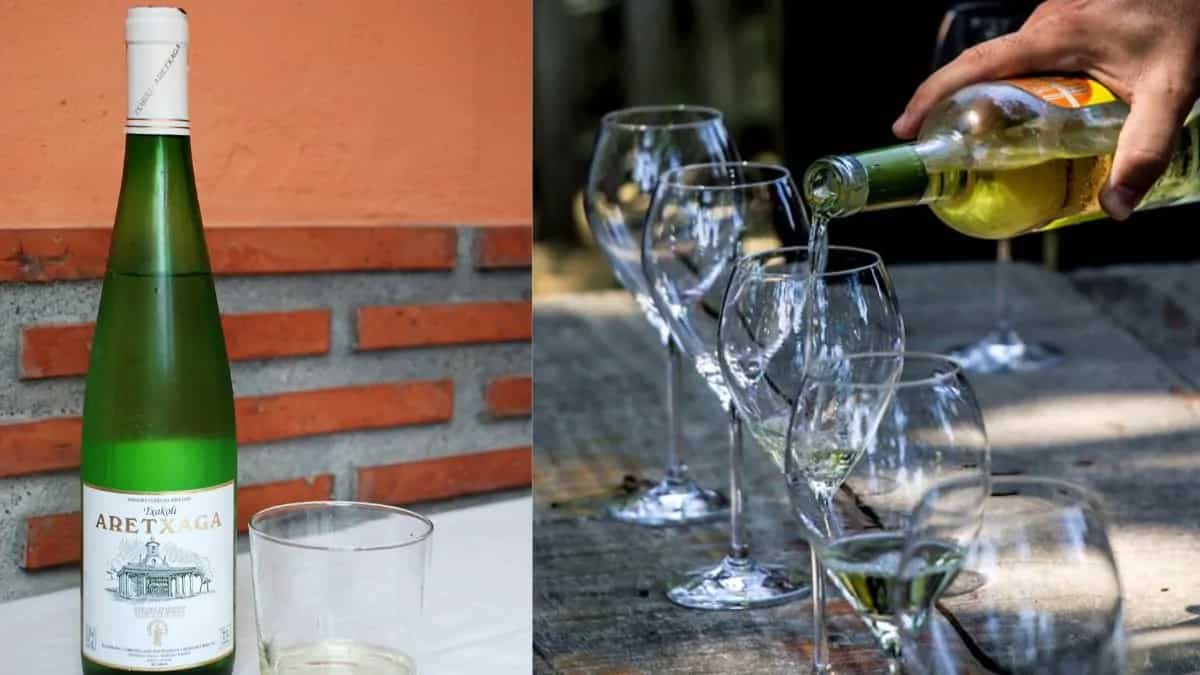
From underrated grape varieties to regional gems, Spain is full of surprise sips. Take txakoli from the Basque Country near Bilbao, a fresh, slightly fizzy white and rosé that’s complex, exciting, and totally worth discovering. A mixologue will pour a lengthy stream of wine into a wide-mouthed, flat-bottomed tumbler glass held near the waist, a few feet below, while holding the bottle almost at arm's length, high above his or her head.
Txakoli has always been known for its bracing acidity and mild effervescence, which historically occurred naturally in the bottle after fermentation in neutral barriques. It is traditionally built on the high acid, native varietals Hondarrabi Beltza (a red grape used in the production of red wines and rosés) and Hondarrabi Zuri (a white grape that makes up the majority of plantings in Getariako Txakolina D.O), located about 20 minutes by car from San Sebastian.
But the style wasn't redefined until 1989 with the creation of Getariako Txakolina DO, the region's oldest appellation, which also includes Bizkaiko Txakolina, near Bilbao, and Arabako Txakolina, further inland. This was done by using stainless steel tanks and a simplified production process that preserved the wine's now-famous effervescence. Are you intrigued already? Then let’s learn about Northern Spain’s txakoli.
An Origin With A Sense Of Belonging
Txakoli, sometimes known as Txakolina or Chacoli, is the typical wine of northern Spain's Basque area. Mists, drizzle, and lush green hillside vineyards are the hallmarks of this damp, chilly area. Many of the vineyards overlook the tumultuous Cantabrian Sea. The region is typified by tiny family wine producers that fight for both the survival of their own strongly autonomous Basque culture and maturity in this difficult climate. The majority of txakoli wine was consumed locally until recently. Txacoli's gradually increasing reputation can be attributed in part to the emergence of sommeliers' interest in rare native grape types.
Image Credit: Flickrr
Located at the base of the Pyrenees mountains on the far western end of Spain's border with France, the Basque Country of Spain is an autonomous state. Since the Roman era, 95% of the wine produced in this area has been white. Txakoli, or Txakolina as the Basques refer to it (pronounced sha-ko-Lee-na), is the most well-known and well-known white wine in the country. The Arabic name for it means "thinness." The name may be difficult to pronounce, but it's a great wine for hot weather and summertime picnics.
The majority of this wine is made from Hondarrabi Zuri, a white grape. Depending on the regulations of that particular appellation, the blend may contain a variety of local grapes. Nowadays, a lot of producers are starting to develop rosé txakoli wines, which are usually made from the red Hondarrabi Beltza and the white Hondarrabi Zuri grape.
The Science Of Siping Txakoli
Of course, a fantastic anecdote is also told about the manner in which txakoli is poured. Additionally, it enhances the wine's charm. Because of the hillside vines' high elevation, txakoli naturally has an acidic composition. It is a wine that miraculously matches with fish and seafood because of its light body and modest alcohol content (less than 11.5% abv). According to Basque custom, the wine is poured eight to ten inches above the ground into tall, flat-bottomed glasses. Depending on how close the vines are to the sea, this wine frequently has a delightful salty minerality.
Image Credit: Flickrr
The vineyards' elevation, location, and proximity to the sea all affect the wine's flavour. Other factors include the characteristics of the vintage, the mix of local varieties used in the blend, and the “house style” of the producer. To improve the wine's smoothness and complexity, some producers are experimenting with ageing it on its lees, or with spent yeast cells that remain after fermentation, in addition to the rosé version. Plus, several manufacturers are experimenting with ageing Acacia wood. Although the Basques drink this wine throughout the year, the finest seasons to pair it with fresh produce and the season's seafood may be spring and summer.
The low alcohol content of the delightful txakoli wines perfectly aligns with the current trend toward fresher, lighter types. Before long, the world will sit up and take note of this Basque gem.