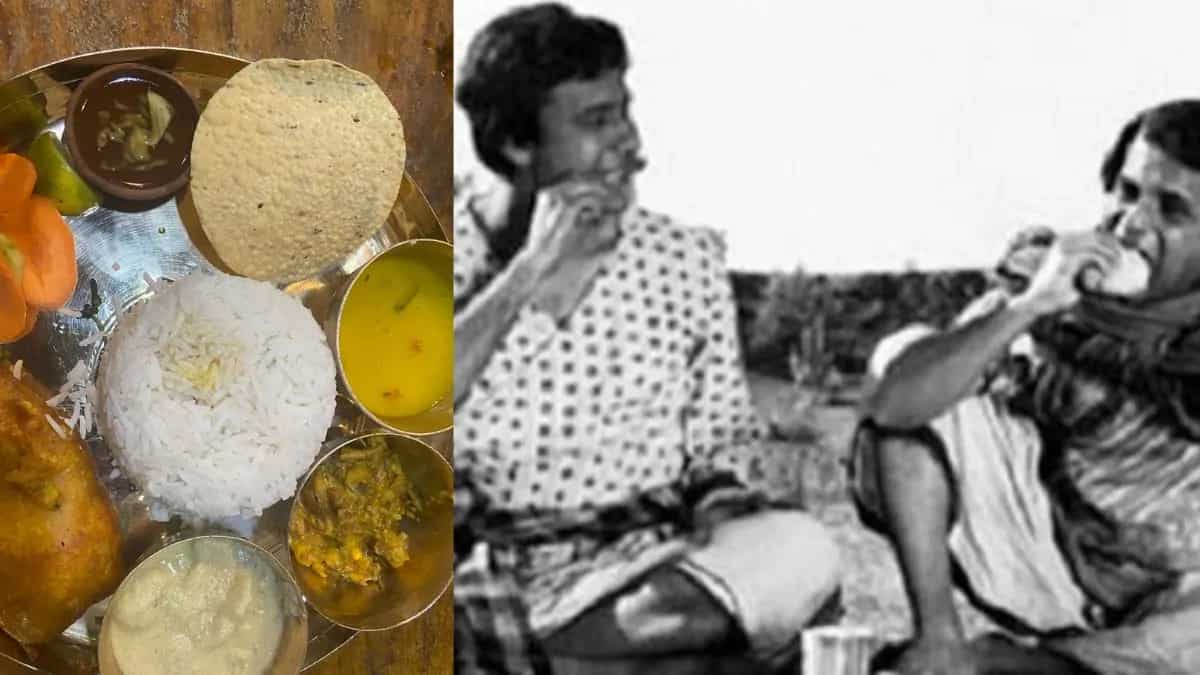
It may sound cliché or stereotypical, just like any other Bengali, that being away from home can make me yearn for the little gems of my home state’s cuisine. When you’re growing up surrounded by art, books, and great food that your mother, grandmother, and ancestors have passed down, you can never really forget your roots and where you come from, and distance from the place you call home can really throw that into focus.
Image Credit: Rajlakshmi Dastidar
After spending a few years away from West Bengal - away from home - because work mattered more, I realised something. The hardest part wasn’t the distance from home or my friends. It was the food. I missed the way meals were cooked, the familiar flavours, and everything that came with cooking and sharing food. And then, I’d remind myself, I still had it better than many. Some people get just one meal a day, and for some, even that isn’t guaranteed. Maybe that’s why food in films hits so differently, and when you’re alone, a simple scene of someone cooking, eating, or even searching for a meal can stay with you longer than big dramatic moments.
Bridging The Homesickness With Cinema
Cinema has always understood that food is never just food; it can mean home, memory, class, hunger, love, or even survival. And sometimes, without saying it directly, films remind us that what’s on a plate can also be political. Who gets to eat, who has to wait, and who goes without. And when you miss home, you try to see or do things that not only open up more tabs in your brain and make you look at the world differently, but gives you a reality check at best.
That’s what happened when I binged a few films of Satyajit Ray the last time I had to be away from home. From dinner table conversations that taught me every little thing matters, every food on my plate is valuable and if I ever struggle with food, a modest bowl of plain rice can keep me satiated, food created the core understanding of how I should lead my life and appreciate the little culinary joys. And, while I was watching his films, I realised how he uses food and portrays messages through certain scenes in his films, where hunger is not a question but a result of human inaction. Food and hunger were rarely addressed as spectacles in Satyajit Ray's films; rather, they were subtly woven into the emotional and social fabric of his narrative. Across many of his films, meals, cravings, and kitchen scenes became markers of class, affection, deprivation, and survival.
Yearning For Familiar Flavours Through Ray’s Films
This made me wonder, is it just me, as a Bengali who feels this, or are there others who feel it, and when they watch his films, they can nod along to each dialogue and scene that plays in front of them? So when the time came, I watched his films again, to get a better idea of these questions and tried answering them on my own and what I found became something of a reflection that I and many others like me experience.
Aranyer Din Ratri is the first film that brings back memories of my fascination with food as the main focus of his films. This famous Satyajit Ray film follows four young guys on vacation. So, of course, people are always looking for new and intriguing meals, and their meals are a crucial element of the plot. As soon as they reach the forest bungalow, where they don’t have a reservation, they find out the caretaker’s wife is sick, and can’t cook for them as she usually does for the guests. The caretaker reluctantly agrees to fill in, and Lokha, one of the village lads, is sent to acquire the materials from the market. Even as they set out to enjoy the jungle's beauty and quiet, the lads crave the luxuries of city life. Sanjoy wants his coffee, while Shekhar wants eggs. On their first morning, the caretaker offers them tea.
However, there is nothing to accompany the tea, and their reaction suggests that something dreadful has transpired. In Aranyer Din Ratri, food is often discussed, and its lack is cherished. When they're invited to breakfast with the Tripathi family, Shekhar's first question is, "Dim khawaben toh?" [You will feed us eggs, correct?] Food is an excellent approach for the boys to establish friendships with their family members they meet. As I grew older, the distinction between travel and food became blurred in my mind. Going to new places means new cuisines and new recipes, sure, but even now, I can only imagine how chaotic an Airbnb would feel if there was nothing to accompany tea on the first morning.
But what I miss more, more than the food itself, I believe, is the incessant conversation about food. I miss the dominant position that food has in our lives. I miss talking about the quality of the seafood in the market and the cuisine provided at weddings, that bring on discussions at the table itself about politics around food, the economic status of what food a family can afford or not and what they serve and why they serve during festivals. I miss the fact that no one notices when you mention Digene and Imodium at the dinner table.
Image Credit: Pexels
Food In Ray’s Films Reflects Society, Survival And Status
The next film where hunger is used as a narrative more often is Pather Panchali, where it is both genuinely personal and heartbreakingly understated. Indir Thakrun, the elderly, lives a life of perpetual shortage, frequently disregarded and denied necessities, which is the representation of a society that is regressive even when it comes to something as basic as daily food. Durga, moved by compassion, sneaks green chiles and fruit to share with her. Sarbajaya, burdened by poverty and the daily battle to feed her children, seems stern, but her harshness is determined by circumstance as much as disposition.
The ageing aunt Indir Thakrun's dented brass dish symbolises the utter hopelessness of her destitute, unwelcome existence. Indir is introduced with a close-up of a metal bowl full of mush, and the camera then pans back to reveal the bent, toothless woman eating from the bowl. The jug that carries her water represents the fact of her terrible demise as it tumbles noisily down the stones, implying that she is no more. Ray doesn't pay any attention to this metal vessel, so neither do we. Only after she dies and it tumbles down the steep slope due to Durga's unintentional touch does the camera close in and track its progress until it crashes into the sea, revealing that it is horribly damaged, much like its owner's life. It drowns when its owner dies, as abruptly as Indir.
Image Credit: Pexels
Food items may be found all across Pather Panchali. Little Durga conceals a guava she stole from the Mukherjees' garden inside an earthen pot behind a bunch of bananas. When Apu grows up and attends the village school, which also serves as the local grocer's shop, we see him sipping milk from a large bowl, and when he finishes, some milk streaks down the corners of his lips. We never see Durga sip milk. Durga is constantly slipping off to find something to eat. Whether it's guavas or raw mangoes from the Mukherjees' garden, she rarely heeds warnings or her mother's reprimands. She transforms her small stolen discoveries into a sour snack, silently shares it with Apu, and instructs him not to say anything. She even organises a little picnic with her pals, where the youngsters cook khichuri over a wood fire and argue about who forgot the salt and oil—just like any other bunch of kids. These moments may appear simple, even amusing, yet they convey a lot. In films like Pather Panchali, food is more than just a meal. It becomes a means to depict childhood, hunger, family problems, and the modest joys that people hold onto even when things are difficult, because if you look at some parts of my hometown, Kolkata, these are exactly what your eyes will see.
There are villages, towns and even modern Kolkata kitchens and homes that struggle to put food on the table, either due to a price surge or maybe someone’s sick at home and bills are overdue and so cheaper recipes and gas-saving dishes have to be made or maybe it’s just me sitting in a PG, eating something watery that looks like a dal and rice that’s so thick I can’t swallow it past a gulp and the feeling is almost similar to how hunger feels in this film and how it’s depicted.
I asked Anjali Mukherjee, a creative producer at Eightflow Films in Bengaluru, and a self-described Probashi Bengali—someone who grew up away from West Bengal but stayed connected to her roots through food and cinema, whether Satyajit Ray’s films had changed the way she looks at food, the emotions around it, and the stories it can tell. She remarked on how film and culinary culture had changed over time, and certain scenes from his films reflect modern world problems around food, status and power. "The way we look at food has changed with society," she stated. “When I was in college, eating was often seen as a means to an end. But, throughout time, food has been associated with memory, identity, and storytelling. She also mentioned Ray's cinematic approach to food, which affected not only audiences but generations of filmmakers.
According to her, directors such as Aparna Sen and Srijit Mukherji have carried on that sensitivity, depicting food as an emotional and cultural language in their films rather than just a prop. That influence inevitably makes its way into her food habits daily, especially while preparing Bengali cuisine away from home.
A Feast, A Famine, A Revolution
51 years after its release, Satyajit Ray's first children's film, Goopy Gyne Bagha Byne or The Adventures of Goopy Bagha (1969), remains at its core - as perfectly summarised in the preceding few lines - a story exposing the futility of war while exploring various social issues plaguing the world at the time of its production. The film begins with a classic folktale set in rural Bengal, where Goopy is a poor farmer's kid who aspires to be an artist, namely a classical vocalist. He is endearingly goofy, as his name implies, and is frequently taken advantage of. Despite his lack of aptitude, he spends his days practising music, earning his father's chastising, but refuses to acknowledge his defects or change. This fervent love of music does not sit well with the other inhabitants of his community since "classical music and farming don't mix, especially in traditional Indian cultures". Farmers meant for labour and the production of food aren’t welcome to try to ascend to higher levels where music resides.
When disaster strikes, the story moves forward, and Goopy is now an impoverished and hungry nomadic resident of the forests. The forest, a dangerous site meant for punishment, crimes and the wild, is presented by Ray, at odds with its conventional situation in Goopy’s life. It becomes a very essential venue, allowing for the first interaction between Goopy and Bagha, which eventually alters their lives. Bagha, an exiled musician with his dhol, is first frightened by the arrival of a stranger, but gradually relents when he discovers that the two are quite similar. Their enthusiastic self-preservation performance inspires change and blessing brought to them by the pleased Bhooter Raja (King of Ghosts), who, unlike humans, is pleased with their off-key performance and presents his own, emphasising the concept of differing tastes in different beings and cementing the story's historical and political allegory.
Ray altered the sequence in which his grandfather delivered the three wishes given by the Bhooter Raja, probably to emphasise the necessity of food in life. Food is one of the most basic human needs, dictating how individuals live and behave. As a result, food must be the major desire of two banished simpletons who have no idea what the future holds. Even when the food emerges out of thin air in an extravagantly elaborate set of plates and bowls, the starving heroes take the time to wash their hands and clean up for the feast that awaits them. While eating ravenously, they reflect on their futures, recognising the value of togetherness and choosing to try their luck as court musicians, saving some food and thought for a stray, sharing their wealth with the weaker and defenceless creature, whatever small it may be. After making a few funny mistakes in deciding where to put their newly learned abilities to the test, they stumble into a "classical musicians" party on their way to a tournament in the distant Kingdom of Shundi. The courageous couple decides to follow them, test their newly acquired musical abilities, and try to please the monarch. This allows Ray to provocatively set his story in the two diametrically opposite kingdoms of Shundi and Halla, into which the couple is moved. Food is utilised to show contrasts between the two kingdoms, the status of the people, and, eventually, as a weapon to avert conflict.
Shundi's wealth is demonstrated when Goopy and Bagha visit the kingdom via lush fields and find themselves in a bustling and vibrant market, despite the fact that the kingdom's inhabitants are unable to communicate. Unaccustomed to receiving favours from strangers, they are distrustful and clearly thrilled when a man presents them fruit out of pure kindness - an action that demonstrates, beyond human sensitivity, the economic security of the inhabitants of this area. In sharp contrast, we are frequently shown the conditions of the soldiers training for battle in Halla.
Image Credit: Wikimedia Commons
It is evident relatively quickly that these citizens haven't eaten in days, are destitute, and that the administration's despotism is exposed. In another incident, the wicked minister is seen enjoying meat in front of his employee, a spy who provides him with information about Shundi. When the minister notices the weak guy looking at him eat and realises he hasn't eaten in days, he mocks him by alluding to his class and saying, “Tomra shob shomoy khai khai koro keno bolo toh? (Why do you people always talk of eating?)." When Goopy and Bagha are imprisoned and fed like captives, we have a bit less sophisticated knowledge of the plight of the people of Halla (aptly called). At first, they wonder if it's for rodents and refuse to eat despite their hunger. Finally, the minister intervenes and compels them to consume the food, which is served in primitive bowls, telling them that this is what all compatriots in the kingdom eat. What is also awful is his attitude, in which he refuses to let them wash their hands and entertains himself by watching them eat miserably.
Food is a strong tool, and it is frequently the first and most obvious reason we go to work, or work hard. It is our most fundamental need, and it physically manifests itself at least three times every day. It is also quite effective in inducing pleasure. In the face of extreme hunger and poverty, a nice dinner is a far more effective and immediate inducement than money, and this is ultimately what turns the tale around. The starved guard wakes up to finding the two prisoners, who are supposed to be much worse off than even he is, eating the most lavish meal he has ever seen, so much so that Goopy and Bagha end up having to explain to him what the individual items are called. Even though he can't speak, he shouts with joy at the sight of the meal.
The charitable convicts take advantage of this chance to not only share their goodness, but also to escape, as the guard unlocks the jail cell door and pounces on the fish head, unconcerned about his duties. Finally, the battle is ended with the use of music - the global language of peace, and food, which ends up capturing the attention of the physically weak warriors, as Goopy and Bagha shout to the sky. As troops and even the wicked minister rush for the sweets falling from the sky, there is a stampede. An opportunity to satisfy greed and hunger provide an odd diversion, allowing the two musicians to restore peace to both realms. Ray, ever the visionary, planted food firmly in the plot in novel ways that underlined the value of sustenance in people's lives, as well as food as a commodity, at a time when the country and various regions of the world were still rebuilding from conflicts and learning to rectify previous harm.
In conversation with Indrajit Lahiri, cultural storyteller and founder of Foodka, he explains how food in Ray’s cinema maps social hierarchy—between zamindars, urban bhadralok, and rural households. He tells me, “Ray was very sharp here. In Jalsaghar or even Kapurush Mahapurush, food feels like a display, almost like it’s part of the performance of being rich. There’s excess, but also a kind of emptiness behind it. Then, in something like Mahanagar, food becomes practical. It fits into a schedule. It’s about managing time, money, and routine.”
Food Becomes A Mirror Of Tension & Truth In Ray’s Films
Ray directed Shakha Proshakha (The Branches of the Tree) in 1990. The film tells the narrative of an emancipated upper-middle-class family who had reunited after many years apart. In the film, there is a lengthy sequence in which the protagonists enjoy a full course dinner and catch up on family concerns. As the discussion flowed effortlessly during the lunch, suspense steadily built in the film, smoothing the transition to the next phase. The awful, psychodramatic moment occurs while all of them are at the dinner table, and two of the brothers (Prabodh and Probir) discuss their occupations. The mood is tight and dismal, and everyone is eating in a state of numb anticipation. Then, at the dinner table, everything changes. Proshanto starts slamming his fist on the table in a constant pace. Plates tremble, silverware rattles, and the dinner comes to an end. No one knows what to say, yet everyone understands something is deeply wrong.
Decades later, those dinner-table situations remain uncomfortably familiar in today's households. What struck me the most was Ray's pointed reminder: in a movie, food may demonstrate inequity more effectively than language ever could. In Agantuk, the returning uncle, Manomohan, may have toured the world for decades, but the supper waiting for him at a Bengali table is clearly home, shukto, shaak, daler bora, fish, and mutton curry. In Agantuk, I was shocked by Manomohan's disturbing discourse about cannibalism.
When Ray casually discusses tribes, culinary patterns, and what people deem "civilised," he makes me wonder if we are truly characterised by what we eat or how we choose to live with one another. If one civilisation consumes something that another culture deems offensive, who judges what is sophisticated and what is primitive? Ray uses food to disrupt the comfort of middle-class morality and invites us to look beyond appearances.
Ray, as we all know, was a perfectionist who paid great attention to the smallest details in his films. So it's no wonder that when he depicts food in his films, he pays close attention to detail. Mr Indrajit Lahiri also noted how food rituals like serving, eating together, and hierarchy at the table mirror what you saw in his films. He said that it was “Almost identical. In our homes, food wasn’t chaotic. There was a rhythm to it. Who gets served first, how things are passed around, when you start eating, none of it was spoken, but everyone knew. Watching Ray, I realised he understood that these small things define a household.”
That's what Satyajit Ray nailed so well. He transformed the dinner table, which is often used for food, family, and discussion, into a location where stillness, tension, and unsaid emotions emerge. At the same time, his films opened up a new thought process in my head around questions that many ask and are trending all the time, such as ‘Is food political?’ or ‘Does financial stability or inability control what’s on the plate?’ or maybe it’s as simple as ‘Oh, this is what you eat in a day?’ All I have for such questions is, yes, food is deeply political. Yes, financial reality dictates every morsel on the plate. But Ray's genius was in never making it a lecture; he made it a feeling. And perhaps that is the most honest answer to all those trending questions, not a policy argument, not a food diary, but a quiet, unflinching look at a plate and everything it reveals about the hand that set it there.