


 Share
Share

HUNGER has never stayed confined to the body. It has travelled through history as a warning passed hand to hand, a courtroom drama played out over a shared plate, a last meal request that never arrived in time. If you want to sit with these ideas a little longer after today's newsletter, these four reads are where we'd point you next.
Start with Freedom On A Plate: How Food Became A Weapon For Liberation, which opens on Gandhi at Dandi and doesn't stop there — it moves through the Boston Tea Party, Haiti's forbidden soup joumou, the bread riots that fed into the Arab Spring, the Black Panthers' breakfast programme, and even the watermelon slice that quietly stands in for a flag Palestinians have often been forbidden to raise. It's less an essay than a world tour, and its real achievement is showing how many different registers "food as protest" can be spoken in — from theatre to sabotage to slow, patient nourishment.
Then there's Bhagat Singh: Food Vignettes From The Martyr's Life, a smaller, quieter piece that circles the same young revolutionary who once starved himself for over a hundred days in jail — but finds him here in gentler moments: arguing that an egg is basically a fruit, requesting a home-cooked last meal that a grieving sweeper named Bebe was never able to deliver, sneaking out at night for a kulhar of milk with rabri on top. It's a useful corrective to the marble-statue version of a martyr — a reminder that the men who starved for a cause also had appetites, jokes, and cravings right up until the end.
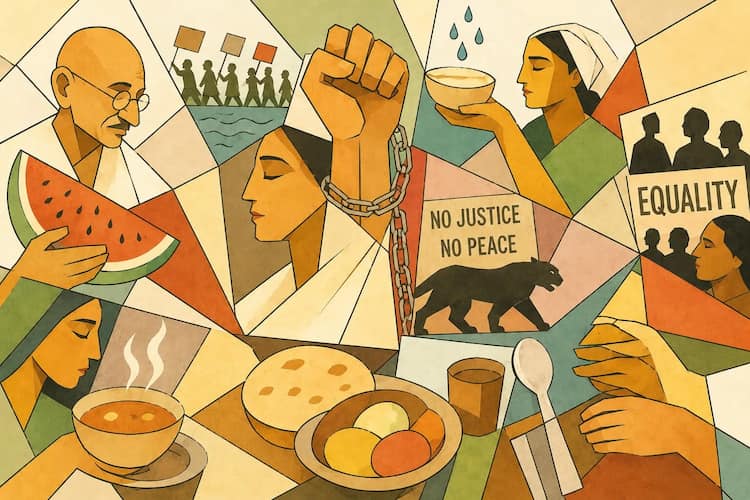
For the longer view, From Chapatis & The 1857 Revolt To France's Flour War: Foods That Fed Revolutions is the closest thing to a syllabus — flour, bread, tea, potatoes and salt, each traced through the uprisings they helped ignite, from the still-unexplained chapati network that unsettled British magistrates months before 1857, to the French crowds who stormed granaries a full fourteen years before they stormed the Bastille. Read together, these five ingredients make an argument of their own: that revolutions rarely begin with ideology alone. More often, they begin with an empty larder.
And finally, Dr Ambedkar's Campaign For Democratic Dining turns the lens away from scarcity and toward the table itself as the site of struggle. It follows Babasaheb Ambedkar's decades-long insistence that caste Hindus and "untouchables" sit down and eat together — through the Samaj Samata Sangh's monthly dinners, a candlelit sahabhojan in Pune that survived a deliberately cut power line, and a 1930 dinner in London that made front-page news in the New York Times simply for existing. Here, the protest isn't refusing food. It's insisting on sharing it — and discovering how much resistance that simple act alone could provoke.
Read in sequence, these four pieces circle the same truth from four different directions: that hunger — whether endured, denied, weaponised, or shared — has always been one of the more honest languages available to the powerless. It asks nothing that requires literacy, permission, or platform. Just a body, and a willingness to let it speak.




