


 Share
Share

THE FIRST MISTAKE is to imagine a pudding shop.
The English phrase suggests glass counters, paper cups and a narrow commitment to dessert. Somewhere that opens after lunch, perhaps, and smells predominantly of vanilla. Somewhere one visits because one has already eaten.
An Istanbul muhallebici is harder to categorise. It may greet the morning with eggs scrambled with tomatoes and peppers. At lunchtime, there may be bowls of chicken soup, chickpeas and rice under bright lights. Office workers arrive alone. Families occupy long tables. Someone orders only tea. Someone else eats chicken and rice, then follows it with a milk pudding that may also contain chicken.
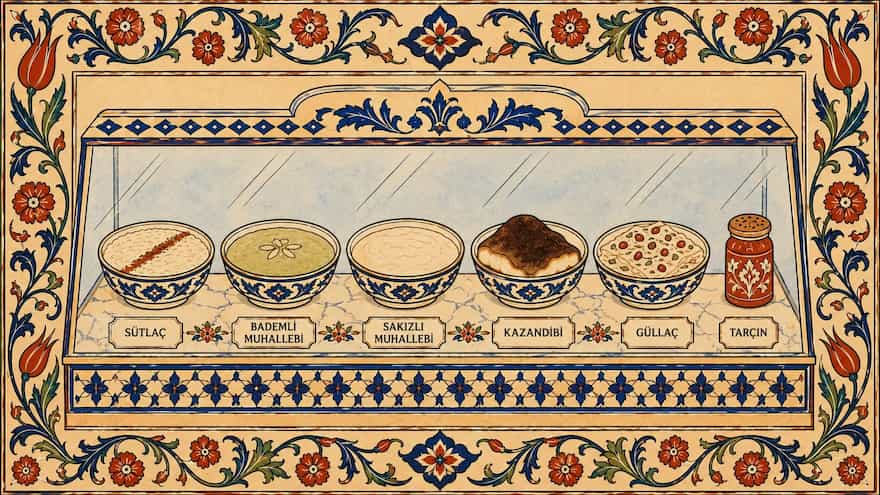
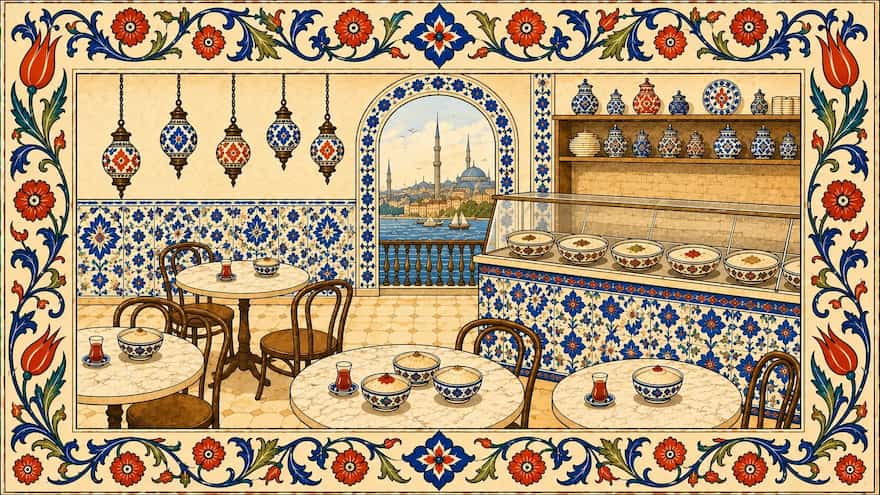
The desserts wait in refrigerated cases: pale bowls of rice pudding, almond-thickened keşkül, elastic sheets of tavuk göğsü, and folded portions of kazandibi with their scorched brown surfaces turned proudly upwards. Cinnamon sits in a shaker nearby. Pistachios may appear as decoration, though these are not generally sweets that depend on ornament.
The room is neither quite a restaurant nor quite a café. It is too useful to be merely nostalgic and too old-fashioned to feel designed. It operates according to one of the city’s enduring needs: there must always be somewhere respectable, affordable and unceremonious to sit down.
For generations, the muhallebici has been that place.
Its history belongs partly to the evolution of Ottoman sweets, partly to the migration of Anatolian families into Istanbul, and partly to the lives of women navigating a city whose traditional coffee houses were not made for them. It is also a history of kitchen practicality. The savoury meal and the dessert were once connected by the anatomy of the same bird.
All of this survives in rooms built around milk.
A PUBLIC ROOM FOR PUDDING
The word muhallebici derives from muhallebi, the broad family of milk puddings thickened with rice or starch. Yet the establishment attached to the word became larger than its speciality.
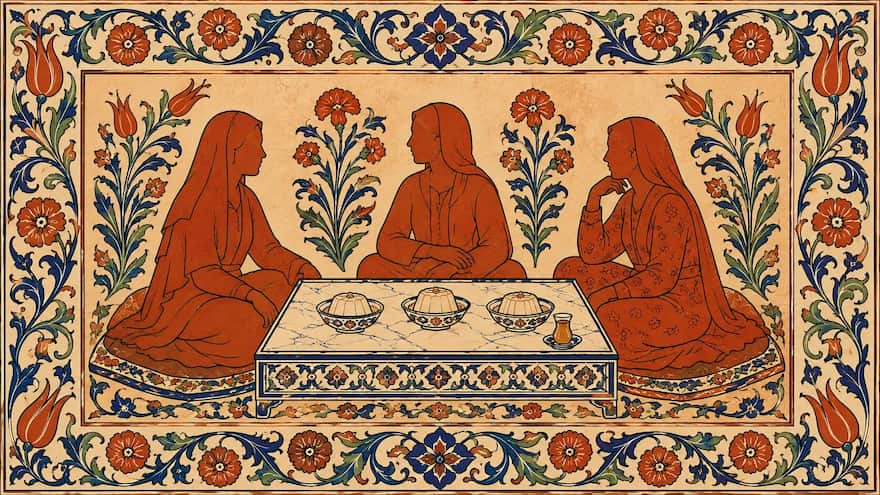
A muhallebici could serve as a neighbourhood dining room: open early enough for breakfast, available through lunch, and still illuminated late in the evening. It required neither the formality of a restaurant nor the lingering masculine culture of the coffee house.
That distinction mattered.
Traditional coffee houses in Ottoman and later Turkish urban life were social institutions, but overwhelmingly male-centric. Men gathered to drink coffee, smoke, play games, discuss politics and pass the time. A woman entering alone would not simply have been conspicuous; in many periods and neighbourhoods, the idea would have been socially unthinkable.
Pudding shops occupied different ground. They were public without being disreputable, sociable without centring on alcohol, and casual without carrying the gendered associations of the coffee house. Women and girls could meet there. Families could stop in. A young couple could sit together under the supervision of a room that was public enough to be safe and ordinary enough not to be remarked upon.
The pudding was part of the permission.
Milk desserts carried associations of nourishment, domesticity and moderation. A shop selling them did not announce danger or dissipation. It offered something soothing and familiar, served in a clean, brightly lit room where people came and went throughout the day.
In a city organised through countless informal rules about who could occupy which spaces, the muhallebici quietly widened the map.
It is easy to sentimentalise this role — to imagine every pudding shop as a sanctuary and every bowl of muhallebi as an act of emancipation. The reality would have been more ordinary. That is precisely what made the shops important. They did not need to declare themselves socially radical. They simply gave women somewhere to be.
A safe public space can look remarkably undramatic from inside it. A marble-topped table. A spoon against a glass bowl. Two friends talking longer than they had intended.
A CUISINE OF PALE SURFACES
The desserts themselves can appear almost austere beside Turkey’s more internationally famous sweets.
Baklava announces its labour. Its layers are visible, its nuts abundant, its syrup gleaming. Künefe arrives hot, dramatic and structurally improbable, crisp pastry concealing cheese that stretches as the portion is lifted. Kadayıf is tangled, golden and soaked.
A tray of milk pudding does not behave this way. Its surface is often white. Its ingredients are few. Its pleasures emerge through temperature, texture, fragrance and the quality of the milk.
This family is known as sütlü tatlılar: milk-based sweets. They include sütlaç, Turkey’s ubiquitous rice pudding; keşkül, made with ground almonds; mastic-scented sakızlı muhallebi; tavuk göğsü, thickened traditionally with finely shredded chicken breast; and kazandibi, in which the bottom of the pudding is deliberately scorched against a metal tray.
Their apparent simplicity is deceptive. When a dessert is made primarily from milk, sugar and starch, every weakness becomes apparent. There is no chocolate to dominate mediocre dairy, no syrup to flood the palate, no heavy spice mixture to distract from a poorly cooked base.
The milk must taste of something.
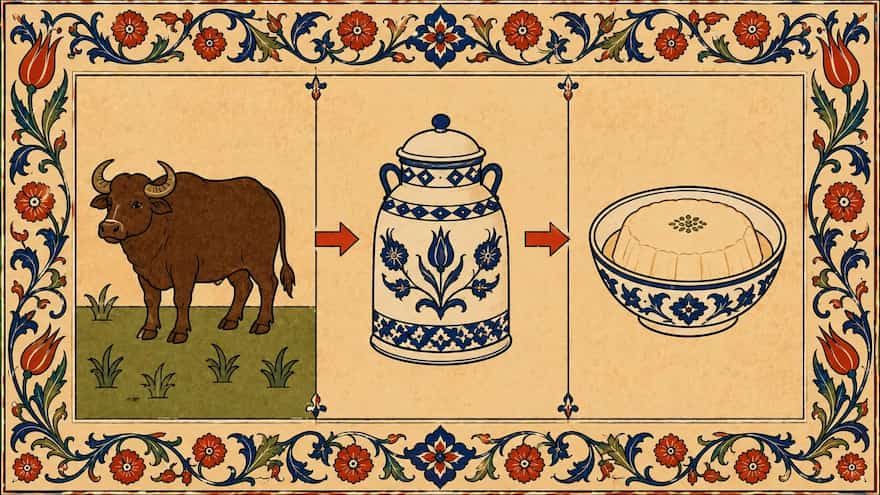
Historically, buffalo milk was particularly prized. Richer, sweeter and higher in fat than ordinary cow’s milk, it gave puddings body without requiring the quantities of cream or egg associated with many European custards. It produced a sweet that felt substantial but remained recognisably milky.
The connection between dairy and pudding became so important that some established shops sought control over the entire supply chain. Saray Muhallebicisi, founded in 1935, has long publicised its own large water buffalo farming operation. Posters have promised a direct journey from the animals to the table.
The language belongs partly to marketing, but the logic is culinary. If the recipe depends upon three ingredients, owning the source of the most important one is not extravagance. It is quality control.
A pudding shop running a buffalo farm may seem an implausibly grand solution to the problem of dessert. Yet it reveals how seriously these establishments took foods that looked, to the uninitiated, like bowls of beige and white.
THE CHICKEN PROBLEM
The older muhallebici menu carries one of the most peculiar examples of kitchen economy in Istanbul.
Traditional tavuk göğsü requires chicken breast. The meat is boiled, separated into extremely fine fibres and repeatedly washed or pounded before being cooked with milk, sugar and starch. By the time the pudding is finished, the chicken is largely invisible. It contributes not a recognisable poultry flavour but structure: a dense, elastic quality that starch alone does not reproduce exactly.
A restaurant cannot conveniently purchase only the symbolic idea of a chicken breast. Historically, shops bought whole birds. Once the breasts had been reserved for pudding, the darker meat remained.
So the pudding shop served chicken.
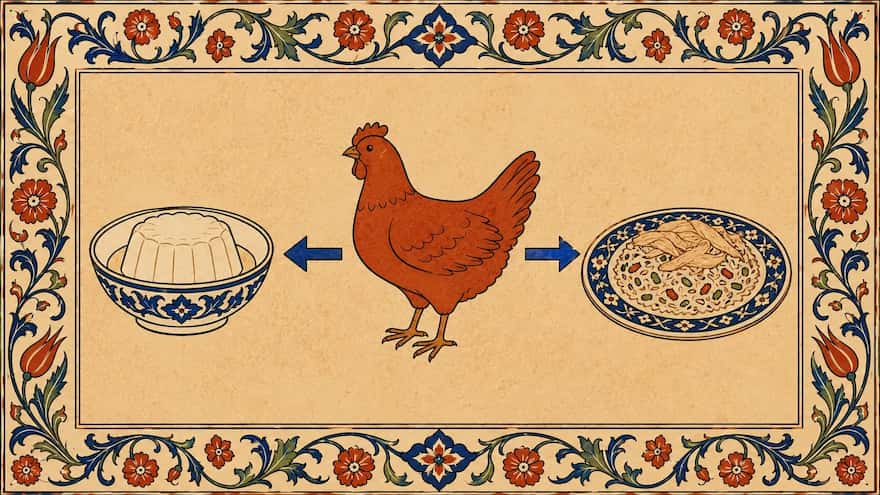
It appeared in soup, over rice, or in other inexpensive savoury dishes. Tavuklu pilav — chicken with rice — became a natural companion to a dessert operation that generated cooked legs and thighs every day. The menu was not divided into a savoury business and a sweet business. It was a single system.
A customer could therefore eat chicken and rice, followed by tavuk göğsü, consuming two halves of the same practical decision. One dish used the meat diners expected to eat; the other transformed the breast into a sweet whose presence would be almost impossible to detect.
This culinary loop is often presented as a charming curiosity. It is also evidence of how small food businesses survive. Ingredients must move. Waste must become lunch. The prestige of an Ottoman-derived pudding depends upon somebody finding a use for a pot of dark meat.
The muhallebici may have served imperial desserts, but its kitchen operated according to the unromantic arithmetic of neighbourhood dining.
NEW ISTANBUL, OLD HOMETOWNS
Many pudding shops also contain the history of migration to Istanbul.
As families arrived from different parts of Anatolia, they opened businesses that offered both livelihood and continuity. Some named their shops after the towns or regions they had left behind. The name above the door could function as a declaration of origin: we are in Istanbul now, but this is where we came from.
Göreme Muhallebicisi, established in the Kurtuluş neighbourhood in 1965, is one such example. The name invokes Göreme in Cappadocia, tying a city establishment to an Anatolian homeland.
This pattern is familiar across the world. Migrants frequently enter urban life through food because food can be made with inherited knowledge, family labour and relatively little explanation. Yet the muhallebici did not necessarily reproduce a narrowly regional cuisine. It became part of Istanbul’s shared repertoire.
That transformation matters. The shop could retain the memory of a hometown while serving as a city-wide institution. A family’s migration story became embedded in dishes that Istanbul residents understood as their own.
The city itself changed around these businesses. Apartment blocks rose. Tram routes shifted. Neighbourhood populations altered. International chains arrived with their standardised cups and menus. The word “dessert” expanded to include cheesecakes, brownies, waffles piled with fruit and sauces, and brightly branded cafés designed for photographs.
The older pudding shop remained stubbornly functional. Its display cases could look almost unchanged. Its dishes did not need reinvention every season. The most compelling visual effect might still be the scorched skin on a piece of kazandibi.
This constancy now attracts a language of disappearance. Visitors and food writers often describe historic muhallebici as remnants of “old Istanbul”, treating them as windows into a gentler, more authentic city.
But “old Istanbul” is a slippery destination. It can mean the Ottoman capital, the republican city of the 1930s, the migrant Istanbul of the 1960s, or simply the version that existed before the speaker arrived. Nostalgia compresses these periods into one imagined past where shops were independent, milk came from buffaloes, and nobody ate dessert from a disposable cup.
A functioning muhallebici is not valuable because it has escaped time. It has not. It has changed suppliers, adapted recipes, removed chicken from some puddings and perhaps added vanilla to others. It may serve tourists who discovered it on social media alongside residents who have eaten there for decades.
Tradition survives partly by tolerating impurity.
WHAT REMAINS AFTER THE BURN
Kazandibi makes the most dramatic case for this principle.
Its name means the bottom of the pan. The dessert is prepared by cooking a milk pudding in a metal tray until its underside darkens and catches. The base is scraped up, folded or rolled, and served with the burnt portion visible.
The effect is striking: a pale, wobbly square bearing a brown-black skin. Beneath the scorch, the pudding is cool, smooth and faintly elastic. The top tastes of coffee, caramel and controlled bitterness. The milk below softens the burn.
The traditional version begins with tavuk göğsü, meaning that the pudding contains chicken fibres. Many modern versions do not. There are also disagreements over how the crust should be produced. Some cooks dust the pan with sugar to encourage caramelisation. Purists insist that the milk itself should burn directly against the metal, creating an earthier, less confectionery taste.
A dish that appears to depend upon a simple accident is therefore surrounded by rules.
How dark is dark enough? Should the pan be sugared? Must the pudding contain chicken? Can cornstarch stand in for soaked and ground rice? Is cow’s milk sufficient? Does vanilla improve the dessert or blur its identity?
These arguments are not incidental to tradition. They are how tradition continues. A food nobody debates is often a food nobody is making.
The muhallebici gives such disagreements a home. It turns dessert from a recipe into an institution: a supply chain, a daily clientele, a style of service and a set of expectations built across generations.
SOMEWHERE TO SIT
Perhaps the deepest appeal of the pudding shop is not that it preserves a rare Ottoman technique or provides access to buffalo milk. It is that it remains a place one can enter without a plan.
Travel writing tends to seek culmination. The hidden restaurant. The perfect view. The dish worth crossing a city to taste. Yet much of a city’s food culture is built around establishments that relieve people of the need for occasion.
The muhallebici is useful when it is raining, when the afternoon has stretched unexpectedly, when a child needs feeding, when two friends want to talk, when one person does not wish to go home yet. It serves lunch without ceremony and dessert without celebration.
There is dignity in that ordinariness.
At a table, a bowl of sütlaç may arrive with cinnamon across its surface. The rice has softened into the milk but has not disappeared. Nearby, a portion of keşkül carries the nuttiness of almonds. A sheet of tavuk göğsü resists the spoon slightly before yielding. Kazandibi bears the dark record of the tray in which it was cooked.
None is excessively sweet. They are not designed to stun the palate into silence. They soothe, perfume and conclude.
Turkish dessert culture is often represented abroad through abundance: syrup, pistachios, stacked pastry, and the inherited splendour of imperial confectionery. The pudding shop preserves another form of luxury. Good milk. Slow cooking. A cool bowl. A clean table in a room where one is permitted to remain.
Its history includes sultans, buffalo herds, migrant entrepreneurs and the practical redistribution of chicken parts. It includes women claiming space in the city without needing to call the act a claim. It includes foods travelling from palaces into neighbourhood shops and becoming less exclusive without losing their strangeness.
A muhallebici may be a diner, a dessert parlour, a meeting place or a memory. Most successfully, it is all of these without insisting upon any of them.
The spoon goes through the scorched skin of the kazandibi. Beneath it, the pudding trembles but holds.
So, somehow, does the shop.




