


 Share
Share

THERE IS SOMETHING faintly confrontational about the first appearance of kazandibi.
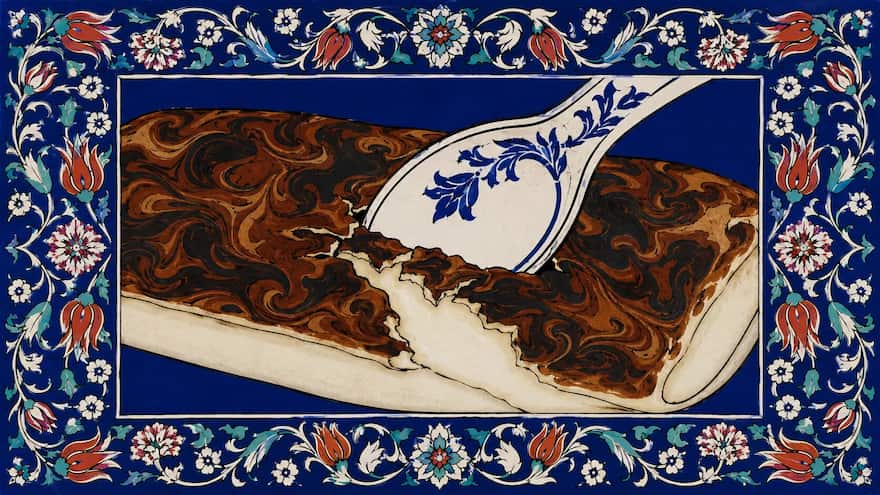
It arrives not in the jewelled geometry associated with Turkish pastry, nor shining beneath syrup, nor crowned with a triumphant green drift of pistachios. Instead, it lies folded upon the plate like a thick square of cream-coloured fabric, its surface mottled brown and black. One side is smooth and milky. The other looks as though somebody has neglected it.
This is not a flaw. It is the point.
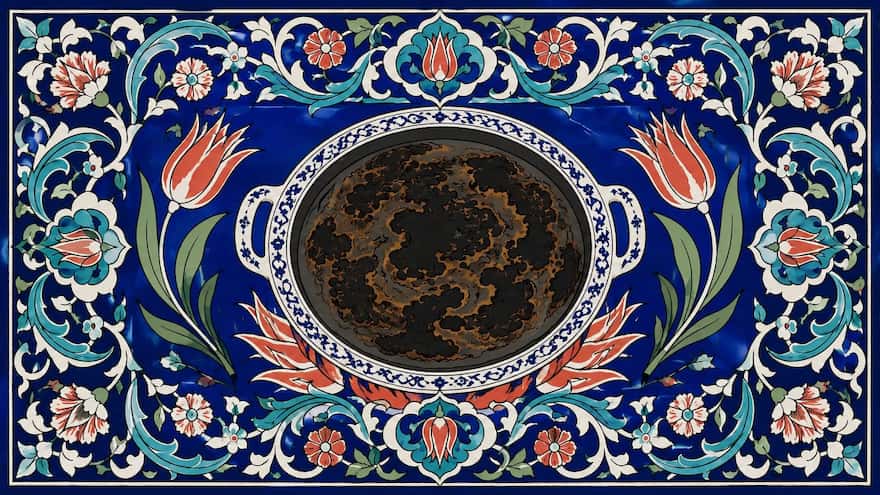
The name kazandibi means “the bottom of the cauldron” or “the bottom of the pan”, and the dessert is created by allowing—or compelling—the lowest layer of a milk pudding to catch against hot metal. The scorched portion is loosened from the tray, rolled or folded over, and presented uppermost: the evidence of the burn displayed rather than concealed.
The result belongs to that small family of foods whose identity depends upon approaching culinary disaster and stopping at precisely the right moment. Like the dark dome of a Basque cheesecake or the crackling lid of crème brûlée, kazandibi turns damage into flavour. Yet it is less brittle than crème brûlée and far more yielding than cake. Beneath the mahogany crust, the pudding trembles. It is dense, elastic and cool, almost chewable—a texture that can recall mochi more readily than the soft custards of Europe.
Its flavour first appears simple: fresh milk, gentle sweetness, perhaps cinnamon or the piney murmur of mastic. Then comes the bottom of the pan. It tastes of caramel, but also of toasted grain, dark coffee and something faintly earthy. In the oldest versions, there may be another, still more elusive savouriness underneath.
That is because traditional kazandibi is not merely a burnt milk pudding. It is the burnt form of a pudding made with chicken breast.
THE BIRD INSIDE THE PUDDING
Before kazandibi, there was tavuk göğsü: literally, “chicken breast”.
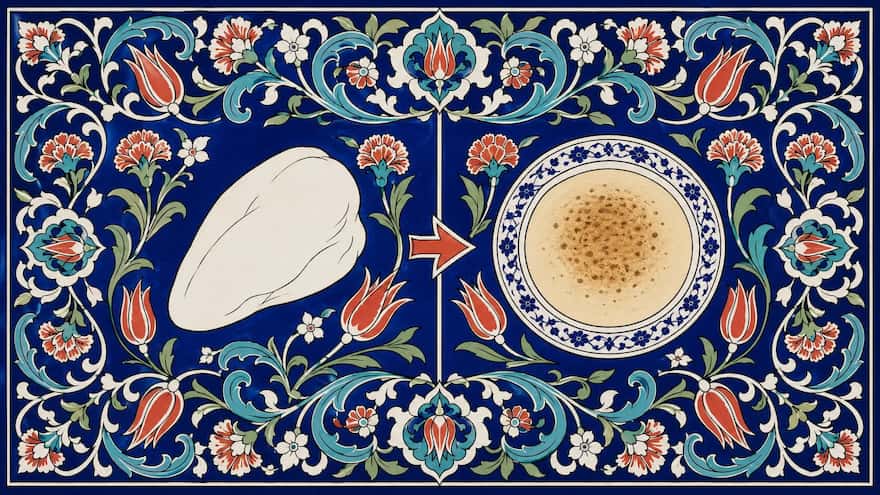
The name is not metaphorical. Chicken is boiled, pulled into increasingly fine threads and pounded until its fibres almost disappear. It is then cooked with milk, sugar and a starch—historically a paste called sübye, prepared by soaking and grinding rice—until the ingredients become a thick, glossy pudding.
There should be no recognisable pieces of meat. A properly made tavuk göğsü does not taste like a sweetened chicken dinner. The breast fibres function structurally, lending the pudding its peculiar density and stretch. But they can leave behind a low current of umami: something sensed rather than immediately identified.
To a modern diner accustomed to policing the border between savoury and sweet, chicken pudding sounds like provocation. To medieval cooks, it would have been less extraordinary. Similar combinations existed in Byzantine cookery, while early European blancmanges paired poultry with rice, milk, sugar and almonds. Sweetness was not yet confined to the end of a meal, and meat did not always know that it was supposed to remain on the savoury side.
The Ottoman palace kitchens inherited, refined and elaborated this culinary world. Food historians associate both tavuk göğsü and kazandibi with the kitchens of Topkapı Palace, where enormous teams of cooks prepared highly codified dishes for the imperial household. Culinary lore sometimes makes the pudding a favourite of Mehmed II, conqueror of Constantinople. Another story imagines an impatient sultan demanding a sweet in the middle of the night, forcing the palace cooks to improvise with the only suitable ingredient left in the kitchen: chicken.
Kazandibi has its own origin myth. In the familiar telling, a distracted palace cook left a tray of pudding over the flame for too long. The base burned. Rather than throw it away, someone tasted it and discovered that the bitterness of the char sharpened the milk’s sweetness.
It is an appealing story, as stories about accidental invention tend to be. It turns the palace kitchen into a place of recognisable panic: a forgotten pan, an approaching sovereign, a cook trying to disguise a mistake. Whether it happened is almost beside the point. Kazandibi feels accidental even when produced through meticulous repetition. Its burn must always look a little transgressive.
Today, many versions contain no chicken at all. These are often described as muhallebi kazandibi: a starch-thickened milk pudding caramelised in the same manner. They are easier to produce and considerably easier to explain to visitors. Yet the chicken-based original remains one of the clearest reminders that Ottoman dessert was not built according to the categories through which contemporary diners understand sweetness.
MILK, FLAME & ARGUMENT
Kazandibi appears minimalist. Its ingredients may amount to little more than milk, sugar and starch. Minimalism, however, can be demanding. There is nowhere for indifferent milk to hide.
Traditional Turkish milk puddings do not necessarily depend upon eggs or large quantities of cream for richness. Their character emerges through the quality of the dairy and the patience of the cooking. Buffalo milk, naturally sweeter and higher in fat than cow’s milk, has long been particularly prized.
This helps explain why some of Turkey’s most established pudding shops have sought extraordinary control over their milk supply. Saray Muhallebicisi, an Istanbul institution founded in 1935, has promoted the fact that it operates its own large water-buffalo farm. The claim is more than pastoral branding. When a pudding contains so little, the distance between an ordinary version and a memorable one may begin at the farm.
Then there is the matter of the burn.
Some cooks grease the metal tray and dust it with powdered sugar before adding the pudding, creating a readily caramelised foundation. Others use butter or beet sugar. Purists object. In a proper pastry shop, they argue, the milk mixture itself should be placed in direct contact with the heated metal. Adding a separate layer of sugar may produce a handsome crust, but it also makes the flavour more conventionally caramel-like. The direct burn is harsher, milkier and more mineral.
The tray is moved over the flame so that the base scorches evenly. Once chilled, the pudding must be scraped up without losing the dark skin on which its identity depends. The serving is then turned over or folded so the scorched underside becomes its face.
It is a dessert assembled through reversals. The bottom becomes the top. Chicken becomes pudding. Burning becomes craft. A pale, restrained sweet acquires its strongest flavour from a blackened surface.
BEYOND THE BAKLAVA POSTCARD
Outside Turkey, the phrase “Turkish dessert” frequently summons a particular sort of abundance. There is baklava, its phyllo layers lacquered with syrup and butter. There is künefe, in which fine strands of pastry surround molten cheese before being soaked in syrup. There is kadayıf, crisp, tangled and often packed with nuts. These are desserts of intricacy and spectacle, their sweetness inseparable from the crunch of pastry and the gleam of syrup.
They are not false representatives. But they are incomplete ones.
Turkish dessert culture contains an equally important repertoire of sütlü tatlılar: milk-based sweets whose pleasures are quieter. They tend to be pale, soft and comparatively restrained, built from milk, rice, starch, nuts or fragrant resins. Rather than announce a feast, they often settle it.
There is sütlaç, the rice pudding found almost everywhere, sometimes baked until its surface blisters into brown patches. There is keşkül, enriched with almonds and often finished with pistachios or coconut. Sakızlı muhallebi carries the resinous aroma of mastic, an Aegean flavour that suggests pine needles, juniper and sea air without tasting exactly like any of them.
And there is güllaç, most closely associated with Ramadan: fragile starch wafers softened in sweetened milk and layered with nuts. Where kazandibi is dense and elastic, güllaç is wet, light and almost weightless. It is frequently perfumed with rose water and decorated with pomegranate seeds, the fruit’s red brightness scattered across a white surface.
These puddings do not stand in opposition to baklava so much as complete the cuisine’s sense of balance. The same table can accommodate syrup and milk, crunch and wobble, splendour and repose. Sweetness does not have one ideal form.
Kazandibi occupies an unusual position even within this milky family. It lacks the innocence of a plain pudding. It takes the soothing qualities of milk and interrupts them with smoke. It is both an elegant conclusion and a reminder of the heat that produced it.
A SHOP BUILT AROUND PUDDING
To understand kazandibi fully, it helps to leave the palace and enter the muhallebici.
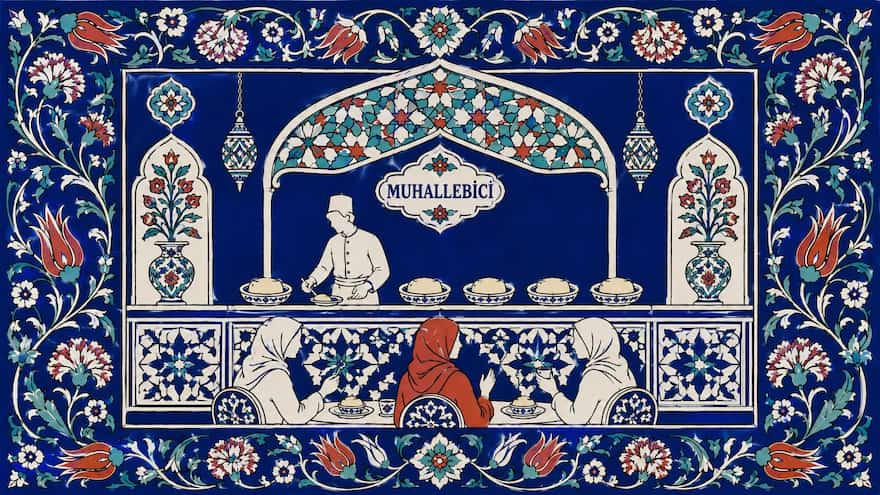
A muhallebici is usually translated as a pudding shop, but the term can be misleading. These establishments are not necessarily tiny confectioners dedicated solely to sweets. Many function as a cross between a café, a neighbourhood restaurant and a dessert parlour. They open early, close late and serve the sort of food that does not require ceremony: chicken soup, chickpeas, menemen, rice and shredded chicken.
Then come the puddings.
The arrangement emerged partly through culinary economy. A shop making traditional tavuk göğsü needed chicken breasts. Whole birds left behind legs and darker meat, which could be simmered and served over rice as tavuklu pilav. Dessert production created the savoury menu. A bowl of chicken and rice followed by chicken pudding is not repetition but an efficient division of the bird.
The shops also acquired a social role larger than their menus. Istanbul’s traditional coffee houses were historically male spaces. The muhallebici, by contrast, offered women and girls somewhere respectable to sit, meet and eat outside the home. Their long hours and alcohol-free atmosphere made them hospitable to families, courting couples, solitary diners and people with time to pass.
In this sense, the pudding shop became a form of civic interior: public but sheltered, informal but orderly. You could eat a full meal or only a plate of kazandibi. You did not need to dress for the occasion, understand a ritual or justify remaining at the table.
Many such businesses were opened by Anatolian families who had moved to Istanbul and named their shops after the places they had left. Göreme Muhallebicisi, established in the Kurtuluş neighbourhood in 1965, carries the name of its founders’ home region. Like countless urban restaurants formed through migration, the muhallebici could be both an Istanbul institution and a vessel for elsewhere.
The best-known surviving shops are now often described as portals into “old Istanbul”, a phrase that can turn working restaurants into museum pieces. Yet nostalgia alone does not keep a pudding shop open. Its food must continue to satisfy people who are not visiting to participate in an act of preservation.
Kazandibi survives because it remains pleasurable: cool in hot weather, comforting in cold weather, modest enough for an ordinary afternoon and strange enough to resist becoming dull.
THE FLAVOUR OF ALMOST GOING TOO FAR
The most famous Turkish desserts frequently depend upon excess managed with great precision: dozens of pastry layers, quantities of nuts, molten butter, strands of dough, syrup poured at the correct temperature. Kazandibi achieves complexity through deprivation. Its palette is narrow. Its decoration may be no more than cinnamon. Its principal drama happens where the diner initially cannot see it, between pudding and pan.
That may be why it feels so revealing.
It retains the resourcefulness of medieval cookery, when chicken could thicken a sweet. It retains the refinement of an imperial kitchen that transformed a handful of ingredients into an object of ceremony. It depends upon dairy farming and the daily discipline of pudding makers. It carries the social history of shops in which women could gather when other public rooms excluded them. It also belongs to the unglamorous logic of restaurant kitchens, where leftover dark meat became lunch because the breast had gone into dessert.
Kazandibi does not summarise Turkish sweets; no single dish could. It does, however, complicate their international image. It offers neither the expected pistachio-studded opulence nor the theatrical pull of cheese beneath syrup. It is a folded slab of milk pudding whose greatest virtue is that somebody has burned it.
Take a spoon to the dark surface and there may be a moment of resistance before it gives way. The scorched skin arrives first: smoky, bittersweet, almost stern. Then the cold pudding follows, smooth and softly sweet, erasing some of the bitterness but not all of it.
The two flavours need each other. Without the pale pudding, the burn would be merely acrid. Without the burn, the pudding might be comforting but forgettable.
At the bottom of the pan, Turkish dessert finds one of its most enduring balances: milk and fire, refinement and accident, sweetness and the precise taste of having almost gone too far.




