


 Share
Share

The rugged terrains of Jammu, Himachal Pradesh, and the northern reaches of Punjab are home to many culinary anomalies that challenge modern gastronomic logic. Among these, Malai Baraf stands out as a fascinating paradox. To the uninitiated, the name suggests a frozen confection involving ice or refrigeration. However, the authentic, traditional version of this delicacy is a triumph of thermal manipulation where ice is entirely absent from the preparation. It is a dessert born of fire, patience, and the remarkable transformative properties of pure dairy.
The Paradox Of Heat Creating Cold
In the high altitudes and cool climates of the north, the concept of baraf or ice often refers more to the appearance and the cooling sensation of a dish rather than its physical state or the method of its creation. Malai Baraf is essentially a hyper-concentrated milk solid that achieves its structural integrity through hours of slow boiling. While modern ice cream relies on the rapid formation of tiny ice crystals through churning and sub-zero temperatures, Malai Baraf relies on the density of milk fats and the removal of water content to create a mouthfeel that is remarkably similar to a frozen custard.
This process is a slow dance with thermodynamics. The artisans begin with vast quantities of full-fat buffalo milk, prized for its high cream content. This milk is poured into large, wide-mouthed iron vessels known as kadhais. These vessels are placed over a steady wood fire, which is the heart of the entire operation. The choice of wood is not accidental: local varieties are used to provide a consistent, manageable heat that does not scorch the milk but allows it to simmer at a precise temperature for hours.
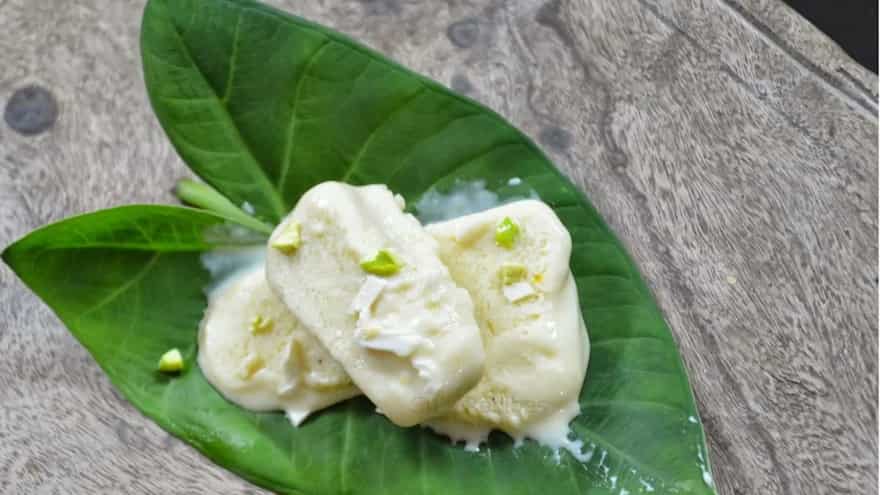
Image credit: Su's recipes
The Alchemy Of The Kadhai
As the milk heats, the journey from liquid to semi-solid begins. This is not the industrial homogenization seen in commercial dairies. Instead, it is a manual, labour-intensive process. The maker must constantly stir the milk, scraping the sides of the iron pot where the cream tends to stick and caramelise. This constant movement ensures that the proteins and fats do not separate in an unappealing way, but rather integrate into a thick, luscious texture.
Over several hours, the milk reduces to a fraction of its original volume. As the water evaporates, the natural sugars in the milk, known as lactose, undergo a subtle Maillard reaction. This is what gives Malai Baraf its characteristic off-white or pale golden hue and a deep, nutty flavour profile. The end result of this reduction is a rich Rabri, but the process does not stop there. The Rabri is continued to be heated until it reaches a point of extreme density, where it can hold its shape at room temperature or when cooled by the naturally crisp mountain air.
There is no churning involved. There are no salt-and-ice barrels or mechanical agitators. The thickness is achieved purely through the concentration of solids. When the mixture finally cools, it sets into a dense, fudge-like consistency that feels remarkably cold on the palate, a sensation enhanced by the evaporation of whatever minute moisture remains.
The absence of artificial flavourings is another hallmark of the traditional method. While some makers might add a sprinkle of sugar, crushed cardamom or a few strands of saffron, the primary hero is the milk itself. The richness is so profound that even a small portion is deeply satisfying. It is a celebration of the ingredient in its most honest form, stripped of the stabilisers, emulsifiers, and gums that plague contemporary frozen desserts.
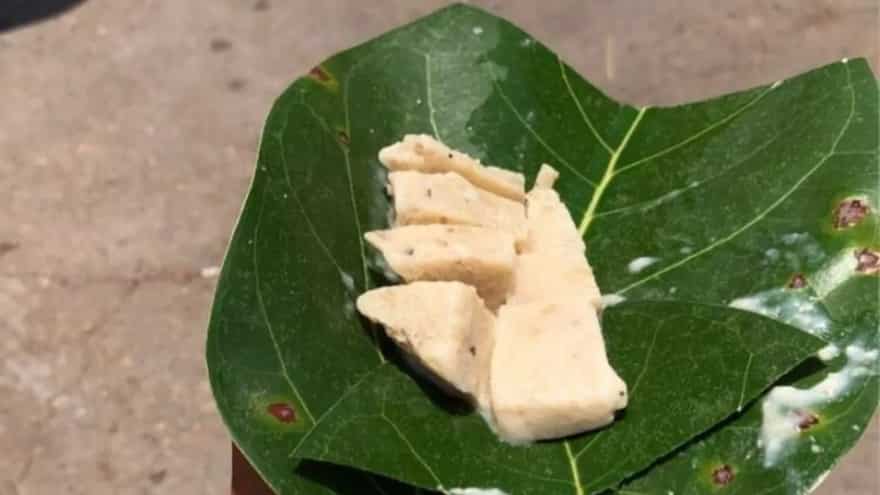
Image credit: Pinterest
Sustainability On A Leaf
The serving of Malai Baraf is as much a part of the experience as its preparation. Following age-old customs, the thick cream is scooped out and placed onto a fresh leaf, usually from local trees like the Sal or Banyan. This practice is a perfect example of traditional wisdom aligning with modern environmental consciousness.
Serving food on a leaf is not merely a rustic aesthetic. The leaf provides a natural, biodegradable vessel that requires no water for washing and leaves no plastic footprint. Furthermore, the tannins in the leaf are said to interact with the warm or room-temperature Malai Baraf, adding a subtle astringency that cleanses the palate. This method of service supports local ecosystems and ensures that the entire lifecycle of the dessert remains in harmony with the environment. There is something deeply grounding about holding a piece of the mountain’s bounty on a leaf, connecting the consumer directly to the land.
A Texture Defined By Density
Because it is not aerated or frozen with ice, the texture of Malai Baraf is uniquely substantial. It does not melt into a puddle the moment it is served. Instead, it maintains its form, allowing the eater to savour the richness. It has a grainy, velvety quality that is often described as danedar, a term used in Indian confectionery to denote a desirable, tiny-grained texture. This graininess comes from the milk solids that have clumped together during the reduction process, providing a satisfying bite that is entirely different from the smooth, oily finish of many commercial ice creams.
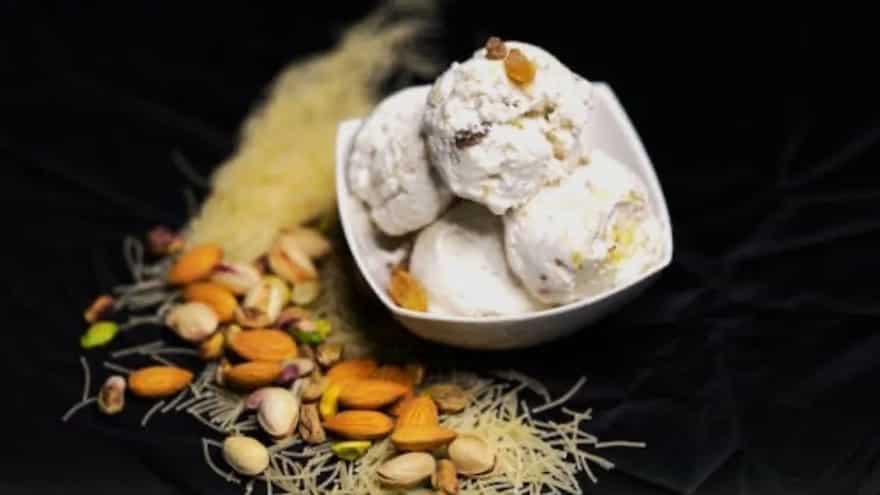
Image credit: Pexels
The Cultural Footprint In The North
In the markets of Jammu and the quiet corners of Himachal Pradesh, Malai Baraf is more than just a sweet. It is a symbol of the slow food movement that has existed in India for centuries. It represents a time when food was not rushed and when the quality of a dish was measured by the hours spent over a flame. For the local communities, it is a nostalgic reminder of fairs and mountain festivals where the scent of boiling milk and wood smoke would fill the air.
In northern Punjab, particularly in the regions bordering the hills, this version of Malai Baraf remains a prized treat. It serves as a bridge between the nomadic traditions of the mountain shepherds and the settled agricultural life of the plains. It is a calorie-dense food, originally designed to provide energy to those living in harsh, cold environments, proving that even a dessert can have a functional, sustaining purpose.




