Share


Editor’s note: This is part three of The Great Asterix Feast, a six-part series on food in Asterix, published in the centenary year of its writer, René Goscinny. Parts one and two covered the boar and the village table. This instalment leaves home and eats its way through Gaul, Britain, Switzerland and Belgium.
GAUL ITSELF — ASTERIX AND THE BANQUET (LE TOUR DE GAULE, 1965)
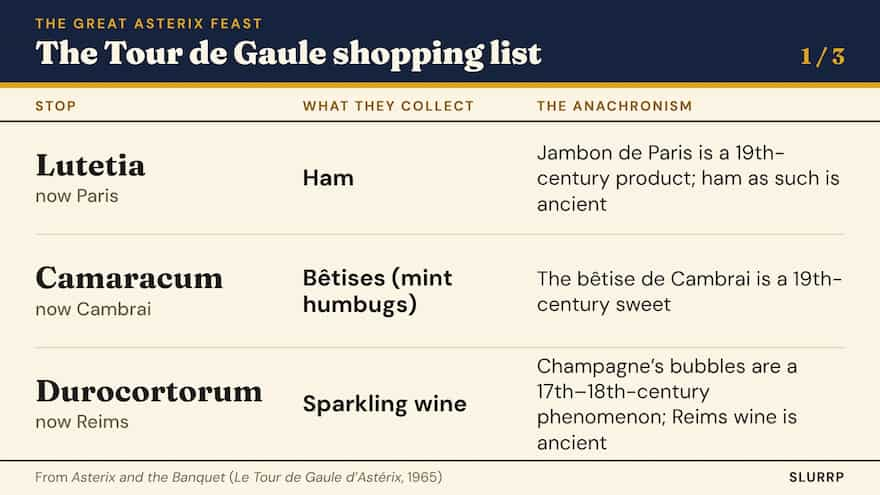
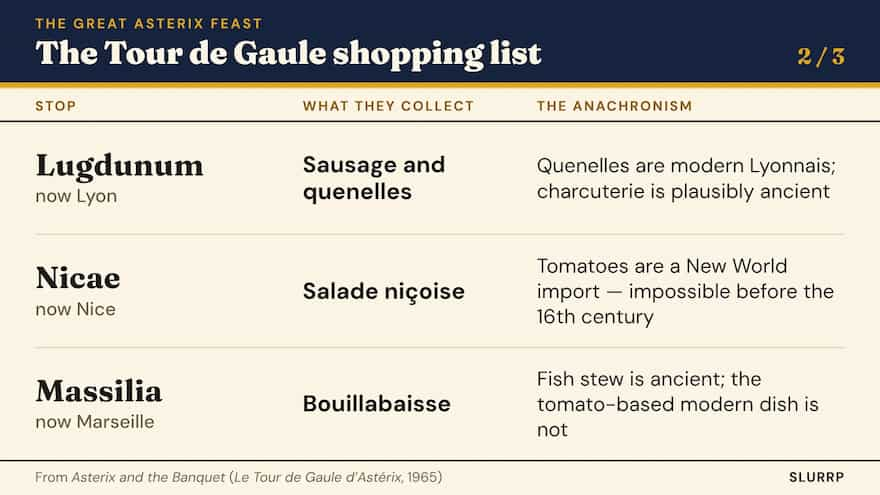
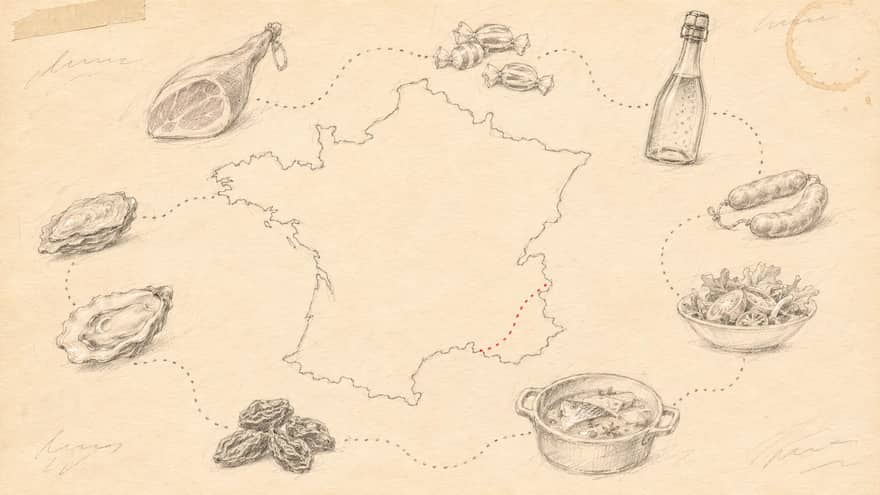
THE FIFTH ALBUM is the purest food book in the canon and, I would argue, the key to all the others. The Romans wall the village in; Asterix wagers he can tour the whole of Gaul regardless and, to prove it, return with a speciality from every region for a banquet. What follows is a Tour de France with a shopping list — and every item on it is a modern French regional delicacy smuggled into 50 BC with a straight face.
***
***
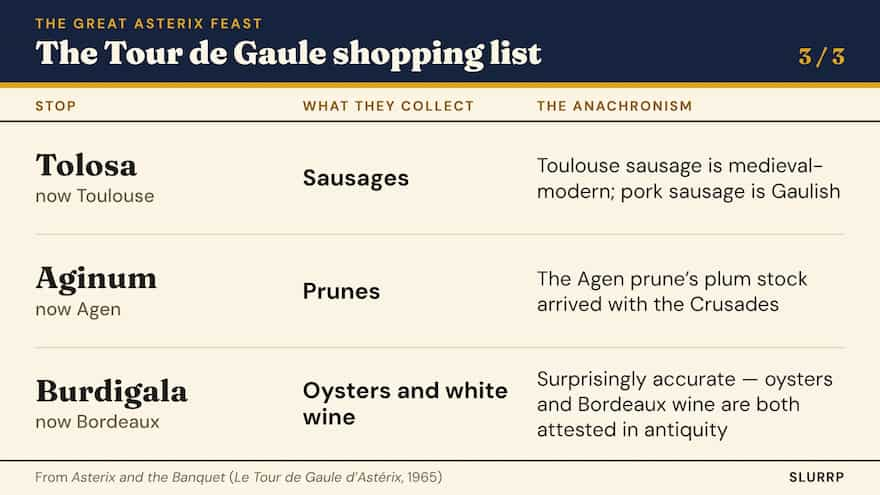
Two stops — Rotomagus (Rouen) and Divodurum (Metz) — yield nothing but Roman ambushes. And the finale is the finest culinary punchline in the series: when the Roman inspector general who took the wager demands his share, Asterix presents him with the speciality of the village. It is a punch in the face. The regional dish of Armorica, it turns out, is a knuckle sandwich — served, naturally, before the real banquet begins.
What Goscinny is doing here is not describing ancient Gaul at all. He is describing the France of the 1960s: the France of the Guide Michelin, the route nationale, the Sunday drive to the good restaurant, the belief — held with religious force — that every département has one thing it does better than anywhere on earth. He then pretends this France has always existed. The genius is that French readers did not notice the trick, and English readers did not need to.
BRITAIN — ASTERIX IN BRITAIN (1966): A DOUBLE MIRROR
No album is as thoroughly about food. The Britons, in Goscinny’s telling, are the Gauls’ cousins gone wrong: they stop fighting at five o’clock every afternoon for a cup of hot water with a drop of milk; they drink their beer warm; they boil their boar and serve it with mint sauce; they play a sport involving a ball and are terribly decent about losing. Obelix, watching a Briton pour mint sauce over a boiled boar, achieves the expression of a man witnessing a war crime.
The food is the plot. Asterix brings a cask of magic potion to a village of resisting Britons; the cask is lost; and at the climax, needing to rally the Britons before battle, Asterix improvises a “potion” from hot water and a bag of strange dried leaves Getafix pressed on him before he left. The Britons, who believe in it, fight like lions. Afterwards, the village chief asks what the leaves were. They were, Asterix says, herbs from a distant land — and the book ends with Getafix naming the hot-water-and-herb drink the Britons will adopt as their national beverage. Asterix invents tea. The last joke of a book about British food is the origin myth of the one British food the French actually respect.
And now the translation problem, which is unique in comics. Goscinny was writing French jokes about the British — jokes that depend on a French reader finding boiled meat and warm beer barbaric. Anthea Bell had to render those jokes in English, for the very people being mocked. Her solution, as far as one can reconstruct it from the published text, was to lean into it: the English Britons speak in a kind of stiff-upper-lip P.G. Wodehouse register, saying “I say” and “what” and “jolly good,” so that the English reader laughs at a caricature of themselves that they recognise as English rather than as a French idea of English. Where Goscinny’s Britons were a foreign joke, Bell’s were a self-deprecating one. The book was published in English in 1970 and it has never been out of print, which suggests the double mirror held.
SWITZERLAND — ASTERIX IN SWITZERLAND (1970)
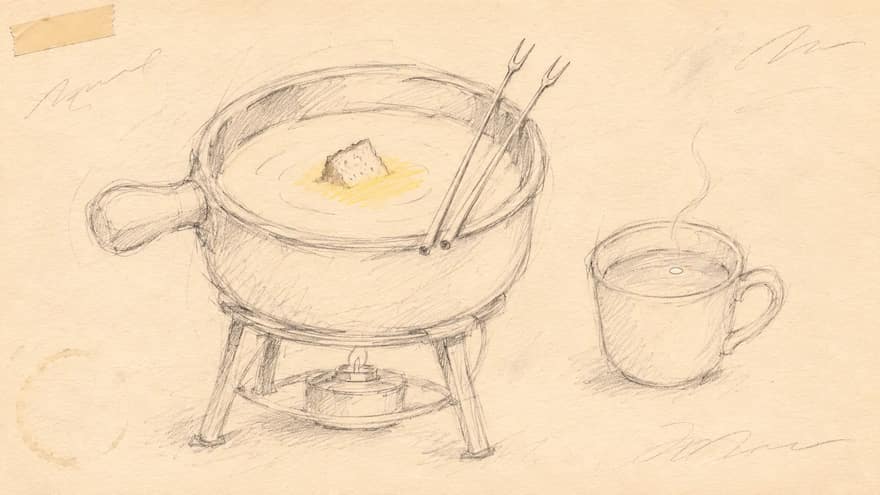
Everything about the Helvetians is clean, punctual and on time, and their national dish follows suit: the fondue, eaten communally from a single pot with strict rules. Lose your bread in the cheese and you are punished — and the punishments escalate with each offence, from a beating with a stick, to the whip, to being thrown into the lake with a weight on your feet. Goscinny turns a convivial Swiss custom into a regime of terror administered with a smile — and hands it to the Romans, whose governor in Geneva runs his orgies around the fondue pot. The hotel where the Gauls stay is run by Petitsuix — named, in both French and English, after Petit Suisse, the small fresh cheese; the joke survives translation because the cheese does. Against all this Roman decadence stands Swiss hygiene: the orgy is so squalid, its guests so thickly coated in melted cheese, that the Helvetians mopping the floor around them read as a relief. Fondue as it is eaten today is a modern Swiss dish; the ancient Helvetii ate cheese, certainly, but nobody was being thrown in Lake Geneva over it.
BELGIUM — ASTERIX IN BELGIUM (1979)
The Belgians out-eat the Gauls, which is the book’s central idea and its highest compliment. The plot turns on a single sentence of Julius Caesar’s — that of all the peoples of Gaul, the Belgians are the bravest — which sends Vitalstatistix into a jealous rage and north across the border to prove otherwise. The Belgian chief Beefix and his wife Bonanza (Nicotine in French, a caricature of the Belgian singer Annie Cordy) keep a table that runs from breakfast to sunset: boar, pâté, ox tongue and, in one of the great anachronism jokes of the canon, the invention of chips. Beefix, contemplating a pot of boiling oil, starts wondering what might be fried in it; later, presented with a pile of mussels salvaged from the pirates’ wreck, he wonders how fish might go with them. In two panels the book invents moules-frites and fish and chips, some sixteen centuries before the potato reached Europe from the Andes. It is a joke about Belgian pride — the frite is Belgium’s, whatever the French call it — and the cartoon claims it for 50 BC. The book also fits in waterzooi, Brussels sprouts, the Manneken Pis and, in its last panel, Bruegel.
THE GREAT ASTERIX FEAST: THE SERIES
Previous in this series | Part 2: The Last Panel, The Stale Fish And The Secret Potion
Next in this series | Part 4: Exploding Cheese, Invented Tea And Asterix Vs Archaeology