Share


Editor’s note: This is part two of The Great Asterix Feast, a six-part series on food in Asterix, published in the centenary year of its writer, René Goscinny. Part one began with a wild boar. This instalment stays home in the village, with the banquet, the fishmonger and the magic potion.
THE LAST PANEL: ANATOMY OF A BANQUET
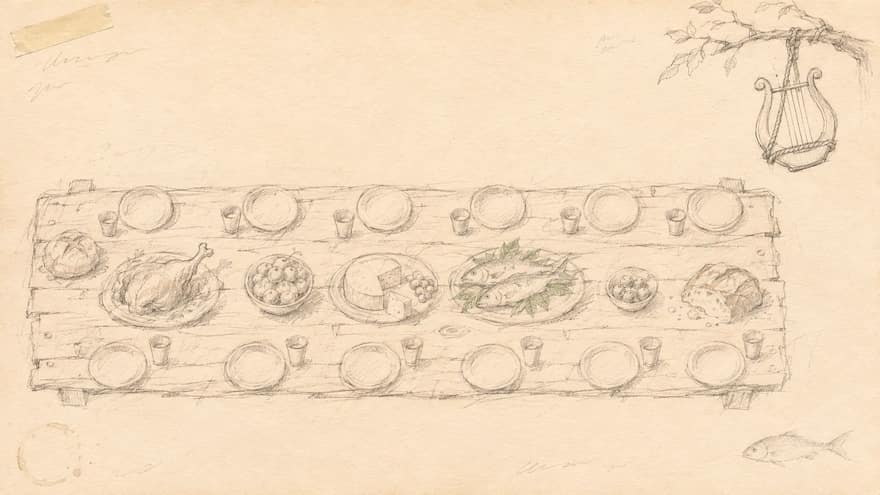
DESCRIBE THE FINAL panel of an Asterix album from memory and you will describe it accurately, which is the point. It is night. A long table runs across the panel under a sky full of stars. The village sits along it — Vitalstatistix in the middle, Impedimenta beside him, Getafix upright and benign, Obelix with a boar in each hand, Asterix small and content, Dogmatix underfoot with a bone. Fires burn. Boars turn on spits. Mugs are raised. And off to one side, tied to a tree, gagged, sometimes with the blacksmith Fulliautomatix’s hammer resting meaningfully nearby, is Cacofonix the bard — silenced so that dinner can be enjoyed.
What is happening in this image is more than a joke. It is a claim about what the adventure was for. The village went out into the world — or the world came to the village — and the outcome, every time, is that the community reconvenes and eats. The banquet is the restoration of order. It is also, crucially, the restoration of appetite: the one thing the Romans, the Goths, the Normans and the Egyptians could not touch.
THE EXCEPTIONS PROVE THE RITUAL
Because the banquet is so fixed, its variations carry enormous weight. In Asterix and the Normans, the bard whose voice has just terrified an entire Norman raiding party is, for once, allowed a seat at the feast — and the reader feels the reversal like a change of key. In Asterix in Belgium, the last album Goscinny lived to write, the closing banquet is held in Belgium rather than Armorica and is composed as a pastiche of Bruegel the Elder’s The Peasant Wedding: the Gauls and Belgians eat side by side, in a Flemish painting, with the boar and the beer flowing. And in the bottom corner of that panel, small enough to miss, a rabbit looks mournfully at Goscinny’s signature. He had died halfway through the book. Uderzo drew rain into every remaining page — a Belgian weather joke and a private grief at once — and then gave his friend the last banquet of the classic era.
Asterix in Corsica inverts the structure: it opens with a great feast, the anniversary of Gergovia, attended by old friends from earlier albums, and the plot is what happens after dinner. It is the closest the series comes to admitting that the banquet, not the adventure, is the real subject.
UNHYGIENIX AND THE FRESHNESS OF THE FISH
The village’s other recurring food is the one nobody wants to eat. Unhygienix the fishmonger sells fish that is, by universal agreement, not fresh — and the reason it is not fresh is the best economic joke in the series. The village sits on the Armorican coast. The sea is a stone’s throw from his stall. And Unhygienix has his fish brought in by ox-cart from the markets of Lutetia, several days’ journey inland, because that is where the proper fish come from. Provenance over proximity. He is a snob, and his snobbery smells.
The fight is a ritual. Fulliautomatix the blacksmith remarks on the fish. Unhygienix takes offence. Someone throws a fish. Within three panels the entire village is brawling under a rain of mackerel while Getafix looks on with the weary patience of a man who has seen this before. In Asterix and the Roman Agent, the Roman provocateur Tortuous Convolvulus needs only a gift-wrapped vase and a few whispers to set the village at its own throat — and when it goes, the fish fly. The freshness dispute is the village’s political fault line. In The Mansions of the Gods, Unhygienix becomes a capitalist, selling his fish at ludicrous prices to the Roman flat-dwellers next door, and the joke curdles into satire of the tourist trade.
There is a translation story here too. In French the fishmonger is Ordralfabétix — “ordre alphabétique,” alphabetical order — a name that is funny purely for its absurdity and says nothing about fish. Anthea Bell and Derek Hockridge threw it out and gave English readers Unhygienix, a name that is the joke. His wife, Iélosubmarine in French (a Beatles gag), became Bacteria. This is the Bell method in miniature: where a French name is merely silly, the English name is about the character. The bard is the same case: Assurancetourix (“comprehensive insurance”) means nothing in English, so he became Cacofonix, which means everything.
Is the fish plausible? Entirely. Armorica had a marine economy, and the Romans’ relationship with the Atlantic coast of Gaul included salted-fish production and the fish-sauce trade. The only implausible thing about Unhygienix is his supply chain, which is the joke.
THE MAGIC POTION: FOOD, MEDICINE, MYTH
The potion is a drink, so it belongs in this essay, but it behaves like a kitchen secret — a national recipe held by one old man who will not write it down. Its ingredients are disclosed only in fragments, and the fragments are jokes.
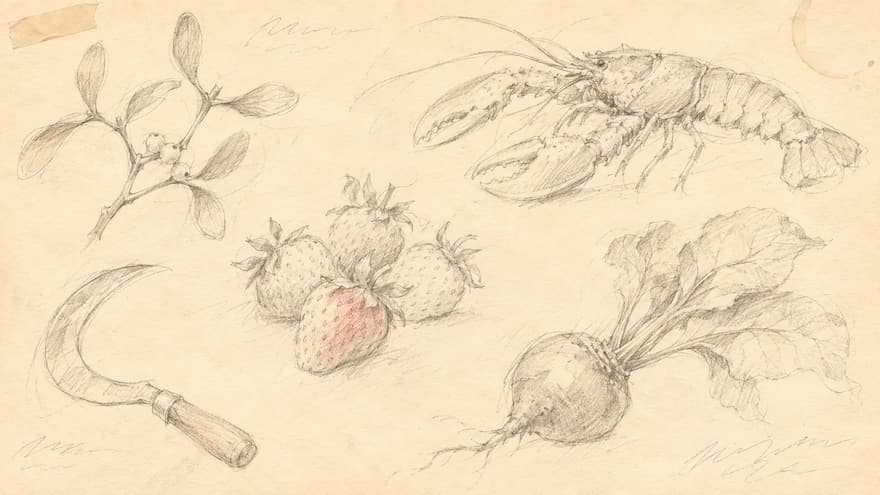
• Mistletoe, cut with a golden sickle — which is why the second album, Asterix and the Golden Sickle, sends the heroes to Lutetia when Getafix’s sickle breaks. This is the potion’s one genuinely historical ingredient. Pliny the Elder, in the Natural History, describes the druids’ reverence for oak-mistletoe, cut with a golden sickle on the sixth day of the moon, in a rite involving white bulls and a belief in the plant’s medicinal power. Goscinny read his Pliny, or read someone who had.
• Strawberries. In the very first album, Asterix the Gaul, Getafix — captured and stalling — demands strawberries for the potion, out of season, and a hapless legionary is sent to scour the known world for them. They are eaten by the druid and Asterix with evident pleasure while the Romans wait. The strawberries were never an ingredient. They were a delaying tactic and the first food joke in the canon.
• Rock oil. In Asterix and the Black Gold, Getafix’s supply of petroleum — an essential ingredient, we are told — runs out, and the album is a journey to the Middle East to find more. Having failed, he discovers on his return that beetroot juice does the job perfectly well. The whole quest was for nothing; the substitute grew in the garden. It is the most Goscinny of plots, even though Uderzo wrote it alone.
• Lobster, admitted to be optional and included purely for the taste — a line that has passed happily into fan lore.
What the potion parodies is not druidry but cuisine: the French mystique of the secret recipe, the grandmother’s sauce, the appellation contrôlée. Its function in the narrative is that of a national dish — proof of identity, the thing the Romans can conquer everything but. And its comic rule is the rule of every good kitchen: the master never measures, and the apprentice always gets it wrong.
THE GREAT ASTERIX FEAST: THE SERIES
Previous in this series | Part 1: A Confession Involving A Boar
Next in this series | Part 3: Eat Your Way Across The Roman Empire