


 Share
Share

Why 2026 is a remarkable year to revisit Asterix
• René Goscinny at 100. The writer of Asterix was born in Paris on 14 August 1926. His centenary is the intellectual peg of this essay: not merely the man who wrote Asterix, but one of the great comic writers of the twentieth century.
• The Twelve Tasks of Asterix turns 50. Released in October 1976, it was not an adaptation of an existing album but an original story written for the screen by Goscinny and Uderzo through their own Studios Idéfix — the only second and last animated film the two creators directed themselves. Éditions Albert René has marked the anniversary with a special illustrated edition and interactive online ‘twelve tasks’ challenges on the official site.
• Asterix in Britain at 60. First published in 1966 — the album that turns the most on food, and the one that would give Anthea Bell her strangest translation problem.
• Obelix and Co. at 50 (1976), and Asterix the Gaul at 65 (1961) — the first album, where the first food joke in the canon is about strawberries.
• Anthea Bell at 90. The English translator of Asterix was born on 10 May 1936; she died in October 2018. Ninety years on, her jokes are still the ones British children read.
• Asterix and the Vikings at 20 (2006), and a new animated feature, Asterix – The Kingdom of Nubia, due in French cinemas on 2 December 2026 — the franchise’s twelfth animated film.
• A living series. The 41st album, Asterix in Lusitania (Fabcaro and Didier Conrad, October 2025), has passed 1.7 million copies according to its publisher. The village is still eating.
I. A Confession Involving a Boar
I should begin with a confession that will sound absurd to anyone raised in Europe and perfectly ordinary to anyone raised where I was: I had never tasted pork before Asterix.
Not a rasher. Not a sausage. Not the ghost of a chop. In the South Bangalore of my childhood, pork simply did not appear on the table, and the question of whether it should was not one anybody thought to raise. It belonged, if it belonged anywhere, to other people’s kitchens. Which is why the single most exotic object in the Asterix books — more exotic than Roman galleys, Egyptian pyramids, Norman longships or the fakir’s flying carpet — was the animal slung over Obelix’s shoulder on almost every other page.
The wild boar. Le sanglier. Drawn by Albert Uderzo as a bristling, grinning, slightly indignant creature in life, and as a glistening bronze mountain of meat in death, laid out on a wooden trestle with its trotters in the air and a haze of steam rising off it like incense. I had no idea what it tasted like. I had never seen one. I was not entirely sure, at eight, that they were real. But I knew, with the certainty children reserve for things that matter, that it must be the most delicious thing on earth, because Obelix — who had access to the whole of the known world and who was not a man of delicate judgement — wanted nothing else.
That is how a comic strip about a village in Armorica in 50 BC ended up, some years later, with me ordering pork in a restaurant with a nervousness usually reserved for proposals of marriage. It was fine. It was, honestly, a bit dry. Nothing in my life has ever tasted the way that drawing looked. I am not sure anything could.
There is a second confession. For a period of my adult life I bore a reasonably convincing physical resemblance to Obelix, and I would like to say that circumstances have since altered beyond recognition. I would like to say that. What I can say is that I have always felt the affection of a fellow traveller for a man whose response to the phrase “you’re fat” is genuine, wounded bewilderment, and whose answer to almost every problem the ancient world can throw at him is a second helping.
This essay is my attempt to repay the debt. Because the more I have re-read these books as an adult — and I have re-read them, in two languages, more times than is respectable — the more convinced I have become of something that sounds like a joke and isn’t: no comic strip in history has made eating as important to its universe as Asterix. Not as decoration. As architecture.
II. What Food Actually Does in Asterix
Every Asterix album is shaped like a stomach. Something is ingested — a Roman plot, a foreign errand, a threat to the village — it is digested, at length and with violence, and then everything returns to the long table under the stars. The banquet is the full stop. A reader who has never opened an Asterix book knows that it ends with a feast, in the way a reader who has never opened a fairy tale knows it ends with a wedding.
But food does far more than close the book. Consider how much work it is doing at any given moment.
• Food establishes character. Obelix eats differently from Asterix: without pause, without embarrassment, and without the slightest interest in what the food is called. Asterix eats like a man who would rather be planning. Getafix eats like a man who has to be reminded.
• Food establishes geography. You know you have arrived in a new country because of what the locals are drinking. Warm beer means Britain. Cheese with holes means Switzerland. Cream on everything means the Normans. A dish is the passport stamp.
• Food establishes the stereotype — usually affectionately, occasionally mercilessly. Goscinny’s foreigners are defined by their tables before they are defined by anything else, and the joke is almost always that they are proud of exactly the thing the Gauls find inedible.
• Food drives plots. A tour of Gaul collecting regional specialities. A poisoned cake in Alexandria. A restaurant in Condatum that fails because the cook eats the stock. A magic potion that cannot be brewed because an ingredient has run out.
• Food signals order and disorder. When the village fights, it fights over fish. When the village is at peace, it eats boar. The state of the table is the state of the polity.
• Food is hospitality, and hospitality is the plot. Nearly every foreign adventure turns on someone offering the Gauls a meal — and the Gauls’ faces as they eat it.
Above all, food creates the ritual of Asterix. The adventures are centrifugal: they fling the heroes outward across the Roman world. The banquets are centripetal: they pull everyone back to the fire. Rome may hold all of Gaul but one small village. Rome does not hold dinner.
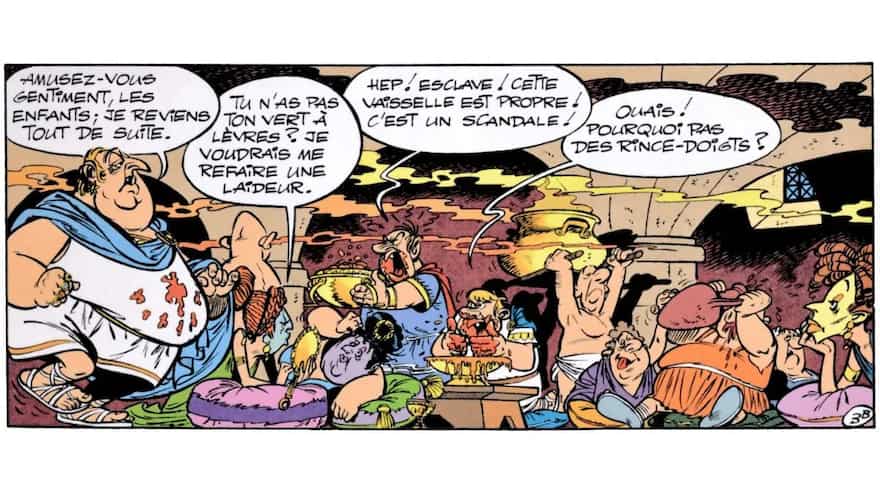
Image credit: Asterix The Gaul
III. The Wild Boar: Comic Mythology and the Archaeology of Appetite
Let us start where Obelix starts. The wild boar is not merely the favourite food of the Asterix universe; it is its currency, its unit of measure and its emotional weather. Boars are carried home in pairs like shopping. They are roasted whole, gnawed to the bone, thrown at Romans, hunted by Dogmatix and, in Asterix in Corsica, pronounced by the locals to be so refined that a mainland boar is scarcely worth the fire. When Obelix is forbidden boar — on Vitalstatistix’s spa diet in Asterix and the Chieftain’s Shield, or in a Britain where they are boiled and served with mint sauce — the deprivation is treated as a genuine tragedy, and the comic engine roars.
So here is the historical question, and it deserves a straight answer: did the Gauls actually live on wild boar?
The short answer: no — but they lived on pig, and that is the same joke told more slowly
The archaeozoology of Iron Age and Gallo-Roman sites is remarkably consistent on this point, and the French scholar whose name comes up most often in the literature is Patrice Méniel, whose long-running work on Gaulish animal husbandry, hunting and ritual feasting — notably his study of hunting and stock-rearing among the Gauls — established a picture that has held up: the animal bones from Gaulish settlements are overwhelmingly domestic. Pig, cattle and sheep dominate. Genuinely wild game, including boar, typically appears as a small fraction of the assemblage. Hunting was real, but it was a pastime and a prestige activity rather than a food supply. Obelix, in other words, would have been eating pork most of the time — and a village that ate as many boars as his does would have emptied the forests of Armorica in a season.
What the comic gets right, and it is a lot, is the centrality of the pig. Strabo, writing around the turn of the first century, remarks on the quantities of salted pork the Gauls produced and exported, including to Rome; Gallic salted meats were a recognised trade good. Pigs suited the wooded, pannage-rich landscape of northern Gaul, and pork — fresh, salted, smoked — was the Gaulish protein. When Uderzo draws a landscape of sausages and hams, he is drawing something an archaeologist would recognise.
The feast is the truest thing in the books
The most striking survival, though, is not a food but a scene. The Greek philosopher Posidonius travelled in Gaul in the first century BC, and although his own writing is lost, later authors preserved his description of a Celtic feast: warriors seated in a circle on the ground, the bravest in the middle, the host beside him; meat boiled in cauldrons or roasted on spits, eaten with the hands; wine for the wealthy and beer for the rest; and — the detail every Asterix reader will recognise with a jolt — a rule that the finest cut of meat, the champion’s portion, went to the bravest man present, and that disputes over who deserved it could escalate to single combat.
A feast that ends in a fight over the meat. Goscinny and Uderzo, with no access to modern archaeology and, one suspects, no great interest in it, arrived at the same image by instinct. The Gauls of the Asterix village are not gluttons because the authors thought that was funny (though it is). They are a warrior society whose central social ritual is the shared feast, and the cartoon version is closer to Posidonius than to any Roman comedy.
Diodorus, wine and the slave for an amphora
Diodorus Siculus, drawing on the same Greek sources, records the Gauls’ notorious enthusiasm for imported Italian wine — drunk unmixed, to the horror of Mediterranean sensibilities — and the famous, probably exaggerated claim that Italian merchants could obtain a slave in exchange for a single amphora. The archaeology bears out the appetite if not the exchange rate: Italian wine amphorae are found in enormous quantities on late Iron Age Gaulish sites, particularly along the Rhône and Atlantic trade routes. When a Roman in Asterix offers a Gaul a drink, he is doing something historically plausible. When the Gaul prefers his own beer, that too is attested: cervesia is a word the Romans borrowed from Gaul.
ASTERIX vs ARCHAEOLOGY — Wild Boar
• Comic version: the village eats wild boar daily, whole, roasted over open fires; Obelix eats several at a sitting.
• Historical reality: domestic pig dominated the Gaulish diet; wild boar was hunted but rare on the plate and carried prestige. Whole-animal spit-roasting is attested for feasts; everyday cooking was more often the cauldron.
• Verdict: Plausible exaggeration. Right animal family, wrong wildness, and about ninety-five boars too many.
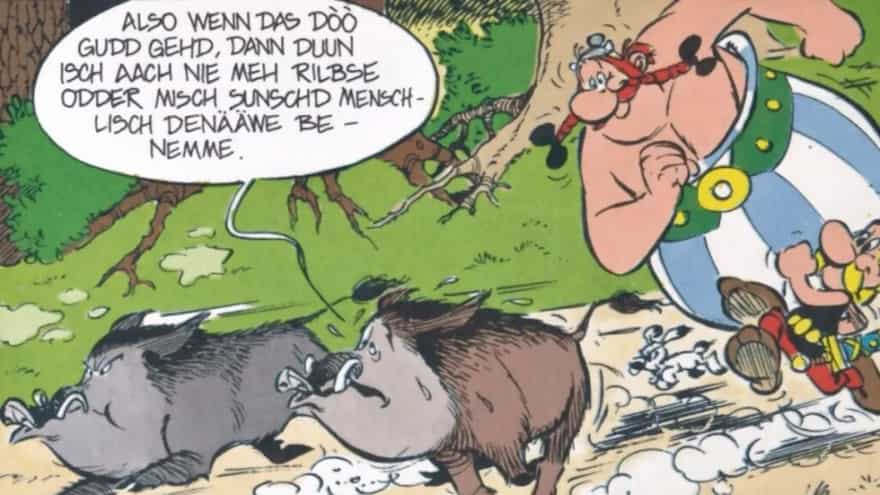
Image credit: Asterix The Gaul
IV. The Last Panel: Anatomy of a Banquet
Describe the final panel of an Asterix album from memory and you will describe it accurately, which is the point. It is night. A long table runs across the panel under a sky full of stars. The village sits along it — Vitalstatistix in the middle, Impedimenta beside him, Getafix upright and benign, Obelix with a boar in each hand, Asterix small and content, Dogmatix underfoot with a bone. Fires burn. Boars turn on spits. Mugs are raised. And off to one side, tied to a tree, gagged, sometimes with the blacksmith Fulliautomatix’s hammer resting meaningfully nearby, is Cacofonix the bard — silenced so that dinner can be enjoyed.
What is happening in this image is more than a joke. It is a claim about what the adventure was for. The village went out into the world — or the world came to the village — and the outcome, every time, is that the community reconvenes and eats. The banquet is the restoration of order. It is also, crucially, the restoration of appetite: the one thing the Romans, the Goths, the Normans and the Egyptians could not touch.
The exceptions prove the ritual
Because the banquet is so fixed, its variations carry enormous weight. In Asterix and the Normans, the bard whose voice has just terrified an entire Norman raiding party is, for once, allowed a seat at the feast — and the reader feels the reversal like a change of key. In Asterix in Belgium, the last album Goscinny lived to write, the closing banquet is held in Belgium rather than Armorica and is composed as a pastiche of Bruegel the Elder’s The Peasant Wedding: the Gauls and Belgians eat side by side, in a Flemish painting, with the boar and the beer flowing. And in the bottom corner of that panel, small enough to miss, a rabbit looks mournfully at Goscinny’s signature. He had died halfway through the book. Uderzo drew rain into every remaining page — a Belgian weather joke and a private grief at once — and then gave his friend the last banquet of the classic era.
Asterix in Corsica inverts the structure: it opens with a great feast, the anniversary of Gergovia, attended by old friends from earlier albums, and the plot is what happens after dinner. It is the closest the series comes to admitting that the banquet, not the adventure, is the real subject.
V. Unhygienix and the Freshness of the Fish
The village’s other recurring food is the one nobody wants to eat. Unhygienix the fishmonger sells fish that is, by universal agreement, not fresh — and the reason it is not fresh is the best economic joke in the series. The village sits on the Armorican coast. The sea is a stone’s throw from his stall. And Unhygienix has his fish brought in by ox-cart from the markets of Lutetia, several days’ journey inland, because that is where the proper fish come from. Provenance over proximity. He is a snob, and his snobbery smells.
The fight is a ritual. Fulliautomatix the blacksmith remarks on the fish. Unhygienix takes offence. Someone throws a fish. Within three panels the entire village is brawling under a rain of mackerel while Getafix looks on with the weary patience of a man who has seen this before. In Asterix and the Roman Agent, the Roman provocateur Tortuous Convolvulus needs only to whisper about the fish to set the village at its own throat — the freshness dispute is the village’s political fault line. In The Mansions of the Gods, Unhygienix becomes a capitalist, selling his fish at ludicrous prices to the Roman flat-dwellers next door, and the joke curdles into satire of the tourist trade.
There is a translation story here too. In French the fishmonger is Ordralfabétix — “ordre alphabétique,” alphabetical order — a name that is funny purely for its absurdity and says nothing about fish. Anthea Bell and Derek Hockridge threw it out and gave English readers Unhygienix, a name that is the joke. His wife, Iélosubmarine in French (a Beatles gag), became Bacteria. This is the Bell method in miniature: where a French name is merely silly, the English name is about the character. The Wikipedia summary of the English translations makes exactly this point about the bard — Assurancetourix (“comprehensive insurance”) means nothing in English, so he became Cacofonix, which means everything.
Is the fish plausible? Entirely. Armorica had a marine economy, and the Romans’ relationship with the Atlantic coast of Gaul included salted-fish production and the fish-sauce trade. The only implausible thing about Unhygienix is his supply chain, which is the joke.
VI. The Magic Potion: Food, Medicine, Myth
The potion is a drink, so it belongs in this essay, but it behaves like a kitchen secret — a national recipe held by one old man who will not write it down. Its ingredients are disclosed only in fragments, and the fragments are jokes.
• Mistletoe, cut with a golden sickle — which is why the second album, Asterix and the Golden Sickle, sends the heroes to Lutetia when Getafix’s sickle breaks. This is the potion’s one genuinely historical ingredient. Pliny the Elder, in the Natural History, describes the druids’ reverence for oak-mistletoe, cut with a golden sickle on the sixth day of the moon, in a rite involving white bulls and a belief in the plant’s medicinal power. Goscinny read his Pliny, or read someone who had.
• Strawberries. In the very first album, Asterix the Gaul, Getafix — captured and stalling — demands strawberries for the potion, out of season, and a hapless legionary is sent to scour the known world for them. They are eaten by the druid and Asterix with evident pleasure while the Romans wait. The strawberries were never an ingredient. They were a delaying tactic and the first food joke in the canon.
• Rock oil. In Asterix and the Black Gold, Getafix’s supply of petroleum — an essential ingredient, we are told — runs out, and the album is a journey to the Middle East to find more. Having failed, he discovers on his return that beetroot juice does the job perfectly well. The whole quest was for nothing; the substitute grew in the garden. It is the most Goscinny of plots, even though Uderzo wrote it alone.
• Lobster, admitted in one telling to be optional and included “for the taste” — a line that has passed into fan lore so thoroughly that I flag it here as remembered rather than re-verified against a page.
What the potion parodies is not druidry but cuisine: the French mystique of the secret recipe, the grandmother’s sauce, the appellation contrôlée. Its function in the narrative is that of a national dish — proof of identity, the thing the Romans can conquer everything but. And its comic rule is the rule of every good kitchen: the master never measures, and the apprentice always gets it wrong.
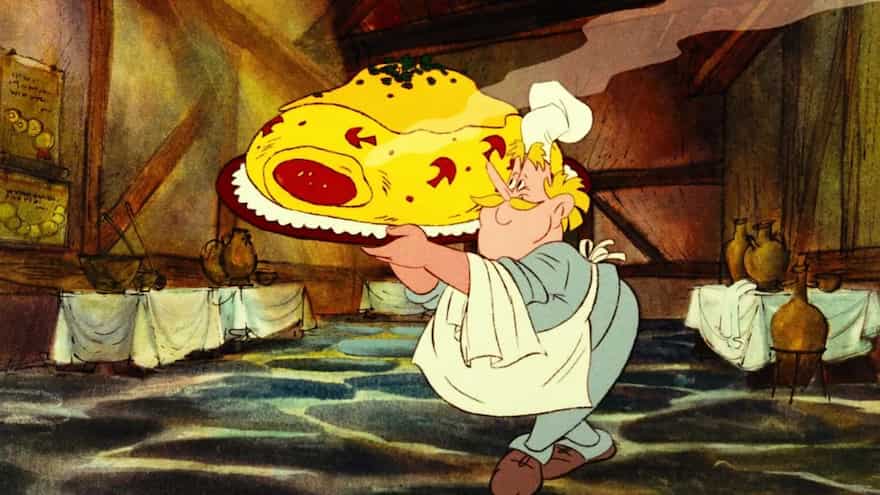
Image credit: Wiki
VII. Eat Your Way Across the Roman Empire: A Culinary Atlas
Gaul itself — Asterix and the Banquet (Le Tour de Gaule, 1965)
The fifth album is the purest food book in the canon and, I would argue, the key to all the others. The Romans wall the village in; Asterix wagers he can tour the whole of Gaul regardless and, to prove it, return with a speciality from every region for a banquet. What follows is a Tour de France with a shopping list — and every item on it is a modern French regional delicacy smuggled into 50 BC with a straight face.
Ancient name | Modern city | What they collect | The anachronism |
|---|---|---|---|
Lutetia | Paris | Ham | Jambon de Paris is a 19th-century product; ham as such is ancient |
Camaracum | Cambrai | Bêtises (mint humbugs) | The bêtise de Cambrai dates to the 1850s |
Durocortorum | Reims | Sparkling wine | Champagne’s bubbles are a 17th–18th-century phenomenon; Reims wine is ancient |
Lugdunum | Lyon | Sausage and quenelles | Quenelles are modern Lyonnais; charcuterie is plausibly ancient |
Nicae | Nice | Salade niçoise | Tomatoes are a New World import — impossible before the 16th century |
Massilia | Marseille | Bouillabaisse | Fish stew is ancient; the tomato-based modern dish is not |
Tolosa | Toulouse | Sausages | Toulouse sausage is medieval-modern; pork sausage is Gaulish |
Aginum | Agen | Prunes | The Agen prune’s plum stock arrived with the Crusades |
Burdigala | Bordeaux | Oysters and white wine | Surprisingly accurate — oysters and Bordeaux wine are both attested in antiquity |
Two stops — Rotomagus (Rouen) and Divodurum (Metz) — yield nothing but Roman ambushes. And the finale is the finest culinary punchline in the series: when the Roman prefect who set the wager demands his share, Asterix presents him with the speciality of the village. It is a punch in the face. The regional dish of Armorica, it turns out, is a knuckle sandwich — served, naturally, before the real banquet begins.
What Goscinny is doing here is not describing ancient Gaul at all. He is describing the France of the 1960s: the France of the Guide Michelin, the route nationale, the Sunday drive to the good restaurant, the belief — held with religious force — that every département has one thing it does better than anywhere on earth. He then pretends this France has always existed. The genius is that French readers did not notice the trick, and English readers did not need to.
Britain — Asterix in Britain (1966): a double mirror
No album is as thoroughly about food. The Britons, in Goscinny’s telling, are the Gauls’ cousins gone wrong: they stop fighting at five o’clock every afternoon for a cup of hot water with a drop of milk; they drink their beer warm; they boil their boar and serve it with mint sauce; they play a sport involving a ball and are terribly decent about losing. Obelix, watching a Briton pour mint sauce over a boiled boar, achieves the expression of a man witnessing a war crime.
The food is the plot. Asterix brings a cask of magic potion to a village of resisting Britons; the cask is lost; and at the climax, needing to rally the Britons before battle, Asterix improvises a “potion” from hot water and a bag of strange dried leaves Getafix pressed on him before he left. The Britons, who believe in it, fight like lions. Afterwards, the village chief asks what the leaves were. They were, Asterix says, herbs from a distant land — and the book ends with Getafix naming the hot-water-and-herb drink the Britons will adopt as their national beverage. Asterix invents tea. The last joke of a book about British food is the origin myth of the one British food the French actually respect.
And now the translation problem, which is unique in comics. Goscinny was writing French jokes about the British — jokes that depend on a French reader finding boiled meat and warm beer barbaric. Anthea Bell had to render those jokes in English, for the very people being mocked. Her solution, as far as one can reconstruct it from the published text, was to lean into it: the English Britons speak in a kind of stiff-upper-lip P.G. Wodehouse register, saying “I say” and “what” and “jolly good,” so that the English reader laughs at a caricature of themselves that they recognise as English rather than as a French idea of English. Where Goscinny’s Britons were a foreign joke, Bell’s were a self-deprecating one. The book was published in English in 1970 and it has never been out of print, which suggests the double mirror held.
Switzerland — Asterix in Switzerland (1970)
Everything about the Helvetians is clean, punctual and on time, and their food follows suit: the fondue, eaten communally from a single pot with strict rules. Lose your bread in the cheese and you are punished — and the punishments escalate with each offence, from a beating with a stick to being thrown into the lake with a weight on your feet. Goscinny turns a convivial Swiss custom into a regime of terror administered with a smile. The hotel where the Gauls stay is run by Petitsuix — named, in both French and English, after Petit Suisse, the small fresh cheese; the joke survives translation because the cheese does. Against all this Swiss hygiene stands the Roman governor’s orgy: a scene of Roman decadence so squalid — the governor having his guests dunk their bread in something that is not fondue — that the Swiss cleanliness reads as a relief. Fondue as it is eaten today is a modern Swiss dish; the ancient Helvetii ate cheese, certainly, but nobody was being thrown in Lake Geneva over it.
Belgium — Asterix in Belgium (1979)
The Belgians out-eat the Gauls, which is the book’s central idea and its highest compliment. The plot turns on a single sentence of Julius Caesar’s — that of all the peoples of Gaul, the Belgians are the bravest — which sends Vitalstatistix into a jealous rage and north across the border to prove otherwise. The Belgian chief Beefix and his wife Bonanza (Nicotine in French, a caricature of the Belgian singer Annie Cordy) keep a table that runs from breakfast to sunset: boar, pâté, ox tongue and, in one of the great anachronism jokes of the canon, the invention of chips. Beefix, contemplating a pot of hot oil and some tubers, wonders whether they might be fried; later, presented with a pile of mussels salvaged from the pirates’ wreck, he wonders how fish might go with them. In two panels the book invents moules-frites and fish and chips, some sixteen centuries before the potato reached Europe from the Andes. It is a joke about Belgian pride — the frite is Belgium’s, whatever the French call it — and the cartoon claims it for 50 BC. The book also fits in waterzooi, Brussels sprouts, the Manneken Pis and, in its last panel, Bruegel.
Corsica — Asterix in Corsica (1973)
Corsica is the book of the siesta, the vendetta and the cheese. The Corsican cheese is presented as a thing of such potency that its odour drives Romans from their posts, and in the climax its fumes, meeting a naked flame aboard the pirates’ ship, blow the vessel to matchwood. Corsican boar, the locals insist, is incomparably finer than the mainland kind, being fed on chestnuts — a genuine Corsican culinary boast rendered as tribal pride. Sheep’s-milk cheese and chestnut-fed pigs are both plausible for ancient Corsica; the exploding cheese is not, though every Frenchman who has opened a wheel of brocciu in a hot car will feel the truth of it.
Spain — Asterix in Spain (1969)
Spain gives us the greatest culinary name in the series: the Iberian chief who holds out against Caesar is called, in both languages, Huevos y Bacon — eggs and bacon, a Spanish freedom fighter named after an English breakfast. His son, the ferociously stubborn Pepe, protests by holding his breath — the child’s hunger strike as political weapon. Along the way the book parodies French tourists clogging the roads south in caravans, the aurochs-fight as bullfight, and the olive-oil-soaked table of the Iberians. Olive oil and olives are, for once, entirely historical; Roman Spain was one of the empire’s great oil producers.
The Normans — Asterix and the Normans (1966)
Goscinny’s Vikings are the Normans of Normandy — which is to say they cook everything à la crème and drink Calvados. Cream is ancient; the apple brandy is a product of distillation and belongs to the sixteenth century at the earliest. The joke, for a French reader, is that the terrifying seaborne raiders of the ninth century have the palate of a Rouen bistro.
Egypt — Asterix and Cleopatra (1965)
The food joke in Egypt is a cake. The villainous architect Artifis sends Cleopatra a poisoned cake in the Gauls’ name; accused, the Gauls prove their innocence by eating it themselves, Getafix having dosed them with an antidote. Obelix, naturally, enjoys the cake enormously and would like the recipe. It is one of the purest examples of Goscinny’s method — a plot device (poison) resolved by an appetite (Obelix) — and the book’s Egyptian tables, with their lentils, dates and beer, are among Uderzo’s most historically careful.
America — Asterix and the Great Crossing (1975)
Blown across the Atlantic, the Gauls encounter a large, strutting bird unknown in Europe, roast it, and find it dry. Obelix is unimpressed. The bird is a turkey, which is historically impeccable — the turkey is a New World native — and comically inverted: the Gauls have discovered the Thanksgiving dinner fifteen centuries early and don’t like it. Later, among the Vikings, there is a scene of Norse feasting that gives Obelix a second chance at a proper meal.
India — Asterix and the Magic Carpet (1987)
As an Indian reader, I approached this one with a notebook and came away with a mostly empty page. Uderzo’s India — the album was his, written after Goscinny’s death — is a country of fakirs, flying carpets, elephants, tigers and a rajah’s daughter, Orinjade, who must be sacrificed unless it rains. The solution is Cacofonix, whose singing has always made it rain. It is a book about weather, not food. What culinary content there is belongs to the journey: on the way east the Gauls pass through a Persian and Arabian world where, one contemporary account notes, caviar and roast camel stand in for the boar Obelix cannot find, and where his suffering is the joke. India itself — the spices, the sweets, the vegetarian tables, the whole edible civilisation a Goscinny might have feasted on — barely appears. This is not offensive; it is thin. The visual stereotypes are those of a 1980s French adventure film, and the exoticism is affectionate rather than contemptuous. But it is the clearest evidence in the canon of what the series lost when it lost its writer. Goscinny would have sent Obelix into a market.
VIII. The Food Names: A Miniature Dictionary of Culinary Wordplay
Every Gaulish name ends in -ix, every Roman in -us, every Briton in -ax, every Egyptian in -is — and a surprising number of them are edible. A selection, giving only puns I can demonstrate:
English name | French name | Album | The joke |
|---|---|---|---|
Unhygienix | Ordralfabétix | Various | French: ‘alphabetical order’ — pure nonsense. English: the fish is not fresh. Bell replaced a silly name with a characterising one. |
Bacteria | Iélosubmarine | Various | French: ‘Yellow Submarine’. English: what lives in her husband’s fish. |
Petitsuix | Petitsuix | Asterix in Switzerland | Petit Suisse, a fresh cheese; the hotelier’s name in both languages — a rare pun that survives untranslated. |
Huevos y Bacon | Soupalognon y Crouton | Asterix in Spain | French: onion soup and croutons. English: eggs and bacon. Both a Spaniard named after a meal — Bell simply picked a British breakfast. |
Winesanspirix | Alambix | Chieftain’s Shield | French: alembic, a still. English: wine and spirits. The Arvernian innkeeper who deals in wine and charcoal. |
Tremensdelirius | Roméomontaigus | Caesar’s Gift | English: delirium tremens — the drunken legionary who gambles away the village. The French name is a Romeo pun; Bell made him a drunk. |
MacAroon | Mac Oloch | Asterix and the Picts | English: the macaroon. The Pict warrior found frozen on the beach is named after a biscuit — one of Bell’s last jokes. |
Beefix / Bonanza | Gueuselambix / Nicotine | Asterix in Belgium | French chief: gueuze lambic, the Belgian beer. English: beef. His wife’s English name is a cattle-ranch joke. |
Mannekenpix | Mannekenpix | Twelve Tasks (film) | The cook of the Titans, after Brussels’s Manneken Pis; the -ix makes him Gaulish, the reference makes him Belgian, and the food he serves is frites. |
Dogmatix | Idéfix | Various | Not a food name — but note the method: ‘idée fixe’ becomes ‘dogmatic’, and both are about the dog’s stubbornness. Bell keeps the meaning, not the words. |
IX. Anthea Bell: The Secret Ingredient
It is worth stating plainly: English-speaking readers have never read Goscinny. They have read Anthea Bell and Derek Hockridge’s re-creation of Goscinny, and the difference is not pedantic. A pun cannot be translated, only replaced. Every -ix name, every Briton saying “I say,” every Roman slogan, every fishmonger’s insult in the English editions was invented in Cambridge and Leicester rather than Paris.
The facts of the collaboration are these. Bell (born Suffolk, 10 May 1936) was the daughter of Adrian Bell, the countryside writer who set the first Times cryptic crossword — and she credited her father with the lateral-thinking habit that makes a translator of puns. Hockridge was a lecturer in French, and an occasional television actor. Their first Asterix, Asterix the Gaul, was published by the Leicester-based Brockhampton Press in 1969, eight years after the French original. They translated together for four decades. Hockridge died in August 2013; Bell carried on alone through Asterix and the Missing Scroll (2015), then retired through illness in 2016, and died in Cambridge in October 2018. Adriana Hunter, a prize-winning translator of French fiction, took over with Asterix and the Chariot Race in 2017, and the publishers printed a note of thanks to Bell at the back of that book. Hunter has translated every album since, including the Fabcaro era.
The best description of what Bell did comes from a fellow translator. In the Guardian’s obituary coverage, Daniel Hahn — a translator himself — said he first learned her name, as so many did, because she wrote all those impossible Asterix jokes he loved, before discovering she was also the English voice of Sebald, Kafka and Zweig. The word wrote is the important one. Hahn did not say translated.
Her method, reconstructed from the evidence
• Replace the silly with the significant. French names are often absurd for absurdity’s sake (Ordralfabétix, Assurancetourix, Abraracourcix — ‘à bras raccourcis’, with arms flailing). Bell’s names describe the character: Unhygienix, Cacofonix, Vitalstatistix. English readers know the fishmonger’s problem, the bard’s crime and the chief’s figure before either has spoken.
• Keep the mechanism, change the material. Where Goscinny’s Spaniard is named after onion soup, Bell’s is named after eggs and bacon. The joke — a freedom fighter named after a meal — is identical; the meal is local.
• Turn foreign mockery into self-mockery. Her Britons in Asterix in Britain talk like Bertie Wooster. A French idea of the English became an English idea of the English, and the English laughed.
• Trust the reader. Bell and Hockridge did not explain jokes. If a Roman’s name is Crismus Bonus or a legionary’s is Tremensdelirius, the reader either gets it or grows into it. Much of the pleasure of re-reading Asterix as an adult is discovering the jokes that were waiting.
Whether Bell should be called a co-author is a question I will leave to the copyright lawyers. I will only say this: for every English-speaking child who laughed at the fishmonger, the joke they laughed at was hers.
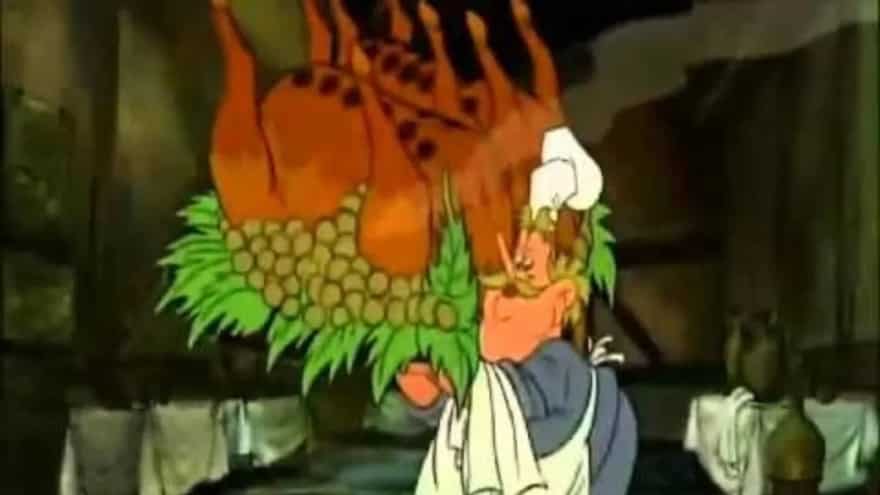
Image credit: Asterix The Gaul
X. Goscinny: The Comedy Engine
Why are Goscinny’s food jokes so good? Take a few apart, gently.
• Repetition with a twist. The fish is always not fresh. The joke is never the freshness; it is the villagers’ new pretext for pretending to have noticed for the first time. Goscinny understood that a running gag is funniest not when repeated but when varied by a hair.
• Escalation. The fondue penalties. The strawberries that must come from further and further away. The Belgian table that keeps being laid. He rarely tells a food joke once; he tells it three times, each bigger.
• Absurd specificity. Not ‘a regional dish’ but bêtises de Cambrai. Not ‘something fried’ but chips, with mussels. The precision is the comedy; the reader who knows the dish laughs twice.
• The straight face. Every anachronism is delivered without a wink. Salade niçoise in 50 BC is funny only because nobody in the panel finds it strange.
• Appetite as innocence. Obelix’s hunger is never greed. He is not grasping; he is hopeful. The poisoned cake is dangerous, the Titans’ meal is a trial, the British boar is a tragedy — and Obelix approaches each with the same open face. The joke is on the world for being so stingy.
• The double audience. The child laughs at the boar being thrown. The adult laughs at the 1960s Guide Michelin being smuggled into antiquity. The same panel, two jokes, no compromise. This — writing simultaneously for two readers who never notice each other — is the skill the centenary should honour.
Goscinny was also, it should be said, a gourmand in the French sense: a man who took the table seriously as a stage for human folly. The clue is in what he chose to mock. He never mocked hunger. He mocked pretension — the imported fish, the Roman orgy, the Swiss rules, the Briton’s mint sauce, the spa diet. The village eats simply and well, and everyone else eats badly and proudly.
XI. Uderzo: Why the Food Looks Delicious
Food in Asterix is not written; it is drawn, and Albert Uderzo drew it better than almost anyone in the history of the medium. His roast boar is a masterpiece of appetite engineering: the body glazed a deep amber, the skin rendered with short hatching to suggest crackling, three wavy lines of steam rising from the flank, and — always — the trotters up, so that the animal reads as complete, a whole creature converted into a whole meal. Beside it, gnawed bones lie on the table in a pattern that tells you exactly how many boars have been eaten and by whom.
Uderzo understood that cartoon food outperforms photographed food because it can show the idea of the dish rather than its evidence. Photographed roast pork is brown and specific. Uderzo’s is the Platonic boar, the one you imagined before you tasted meat. His fish are silver and stiff and slightly cross-eyed, so that you smell them. His cheeses are wedges with holes you could put a finger through. His amphorae tilt at the angle of a hand about to pour. His Roman banquets are a different grammar entirely — reclining figures, grapes held at arm’s length, low tables, a decadence drawn with just enough disgust to make you prefer the Gaulish trestle.
And then there is Obelix eating. Uderzo draws him at speed: a blur of hands, a boar reduced to skeleton between two panels, a satisfied belch drawn as a small cloud. The physical comedy depends on scale — the boar is enormous, Obelix is more enormous — but also on innocence. There is no shame in his face. He is not stuffing himself; he is simply eating at his natural pace, and the world is too slow.
XII. Obelix, the Greatest Eater in Comics — and the Meal of the Titans
Obelix’s appetite is the most consistent characterisation in the series, and the most misread. He is not a glutton in the moralising sense; gluttony implies excess against a norm, and Obelix has no norm. He eats the way a river flows. The catalogue of his greatest performances — the restaurant in Asterix and the Cauldron that fails because the cook eats the ingredients; the boars mourned in Britain; the cake in Egypt; the turkey judged and found wanting in America; the spa diet endured in Arvernia; the hunger, in the Persian deserts of The Magic Carpet, that turns roast camel into a consolation — is a catalogue of a man meeting the world through his stomach and finding it, mostly, wanting.
But his masterpiece is not in the albums. It is in the film.
The Twelve Tasks of Asterix (1976): Obelix versus Mannekenpix
Fifty years ago, Goscinny and Uderzo — who had founded their own animation studio, Studios Idéfix, precisely so that they could make films their own way — wrote an original story for the screen. Caesar, exasperated, offers the Gauls a deal: complete twelve tasks in the manner of Hercules and he will concede they are gods.
One of the tasks is a meal. Obelix must eat everything prepared by Mannekenpix, the cook of the Titans, a vast, moustached Belgian-coded figure whose name is a Brussels statue with a Gaulish suffix.
The courses, as the film presents them — and I give this list from memory of the film rather than from a script, so treat the order as approximate:
• A roast wild boar, to open. Obelix’s face lights up; this is home.
• A herd of sheep — not a joint, the herd.
• An omelette of eight dozen eggs.
• A school of fish.
• A whole roast ox.
• A single serving of caviar — the cook’s joke, a mouthful after a mountain — on a small piece of toast.
• A roast camel.
• An elephant stuffed with olives (or, in some tellings, with vegetables), carried in on a platter the size of a courtyard.
• Frites — the Belgian cook, of course, fries chips; the same joke that would close Goscinny’s career in Asterix in Belgium three years later.
Obelix eats all of it with the contented rhythm of a man at a Sunday lunch. The cook, sweating, produces course after course, each more impossible, each consumed. And the punchline — the perfect, characteristic, Asterix punchline — is that when the kitchen is finally empty and the Titans’ cook has collapsed, Obelix looks up, wipes his mouth and asks, politely, whether there is anything else. He is still a little hungry. He wonders about dessert.
Why does it work? Because the scene is constructed as a trial — a labour of Hercules — and Obelix does not experience it as one. Every other task tests the heroes’ cunning or courage. This one tests only whether the world can out-supply Obelix, and the answer, delivered with total innocence, is no. The joke is not that he ate an elephant. The joke is that he was not trying.
How much did Obelix eat? (Estimates only — do not quote as fact)
• Assumptions: a roast boar dressed at ~60 kg; a ‘herd’ read as ten sheep at ~20 kg edible each; 96 eggs at ~5 kg; a ‘school’ of fish taken as 30 kg; a dressed ox at ~250 kg; caviar negligible; a camel at ~200 kg edible; an elephant at, conservatively, 2,000 kg edible.
• Rough total: on those assumptions, somewhere in the region of 2.7 to 3 tonnes of food in a single sitting. The margin of error is the elephant.
• Calorie range: at roughly 2,000–2,500 kcal per kilogram of cooked meat, that is on the order of five to seven million kilocalories — the maintenance intake of an ordinary adult for about seven to nine years.
• The point of the estimate: not precision, but that the film’s escalation is built on real quantities. Each course is roughly an order of magnitude beyond the last, and the elephant is the only one nobody has tried to draw to scale.
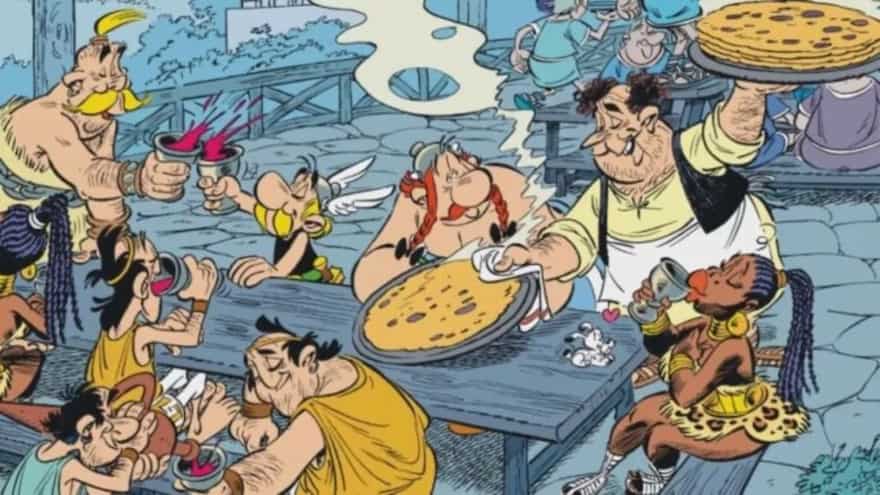
Image credit: Asterix The Gaul
XIII. Asterix vs Archaeology: A Field Guide
What did an ordinary Gaul actually eat in 50 BC? The evidence — animal bone, seed remains, amphora sherds, Roman authors — suggests a diet built on cereals (wheat, barley, and in the north millet and oats, eaten as bread and as porridge), legumes, pork and beef, cheese, beer, and increasingly, along the trade routes, Italian wine. Fish where there was water. Salt, which Gaul had in abundance and which made the pork trade possible. Feasting was politically central: the elite banquet, the champion’s portion, the host’s obligation to be generous. Against that background, a selection of the comic’s claims:
Asterix depiction | Album | Evidence | Verdict |
|---|---|---|---|
Daily wild boar | Everywhere | Bone assemblages: domestic pig dominant; boar a small fraction | Plausible exaggeration |
Whole-animal spit roast at feasts | Every banquet | Attested for elite feasting; everyday cooking was the cauldron | Broadly plausible |
Gauls drinking beer (cervoise) | Everywhere | Cervesia — a Gaulish word the Romans borrowed | Surprisingly accurate |
Romans offering Gauls wine | Various | Diodorus on Gaulish wine appetite; Italian amphorae abundant on Gaulish sites | Surprisingly accurate |
Ham from Lutetia, sausage from Tolosa | Banquet | Strabo on Gaulish salted pork exports | Right food, wrong branding |
Oysters and white wine at Burdigala | Banquet | Both attested in the region in antiquity | Surprisingly accurate |
Salade niçoise | Banquet | Tomatoes are a New World crop | Magnificent nonsense |
Champagne at Reims | Banquet | Reims wine ancient; bubbles 17th–18th c. | Deliberate anachronism |
Britons drinking hot water; tea ‘invented’ | Britain | Tea reached Europe in the 17th century | Deliberate anachronism (and the joke) |
Mint sauce on boiled boar | Britain | Mint sauce is early-modern English | Deliberate anachronism |
Fondue with penalties | Switzerland | Modern Swiss dish; cheese ancient | Deliberate anachronism |
Chips and mussels | Belgium | Potato reached Europe in the 16th c. | Magnificent nonsense |
Cream and Calvados | Normans | Cream ancient; apple brandy 16th c. at earliest | Deliberate anachronism |
Corsican chestnut-fed boar | Corsica | Chestnuts and pigs both ancient on Corsica | Broadly plausible |
Exploding cheese | Corsica | No | Magnificent nonsense |
Turkey in America | Great Crossing | Turkey is a New World native | Surprisingly accurate |
Mistletoe cut with golden sickle | Golden Sickle | Pliny the Elder, Natural History | Surprisingly accurate |
Olive oil and olives in Spain | Spain | Roman Baetica was a major oil exporter | Surprisingly accurate |
Egyptian lentils, dates, beer | Cleopatra | All staples of Egyptian diet | Surprisingly accurate |
Strawberries out of season | Asterix the Gaul | Wild strawberries ancient; cultivated large fruit 18th c. | Plausible but exaggerated |
Beetroot juice as potion base | Black Gold | Beet was grown in antiquity, mostly for leaves | Cannot be established (it’s a potion) |
Feast ending in a fight over the meat | Every village brawl | Posidonius on the champion’s portion | Surprisingly accurate |
XIV. Foods That Shouldn’t Be There — But Thank Toutatis They Are
The anachronisms in Asterix are not errors. They are the point: the whole series is a 1960s France wearing a Gaulish helmet, and the food is where the disguise slips most gloriously. My favourites, ranked by audacity:
• Chips and mussels, Belgium. Sixteen centuries early, invented by a chief looking at a pot of oil. The best food joke in the canon.
• Tea, Britain. Not merely anachronistic but inverted: the book explains how the Britons came to drink tea, and the answer is a Gaul with a bag of herbs.
• Salade niçoise, Nice. A tomato in 50 BC is as impossible as a telephone; nobody in the panel blinks.
• Champagne, Reims. The amphora of bubbly. The Gauls have discovered secondary fermentation and are keeping it quiet.
• Fondue, Switzerland. Served with a penal code.
• Calvados, the Normans. Distillation arrives in Normandy nine hundred years before the Normans do.
• Bêtises de Cambrai. A boiled sweet invented in the 1850s, allegedly by accident — hence the name, ‘blunders’ — travelling with Asterix in a bag.
• Caviar on toast, the Titans’ kitchen. The Romans ate sturgeon; salted roe as a luxury ‘course’ is a later Persian-Russian idea, and the toast is a joke about portion size.
• Prunes from Agen. The plum came to the Lot valley with returning Crusaders — a mere thirteen centuries late.
• The spa diet at Aquae Calidae. Vitalstatistix takes the waters at Vichy for his liver and is put on boiled vegetables. Roman spas are real; the French liver, as a national organ of complaint, is a nineteenth-century invention.
XV. Did the Food Change After Goscinny?
Yes, and in an instructive way. Uderzo’s solo albums (1980–2009) are not food-poor — Black Gold is a quest for a potion ingredient; The Magic Carpet runs Obelix through the deserts on camel and caviar; All at Sea and Asterix and Son both use the potion as plot — but the density of culinary joke-per-page falls. Uderzo’s instincts were visual and mythological: he reached for aliens, Atlantis, a baby, a female warrior. Goscinny’s were social: he reached for the table.
The Ferri–Conrad era (2013–2021) consciously restored the older rhythm. Asterix and the Picts gave English readers a warrior named MacAroon and a Scottish landscape of malt and mist; Asterix and the Chariot Race is a Tour of Italy in which regional pride is, once again, edible. The Fabcaro albums push further: Asterix and the White Iris (2023) sends a Roman self-help guru into the village preaching positivity and — if I read the satire correctly — lighter eating, so that Obelix’s appetite becomes the last redoubt of common sense against wellness culture.
Asterix in Lusitania (2025), which I have read only in part, takes the heroes to Portugal, where — I would wager — the fish is finally fresh. The series has, in its seventh decade, remembered that its subject is dinner.
XVI. Food Is Home
Here is the argument I have been circling. Asterix is a comic about leaving. Its heroes go to Britain, Germania, Rome, Egypt, Greece, Spain, Switzerland, Belgium, Corsica, America, the Middle East, India, Scotland, Italy again, Sarmatia, Lusitania. In every place they encounter a language they must speak badly, a government they must outwit, a custom they must endure and — always, first — a meal they must eat. The foreign food is the foreign country. To be abroad, in Asterix, is to be served something you did not order.
And then they come back. And the village eats what it always eats, by the fire, with the bard tied to a tree. The banquet is not a joke about gluttony. It is a statement about home: that home is where you know what dinner will be. Rome can build camps on every side. Rome can tax and conscript and wall the village in. But the Romans never once sit at that table, and the boar keeps turning.
This is why the banquet is such a perfect narrative full stop, and why the exceptions land so hard — why a banquet in Belgium, painted as a Bruegel, with a rabbit weeping at a dead writer’s signature, is among the most moving single panels in European comics. The feast is the community counting itself and finding everyone present. Every Asterix album ends with a census taken in boar.
XVII. Another Boar Has Arrived
I go back, at the end, to the child in South Bangalore with the book open on the floor, looking at a drawing of a fat man carrying a wild boar and wondering what on earth it tasted like. Books teach children history, or claim to; they teach geography; occasionally, it turns out, they decide what somebody orders for dinner thirty years later. I have eaten in a great many places since, and I have eaten wild boar, and I can report that it does not taste like the drawing. Nothing does. The drawing tastes of being eight.
What I did not understand then, and understand now, is that the boar was never the point. The point was the table it was carried to. Some fictional worlds stay with us because we remember how they looked, and some because we remember how they sounded, and a very few because we remember how we imagined they tasted — and Asterix is all three, and the third is the one that gets you, years later, in a restaurant, holding a menu.
So: the Romans have been thrashed. The adventure is over. Cacofonix has, with any luck, been prevented from singing. The fire is high. Another boar has arrived. And everybody — every single one of them — is home.
Pass the mint sauce. Actually, don’t.
Appendix A — The 25 Greatest Gastronomic Moments in Asterix
An alternative history of the series, told entirely through eating. Ranked, with a line on why each matters.
- The village speciality (Asterix and the Banquet) — The regional dish of Armorica is a punch in the face. The finest culinary punchline in the canon.
- Obelix vs Mannekenpix (The Twelve Tasks of Asterix, 1976) — Boar, sheep, omelette, fish, ox, caviar, camel, elephant — and he asks for dessert.
- The invention of chips and mussels (Asterix in Belgium) — Beefix, a pot of oil and a pile of mussels: moules-frites and fish and chips, sixteen centuries early.
- The invention of tea (Asterix in Britain) — A bag of Getafix’s herbs in hot water rallies the Britons; the last panel names the drink.
- Boiled boar with mint sauce (Asterix in Britain) — Obelix’s face is the whole Franco-British relationship in one panel.
- The poisoned cake (Asterix and Cleopatra) — The Gauls prove their innocence by eating the evidence. Obelix asks for the recipe.
- The strawberries (Asterix the Gaul) — The first food joke in the series: a delaying tactic disguised as an ingredient.
- Fondue with penalties (Asterix in Switzerland) — Lose your bread, lose your dignity, then your life. Conviviality as regime.
- The Bruegel banquet (Asterix in Belgium) — The last Goscinny feast, painted as The Peasant Wedding, with a rabbit mourning his signature.
- The fish brawl (Asterix and the Roman Agent) — A whisper about freshness and the village is at war under a rain of mackerel.
- The exploding cheese (Asterix in Corsica) — A cheese so strong it sinks the pirates.
- The Gergovia anniversary feast (Asterix in Corsica) — An album that opens with the banquet, and lets the plot happen after dinner.
- Beetroot juice (Asterix and the Black Gold) — A whole odyssey for rock oil; the substitute was in the garden.
- The failed restaurant (Asterix and the Cauldron) — Obelix as cook. The stock does not survive.
- The spa diet (Asterix and the Chieftain’s Shield) — Vitalstatistix on boiled vegetables at Vichy; Obelix in mourning.
- The turkey (Asterix and the Great Crossing) — The Gauls discover Thanksgiving fifteen centuries early and find it dry.
- Cream on everything (Asterix and the Normans) — Terrifying seaborne raiders with the palate of a Rouen bistro.
- Huevos y Bacon (Asterix in Spain) — A freedom fighter named after breakfast; his son on hunger strike.
- The hangover cure (Asterix and the Laurel Wreath) — A stew made to be inedible turns out to cure the young master’s morning after.
- Cacofonix at the table (Asterix and the Normans) — The one banquet where the bard is untied, and the reader feels the reversal.
- The Belgian breakfast-to-sunset table (Asterix in Belgium) — The Gauls, for once, are out-eaten.
- Roast camel and caviar (Asterix and the Magic Carpet) — Obelix’s substitute boars, and the loneliest he ever is.
- The Roman governor’s orgy (Asterix in Switzerland) — Decadence drawn so squalidly that Swiss cleanliness feels like mercy.
- Unhygienix’s price list (The Mansions of the Gods) — The fishmonger discovers tourism.
- Oysters at Burdigala (Asterix and the Banquet) — The one stop on the tour that is entirely historically accurate — and nobody notices.
Appendix B — The Asterix Pantry
A categorised reference index. Entries are deliberately concise; album citations are to the English titles.
Meat & Game
Food | Album(s) | Context / joke |
|---|---|---|
Wild boar | Everywhere | The currency of the village; Obelix’s life’s work. Historically: pig, not boar. |
Pork sausage / ham | Banquet; village | Lutetia ham, Toulouse and Lyon sausage; Strabo’s Gaulish charcuterie. |
Ox / beef | Belgium; Twelve Tasks | Ox tongue at Beefix’s table; a whole ox for Obelix. |
Sheep | Twelve Tasks | Served by the herd. |
Camel | Magic Carpet; Twelve Tasks | The desert substitute for boar. |
Elephant | Twelve Tasks | Stuffed. On a platter the size of a courtyard. |
Turkey | Great Crossing | Discovered in America; found dry. |
Boiled boar | Britain | With mint sauce. Obelix’s darkest hour. |
Fish & Seafood
Food | Album(s) | Context / joke |
|---|---|---|
Unhygienix’s fish | Most village albums | Not fresh; imported from Lutetia by ox-cart despite the sea being next door. |
Oysters | Banquet (Burdigala) | Historically accurate Bordeaux oysters. |
Bouillabaisse | Banquet (Massilia) | Modern Marseille fish stew smuggled into 50 BC. |
Mussels | Belgium | Salvaged from the pirates; paired with chips. |
A school of fish | Twelve Tasks | One course among nine. |
Caviar | Twelve Tasks; Magic Carpet | A single mouthful after the ox; Persian luxury. |
Cheese & Dairy
Food | Album(s) | Context / joke |
|---|---|---|
Corsican cheese | Corsica | So pungent it drives off Romans and sinks pirates. |
Fondue | Switzerland | Communal, with escalating penalties for lost bread. |
Petit Suisse | Switzerland | The hotelier’s name; the cheese survives translation. |
Cream | Normans | On everything; the Normandy joke. |
Milk | Britain | A drop, in hot water, at five o’clock. |
Bread, Cereals, Fruit & Vegetables
Food | Album(s) | Context / joke |
|---|---|---|
Strawberries | Asterix the Gaul | Demanded out of season for the potion; eaten by the druid. |
Prunes | Banquet (Aginum) | Agen prunes, thirteen centuries early. |
Olives / olive oil | Spain; Twelve Tasks | Historically accurate in Iberia; stuffing for an elephant. |
Potatoes (chips) | Belgium; Twelve Tasks | The great anachronism — fried by a Belgian chief and a Belgian cook. |
Brussels sprouts / waterzooi | Belgium | Referenced in passing; the book crams in every Belgian dish it can. |
Boiled vegetables | Chieftain’s Shield | The spa diet. A punishment. |
Beetroot | Black Gold | The potion’s rock-oil substitute, discovered too late. |
Lentils, dates | Cleopatra | Uderzo’s careful Egyptian table. |
Mistletoe | Golden Sickle; everywhere | The potion’s one historical ingredient, per Pliny. |
Sweets & Cakes
Food | Album(s) | Context / joke |
|---|---|---|
Bêtises de Cambrai | Banquet | 1850s mint humbugs in a Gaulish bag. |
The poisoned cake | Cleopatra | Eaten to prove innocence; Obelix wants the recipe. |
Macaroon | Picts | A Pict named after a biscuit — Anthea Bell’s late joke. |
Drink
Drink | Album(s) | Context / joke |
|---|---|---|
Beer (cervoise) | Everywhere | The Gaulish drink; historically the Gaulish word. |
Warm beer | Britain | The British crime. |
Hot water with milk / tea | Britain | The five o’clock ritual; tea ‘invented’ in the last panel. |
Wine | Rome; Banquet; Chieftain’s Shield | Roman, Bordeaux, Arvernian — sold by Winesanspirix. |
Sparkling wine | Banquet (Durocortorum) | Champagne, bubbles and all. |
Calvados | Normans | Apple brandy, nine centuries early. |
Gueuze / lambic | Belgium | The Belgian chief’s French name is a beer. |
Magic potion | Everywhere | Mistletoe, secrecy, lobster for taste; medicine, food and myth at once. |
Getafix’s failed brews | Big Fight | The amnesiac druid’s random potions; what happens when the recipe is lost. |
Sourcing note: canon, dates and translator history verified against Wikipedia’s List of Asterix volumes and English translations of Asterix and the official asterix.com site; the Belgian chips/mussels scene, Bonanza/Annie Cordy, the rain after Goscinny’s death and the mourning rabbit verified via the Wikipedia.




