


 Share
Share

Walk into any Hindu temple in India, and in most of them, the scent of ghee, roasted gram flour, camphor, and incense is more likely to hit your senses long before the deity does. Offerings of fruits, sweets, rice, even dal and vegetables have become so familiar that temple or any puja-related food is automatically imagined as an entirely vegetarian, sattvik realm. But India has never fed itself in a universal, single manner; then why should their deities eat alike?
In parts of eastern and north-eastern India, particularly within Shakta traditions, the sacred bhog plate can be very different. In some temples, an animal may be sacrificed and the meat subsequently distributed to devotees, while in others, cooked fish or meat is specifically prepared as bhog. These practices are rooted in various regional customs, theological traditions, as well as specific forms of goddess worship. They do not represent Hindu temples or their way of life as a whole, nor are they uniform even among temples dedicated to the same deity, such as Maa Kali and her various forms.
Yet these traditions reveal something fascinating and layered about Indian food culture. What you consider your daily lunch can be offered to a tantric or Shakta deity very respectfully. This is when humanity understands the true humility of divinity: it does not seek the world, only your devotion; the prasad form is irrelevant; the adoration and intention are what matter. This is particularly visible in Bengal, Assam, and parts of Odisha, where the fierce forms of the divine feminine Mother have long been worshipped through traditions that can accommodate both vegetarian and non-vegetarian offerings with ease.
Why Do Some Hindu Gods Receive Fish Or Meat?
The answer lies partly in the extraordinary diversity of Hindu worship. Different traditions have developed varying ideas about what is appropriate to offer a deity. Vaishnavite traditions are often strongly vegetarian, while several Shakta traditions have historically accommodated animal sacrifice and non-vegetarian offerings. Plus, regional food customs matter as well.
Goddess Kali, in particular, has been worshipped in several forms and through different ritual traditions. In some Shakta settings, offerings of meat, fish, or animal sacrifice form part of the actual relationship between the devotee and the deity. In others, the goddess also receives an entirely vegetarian spread. Therefore, it is not a contradiction to find veg prasad also being served to Maa Kali, while fish and meat are offered by others. The contradiction appears only when India's religious food traditions are expected to follow one national menu.
Kalighat Temple
Few places exist where religion and the everyday life of a city are as closely intertwined as Kalighat. The Kali temple, counted among the 51 Shakti Peethas, has been one of Kolkata's most important pilgrimage centres for generations. Its current physical structure dates back to the 19th century, although the sanctity of the site is much, much older. The temple's reputation travels far beyond Bengal, magnetically drawing everyone from first-time pilgrims to politicians, celebrities, to ordinary Kolkata families who return year after year for a glimpse of their beloved Maa and her blessings. And then there is the bhog.
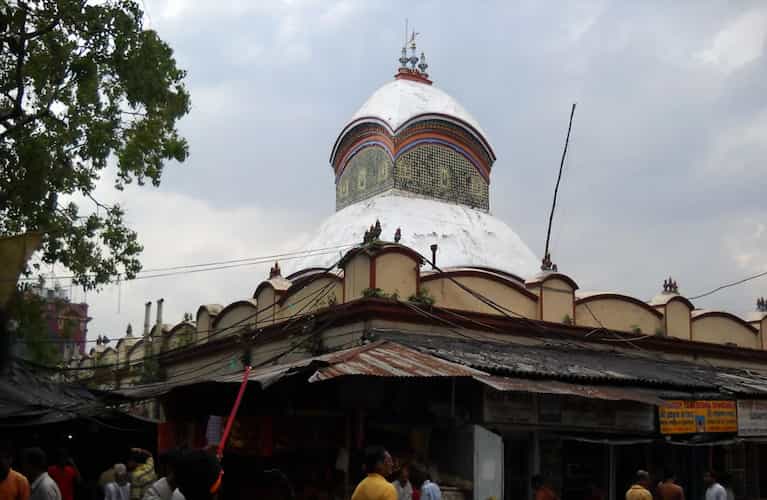
Image credit: Wikimedia Commons
At Kalighat, the sacred bhog can include an unmistakably Bengali spread: rice or pulao, vegetables, dal, and sweets alongside fish or goat meat on particular occasions. For instance, the recent Kaushiki Amavasya celebrations saw elaborate offerings such as several kinds of fish and goat meat. But there is an important ritual distinction here. Not every item of non-vegetarian food associated with the temple is necessarily offered directly to the main deity. Often, these offerings connected with Maa Kali are for her loyal attendants, Dakini and Yogini. But that detail is quintessentially Kalighat.
Tarapith Mandir
If Kalighat belongs to the restless pulse of Kolkata, then Tarapith belongs to a different, intensely spiritual and tantric landscape. The Birbhum shrine is dedicated to Maa Tara, a highly powerful form of the goddess, and is closely associated with Shakta and Tantric traditions. Its proximity to the cremation ground is central to its religious identity, giving the pilgrimage town an almost supernatural atmosphere unlike the polished grandeur of many major temple complexes. Its food traditions are also equally distinctive.
Tarapith's bhog can unite vegetarian dishes and non-vegetarian offerings in the same ritual universe. Fish and goat meat traditionally feature alongside rice, khichuri, vegetables, pulao, chutney, payesh, and sweets. During major ritual occasions, preparations involving roasted fish and goat meat have been reported as part of the temple's offerings, along with liquor. For someone accustomed to the idea that sacred food must be vegetarian or sattvik, the plate at Tarapith can be startling. However, within the temple's Shakta framework, this apparent contradiction disappears as the food belongs to the ritual tradition of the deity being worshipped.
Dakshineswar Temple
Dakshineswar is among the most recognisable temples in Bengal, its nine-spired silhouette rising dreamily beside the Hooghly River, against a stubbornly pretty sky, and its history is inseparable from Rani Rashmoni and Sri Ramakrishna. The temple was founded by Rani Rashmoni herself in the 19th century and became closely associated with Sri Ramakrishna Paramahansa, whose spiritual life and teachings drew visitors from across Bengal and far beyond. Today, it remains one of Kolkata's most visited religious landmarks.
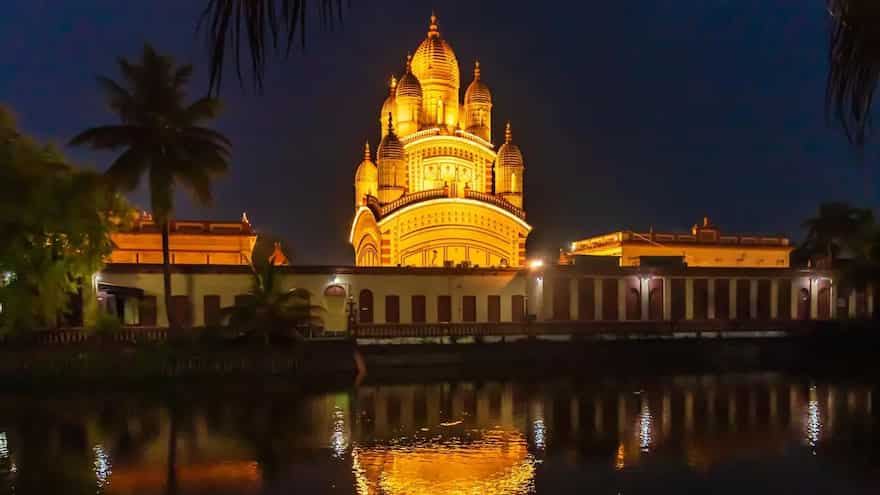
Image credit: Wikimedia Commons
But its food tradition provides a fascinating counterpoint to assumptions about Goddess Kali worship. At Dakshineswar, Maa Bhavatarini, the temple's presiding form of the Goddess, receives fish as part of her bhog. The temple does not practise animal sacrifice, and meat does not form part of the offering. The fish, or maacher bhog, is accompanied by rice, ghee, vegetables, and sweets. For Bengalis, this is less surprising than it sounds, as fish has occupied an exceptionally significant place in the region's cultural life for centuries. At Dakshineswar, that familiarity enters the sacred kitchen.
Thanthania Kalibari
Thanthania Kalibari may lack the monumental grandeur of Dakshineswar. And that is precisely part of its charm. Set amid the crowded streets of central Kolkata, the Siddheshwari Kali shrine dates to 1703 and ranks among the city's really old Goddess Kali temples. Its history is interwoven with the very essence of old Kolkata, and its association with Sri Ramakrishna further adds to its religious importance. The temple's food traditions are particularly intriguing.
While fish is offered as bhog, animal sacrifice has historically been part of particular ritual occasions. More importantly, the practice distinguishes sacrificial meat from food cooked and offered as the temple's regular bhog. This means meat from a sacrifice may be handed over to the devotee who made the offering rather than becoming part of the deity's cooked meal.
Thanthania also has an unusually memorable food story attached to its religious history. Its dab-chingri, aka prawns cooked with tender coconut, is associated with a prayer made by Sri Ramakrishna for Indian revolutionary Keshab Chandra Sen's recovery. This is the kind of anecdote that makes Kolkata's old temples feel less like monuments and more like living neighbourhoods, where food, faith, divinity, and memory peacefully co-exist for centuries before and after.
Kamakhya Temple
On Assam's Nilachal Hill, Kamakhya is one of India's most important Shakti shrines. The temple is particularly associated with Tantric Shakta worship, the power of Maa’s divine yoni, and the annual Ambubachi tradition that draws devotees, ascetics, and visitors from nearly every corner of the country. Here as well, animal sacrifice remains part of the ritual landscape.
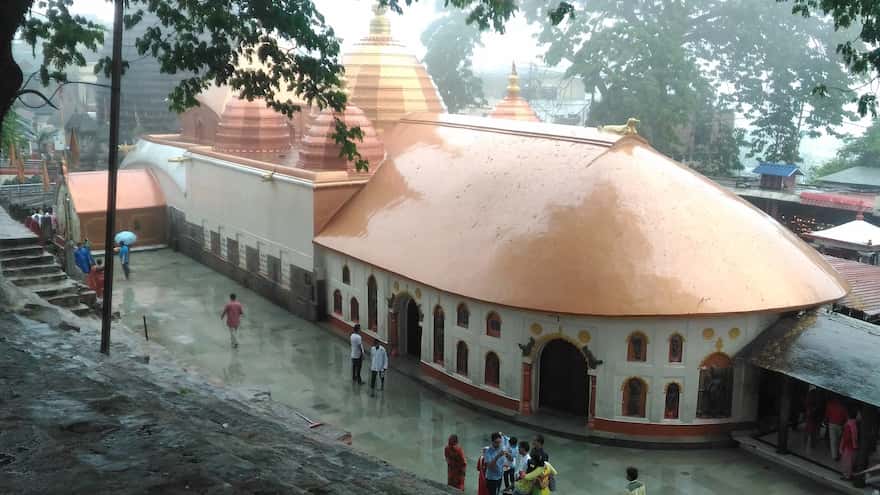
Image credit: Wikimedia Commons
Goat sacrifice is traditionally practised at Kamakhya, and its ritual culture includes both vegetarian and non-vegetarian offerings. Fish and goat meat have a place within the broader food traditions surrounding the shrine. Kamakhya Temple is a useful reminder that the relationship between food and Hindu worship cannot be separate from the identity of the deity. If you take away the food, you compromise on an integral part of your devotion: acceptance of the Goddess in all her glory. The goddess worshipped here can not be approached through the same ritual vocabulary as a Vaishnavite deity whose offerings are strictly vegetarian.
Baripada Kali Mandir: An Odisha Tradition
The saga continues beyond Bengal and Assam. In Odisha, traditions surrounding animal sacrifice and the offering of meat in Goddess Kali temples have also survived. Here, the distinction between animal sacrifice and sacred bhog becomes important again. In Baripada, in northern Odisha's Mayurbhanj district, Maa Kali worship carries an older martial memory. The city's current religious landscape has been shaped by the Bhanja royal tradition, while the surrounding region remains one of Odisha's richest centres of folk and tribal culture.
The Kali Mandir at Baripada is associated with the ritual sacrifice of a goat to the goddess, a practice linked in local tales to the martial traditions of the region. The goat sacrifice is understood within that older warrior tradition as an offering of blood to the ultimate Goddess of war. The sacrificial goat and the subsequent handling of its meat belong to a ritual system of their own. It is more accurate to describe the temple as one where animal sacrifice forms part of Kali worship than to suggest that devotees routinely receive a cooked mutton bhog in the manner of a conventional temple meal.




