


 Share
Share

The latest argument over fish, meat, and Durga Puja is not really about food. It is about who gets to define Bengali Hindu tradition, and there are some things a Bengali does not need to be taught. Be it eating any fish by picking bones like a pro, arguing about the superiority of ilish, or simply judging a Puja bhog by its khichuri, like a chef. And, most importantly, how or what to eat during the much-awaited Durga Puja, especially according to the opinions of somebody who cannot understand this Bangaliyana. Yet, just weeks before Durga Puja, the entire state of Bengal has found itself having precisely that argument.
It began with Bageshwar Dham preacher Dhirendra Krishna Shastri, who, while speaking in Howrah, appealed to the people not to cook or eat fish and meat during Durga Puja and called those who ignored the appeal ‘pakhandis’ (religious hypocrites). He also sought to keep non-vegetarian food away from Durga Puja pandals. The comments landed pretty badly in a state where fish and meat have long co-existed alongside Hindu religious practice. Of course, Bengalis had a lot to say in response.
The Puja Politics Before Puja Parikrama
What followed was an unusually revealing and moderately funny political scramble. The Bengal BJP did not really embrace Shastri's dietary prescription. State BJP president Samik Bhattacharya was among the earliest and clearest voices to distance their party from such a remark. He said in interviews that what Bengalis eat is their own choice and argued that Bengal's established religious and cultural traditions cannot just be rewritten by an outside religious figure. He pointed out the familiar Bengali Puja culinary calendar, noting that Bengalis adore eating veg food and luchi on Ashtami before feasting on mutton on Navami.
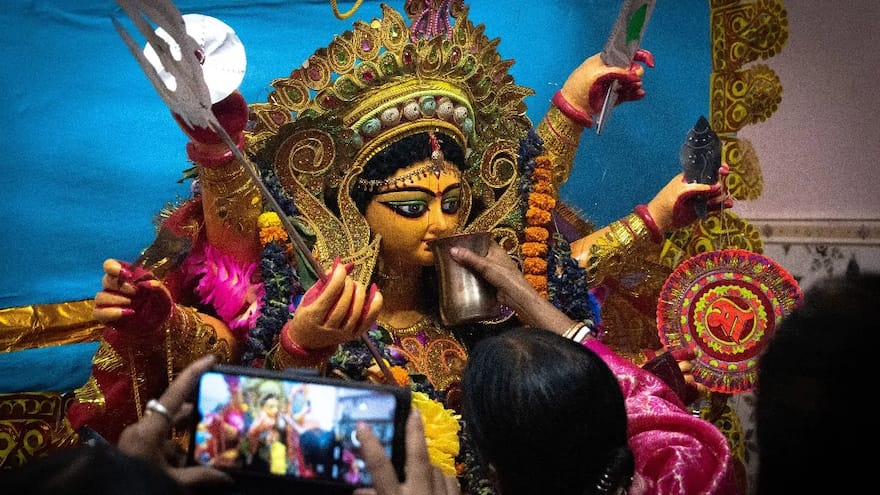
Image credit: Pexels
On another occasion, he invoked Swami Vivekananda to make the broader point that no contemporary religious preacher should be treated as an unquestionable authority over Bengal's customs. They need to be worthy first. Senior BJP leader Dilip Ghosh was similarly forthright in describing food as a matter of personal choice and pointed to the long history of animal sacrifice and consumption of sacrificial meat as prasad in Bengal's religious traditions.
Instead, he made a larger, rather pointed complaint: why should Bengal be taught its own culture by outsiders? Forget mansplaining; culturesplaining is the present and future. And this is where the story became more interesting than a routine vegetarian versus non-vegetarian spat. Because it exposed something that Bengalis have always known. There is no one universal Hindu food culture in India, and there certainly is no single, restrictive Hindu food culture in Bengal.
The Congress took an even harder hit against Shastri. Its leaders filed a police complaint over his remarks, arguing that they offended Bengali religious and cultural sentiments. Congress leader Atanu Das later faced arrest after protests against Shastri, including an incident involving the burning of the latter’s photograph. Bengal Congress chief Subhankar Sarkar condemned the arrest, accusing the government of targeting protesters instead of addressing the original controversial remarks.
In the meantime, the Trinamool Congress treated the episode in familiar political terms, with the valid question of an ‘outsider’ attempting to prescribe Bengali customs, without understanding the nuances. Then came an irony that was pretty hard to miss.
CM Suvendu Adhikari Had A Different Message
Chief Minister Suvendu Adhikari did not support the idea that Shastri's personal belief should become anybody else's compulsory dietary rule. In essence, he publicly disclosed that a religious leader was entitled to express his own beliefs and that people could choose to follow or not to follow them. But Adhikari simultaneously took a hard stand against those protesting by burning Shastri's photographs.
He directed the Kolkata Police Commissioner to take action against those involved. The Honourable CM also used the episode to attack the Trinamool Congress over what he described as its typical politics of appeasement. And then, on Kaushiki Amavasya, the matter acquired an almost theatrical Bengali ending. Adhikari went to Kalighat to pay obeisance to the Goddess and savoured her sacred bhog. Which had fish in it.
The Kalighat Plate That Changed The Conversation
On September 10, CM Adhikari visited Kalighat Temple for Kaushiki Amavasya and participated in the worship of Maa Kali. The bhog offered at the temple included basanti pulao, several vegetarian preparations as well as fish, including hilsa, prawns, bhetki, parse, and katla, along with the respective fish heads. Goat meat was also part of the reported offering. Adhikari subsequently sat down inside the temple premises and ate the bhog, with his plate holding vividly visible portions of rice, fish, and a fish head.
For a Bengali, the symbolism hardly requires any translation. Adhikari has explained that he eats sattvik food on Ashtami and other niramish puja occasions, but also accepts fish offered to the Goddess according to Hindu Shakta tradition. He made the distinction between his personal observances and the food he consumed as being respectfully part of any particular religious tradition. So, in other words, both things are not mutually exclusive.
A Bengali can observe a vegetarian ritual day and also eat fish offered as sacred bhog on the relevant religious occasions. That is not hypocrisy. Hypocrisy is backpedalling on what you have said in comparison to what you have done or continue to do. And this is precisely the kind of layered religious practice that has existed in Bengal for generations.
So, Is Non-Veg Actually Forbidden During Durga Puja?
No, not as a universal rule. And this is perhaps the most important myth to clear up first. There is no blanket rule in Kolkata that bans Bengalis from eating fish or meat during Durga Puja. The VHP has made an appeal concerning non-vegetarian food around pandals, but it has also clarified that it was not imposing a complete ban on non-vegetarian food or dictating what people eat privately.
Dhirendra Shastri himself has now attempted to soften his original remarks. From Glasgow, he has communicated that he was not trying to interfere with anyone's personal food choices and framed his comments instead around his own personal belief in ahimsa, opposition to the killing of animals, and the sanctity of worship spaces. While the clarification is noted, it does not erase the original cultural question. Because Bengal's Puja traditions cannot be understood via a single Navratri template imported from elsewhere.
Bengal Never Had One Puja Menu
There are a plethora of Bengali households with varying beliefs. There are Bengali households where Puja means strictly vegetarian food. While households following Shakta traditions ensure animal sacrifice and consumption of the sacrificial meat as part of the ritual. Then there are families that offer fish to their deity, along with some Bengali kitchens where the dinner is fish, but the bhog is vegetarian. And finally, the people. Several opt to fast, and others indulge their Puja cravings in every alternate meal, while some do both, depending on the day of Puja.

Image credit: Pexels
None of these practices make one person more Bengali or Hindu than the other. How much of a Bangali or Sanatani you are depends entirely on your belief system, approach to life, and perspective, not by the contents of your plate. We are better than that. And this is where the distinction between bhog and festive food becomes essential.
Fish offered to a deity and fish curry eaten after pandal-hopping are not automatically the same religious act. Similarly, a plate of mutton biryani after visiting three pandals is not prasad simply because it was eaten during Puja. So, when fish or meat is prepared and offered within a temple's established ritual practice and then distributed as prasad, calling it merely ‘non-veg food' strips the act of its religious and cultural context.
And Then There Is Kolkata During Puja
Anyone who has actually spent Durga Puja in Kolkata knows how absurdly expansive the city's food culture becomes especially during those 10 days. Plus pandal-hopping produces its own appetite. The city eats rolls, chops, biryani, fish fry, Mughlai paratha, kebabs, sweets, and everything in between for the ultimate seasonal feasting. This is not a theological statement. It is simply what happens when an entire city celebrates the arrival of their Divine family members.
And perhaps that is what has been most frustrating about this debate from a Bengali point of view. The common Bengali knows this: the difference between what devotees offer the Goddess, what they eat at home, and what they grab from a roadside stall at 1 am after visiting six pandals with a broken sandal. Bengal has never needed politicians, preachers, or television anchors to explain that difference; the state can still think for itself.
So, no, Kolkata does not become non-vegetarian-free during Durga Puja. And not eating fish or meat during Puja neither makes you a sinner, nor does avoiding them make you a saint. The real tradition is considerably more interesting, instead, as it is plural, contradictory, intensely personal, and deeply regional. And most importantly, it is ours.




