It is that magical time of the year again. When there is a cool and festive nip in the air across India after Diwali, and when lit-up stores and festivities continue until the new year. The air quality of Delhi and NCR during winter is a different animal, of course, but that makes for a different topic of discussion, altogether. I don’t know about you, but for me my happiness quotient also stems, for the most part, from the abundance the winter season brings to our dining tables.
So, even though it’s not yet strictly winter for most parts of India, the onset of it hanging expectantly in the air, brings forth the promise of all the signature winter specials Indian cuisine is popularly known for. Let’s see, what am I looking forward to this winter? The list is music to one’s ears: aloo/paneer matar mooli/gobhi/methi ke parathe, sarson ka saag, palak mutton, undhiyu, gajar ka halwa, koraishutir kochuri (why do the Bongs complicate the name of a simple vegetable like matar?) my mother’s methi fish fry (my favourite in winter), gongura mamsam, a Telangana special, and palaw chattu or straw mushrooms typical to winters in Odisha, among many other such winter jewels.
For example, I have just dined on some superbly fresh and aromatic sarson da saag and makki ki roti, following chef Kunal Kapur’s recipe to a T and I am pretty chuffed, obviously. The neighbourhood akoora (the Telugu word for local greens) guy who sits outside our locality park had stocked some early editions and my kitchen help called up excitedly to check if I wanted sarson saag or mustard greens.
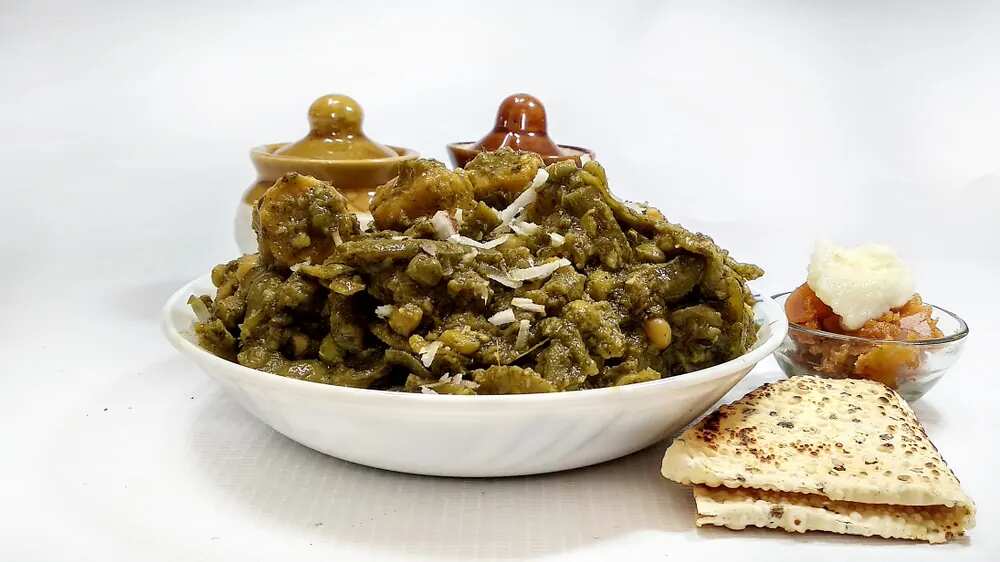
I am equally excited to find Gaurang Shah announcing on his social media posts that Gujarati winter special Undhiyu is now available at his restaurant here in Hyderabad. I find myself turning nostalgic over our years in Ahmedabad, when I was first introduced to the alien, but absolutely lip-smacking duo of Puri- Undhiyu at a Makar Sankranti lunch hosted by an office colleague.
Undhiyu/Pic-Gaurang's Kitchen
Undhiyu, a one pot vegetable casserole, is traditionally cooked in earthen pots in southern Gujarat and uses various winter vegetables, usually root ones like sweet potatoes, yam, (both purple and regular), baby potatoes, besides raw banana, baby brinjals, Indian flat beans also known as hyacinth beans or what is referred to in Gujarat as Surti Papdi, and various other assorted winter veggies, but for me the highlights of the dish are the mint-green fresh Tuvar Lilva or pigeon peas and methi muthiya,
The dish derives its name from the Gujarati word ‘undhu’, which means upside down. The vegetables are placed in a sealed pot upside down and cooked overnight on a slow fire pit dug in the ground. The slow cooking in the earthen pot gives the dish its rooted, rustic flavour. Undhiyu goes best with hot, puffed-up puris though the earthier bajra bhakri is a healthier and more evolved option.
Can any Indian winter ever be considered complete without the joyful ritual of shelling peas for all of one’s favourites, like aloo matar with ‘dher saara matar’, pre-millennials might remember the cooking oil ad of the early 90s? The sheer delight one feels, spotting the first batches of peas at the supermarket nestled amongst the red carrots and emerald green broccoli, cabbage and whitest of cauliflower is unmatched.
It might surprise you to know that the best quality peas come from the east of India, in Jharkhand, which produces 9% of the country’s peas output. I got to know this by default while being on a work-related road trip in Ranchi. Suddenly, on the highway, we spotted a bustling hub of winter vegetables of all kinds, in a riot of colours. That is when I also got to know that Ranchi is one of the major vegetable hubs for most of eastern India.
Speaking personally, I don’t tire of pea recipes of all kinds, be it peas-stuffed kachoris made the Bong way, or parathas made the North Indian way. And when winter is receding, you will find even food connoisseur and author Rocky Mohan sharing ways and means of freezing fresh peas until the coming season.
In Hyderabad, it is the seasonal greens or Akoora which certainly holds the spotlight in winter. One of the winter bestsellers, both at restaurants and home kitchens, is the absolute sparkler of a mutton dish, gongura mamsam, made of the tangy roselle leaves or gongura considered to provide the much-needed warmth to the human bodies. Ponnanganti koora and chukka koora are other winter greens, which are usually added to dals or meat dishes in Telangana. Full of antioxidants and nutrient-dense, these are not only light and nutritious, but have their unique flavour too.
Another green winter visitor to Hyderabad is the harboota or the green chana, or the choliya, as it is also known in the north. Fresh, tender green chickpeas that come in shells just like peas, unshell, saute them in ghee/butter with a dash of salt-pepper seasoning and a squeeze of lime, and if you further add a coriander leaf garnish, you are up with something fresh and delicious.
And it's certainly not vegetables, which hold sway in winter. How can we forget the rosy apples, peaches and plums from Kashmir and Himachal Pradesh? Or the fragrant, vitamin-loaded Nagpur oranges which I remember loving to munch in the Delhi sun as an undergrad.
Right now, Hyderabad streets are dotted with carts selling custard apple or sitaphal, as it is known more commonly here, and part green-part red figs too. Sitaphal is now used extensively in icecreams and this is the season when it is peeled and frozen to go into sorbets and gelatos and ice creams too.
But personally speaking, it is Delhi (albeit of the 90s), which defines the concept of winter eating for me, the methi-gobhi-aloo-paneer parathas, the shalgam-gobhi-gajar pickles in mustard and vinegar tossed in a big glass bottle presented to me by my Punjabi aunt in Karol Bagh, the freshness of a hot, nuts-and-raisins laden gajar ka halwa, or even the rewri gajak vendors shouting out their wares. These are the memories which keep you snug in the harshest of winters, anywhere in India.
In the end, winter anywhere in India is a winning proposition, with all the goodness it brings along in terms of nutrition. So stock up on your greens, your peas, apples and oranges and stay healthy.