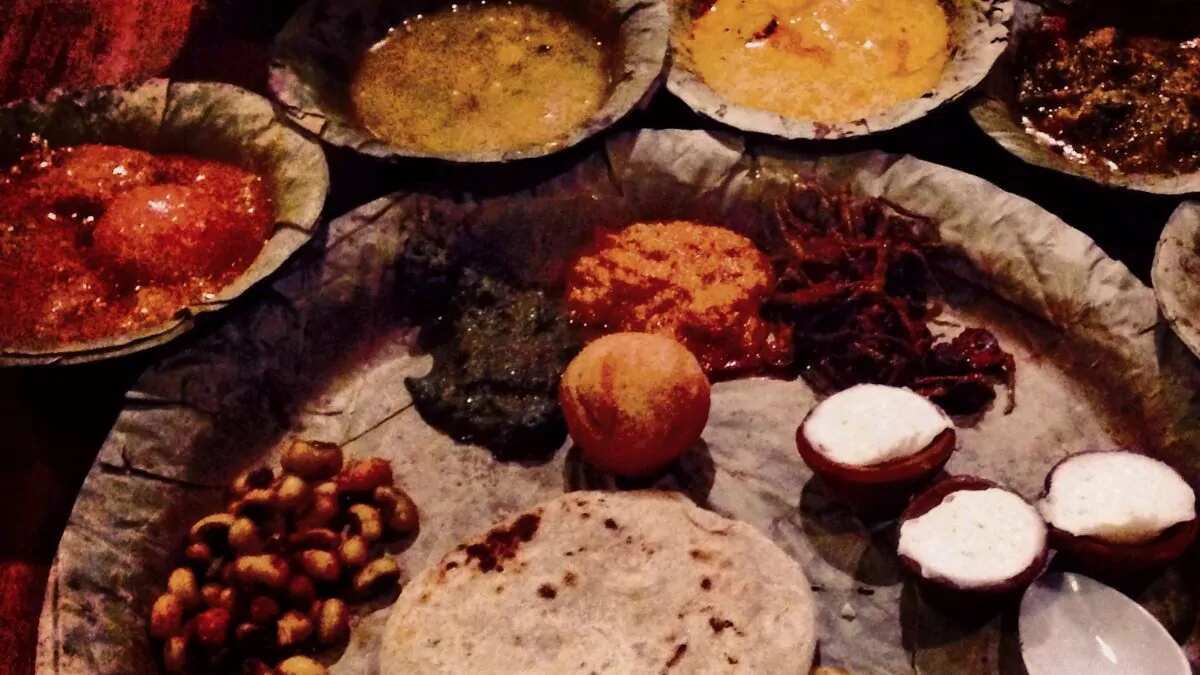
Words like gatte ke subzi and dal baati churma fall out of our mouths instantly when anyone talks of Rajasthani cuisine. Non-veg delicacies like laal maas and junglee maas are some of the popular rustic curries, hailing from the region. Amidst all these well-known dishes, certain local specialities often get overlooked. One such dish is ker sangri. Ker refers to black berries, which are dried and soaked along with beans from the khejri trees in mustard oil. The addition of red chillies and raw mango makes the ker sangri a pickle-like dish. The locals generally enjoy it with lal dal ki puri (a very thin sheet-like puri) as an achaar, but it is also served as a main dish along with your roti and rice. The dry taste of the ker sangri might not seem very appealing at first, but once the complex flavours explode in your mouth, there is no looking back.
Culinary Roots Of Rajasthani Ker Sangri
Since Khejri trees have deep roots which can retain water for long, these are perfectly suited for the desert region. People have devised their own versions of the ker sangria, where some enjoy it with curd or kadhi, and others like to have it dry. It is no longer limited to Marwari households but relished by Gujaratis equally. It may sound like a simple dish, but preparing the perfect ker sangri requires a lot of time and effort.
The ker needs to be fine and thin, which is why you need to be careful while cooking it so that it doesn’t get burnt. The traditional Rajasthani pairing of this wild berry from the Thar desert is bajre ki roti, and not to forget, oodles of white butter on top. The natural herbs and spices which are available locally lend this dish a distinct flavour. Try this ker sangri pickle recipe, and you’d have a secret achaar hack to boast of then!
Image Credit: Adobe Stock
It has received the GI tag too. Ask any shop vendor or household, and they will tell you the crucial role these dried beans and berries play in the local cuisine. They are not only used for pickling but can also be used as a star ingredient to prepare sabzi. Getting GI-tagged is a validation from a reputed organisation; thus, it adds a slight value to the characteristics, origin, and location of that ingredient. Now, Rajasthan’s ker sangri is protected against counterfeiting, and its economic value will also increase with time while bringing the local culinary heritage into focus.
The Uniqueness Of Rajasthani Ker Sangri
Rajasthani ker sangri is known for its flavours that are enhanced when the dried beans and berries are cooked in local spices, like dried mango powder, turmeric, coriander powder, and red chilli powder. The sabzi boasts nutty, spicy, and earthy notes. If you prepare these in a paste of yoghurt, dry fruits, or simple onions and tomatoes, they will be slightly different and leave you licking your fingers.
It would be wrong to consider that ker sangri does not have any nutritional value. While it grows in the arid regions of Rajasthan, the ingredient has a few exceptional properties, which is why it has been a part of local cuisine for centuries. Sangri is a rich source of fibre, protein, and minerals like iron and calcium. Ker has antioxidants and is known to provide relief from digestive issues.
Versatility Of Rajasthani Ker Sangri
Ker sangri is a versatile ingredient that can be added to mixed vegetables or transformed into a pickle. It is an important ingredient for regional panchkutta or panchmel ki sabzi, which also includes kumatiya (seeds of the Acacia senegal tree), gunda (Indian cherry), and dried mathania mirch (regional chillies). These dried beans and berries are also used to prepare a delicious batch of sabzi. After soaking and boiling, they are cooked with yoghurt and Indian spices. They are served as a pickle in a Rajasthani thali to elevate the taste of dal baati churma, kadhi, gatte ki sabzi, and raita.
Image Credit: Adobe Stock
It is today that many of the seasonal vegetables are available throughout the year, and Rajasthan also has access to fresh produce. Back in the days when produce was scarce, and one could only access seasonal ingredients in a particular season, ker sangri was a source of nutrition that people could consume throughout the year. They are dried and can be stored for months in airtight containers, and can be consumed during famine and lean times.