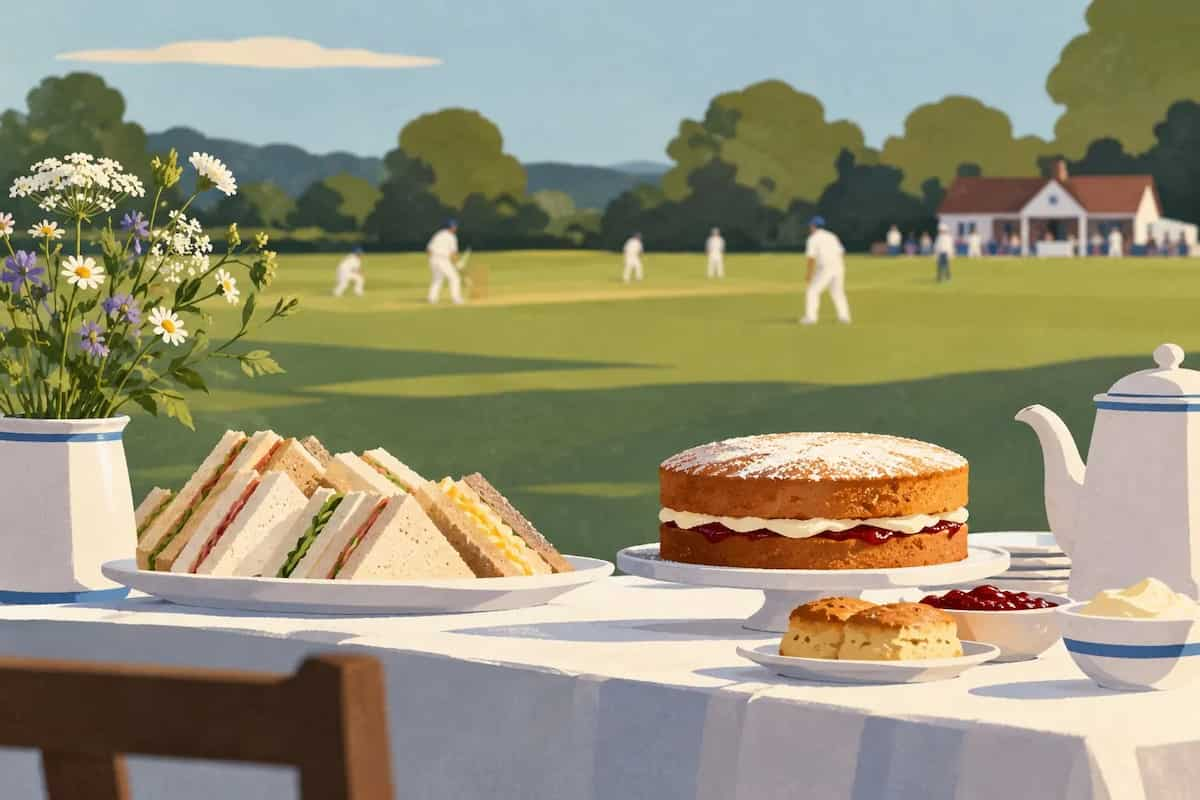
AT Vagabonds Cricket Club in Hampshire, preparing for the tea interval includes a problem of fridge space. There must be room for five trays of sandwiches. The catering guide on the club’s website recommends allowing a couple of hours for the sandwiches alone, with sharp knives and cling film close at hand. Twenty-two players need feeding, before any extras are counted.
The shopping list is cheerfully undramatic: sliced bread, cheese, eggs, tomatoes. Savouries and cakes are needed too. Sandwiches should be cut, arranged and covered promptly. To anyone watching the clock for a pleasant afternoon pause, this is the other side of the interval: someone has been at work for hours.
Cricket’s relationship with food is usually pictured from the eater’s end. A cup arrives; a player reaches for a sandwich. Follow the plate back into the kitchen, though, and the game acquires another cast of characters. Their names do not appear beside the wickets and runs, but their cooking can become part of a club’s reputation.
An interval with conditions
The break has a history of its own. Cricket historian Steven Lynch, writing for ESPNcricinfo in 2013, described how Australia’s captain Joe Darling suggested a tea break on the 1899 tour of England. Refreshments were brought out to the players on the field. That arrangement continued in 1902; Lynch dates the formal departure from the field on those English tours to 1905. A cup could be brought to a player long before the game had settled how everyone should stop for it.
Today, the ICC’s men’s Test playing conditions normally allot twenty minutes to tea and forty to lunch. Those minutes run from the umpire’s call of Time to the call of Play. There are provisions for moving the interval when weather interrupts or an innings ends close to the appointed hour. If nine wickets are down near the scheduled break, play can also be extended.
These are arrangements for international cricket; a local club’s tea follows its own match regulations and practical arrangements. The shared problem is timing. A kitchen can prepare for a stated hour, but the cricket may have other ideas. The people supplying the interval need to understand the game well enough to feed it.
The work before the break
In July 2026, food writer Karen Burns-Booth shared a small example of that preparation on her website, Lavender and Lovage. Her friend Sarah’s son had played for Easton Cricket Club in Suffolk and regularly requested his mother’s BLT sandwiches when she was helping with teas. Sarah cooked the bacon and sliced the tomatoes the night before, leaving assembly for match day.
The published method attends to the things a hungry player need never consider: when to butter the bread, how to cover it, and how to position lettuce to help protect it from tomato juice. A sandwich has to be good when it is eaten, which means thinking about it well before anyone is hungry.
Sometimes that work continues across generations of players. In December 2024, Mill Hill Village Cricket Club published director of cricket Phil Smith’s tribute to Kath Kelly, who had died the previous month. She had been part of the club for more than forty years, providing cricket teas until the Covid pandemic as well as food for its footballers. Smith recalled that she had also cooked the club’s Christmas dinner on more than thirty occasions.
“Our teas were declared the best in the league almost weekly,” he wrote. It was a clubman’s affectionate judgement. Smith remembered visiting players enjoying her food, her calm in the kitchen and the time she spent with players afterwards. The obituary kept her place in the club’s history alongside the people she had fed.
Three different appetites
It would be a mistake, however, to use a club’s cake table as a guide to what an international cricketer eats between sessions. In a 2024 report for ABC, Niharika Raina spoke to private chefs working with Indian players. Akshay Arora, who cooked for Rishabh Pant, described a routine that included a smoothie on the journey to the ground and a gluten-free wrap with chicken or a vegetarian protein during session breaks.
The work involved its own formidable packing list. Chefs carried ingredients and equipment, including an induction cooktop, and negotiated access to unfamiliar hotel kitchens. Harsh Dixit, founder of Mumbai’s The Private Chefs Club, explained that individual players’ requirements affected what they served. Here the food was being planned around a professional’s workload and preferences. The name of the interval did not prescribe the menu.
Spectators have a third appetite, and a different relationship with the clock. Lord’s advertises Ginger Pig picnic hampers inspired by a traditional cricket tea, with food ranging from sandwiches and scotch eggs to cakes. Its afternoon offering includes scones with clotted cream and blackcurrant jam, and a lemon-and-raspberry Battenberg in MCC’s colours. This is a spectator’s picnic, not a description of the players’ dressing-room food.
A cricket tea can therefore mean quite different things to people at the same ground. A player needs to return to the field. A spectator can settle in with another slice. The person responsible for feeding either has to know which meal is being made.
What arrives on the table
A cook brings preferences and family recipes into a club kitchen. Over time, those choices can change what people expect a cricket tea to contain. In 2024, the England and Wales Cricket Board’s Taste of Cricket campaign documented meals at recreational clubs across England and Wales. Its examples gave a much more particular picture than a general menu labelled English cricket tea.
At Bushy Park Girls Cricket Club in Middlesex, there was Sri Lankan vegetable elawalu roti. Holyport Cricket Club in Berkshire had braai burgers seasoned with South African flavours. At Llandaff Cricket Club in Cardiff, the menu included leek bhajis. A familiar vegetable could turn up in a different preparation, and a dish from another country could become something the home club was pleased to serve.
The cookbook that followed, published that November, included Afghan Kabuli pulao from Exwick Cricket Club in Exeter, which had been involved in welcoming refugees into cricket, and Jamaican jerk chicken from Shepherds Bush Cricket Club in London. The recipes came with particular addresses and connections to the people who cooked them.
The book also collected family recipes from well-known players. Isa Guha contributed a Bengali prawn curry inspired by her mother’s cooking; Maia Bouchier’s potato salad came from the food her mother made for childhood cricket matches. Lauren Bell described her mother’s brownies as “a bit of a secret weapon at cricket teas”. Years into an international career, she still associated their smell with her childhood club in Berkshire.
A recipe passed on this way carries a practical memory. Someone learned how much to make, what travelled well and which dish people asked for again. A cookbook can record the ingredients; a player’s recollection supplies the reason they mattered.
Room for one more recipe
Sarah’s tea preparations began the night before the match. Kath Kelly’s cooking became a reason people remembered a club. At a table with leek bhajis or elawalu roti, another cook’s familiar food had found a place in the afternoon. Those contributions could be as personal as the brownies a grown player still remembers from childhood.
The guide on the Vagabonds website eventually leaves room for “your own speciality”. It is a generous instruction for a meal so dependent on the person making it. Alongside everything a club expects, there can be something a new cook knows how to do.
Before anyone gets to find out what it is, of course, someone still has to make room in the fridge.