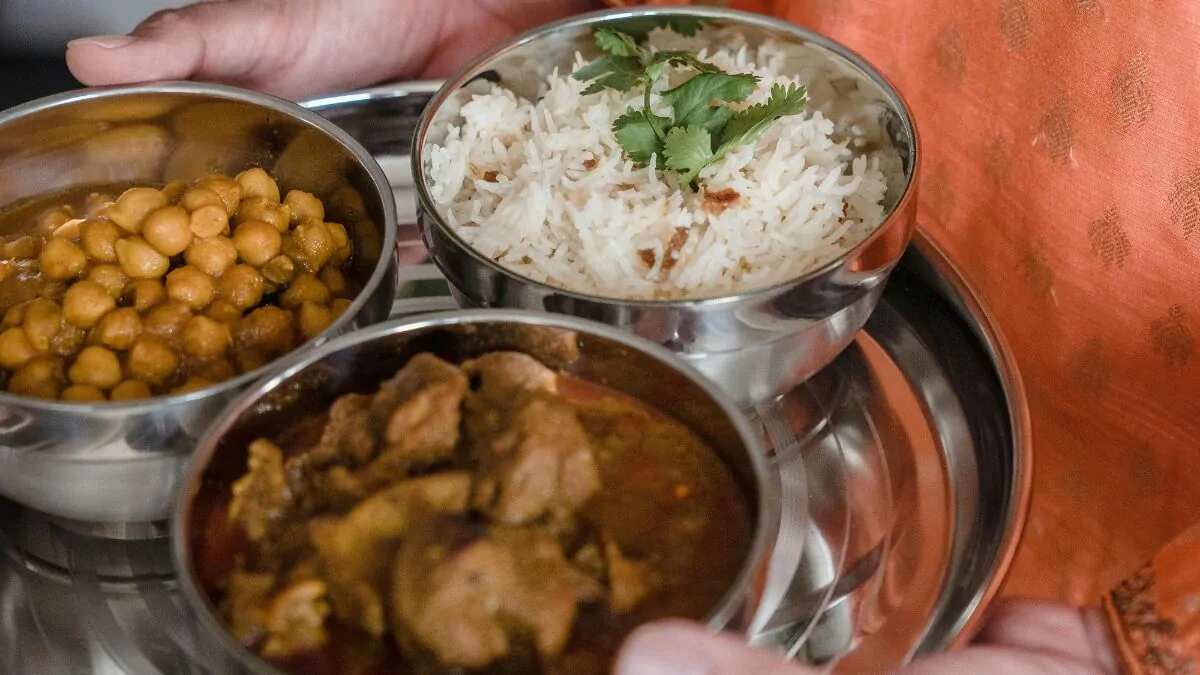
My mother comes from a family that migrated from Lahore to Dehradun during the Partition. They carried with them the resilient, earthy culinary heritage of undivided Punjab. Years later, she chose a love marriage with my father, a man whose roots were firmly planted in the coastal town of Porbandar. Their union brought together two profoundly different worlds. When she moved in with my father, she had to acclimatise to a new cultural landscape. She had to carve out her own space within a family that lived and breathed Gujarati traditions. Food naturally became the bridge she built to navigate this confluence of cultures. A kitchen can be a daunting place for a new bride. It is a space loud with established rituals and inherited expectations. For her, learning to temper mustard seeds and curry leaves was not just a culinary lesson but an act of integration. Yet she never let her own heritage fade into the background.
Image credit: Pexels
In the early days of their marriage, the dining table was a literal representation of this cultural divide. It was entirely normal to see two different bowls of dal served at dinner. On one side rested the quintessential Gujarati dal, thin, sweet, and tangy. On the other sat a thick, rustic Punjabi ma ki dal, a deeply personal comfort food my mother recreated for herself. The simmering pots told the story of her day. The bubbling of whole black lentils provided a comforting soundtrack to her evenings, while the sharp hiss of a jaggery and kokum tempering catered to the family she had married into. But cooking two separate meals every day is a taxing endeavour. She was a working mother who spent her days as a teacher, balancing the heavy demands of a classroom with the responsibilities of a home. She needed a practical solution that would satisfy my fathers palate without forcing her to abandon her own taste in food.
Image credit: Pexels
What began as a necessary hack to ease her workload soon evolved into an entirely new culinary dialect. She started combining the two distinct styles, synthesising the sweetness of Gujarat with the fierce, unpretentious flavours of Punjab. This synthesis became her signature. She began introducing the earthy warmth of roasted cumin and crushed coriander seeds into typically sweeter vegetable preparations. A humble bottle gourd sabzi would suddenly sing with a hearty, almost rustic depth, shedding its usual mild demeanour. It was a way of asserting her identity on a plate without disrupting the harmony of the home. Cooking became her language of diplomacy. My mother possessed a cooking style that was inherently simple, yet the flavours she produced were incredibly pure and robust. She used strong, fundamental ingredients to let the true essence of a dish come through. I grew up watching her make the most extraordinary aloo ke parathe. Her stuffing was remarkably uncomplicated; it was just mashed potatoes mixed with fresh coriander, a generous squeeze of lemon, black pepper, and salt. Yet, that precise combination of minimal spices yielded a taste so sharp and comforting that it remains unmatched.
Image credit: Pexels
Her resourcefulness and inventiveness extended well beyond everyday staples, bleeding into the way she treated seasonal produce and sweets. She had a remarkable talent for desserts, effortlessly whipping up unconventional treats like a delicate green pea kheer or a rich sitaphal basundi, alongside the most perfect, traditional gajar ka halwa. Her green pea kheer was a revelation, where the slight savouriness of the peas melted beautifully into slow-reduced milk, generously laced with cardamom. It was unexpected and entirely delicious. When she eventually took on classic Gujarati dishes, she brought her own heritage into the mixing bowl. Her undhiyu was legendary in our home. It was expertly cooked but deliberately less sweet than the traditional Gujarati recipe, carrying a distinctly Punjabi, hearty quality. The muthias were perfectly spiced, the root vegetables tender, but the base masala had a deeper, more pronounced garlic and chilli warmth rather than the dominant sweetness expected of it. She allowed the natural textures of the yam and plantain to shine against a backdrop of bold, unapologetic flavour. She had effectively taken a beloved regional classic and given it a robust spin that made it uniquely hers.
Image credit: Pexels
Growing up at the intersection of these two rich lineages, I was privileged to experience a third flavour. It made me realise that authenticity in food is a fluid concept. The truest cuisine is the one shaped by circumstance, love, and the daily necessity of feeding the people you care about. I saw firsthand how different regional foods, despite their unique identities, share the exact same soul. You can easily distinguish them on a plate, yet they harmonise beautifully when brought together with intent and care. My palate was trained to seek out this balance, to appreciate the delicate dance between sweet and sour, rustic and refined. I learned that recipes are not rigid mandates but living, breathing entities that adapt to whoever is standing at the stove. Playing around with ingredients and finding what works for your family is a profound lesson I learned from watching her navigate our kitchen.
Image credit: Pexels
There is something incredibly inspiring about the resourcefulness of mothers. They spend so much of their time cooking and nourishing their families, often while exhausted from their day jobs and busy with their children. Yet, they always find a way to cook with immense love. The kitchen was her laboratory and her sanctuary. Through her daily hacks and time-saving shortcuts, she was actually authoring a new culinary heritage for our family. She showed me that a mothers food is not just sustenance. It is a silent autobiography, written in spices and served on a plate, telling the story of where she came from and the beautiful life she built. In their pursuit of making everyday life just a little easier, they invent. They find ways to retain their own identity while caring for others. My mother taught me that you need to nourish your family, but you must also give yourself the leeway to experiment and express your own history through your food. It is a philosophy of love, practicality, and flavour that I proudly carry forward today.