THERE is a particular kind of irony that only Indian food history can produce, and it arrived, fittingly, in the form of a food-safety notice. In late July 2026, the Maharashtra Food and Drug Administration suspended the catering licences of five of Mumbai's most storied private clubs — the Cricket Club of India, RK Juhu Gymkhana, Aparna Juhu Gymkhana, MIG Cricket Club, and Willingdon Sports Club — after inspectors found cockroaches, flies, mouldy vegetables and expired stock in kitchens that have, for the better part of a century, fed the city's most powerful people. The report singled out the Cricket Club of India, ninety-three years old at the time of the raid, as the worst offender.
What the report did not mention — because food inspectors are not historians — is that the kitchen now cited for hygiene violations is the exact kitchen where, in 1975, a twenty-five-year-old cook named Nelson Wang invented Chicken Manchurian. It is difficult to overstate what that means. A dish now sold on tin plates at highway dhabas, folded into Domino's-style fusion menus, and cooked in approximately every third Indian household on a lazy Sunday, was born inside the members-only kitchen of a club so exclusive that most of the country would never be allowed past its gates. The FDA's suspension notice and Wang's origin story are, in effect, two chapters of the same building's biography — one describing what the institution has become, the other what it once quietly gave the world.
This is the paradox at the heart of India's club culture: institutions built explicitly to keep people out have been unusually, almost accidentally, generous in what they let escape.
Built on Exclusion, By Design
To understand why Indian clubs behave the way they do — insular, ritualistic, faintly anachronistic — you have to understand that exclusion was never a side effect of their culture. It was the founding architecture.
The Royal Bombay Yacht Club was established in 1846 as a Europeans-only institution, and it stayed that way, in practice, for over a century. The Bombay Gymkhana and the Byculla Club ran on the same principle. This was not casual snobbery; it was policy, defended in writing. When Lord Willingdon arrived in Bombay in 1913 as Governor, carrying an explicit mandate from King George V "to smash through all fences which socially divide communities," he discovered just how literally those fences were built. Willingdon tried to bring an Indian friend — some accounts say it was Maharaja Bhupinder Singh of Patiala — into the Yacht Club as his guest. The Maharaja was refused entry. Willingdon, by most accounts, genuinely outraged, resigned his own membership on the spot.
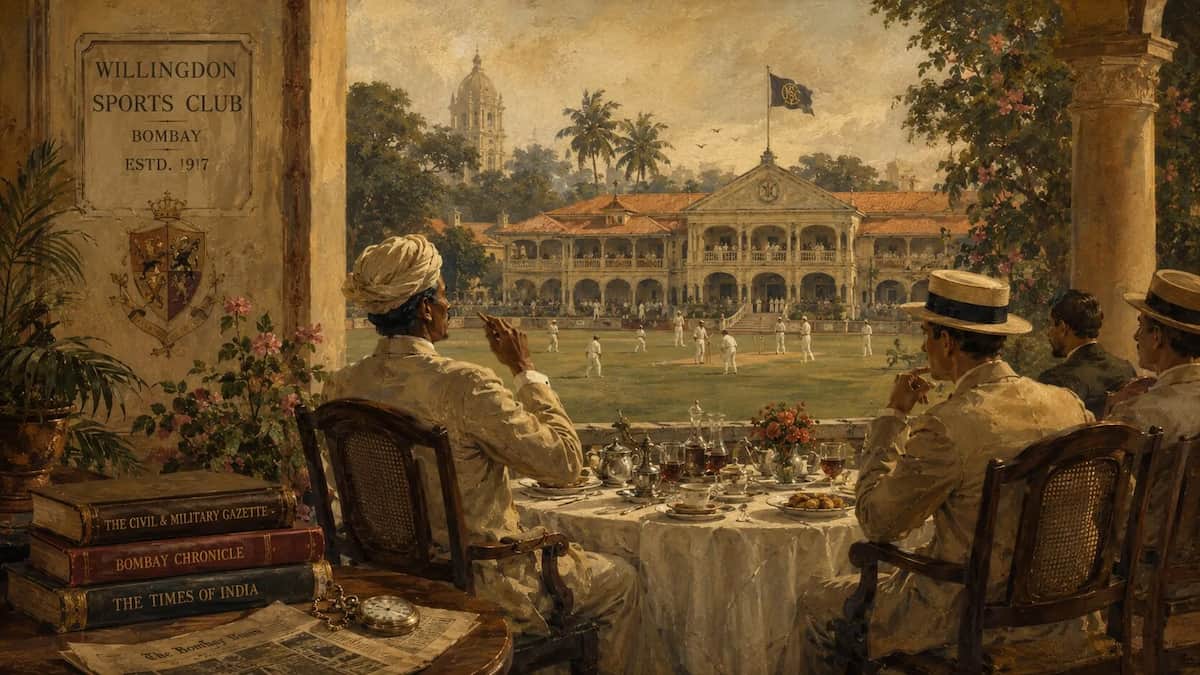
He did not stop there. Unable to persuade the existing clubs to change their admission rules, Willingdon raised money from British residents and Indian princes and built an alternative from scratch. The Willingdon Sports Club held its inaugural meeting on 18 May 1917 and opened its doors that December — the first major club in Bombay to grant full membership to both Indians and Europeans. Its founding document was, in effect, a rebuke to every club that had refused him.
The story does not end there. The same Maharaja of Patiala who was reportedly turned away from the Yacht Club went on, a few years later, to found his own institution nearby: the Cricket Club of India, complete with a stadium large enough to host international matches. Two of Mumbai's most prestigious clubs today — the Willingdon and the CCI — exist because a governor and a maharaja were each, separately, humiliated at a club door and decided the correct response was not protest but construction. The CCI's Brabourne Stadium hosted first-class cricket from 1935, and the Board of Control for Cricket in India ran its headquarters out of the club until 2007, when BCCI finally relocated to the Wankhede Stadium.
By the time India became independent in 1947, the country had inherited dozens of these institutions — the Bengal Club and Tollygunge Club in Calcutta, the Delhi Gymkhana, the Madras Club, the Ootacamund Club up in the hills — all built on the same colonial template of exclusivity, all eventually forced to reckon with what exclusivity meant in a country that had just thrown out the people who invented the rule. Some clubs simply swapped the colour bar for a class bar. A 2013 Economic Times report put the Bombay Gymkhana's membership fee at roughly Rs 1 crore, plus service tax — meaning the arithmetic of exclusion never really went away; it just switched currencies from race to net worth.
The Sandwich That Never Meant to Travel
Club food, everywhere in the world, tends to share a strange quality: it was almost never designed to be famous. It was designed to be quick, filling, and inoffensive enough to serve to a bored member demanding something — anything — that wasn't already on the menu. And yet an outsized share of the dishes now considered global comfort-food classics trace back to precisely that scenario: an irritated member, a kitchen under pressure, and a cook improvising on the spot.
The club sandwich is the clearest example. Its origin is genuinely disputed among food historians — competing claims point to the Union Club of New York, first referenced in an 1889 newspaper article describing "two toasted pieces of Graham bread, with a layer of turkey or chicken and ham between them," and the Saratoga Club House, an exclusive (and, tellingly, all-male, no-locals) gambling club in upstate New York, where the Encyclopedia of American Food and Drink dates itsappearance to 1894. What both origin stories agree on is the setting: a private members' club, catering to men who wanted something more substantial than a canapé but faster than a full dinner. The oldest surviving recipe was published in 1903, in Isabel Gordon Curtis's Good Housekeeping Everyday Cook Book. The sandwich got a further publicity boost at the 1904 World's Fair in St. Louis — the same fair, incidentally, credited with popularising the hamburger, hot dog, ice cream cone, and iced tea, making it arguably the single most consequential food event in American culinary history. It wasn't until the 1970s, in the writing of chef James Beard, that the "triple-decker, toasted, chicken-bacon-lettuce-tomato-mayo" format was formally cemented as the version we now recognise worldwide.
There's a small, apocryphal detail food writers love repeating: that "club" is a backronym for "Chicken and Lettuce Under Bacon." It almost certainly isn't true — the name simply describes where the sandwich was born — but the myth persists precisely because it sounds like something a clubhouse kitchen would proudly stamp onto a menu.
Other Western "club food" exports followed the same pattern. The Waldorf salad was invented at New York's Waldorf-Astoria Hotel in the 1890s by its maître d'hôtel, built originally from nothing more than apples, celery, and mayonnaise — walnuts were added later. The Caesar salad, similarly, is widely credited to Caesar Cardini, an Italian immigrant restaurateur working just across the US-Mexico border in Tijuana in 1924, reportedly improvising with what was left in the kitchen on a busy Fourth of July weekend. None of these dishes was engineered to become iconic. They were engineered to solve an immediate, local, faintly petty problem: an important guest wanted something that wasn't on the menu, right now, and the kitchen had to deliver.
Nelson Wang's Twenty-Seven Rupees
Which brings us back to Bombay, and to a story that deserves to be told with the same reverence Americans reserve for the club sandwich.
Nelson Wang was born in Kolkata in 1950, the son of a Chinese immigrant father who died within days of his birth. Raised by a foster family whose patriarch happened to be a chef, Wang absorbed an early, almost accidental education in cooking. In 1974, at twenty-four, he arrived in Bombay with, by his own account, twenty-seven rupees in his pocket. He took whatever work he could find — including, by some accounts, a stint as a limbo dancer — before landing a job as a cook catering Chinese food at the Cricket Club of India.
In 1975, at a CCI banquet, a customer asked Wang to make something that wasn't on the menu — something entirely new. Wang went back into the kitchen and improvised. He started, by his own description, from the base of a fairly standard Indian preparation: chopped garlic, ginger, and green chillies. But instead of building the dish around garam masala, as an Indian kitchen normally would, he reached for soy sauce. He coated chicken pieces in cornstarch, deep-fried them, and tossed them through the garlic-ginger-chilli-soy sauce base. The dish had no real precedent in Chinese cooking — nothing resembling it exists in the cuisine of the actual Manchuria region in northeast China — but it tasted, to an Indian palate raised on ginger-garlic pastes and deep frying, immediately and completely correct.
Wang left the CCI in 1983 to found China Garden, his own restaurant in Kemps Corner, and Chicken Manchurian went on to do what few dishes ever manage: it created an entire cuisine category around itself. "Indian-Chinese" or "Chindian" food — a genre that includes gobi Manchurian, chilli paneer, Schezwan noodles, and dozens of other dishes with no genuine link to Chinese regional cooking — essentially grew outward from Wang's improvisation. Today, Chicken Manchurian sits on the menu of Indian-Chinese restaurants from Jersey City to Johannesburg, most of whose owners have likely never heard the words "Cricket Club of India."
The dish has since developed the same disputed-origin folklore that surrounds the club sandwich. Some claim other Chinese-Indian chefs of the era were independently experimenting with similar sauces. What's not disputed is the setting: like the club sandwich, like the Waldorf salad, like the Caesar salad, Chicken Manchurian was born from an irritated customer's demand, inside the pressurised, transactional kitchen of an exclusive club — a place built to keep most of India out, that ended up feeding practically all of it.
Before Manchurian, There Was Pepper Water
Nelson Wang wasn't even the first person to invent an entire Indian food genre inside a colonial club kitchen — he was simply the most recent, and the most photogenic. The pattern goes back much further, to a soup most Indians have eaten without ever knowing it started as a diplomatic compromise between two cuisines that had no reason to meet.
Mulligatawny — a name that survives on Indian hotel menus to this day, usually apologetically, next to "tomato soup" and "cream of vegetable" — began life as milagu thanni, Tamil for "pepper water," a thin, home-style broth from Tamil Nadu with no real equivalent to a Western soup course. Traditional South Indian meals didn't have a soup course at all; the concept simply didn't exist. When East India Company officials and, later, British Raj households demanded one anyway — because a proper English dinner required a starter course, full stop — Indian cooks working in colonial homes and clubs improvised. They took the humble rasam-adjacent pepper water and built it out: added meat, rice, lentils, sometimes apple, thickened it with butter and flour to European consistency, and seasoned it with the curry powder the British had, by then, decided was the flavour of India itself. The earliest documented reference to the dish appears not in a cookbook but in a British military song from 1784, composed by a soldier grumbling about army rations during the Second Anglo-Mysore War against Tipu Sultan — meaning mulligatawny was already a recognisable club-and-barracks staple a full century before the club sandwich existed.
Mulligatawny had company. Kedgeree — rice, flaked fish, hard-boiled egg, and curry powder — followed the same trajectory: an Indian dish (likely derived from khichdi) filtered through a colonial club kitchen until it became "Anglo-Indian," then exported to Britain as a breakfast staple, then largely forgotten in the country that gave it its base ingredients. Both dishes tell the same story that Chicken Manchurian would later retell in a different register: club kitchens sat at exactly the cultural fault line where two food traditions were forced into daily, practical contact, and something new inevitably fell out of that friction — usually invented by an Indian cook, usually credited eventually to the club, and usually far more durable than the institution that produced it. Mulligatawny is over two centuries old. Most of the clubs that popularised it have been renovated, downsized, or shut entirely since.
What the Club Actually Sold
It's worth pausing on why clubs, of all places, kept producing food that outlived their own exclusivity. The answer has less to do with culinary genius and more to do with structural incentive.
A private club kitchen occupies a strange economic middle ground. Unlike a restaurant, it doesn't need to advertise, chase repeat custom, or worry about reviews — its clientele is captive by definition; you can't eat at the Cricket Club of India unless you're already a member or a member's guest. But unlike a home kitchen, it operates at real scale, cooking for hundreds of members a day, across events ranging from wedding banquets to quiet Tuesday lunches, with a kitchen brigade large enough to actually experiment. Add to that a clientele that is, almost definitionally, wealthy, well-travelled, and bored — people who have eaten in London and Paris and want their club kitchen to prove it can keep up — and you get exactly the conditions that produce culinary improvisation: pressure, resources, a captive but demanding audience, and zero commercial risk if an experiment fails, because there's no outside customer to lose.
This is precisely the incubator that produced the club sandwich in 1890s Saratoga and Chicken Manchurian in 1970s Bombay. It is also, not coincidentally, the same incubator currently under FDA scrutiny for mould and cockroaches, because the other side of "captive clientele with zero commercial pressure" is an institution with very little external accountability. When your customers can't leave a bad review, can't easily switch clubs (waiting lists for Mumbai's top institutions can run into years, sometimes decades), and are themselves often the very committee members responsible for oversight, hygiene standards can quietly erode for a long time before anyone with real power notices — or a government inspector finally does.
Numbers Worth Knowing
A few figures help put the scale of this world in perspective. The Bombay Gymkhana's membership fee was reported at roughly Rs 1 crore (plus tax) as of 2013 — a figure that will have only grown since. The Willingdon Sports Club, Breach Candy Club, and Bombay Gymkhana together form what Mumbai's club-going elite informally call the "Top Three." The Cricket Club of India, ninety-three years old as of the 2026 FDA raid, would have been founded in the early 1930s — placing its opening within a decade of the Willingdon's, during the same wave of institution-building triggered by colonial exclusion. The World Press Photo-style trivia of club history is genuinely startling once you start counting: a sandwich invented in 1894 took until the 1970s — roughly eighty years — to be formally standardised into the version now served in nearly every diner, hotel, and airport lounge on earth. Chicken Manchurian, by contrast, needed less than a decade to spread nationally across India after Wang's 1975 improvisation, and well under fifty years to become arguably the single most recognisable "Indian" dish among people who have never actually visited India — a testament to how much faster culinary ideas now travel in a media-saturated, migration-heavy world compared to the pre-television 1890s.
What the Club Has Become
Walk into most of India's old-guard clubs today, and you'll find an institution in a state of genuine identity confusion. The original colonial function — segregating British from Indian — collapsed with independence. The secondary function — segregating old money from new — is under quiet siege from a generation of members' children who'd rather be at a rooftop bar in Bandra than the Gymkhana's card room. Membership rolls in cities like Delhi and Mumbai increasingly skew older; committee meetings are, by most insider accounts, dominated by septuagenarians debating whether to modernise a 1950s-era dining room. And yet the waiting lists remain absurdly long — some Mumbai clubs reportedly carry lists stretching well over a decade — because membership still functions as a status marker independent of whether anyone particularly wants to eat the food.
That's what makes the 2026 FDA notice so quietly devastating, beyond the immediate hygiene concerns. These clubs have survived colonialism, independence, economic liberalisation, and generational indifference by selling one core product: the promise that behind those gates, standards are simply higher — the linen, the service, the kitchen, all maintained to some imagined pre-independence ideal that ordinary restaurants can't match. Cockroaches and mouldy vegetables don't just violate a food-safety code. They puncture the entire premise the institution has been quietly selling for a century.
There is also something almost poetic in which club drew the harshest citation. The Cricket Club of India isn't just any Gymkhana; it is the specific building where Indian-Chinese cuisine as a category was born, the kitchen that gave the country a dish now so ubiquitous it barely registers as having an origin story at all. Ninety-three years old, still operating, and now under a suspended licence — the same walls that once let an immigrant's son with twenty-seven rupees in his pocket improvise his way into culinary history are the walls an inspector just found infested.
The Real Legacy
Perhaps the most useful way to think about Indian club culture isn't as a story about exclusivity at all, but as a story about unintended consequence. These institutions were built, quite explicitly, to keep the wrong people out — first by race, then by class. But food, unlike membership, cannot be gatekept once it leaves the building. Nelson Wang didn't need the CCI's permission to open China Garden six blocks away in 1983; the club sandwich didn't stay locked inside the Saratoga Club House once a 1903 cookbook printed the recipe for anyone with an oven and a toaster.
Every exclusive institution, it turns out, eventually leaks — and what leaks first is usually the food, because food is the one part of club culture that was never really about status to begin with. A membership fee can keep a person out. A recipe cannot. Somewhere between the kitchen and the dining room, between the chef and the committee, the class barrier the club was built to enforce simply stops applying — and what's left, travelling out into the world with none of the exclusivity attached, is just something worth eating.
The FDA's cockroaches will presumably be cleared, the licences eventually reinstated, the linen re-pressed. The Cricket Club of India will likely remain, on paper, one of Mumbai's most exclusive addresses for another ninety-three years. But its most lasting export left the building decades ago, in the form of a chicken dish nobody needs a membership card to order — proof that the most democratic thing an aristocratic institution can accidentally produce is dinner.