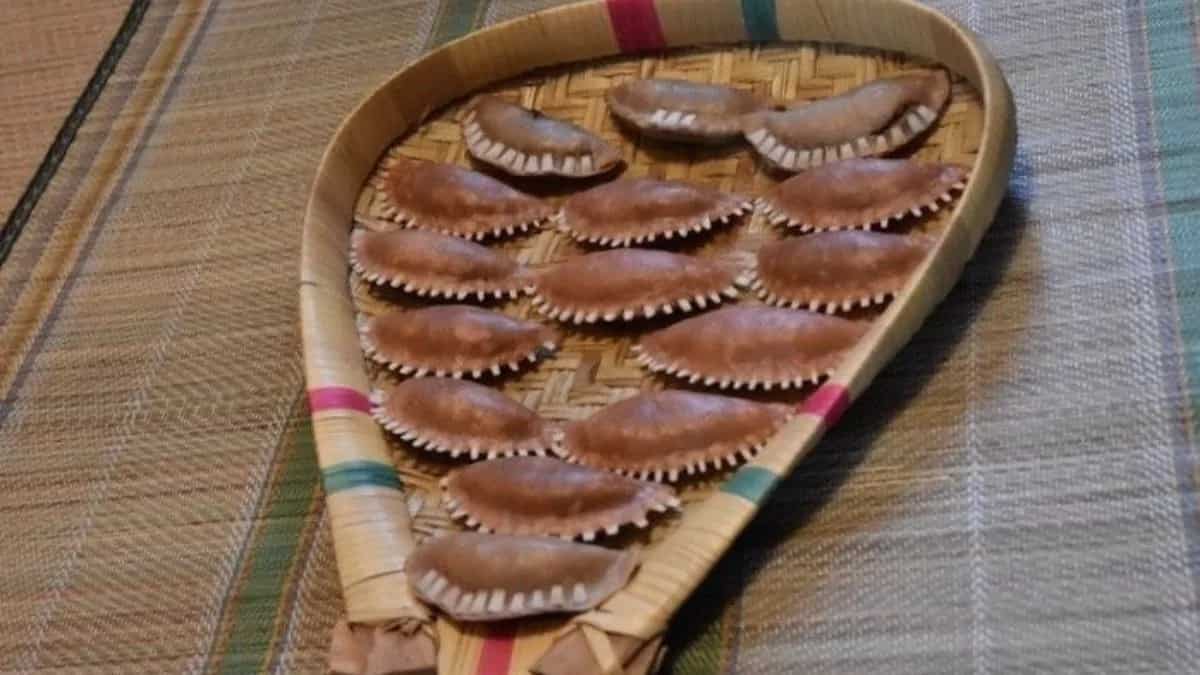
A basket of them, crimped like tiny closed fists, arrives on a woven tray edged in red and green — and before anyone has said a word about religion or region, the shape has already told its own story. Every fold in that dough is a decision someone made a very long time ago, and kept making, generation after generation, without ever writing it down.
I. A Tray, A Tooth, And A Question
The photograph that prompted this essay is unremarkable in the way that only the truly important things in a kitchen are unremarkable: a wide, shallow winnow basket, the kind used across the subcontinent for husking grain, now repurposed to hold rows of half-moon dumplings, their edges pinched into neat fluted ridges, their skins the deep amber of rice flour that has taken on colour from jaggery and roasting. Fourteen or fifteen of them, arranged with the unfussy precision of a home cook who has made hundreds before and will make hundreds more. Nothing about the image announces itself as sacred. And yet this is, depending on which of its several lives you are looking at, either a festival offering to a Hindu god, a folk remedy for a teething infant, or both at once — because in the Tamil-speaking world that stretches from the temple towns of the Kaveri delta to the Jaffna peninsula, the kozhukottai has always lived a double life.
(Credit: Freepik)
The dish carries dozens of names and at least as many meanings. In Marathi it is modak, offered by the millions to Ganpati Bappa every autumn in Maharashtra. In Tamil it is kozhukattai or kozhukottai. In Malayalam, kozhukatta. In Kannada, the Sanskrit-derived modaka sits alongside kadubu. In Telugu it turns up as kudumu or, filled with milk instead of coconut, as palathalikalu. In Konkani it is nevri; in Odia, mandaa. And in Sinhala, spoken across the island where this essay's second story unfolds, it is lavariya. One dumpling, one basic grammar of steamed rice flour folded around something sweet, refracted through half a dozen languages — each of which insists, in its own tongue, that this is a dish worth naming carefully.
That naming is where I want to begin, because the word itself turns out to be a small history lesson, and because the specific tradition this essay was commissioned to explore — the Sri Lankan Tamil custom of pal kozhukottai, given to infants when their first tooth breaks through the gum — depends entirely on getting that etymology right. Pal, in this context, does not mean what most kitchens assume it means.
II. What The Word Actually Carries
Begin with modaka, the oldest and most textually secure of the family's names. Sanskrit grammarians read it as moda, joy or delight, fused with the suffix ka, a diminutive marker roughly equivalent to "that which gives" or "a little portion of." A modaka, then, is etymologically a small vessel of delight — a name that does real work, because in the mythology we will come to shortly, the sweet is never merely food. It is the physical form that bliss takes when it needs to be handed from a mother to a child, or from the universe to a god who has just proven his wisdom.
Kozhukattai is a harder word, and a more interesting one, precisely because it refuses to resolve into a single tidy meaning. Tamil lexicographers have argued over it for at least two centuries. The nineteenth-century American missionary Miron Winslow, whose Comprehensive Tamil and English Dictionary became the scholarly bedrock for the University of Madras's Tamil Lexicon of 1924, traced two competing roots. The first candidate is kozhu or kolu, meaning fat, thick, or well-filled — a plausible enough description of a dumpling stuffed to bursting with coconut and jaggery. The second candidate is koozh, a thin rice-and-millet gruel that was, by every account of Sangam-era eating habits, one of the most basic starches in the ancient Tamil diet. On this reading, kozhukattai would originally have named a solid, hand-shaped cousin of that everyday gruel — the porridge, thickened and given a body. Both readings share the same retroflex consonant that makes the word famously difficult for non-Tamil speakers to pronounce correctly, the same sound that trips up learners of vazhaipazham, the banana. Whichever root wins, the word is Dravidian to its bones, unrelated to the Sanskrit modaka despite naming, in most contexts, more or less the same object.
That divergence — one name from the Sanskritic north, one from the Dravidian south, converging on an identical dish — is itself a small monument to how Indian food culture actually moves. It rarely moves in one direction only. The coconut-and-jaggery filling, the rice-flour shell, the act of steaming rather than frying: these are Deccan and peninsular techniques, older than any Sanskritic naming of them. Modak, the Marathi-Sanskrit term now most associated with Ganesh Chaturthi's grandest, most photographed avatar, may in fact be the newer arrival to a dish whose working technique and probable origin lie further south.
(Credit: Wikimedia Commons)
Tamil also preserves the dish inside its idiom, which is usually a sign that a food has been around long enough to stop being merely eaten and start being spoken. "Vaayla kozhukattai irukka?" — do you have a kozhukattai in your mouth? — is still lobbed at anyone who goes conspicuously silent when a question is asked of them, the dumpling standing in for anything round and obstructive lodged where words should be. And there is the well-travelled folk tale, told with small variations in different households, of the guileless man who tastes kozhukattai for the first time at a wedding feast, falls hopelessly in love with it, and spends his walk home muttering the name to himself so he will not forget it — only to be distracted by a labourer leaping a stream and shouting something else entirely, which the fool then adopts instead, arriving home having forgotten the sweet and remembered only the shout. It is a shaggy-dog story about the fragility of memory, told, appropriately enough, about the one dish every Tamil household is trying hardest to remember correctly, year after year, festival after festival.
III. Before It Was Ganesha's
A Deeper History. It is tempting, especially in the weeks around Ganesh Chaturthi, to treat the kozhukottai as though it were invented for the god — as though Parvati's kitchen were the dish's true point of origin. The historical record, patchy as it necessarily is for something this old and this domestic, suggests the opposite: the dumpling almost certainly predates its most famous devotee by centuries, and was absorbed into Ganesha worship rather than created for it.
Rice-based steamed preparations appear in the corpus of Sangam literature, the extraordinary body of Tamil poetry composed roughly between 300 BCE and 300 CE across the anthologies known as the Ettuthokai and Pathuppattu. This is poetry concerned mostly with kings, cattle raids, love, and the five ecological landscapes of the Tamil country, but it is also, incidentally, one of the richest surviving records of what people on the subcontinent actually ate two thousand years ago — appam, idiyappam, parched rice mixed with milk, and other steamed and pounded rice preparations that food historians such as K. T. Achaya have used to reconstruct an ancient Tamil kitchen already comfortable with rice flour, steam, and sweet fillings.
The poet Avvaiyar, whose work sits at the heart of that Sangam canon, is cited by contemporary food writers as pointing toward the dumpling's ancient pedigree, even if the philological trail from a Sangam-era rice cake to the specific crimped, coconut-stuffed kozhukattai we recognise today is neither short nor perfectly documented. The form itself, most food historians agree, has evolved. What may be the oldest surviving variant is the pidi kozhukattai — pidi meaning a fistful, or a hand-shaped portion — a plain, unfilled dumpling of rice dough pressed roughly into shape between the fingers and steamed without ceremony.
(Credit: Adobe Stock)
The more elaborate object familiar from any Ganesh Chaturthi table today, its dough worked into a thin cup, its filling of coconut and jaggery folded in, its rim pleated shut with a dozen practised pinches, looks like a later refinement — the kind of embellishment a dish acquires once it graduates from daily sustenance to festival offering, when there is suddenly time, and reason, to make something ordinary look deliberate. Ethnographic sources add texture here that mythology alone cannot. The British colonial-era chroniclers Edgar Thurston and K. Rangachari, compiling their sprawling survey Castes and Tribes of Southern India in the early twentieth century, described a women-only ritual in which rice, pooled communally and measured by the handful against the back of the palm, was ground and mixed with the leaves of pongamia and margosa (neem) before being shaped — some pieces flat, some conical, explicitly said to represent Pillaiyar, the Tamil name for Ganesha.
Men were barred from both the making and the eating. It is a striking detail, because it suggests that long before Ganesh Chaturthi existed as the public, city-block-occupying spectacle we know today, there were already private, female-led domestic rites in which the dumpling's very shape did the work of representing the god — conical for the deity, flat for the ordinary business of eating. The kozhukattai's silhouette, in other words, has been theological a long time before anyone thought to write that down.
There is a second, entirely separate strand of the harvest calendar worth noting: Aadi Perukku, the mid-Tamil-month-of-Aadi festival marking the rising of monsoon rivers, is welcomed with kozhukattai by Tamil communities in both India and Sri Lanka — a reminder that this dumpling's ritual life was never confined to a single deity or a single festival. It belonged, and still belongs, to the rhythm of the agricultural year itself, offered whenever rice, coconut, and gratitude needed a shape.
IV. Ganapati: The God Who Arrived Before His Sweet Did
If the dumpling is older than its most famous devotee, the devotee is, in turn, considerably older than most people assume. The name Ganapati — leader (pati) of the ganas, the troops or hosts (gana) — makes its very first appearance not in a Purana but in the Rig Veda itself, in the second of its ten books, in a verse invoking gananam tva ganapatim havamahe: we call upon you, Ganapati, lord of the hosts. Vedic scholars are careful to note that this early Ganapati is almost certainly an epithet for Brahmanaspati, lord of prayer and sacred utterance, rather than a direct ancestor of the elephant-headed god who would later inherit the title — but the title itself, "leader of the troops," was clearly available and meaningful more than three thousand years before it settled permanently onto an elephant-headed figure.
How and when that settling happened remains genuinely contested. Some scholars of Indian religion have argued that Ganesha's roots lie outside the Vedic mainstream entirely — in folk cults of protective, occasionally mischievous spirits who needed to be appeased before any undertaking could safely begin, figures haunting mountain passes and forest edges long before they were dressed in Puranic finery. Others read him as a fusion figure, absorbing attributes from Rudra and Brihaspati. What is not contested is the timeline of his rise to independent supremacy: a dedicated Ganapatya sect, worshipping Ganesha not merely as an auspicious gatekeeper but as the Supreme Brahman himself, emerges clearly between roughly the sixth and ninth centuries CE, reaches its zenith around the tenth century, and leaves behind an entire body of devotional literature, including the Ganapati Upanishad, in which the elephant-headed god is extolled as creator, preserver, and destroyer all at once.
The sect built temples — the rock-cut Ucchi Pillayar Kovil above Tiruchirappalli remains the grandest survivor — and it is somewhere inside this centuries-long climb from Vedic epithet to household deity, to sectarian Supreme Being, that the modaka enters the story as his signature offering. The mythology that explains why is neither singular nor especially old in its current form, which is itself telling: these are Puranic tales, elaborated in texts like the Ganesha Purana and the Mudgala Purana, composed long after the Ganapatya sect's tenth-century high point, retrofitting a sweet-tooth origin onto a god who had already been established for centuries. The most widely repeated version has the Devas presenting Shiva and Parvati with a single modaka said to confer complete mastery of all knowledge and scripture on whoever ate it. Both sons wanted it.
(Credit: Adobe Stock)
Parvati, unwilling to simply choose a favourite, set a contest: whichever of her boys could circle the three worlds first would win the sweet. Kartikeya, quick-tempered and always ready for a literal race, mounted his peacock and set off at speed. Ganesha, heavier and slower by both body and temperament, simply walked a circle around his own parents and declared that they, together, constituted his entire universe — a devotional pun that Parvati rewarded on the spot. A second, gentler version drops the competition altogether: it has Parvati inventing the modaka out of ordinary domestic necessity, having run short of the laddoos her son usually demanded, and shaping something new from rice flour and coconut that Ganesha loved so completely he declared, then and there, that it should always be offered to him. A third tradition, tied to the story of Ganesha's broken tusk — snapped either in his fight with Parashurama or in the act of transcribing the Mahabharata for the sage Vyasa — has him turning afterwards to soft, easily chewed foods, the steamed modaka chief among them, its texture as much a part of the story as its sweetness.
Whichever origin story a household prefers, the ritual mathematics around the sweet are strikingly consistent: twenty-one modakas, offered as naivedya, the number tied to Ganesha's twenty-one traditional names and read as a mark of completeness and auspicious closure. It is worth remembering, too, how comparatively recent the festival's grandest, most public form actually is. For most of its history, Ganesh Chaturthi was a quiet, one-day household observance, largely confined to Maharashtra and practised mainly within Brahmin homes — a small clay idol, a plate of modaks and pongal, the purple crown-flower as the only real ornament, and an unhurried immersion at the end of the day. It was Bal Gangadhar Tilak who, in 1893, transformed it deliberately into a ten-day public spectacle, organising the first Sarvajanik, or community, Ganeshotsav in Pune at a moment when colonial law had banned most other forms of public Hindu assembly. Tilak's Ganesha was explicitly strategic: a shared, caste-crossing, religiously legible rallying point around which Bombay Presidency's Hindus, forbidden from gathering for overtly political reasons, could nonetheless gather in enormous numbers.
(Credit: Wikimedia Commons)
The tactic worked spectacularly, and within a generation the private household modak offering had become the public festival's most recognisable culinary signature — carried out of Maharashtra's kitchens and into a subcontinent-wide, then a diaspora-wide, celebration. Tamil Nadu's own Vinayaka Chaturthi followed a gentler arc toward publicness, staying for much longer a modest, home-based affair — a small clay Pillaiyar decorated with wildflowers, a plate of kozhukattai and pongal — before it too, in recent decades, adopted something closer to Maharashtra's scale of public pandals and processions.
V. Pal Kozhukottai: The Sweet Given To A Tooth
This is the tradition the photograph was really asking about, and it deserves to be treated on its own terms rather than as a footnote to Ganesha's festival, because it belongs to an entirely different calendar — not the lunar reckoning of Bhadrapada, but the far more unpredictable calendar of an infant's mouth. Get the word right first, because this is where casual retellings most often go wrong. The Tamil pal, and its slightly fuller form pallu, mean tooth — unrelated, despite the deceptive closeness in transliteration, to paal, meaning milk.
This distinction matters because there are, confusingly, two separate rice-flour-and-coconut-milk dishes circulating under very similar English spellings: paal kozhukattai, a Chettinad favourite in which small dumplings are simmered in sweetened coconut milk and cardamom, a dessert served at birthdays and festivals with no particular ritual attached to it; and pal — or pallu — kozhukattai, the ceremonial sweet at the centre of this essay, whose entire meaning depends on the presence of a tooth, not a drop of milk. The two dishes share an ingredient list and, in casual transliteration, nearly share a name. They do not share a purpose.
The pallu kozhukattai ceremony is documented among Sri Lankan Tamil communities as a milestone rite performed at the emergence of an infant's first tooth — one of the more intimate entries in a life-cycle calendar that also marks a child's first solid food, first haircut, and first hearing of scripture. Practice varies somewhat by family and by region of the island, but the core of the ceremony, as recorded by contemporary food writers documenting Sri Lankan Tamil kitchens, is consistent: a kozhukattai is prepared with a coin folded into its filling, and this dumpling is deliberately dropped, or allowed to fall, over the child's head — the sweet itself pressed into service as the infant's first "teether," the object the new tooth is symbolically invited to bite into. The coin adds a wish for prosperity to a rite that is, at its core, a wish for healthy dentition: a plea, half practical and half devotional, that all the teeth still to come will arrive as cleanly, as completely, and as whitely as the little dumpling itself. It is not hard to see the visual logic at work — a pale, rounded, faintly tooth-shaped object, offered to a mouth that has just produced its first tooth, in a gesture that is equal parts sympathetic magic and genuine celebration.
Ceremonies of this kind rarely survive in written scripture; they survive in kitchens, passed from a grandmother's hands to a mother's, documented more often by anthropologists of custom than by theologians. That is precisely what makes them valuable to a food historian, and what makes the tray in the photograph — those neat, fluted half-moons, clearly made with festive rather than everyday care — worth pausing over. It is not simply a Ganesh Chaturthi offering, though it may well double as one, given how closely the pallu kozhukottai's shape and ingredients overlap with the naivedya dumpling. It may equally be a first-tooth kozhukottai, made for a child whose family, like so many across the Tamil-speaking world, sees no contradiction in using the same humble dough — rice flour, coconut, a little jaggery, a practised pleat at the rim — to greet both a god's birthday and a baby's tooth. The dumpling, in this reading, is less a religious object than a vessel the culture reaches for whenever something new and slightly miraculous needs marking: a god's arrival on earth for ten days, or a tooth's arrival in a gum that was, until that morning, entirely smooth.
There is something quietly moving in that overlap. Ganesha himself, in the most tender of his origin myths, is a child fashioned by his mother from turmeric paste and brought reluctantly to life. Much of his iconography insists on his youth even as it insists on his wisdom — the god of new beginnings is, iconographically, forever a boy. It is entirely fitting, then, that the same sweet offered to celebrate his annual return to the world is also the sweet a Sri Lankan Tamil family reaches for to celebrate its own child's small, cellular return — a tooth, breaking through, announcing that a beginning has, once again, been made.
VI. A Family Of Sweets Across A Shared Coastline
Pull back far enough and the kozhukottai stops looking like a single dish with a single meaning and starts looking like a technique — rice flour, steam, a sweet or savoury filling, endlessly reinterpreted by whichever community happens to be holding the rolling pin. In coastal Andhra's delta region, the same steamed rice-and-milk logic produces palathalikalu, offered to Ganesha during Chaturthi in a manner that runs almost exactly parallel to the Tamil paal kozhukattai, right down to the near-identical name.
In Kerala, among Syrian Christian communities whose presence on the Malabar coast is traditionally dated to the arrival of St Thomas in 52 CE, a version of the dumpling is prepared on Kozhukatta Shaniyazhcha, the Saturday before Palm Sunday — an entirely separate devotional calendar, borrowing the same dough to mark an entirely different resurrection story, the crimped shell said by some households to evoke the stones thrown during the Passion and the sweet filling, love. In Telugu the dumpling turns up as jilledukayalu; in Konkani, as nevri; in Sinhala Buddhist and Hindu households alike, as lavariya. Even outside South Asia the same shape recurs under different names and different gods — in Japan, a dumpling called kangidan, its cinnamon and cardamom filling wrapped in fried dough, is offered to Kangiten, the Japanese tantric deity understood as a direct counterpart of Ganesha, carried east centuries ago along the same Buddhist transmission routes that carried so much else.
None of this diversity is accidental, and none of it is evidence of one "original" kozhukottai being copied and diluted as it travelled. Dumplings of this general shape — dough folded around a filling, then steamed — appear to have been independently arrived at, or rapidly diffused, across an enormous swathe of the world: the mantou of China, said to trace back to the Warring States period and later spread across the Yuan Empire; the manti of Central Asia; the mandu of Korea; the momo of Nepal and the Himalayan belt; the tamale of Mesoamerica. Rice, wheat, or maize flour; a filling that reflects whatever the local larder considers precious enough for a festival; steam, the gentlest and oldest of cooking methods.
The kozhukottai is South Asia's particular, coconut-and-jaggery-scented answer to a nearly universal culinary instinct, and its association with Ganesha is simply the layer of meaning that happened to stick most durably in the Tamil and Marathi imagination.
(Credit: Wikimedia Commons)
VII. What The Tray Actually Holds
Return, finally, to the photograph. Fourteen or fifteen dumplings, crimped by hand, resting on a winnow basket whose original purpose — separating grain from chaff — feels, in hindsight, like an unintentional metaphor for what this essay has been trying to do: sift a familiar festival sweet for the layers of history folded inside it. A word that may mean "fat" or may mean "porridge," borrowed by no one from anyone else's language, sitting quietly beside a Sanskrit word that means "a small portion of joy." A dish that was almost certainly feeding people in the Kaveri delta a millennium before a Vedic epithet for the lord of prayer slowly migrated onto an elephant-headed god.
A festival that spent most of its life as a one-day family ritual before a nationalist newspaperman turned it, quite deliberately, into the loudest ten days on the Hindu calendar. And, woven through all of it, a smaller, quieter rite that has nothing to do with any god at all — a Sri Lankan Tamil family, somewhere on the island, folding a coin into a dumpling and gently dropping it over an infant's head, asking nothing more than that the teeth still to come arrive as whole and as white as the sweet itself. Ganpati Bappa gets the noise, the processions, the twenty-one modakas offered with full Vedic ceremony. The tooth gets none of that — no public holiday, no immersion procession, no politician borrowing its imagery for a rally. It gets one dumpling, one coin, one small private drop of the hand over a baby's head, and a name, pal, that the rest of the world keeps mishearing as milk.
That asymmetry feels, on reflection, exactly right. Some beginnings are meant to fill a city street. Others are meant to be marked quietly, in a kitchen, by people who understand that a tooth breaking through gum is its own small, entirely sufficient miracle — and that the right way to greet it has always been the same: with rice flour, with coconut, with jaggery, and with the patient, practised fold of a hand that has done this before, and will do it again, long after the reasons for doing it have been half forgotten and lovingly remembered all over again.
A NOTE ON SOURCES
A note on sources: this essay draws on Tamil lexicography (Miron Winslow's Comprehensive Tamil and English Dictionary and the University of Madras Tamil Lexicon), Sangam-era literary scholarship, Edgar Thurston and K. Rangachari's early-twentieth-century ethnographic survey Castes and Tribes of Southern India, food-historical writing on Sangam cuisine and on the kozhukattai tradition (including reporting in Whetstone Magazine), and standard accounts of Vedic and Puranic Ganesha worship, the Ganapatya sect, and Bal Gangadhar Tilak's 1893 reorganisation of Ganesh Chaturthi as a public festival. Where mythological or ceremonial detail varies by family, region, or sect, that variation is noted rather than flattened.