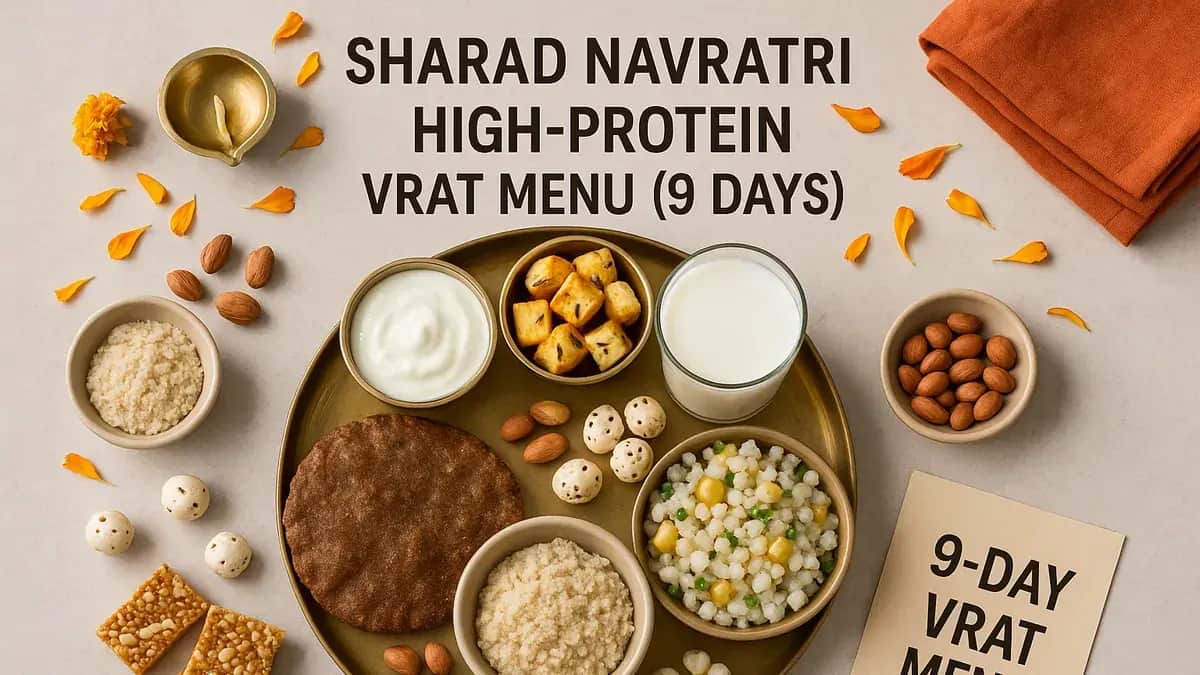
The first real test of a vrat isn’t devotion—it’s 4 p.m., when the day narrows to a cup of chai and the familiar drift toward “just aloo.” This Sharad Navratri plan is built for that hour: a higher-protein rhythm that still tastes like vrat food—warm tawa edges, cool dahi, a steady kind of fullness—so the week doesn’t collapse into potatoes alone.
What This 9-Day High-Protein Vrat Menu Solves
Promise: A 9-day breakfast–lunch–dinner menu designed to be higher in protein using common vrat-allowed foods.
Who it helps: Vegetarian fasting observers who want better satiety and steadier energy, meals that work around busy schedules, and simple protein anchors that may support muscle maintenance.
How to use it (stay flexible):
- Build each meal as: protein anchor + vrat carb + veg/fruit.
- Mix-and-match within the allowed list.
- If time/ingredients run short, repeat any day—the plan is meant to be reusable.
- Keep hydration steady through the day (plain water, lemon water, or what your routine allows).
Variations matter: Vrat rules vary by household/community—some avoid peanuts, some avoid tomato, some avoid onion/garlic, and grain rules can differ. Follow your family tradition first.
If you’re pregnant, diabetic, or managing a medical condition, personalise fasting and portions with a professional.
Allowed Ingredients Checklist
Use this as your shopping baseline. When in doubt, choose simpler, less-processed items.
Protein-forward, vrat-friendly options
- Paneer (your most reliable protein anchor)
- Milk (plain; warm or chilled)
- Dahi/curd + hung/strained curd (Greek-style: plain, unsweetened)
- Nuts & seeds (if allowed in your vrat): almonds, cashews, walnuts, chia/flax (small amounts)
- Peanuts (if allowed in your vrat): roasted peanuts, peanut chutney (confirm household rules)
- Makhana (fox nuts): not a primary protein, but useful for crunchy, controlled snacking
Vrat flours & grains (and best use)
- Kuttu (buckwheat) flour: best for cheela/chilla and tawa paratha
- Singhara (water chestnut) flour: best for dosa/chilla and light tawa rotis
- Rajgira (amaranth) flour: best for rotis and thalipeeth-style pancakes
- Sama/varai/barnyard millet: best for khichdi and “rice” bowls
Produce & add-ons commonly used
- Potatoes/sweet potatoes: use as support, not the base
- Lauki (bottle gourd): fast-cooking and calm alongside dahi
- Cucumber: instant raita/side to keep meals lighter
- Tomatoes (if allowed in your vrat): quick gravies and chutney-like sauces
- Fruits: banana, apple, pomegranate, papaya (choose what’s local)
- Vrat-friendly seasonings: sendha namak, jeera, black pepper, green chilli, ginger, lemon, coriander, mint; ghee in small amounts
Avoid or double-check
- Regular grains/legumes: wheat, regular rice, maida, besan, dals (unless your tradition allows specific items)
- Onion/garlic: avoid if your household does
- Salt: use sendha namak instead of table salt if that’s your rule
- Packaged foods: read labels for regular salt, grain flours/starches, and additives that don’t match your vrat rules
Swap logic (quick examples):
- No sama? Use rajgira rotis or a singhara chilla as the carb base.
- No peanuts? Make dairy your default add-on: hung curd bowl or paneer cubes.
For rule clarity across regions (peanuts, tomato, onion/garlic, grains), ask the Slurrp community about regional vrat rules.
9-day High-Protein Vrat Menu Checklist (Breakfast–Lunch–Dinner)
Every day below keeps a visible protein anchor (paneer/curd/milk; peanuts only if allowed), paired with a vrat carb base and a veg/fruit element. Most items are written to work on a tawa or in an air-fryer so “vrat food” doesn’t automatically mean deep-fried.
| Day | Breakfast | Lunch | Dinner |
|---|---|---|---|
| Day 1 (dairy-led) | Hung curd + fruit bowl | Sama khichdi + paneer cubes + cucumber | Lauki sabzi + curd/raita + small rajgira roti |
| Day 2 (rajgira) | Milk + rajgira porridge | Rajgira roti + dahi raita + small aloo (supporting role) | Paneer bhurji (no onion/garlic if you avoid) + cucumber/fruit |
| Day 3 (kuttu) | Kuttu cheela (tawa) + paneer stuffing | Kuttu paratha (tawa) + curd + fruit | Jeera aloo (moderate) + hung curd bowl |
| Day 4 (singhara) | Singhara dosa/chilla (tawa) + curd | Singhara roti + paneer + cucumber | Dahi aloo + warm milk |
| Day 5 (sama template) | Dahi bowl + pomegranate + roasted makhana | Sama rice bowl/khichdi + paneer + lauki | Paneer tikka (tawa/air-fry) + cucumber raita |
| Day 6 (dahi + cheela) | Hung curd + fruit + chia/flax (if allowed) | Rajgira thalipeeth (tawa) + curd | Kuttu cheela + paneer cubes |
| Day 7 (repeat + reset) | Repeat Day 1 or Day 2 breakfast | Repeat Day 5 lunch template | Cucumber raita + small singhara roti + fruit if needed |
| Day 8 (lighter, workday-friendly) | Warm milk + fruit + nuts (if allowed) | Repeat Day 3 or Day 4 lunch | Smaller sama khichdi + hung curd |
| Day 9 (festive / Kanya pujan) | Hung curd + fruit (keep it steady) | Sama khichdi + paneer + raita | Simple and early: milk/curd + fruit; sweets/fried as small add-ons, not the base |
If you’re short on time, repeat Day 2 and Day 5 templates—they cover most cravings without extra prep.
To sanity-check swaps and portions, estimate protein and calories with Slurrp Nutrimeter.
Protein-Boost Add-Ons
Breakfast add-ons
- Hung/strained curd (plain; add fruit if you want sweetness)
- A glass of milk
- Paneer cubes with sendha namak + pepper
- Peanut chutney (only if allowed in your vrat)
Lunch add-ons
- Keep paneer as the anchor: a palm-sized portion alongside khichdi/roti
- Curd/raita as the default side (cucumber is the fastest)
- Unsweetened milk-based drink (plain milk or thin chaas, if you take it)
Dinner add-ons (lighter options)
- Curd or hung curd instead of extra rotis
- Warm milk as a gentle finish
- Cucumber or a small fruit side; skip heavy fried add-ons late
If you’re very active: add one simple mini-meal between lunch and dinner—curd or paneer or milk—and keep the rest of the day unchanged.
9-Day Prep & Shopping Checklist
Shop-once staples (covers the whole plan):
- Dairy: milk, dahi/curd, paneer
- Pick 2 vrat flours + 1 vrat grain you’re comfortable with (example: kuttu + singhara + sama)
- Produce: cucumber, lauki, potatoes/sweet potatoes (limited), lemons, coriander/mint, 2–3 fruits
- Pantry: sendha namak, jeera, black pepper, green chilli, ginger; ghee (optional)
Batch prep (30–45 minutes):
- Hung/strained curd (keeps 2–3 days refrigerated)
- Roasted makhana for measured snacking
- Roasted peanuts (if allowed in your vrat)
- Chopped cucumbers for instant raita/sides
- Boiled potatoes/sweet potatoes in a limited quantity (so they don’t take over every meal)
Cooking methods (keep it lighter):
- Default to tawa, air-fry, steam; deep-fry rarely.
Want variations without changing the template? Explore more Navratri vrat recipes on Slurrp. For regional inspiration when traveling, explore Slurrp Food Trails.
Conclusion
House rules come first—but within those rules, the easiest way to keep this vrat plan satisfying is to hold a protein anchor at each meal (paneer/curd/milk; peanuts only if allowed) and rotate your carb base across sama, rajgira, kuttu, and singhara. Miss a day or lose prep time? Repeat the templates rather than improvising into “just aloo.”
For quick portion/protein reality checks, use Slurrp Nutrimeter, and for ingredient-rule clarity (peanuts, tomato, onion/garlic, grains), ask the Slurrp community.
Some parts of this article were created with AI assistance.