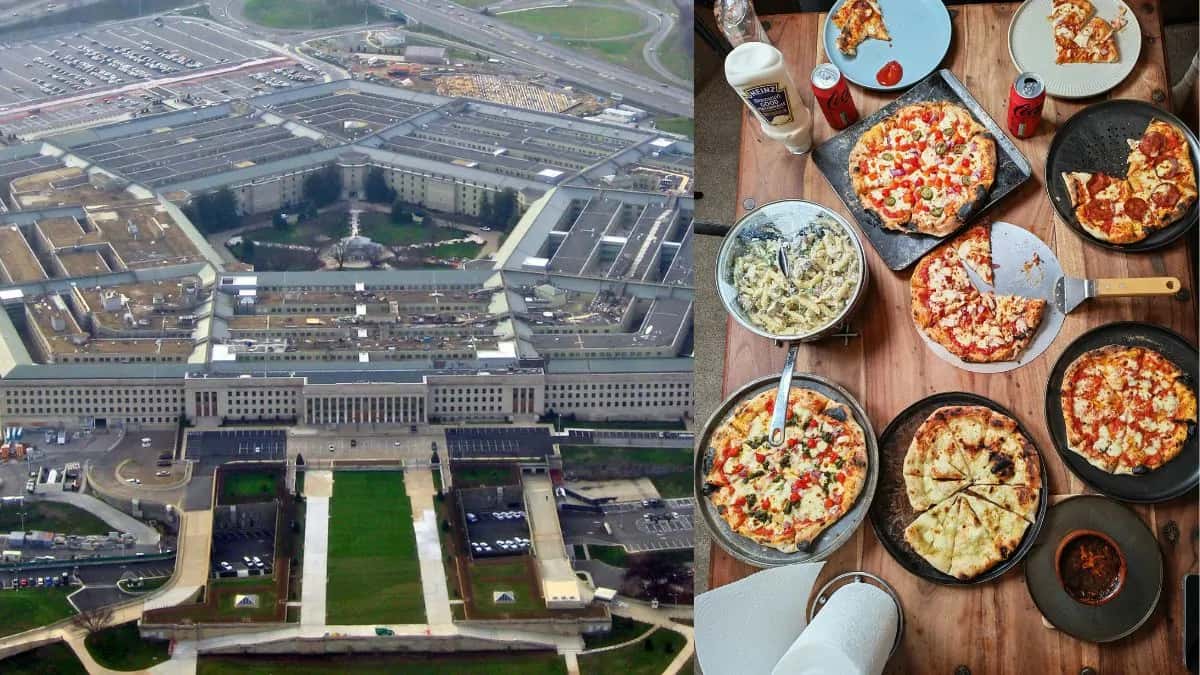
In the high-stakes world of international espionage and national defence, billions of pounds are spent on satellite surveillance, cyber intelligence, and deep-cover operatives. Yet, some of the most reliable data points regarding an impending global conflict might not come from a coded transmission or a high-altitude drone. Instead, they might come from a humble delivery moped idling outside a government building. This is the essence of the Pentagon Pizza Theory, a concept that sits at the fascinating intersection of mundane logistics and world-altering strategy. The theory suggests that a massive, statistically significant surge in pizza deliveries to major US government buildings acts as a leading indicator of major military action or a significant international crisis. When bureaucrats and generals work through the night to plan a strike or manage a collapse, they do not have time for a formal dinner. They order pizza.
The Origin Of The Pizza Meter
The concept first entered the public consciousness in the early 1990s. Frank Meeks, who owned dozens of Domino’s Pizza franchises in the Washington D.C. area, noticed a peculiar pattern. Just before the United States launched Operation Desert Storm in 1991, the volume of deliveries to the Pentagon skyrocketed. On a typical night, the building might see a dozen orders. In the days leading up to the invasion of Kuwait, that number jumped to over one hundred. Meeks famously tracked these surges, noting that the White House and the State Department followed similar patterns. It was not just about the quantity of food: it was about the timing. When the lights stayed on past midnight and the delivery drivers were kept busy until 03:00, the world was usually about to change. Meeks eventually dubbed this the Pizza Meter. While it began as a quirky observation by a savvy businessman, it quickly became a legendary example of open-source intelligence. It proved that even the most secretive organisations in the world cannot entirely hide their human needs.
Logistics As A Proxy For Secrets
To understand why this happens, one must look at the human element of governance. The Pentagon is a city unto itself, housing roughly 26,000 employees. During a standard workweek, most of these individuals head home by the evening. The on-site cafeterias and food courts operate on regular business hours. However, when a crisis breaks, such as a sudden escalation in the Middle East or a cyber-attack on critical infrastructure, the regular schedule evaporates. Key personnel are summoned for emergency briefings. Contingency plans are drafted. Communication lines with allies are kept open across different time zones. In these moments, leaving the building for a meal is not an option due to security protocols and time constraints. The solution is simple: mass-ordering food that is easy to eat with one hand while the other is busy pointing at a map. Pizza is the universal choice for the overworked official. It is calorie-dense, relatively cheap, and can be shared easily among a team of planners.
Image credits: Pexels
Also read: LPG Gas Cylinder Shortage: How India’s Hospitality Sector Is Navigating The Impact Of War In Iran
The Theory In Modern Conflict: The Case Of Iran
The relevance of the Pizza Meter has surged alongside the recent and intense conflicts between the United States and Iran. In early 2024, during a period of extreme tension, social media users began posting screenshots of Google Maps traffic data. They noticed that several pizza establishments near the Pentagon were listed as significantly busier than usual at odd hours.
On 13 April 2024, a notable spike in activity at a Papa John’s in Washington D.C. occurred just as Iran launched a wave of drones and missiles toward Israeli territory. This was not a coincidence. It was the physical manifestation of a war room in full operation. This pattern repeated in June 2025 during Operation Lion, when Israel conducted strikes against Iranian infrastructure. Analysts noted a massive surge in orders at the District Pizza Palace, a venue located only a few miles from the Pentagon, roughly one hour before the first reports of explosions surfaced in Tehran.
The most dramatic application of the theory occurred in early 2026. Following a period of civil unrest in Iran and a massive US military build-up in the region, the Pentagon Pizza Report, a viral social media account dedicated to this tracking, noted a staggering 1,250 percent increase in pizza activity on 5 January 2026. This was the largest spike in recorded history. While many speculated it was a response to operations in Venezuela, the sheer volume suggested something much larger was on the horizon.
On 28 February 2026, the US and Israel launched Operation Epic Fury, a series of strikes that fundamentally altered the Middle East. The pizza deliveries in January were the early warning signs of the planning phase for this massive operation. In a world where satellite photos are scrutinised for troop movements, the number of pepperoni pizzas being moved across Arlington, Virginia, provided an equally valid, if more domestic, signal of war.
Image credits: Pexels
The Indian Perspective: OSINT And Energy Security
For an Indian audience, this theory is more than just a piece of Western trivia. India has a burgeoning community of Open-Source Intelligence (OSINT) enthusiasts who use public data to track regional security. The Pentagon Pizza Theory serves as a reminder that intelligence is not always about high-tech hacking. Sometimes, it is about observing the patterns of everyday life. Furthermore, the US-Iran conflict has direct economic consequences for India. The 2026 closure of the Strait of Hormuz, a key maritime choke point for global oil, led to immediate ripples in Indian fuel prices and supply chains. For Indian businesses and investors, these mundane indicators like pizza spikes at the Pentagon act as an early warning system for market volatility. If the Pizza Meter suggests a major US intervention in the Middle East, the savvy observer in India knows that energy prices are likely to climb.
Image credits: Pexels
The Deeper Meaning: The Death Of Secrecy
Beyond the novelty of tracking fast food to predict a war, there is a deeper, more philosophical meaning behind this theory. It represents the erosion of total secrecy in the modern world. We live in an age where the mundane details of our lives are constantly being recorded. For a government, maintaining the element of surprise is becoming increasingly difficult when the basic logistics of supporting a workforce are visible to anyone with an internet connection.
The theory also highlights the normalisation of crisis. There is a haunting contrast between the act of a delivery driver navigating the streets of Virginia with a stack of boxes and the world-shattering decisions being made by the people who will eat that pizza. It reminds us that behind every headline about a missile strike or a diplomatic breakthrough, there are thousands of exhausted individuals whose lives have been reduced to a cycle of coffee, spreadsheets, and late-night takeaways.
Furthermore, the Pentagon Pizza Theory is a testament to the power of indirect data. In data science, this is known as a proxy variable. When you cannot measure the thing you want to see, such as the contents of a classified briefing, you measure something related to it that is visible. This way of thinking is essential for understanding the modern world. Whether it is tracking the price of onions to predict political stability in India or monitoring pizza deliveries to predict a war, the principle is the same: the truth often hides in plain sight.
Image credits: Pexels
The Human Footprint In The Machine
Today, the Pentagon is far more careful. Reports suggest that they have diversified their food sources and even encouraged staff to use internal mess halls during sensitive periods to avoid creating a spike in external deliveries. Some have joked that the US Department of Defence should invest in its own top-secret pizza ovens to close this intelligence loophole.
However, as long as humans are involved in the machinery of war and diplomacy, their biological needs will remain a vulnerability. Even if they stop ordering pizza, they might order more coffee, or their ride-share activity might increase. The Pentagon Pizza Theory is less about the food itself and more about the unavoidable footprints we leave when we are under pressure.
In the end, the theory proves that no matter how advanced our technology becomes, the most complex systems in the world are still powered by people. And those people, regardless of their rank or clearance, still need a slice of something familiar when the world is going to pieces. It is a grounded, human perspective on a world that often feels cold and distant. In a world of high-tech sensors and artificial intelligence, sometimes the most honest intelligence comes from the bottom of a cardboard box.