I spent three days at The Manila Hotel—the oldest premiere hotel in the Philippines, opened in 1912 on the edge of Rizal Park with a view of Manila Bay that has seduced presidents, dictators, and one particularly stubborn American general . I was in town for WAN-IFRA Digital Media Asia 2026, where I had been invited to speak about product strategy and audience growth for Slurrp, the food platform I am a part of.
But the real education happened at lunch and dinner. I ate lapu-lapu steamed in banana leaves every single day (as a meal for two nights and once for a snack actually) I was there. Not because the menu lacked options—the hotel's kitchens are formidable—but because that particular dish kept unfolding like a map the longer I sat with it. By day three, I realized I wasn't just eating fish, I was eating a product case study wrapped in foliage.
Image Credits: Pexels
Day One: The General's Suite
The Manila Hotel does not whisper its history, it announces it. The lobby marble has been polished by the footsteps of Hemingway, presidents, and wartime occupiers. The top floor was converted into a penthouse for General Douglas MacArthur, who lived here from 1935 to 1941 with his wife Jean and son Arthur while serving as Military Advisor to the Philippine Commonwealth. MacArthur later called this one of the only two real homes he ever had.
I arrived hungry and disoriented. I had spent the morning on a panel talking about recommendation engines and retention curves for Slurrp—how our platform of three lakh-plus recipes and two lakh home chefs uses AI to match users with dishes that fit their dietary, regional and seasonal constraints. It was good, clean product talk but my head was still back in the Kapampangan research I had done on the flight over, about a Tamil rice dish called brinji that had somehow become Filipino bringhe after a thousand-year voyage.
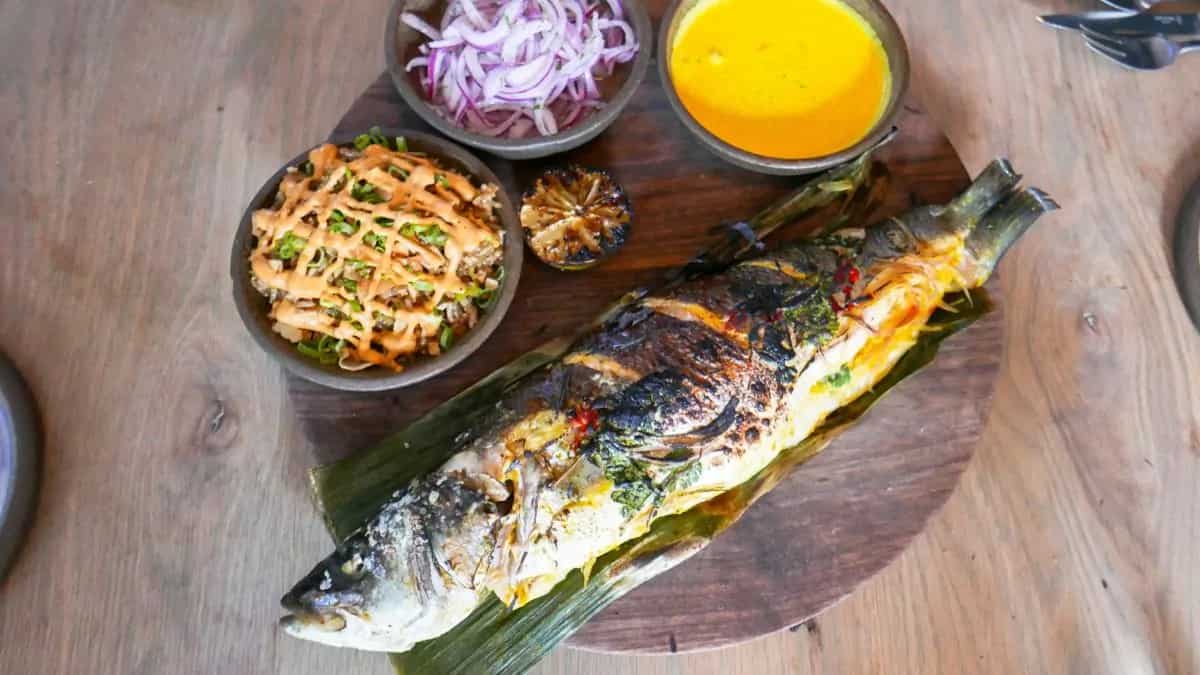
I needed something immediate. Something that would ground me in Manila, not in maritime history. The menu offered lapu-lapu three ways. I chose steamed in banana leaves because it sounded like the least colonial preparation. It arrived folded into a parcel, tied with twine, the leaf edges darkened and fragrant from the steamer. The waiter set down a small pair of scissors. "Cut here, sir, the aroma is the best part."
Image Credits: Wikimedia Commons
He was right. The first snip released a cloud of steam—ginger, garlic, lemongrass and the particular green sweetness of banana leaf that no parchment or foil could replicate. The grouper inside was white, flaky, and sweet, stuffed with slivered ginger and dayap (a local citrus), bathed in coconut cream. The juices had pooled at the bottom of the leaf, creating a thin, intensely marine sauce. I sat there in MacArthur's hotel, eating a fish that shared its name with the first Filipino to resist European colonization, and felt the collision of centuries on my tongue.
The Two Namesakes
Lapu-lapu is two things in the Philippines. He is the national hero—a datu from Mactan Island who killed Ferdinand Magellan in 1521 and became the first Filipino to repel European invasion. He is on the presidential seal. He is grade-school curriculum. He is pride; and he is a fish, grouper. One of the most prized catches in Philippine waters.
According to food historians who have reconstructed the diets of national heroes, Lapu-Lapu, the man favored sinigang na isda sa mangga—a sour fish soup made with unripe green mango rather than tamarind, giving it a tart, fruity brightness specific to the Visayas. It was a fisherman's meal, appropriate for a chieftain who drew his power from the sea.
Image Credits: Pexels
Also Read:
General MacArthur meanwhile, came to the Philippines not to resist foreign rule but to organize it. Yet the hotel's own historians and the kitchen's oral tradition insist that his favorite meal here was the lapu-lapu fish steamed in banana leaves Not steak, not potatoes but leaf-wrapped grouper, Filipino-style, six years running. So here is the coincidence that Manila handed me: the general who came to rule the Philippines loved a fish that shared its name with the man who first refused to be ruled. Two completely different flavors. One gentle and steamed, the other sharp and simmered. United only by phonetics, geography, and the banana leaf.
Day Two: The Leaf As Archive
I ordered it again the second day. This time I paid attention to the architecture. The banana leaf is not just packaging. It is archive. Its waxy surface traps moisture, creating a self-basting environment where the fish cooks in its own juices amplified by aromatics. It imparts tannins that subtly firm the flesh. It contributes a grassy sweetness that permeates every flake. The leaf is a technology—one that Tamil merchants, Spanish colonists, American generals and Filipino heroes all relied upon because it worked.
At Slurrp, we spend enormous energy on ingredient substitutions. A user in Delhi searches for a Kerala fish recipe and we have to suggest what to use when banana leaves aren't available—foil with pandan perhaps, or parchment with coconut water. But every cook knows that the substitution is never perfect. The banana leaf isn't just a wrapper. It is an ingredient. It is integration.
MacArthur understood this. He could have had his lapu-lapu grilled plain or sautéed in butter. But he asked for it wrapped in banana leaves, Filipino-style. The general who said he shall return kept returning to this same lunch. That is the retention curve every product builder dreams of: perfect engagement, zero churn and six years of repeated use. I sat at the same table on day two, cutting open my own parcel, and thought about how the leaf does something no algorithm can. It physically merges with the food. It becomes part of the flavor profile. It is the deepest form of localization.
The Banana Leaf As Connective Tissue
By the third day, I was tracing a pattern. The banana leaf had already appeared in my trip in a completely different context. Two nights earlier, in a Kapampangan restaurant in Makati, I had eaten bringhe—the yellow rice dish that linguists trace from Tamil brinji, carried across the Indian Ocean by 11th-century Chola merchants.That dish, too, had been wrapped in banana leaves, the original Tamil bay leaves replaced by what was locally available.
Image Credits: Wikimedia Commons
Now, at The Manila Hotel, I was eating another leaf-wrapped parcel—this one holding a fish named for a warrior. The banana leaf was the common thread. Tamil merchants had used it to adapt a Persian-named rice dish to Southeast Asian ingredients. Filipino cooks had used it to steam a grouper for an American general. And here I was, a product guy from Mumbai, eating both iterations within seventy-two hours and realizing they spoke the same language. The leaf is the original localization engine. It doesn't just wrap content—it transforms it.
Day Three: The Kitchen Remembers
On my final day, I ordered the lapu-lapu again. The waiter recognized me and smiled. "You like the leaf, sir." "I like the history," I said. He nodded. "General MacArthur, he ate this for six years. Every week, they say." I asked if that was documented or just hotel lore. He shrugged. "The kitchen remembers. The old chefs told the new chefs, that's how we know." Oral tradition as data pipeline. No CRM. No analytics dashboard. Just memory, passed hand to hand, kitchen to kitchen, across generations who never met the general but know exactly how he liked his fish.
Image Credits: Flickr
This is what I came to Manila to understand. I came to talk about product strategy for Slurrp—how we grew to millions of users, how our Nutrimeter helps people understand calorie intake, how our Great Indian Cookout has built a community across four Indian cities. And all of that is true. But the deeper work is about preservation. Not just preserving recipes, but preserving the context of why we cook. The leaf remembers the general. The leaf remembers the Tamil merchant. And when I cut open that parcel on day three, the steam that rose carried all of it.
What The Hero And The General Would Eat
I finished my third lunch and imagined a meal that could never happen. Lapu-Lapu the hero, fresh from the Battle of Mactan in 1521, sits down with General MacArthur, fresh from retaking Manila in 1945. Between them is a table at The Manila Hotel. MacArthur has ordered his lapu-lapu steamed in banana leaves with ginger and coconut cream. Lapu-Lapu has brought his sinigang na isda sa mangga, sour with green mango, rich with fish from his own reefs.
They have nothing in common politically. One resisted foreign rule; the other embodied it. But they share this: both understood that Philippine food was not something to be overwritten. It was something to be eaten on its own terms. That is the lesson I am taking back to Mumbai, and back to Slurrp. We built the platform to surface recipes from every corner of India and beyond but the real work is surfacing the context. The leaf, the history. The reason a general in a colonial hotel asked for his fish wrapped in banana leaves instead of plated with a butter sauce.
The Departure
Image Credits: Flickr
I checked out on the fourth morning and took a cab to Ninoy Aquino International Airport. The driver, hearing my accent, asked where I was from. India, I said. He nodded. "You know, the lapu-lapu fish, it's very expensive now. Hard to find. But when you do, it's the best." I told him I had eaten it three times at The Manila Hotel. He whistled. "MacArthur's hotel," he said. "My grandfather used to talk about that fish. The general loved it." I asked if he knew about lapu-lapu the hero's favorite dish.
He paused. "No. I didn't know that. But it makes sense. He was from Mactan. They have a lot of mango there." History travels in strange containers. Sometimes it's a textbook. Sometimes it's a monument. And sometimes it's a fish, wrapped in a leaf, served to a product manager who came to Manila to talk about digital strategy and left with a full notebook and a fuller stomach. The Chola Empire fell. The Spanish Empire fell. MacArthur's penthouse was shelled and rebuilt. But the leaf endures. The leaf remembers.