


 Share
Share

By the second afternoon of the WAN-IFRA conference in Manila, a particular kind of intellectual fatigue had set in—the kind that has nothing to do with the quality of what is being said. The sessions were sharp, the participants serious. The conversations about AI, monetisation and audience distribution were anchored refreshingly, in what actually works rather than what sounds impressive. People in that room were building things, and more importantly, questioning what they had built. That lends a certain honesty to proceedings; very little was decorative.
But by mid-afternoon on day two, repetition had done its quiet work. The same fundamental problems were being approached from multiple angles, which is usually the point at which clarity begins—and also the point at which the body quietly registers its own priorities. The intellectual density had been accumulating since morning. Models, pipelines, cost curves, audience flows and then, cutting through all of it, something simpler and more insistent—hunger.
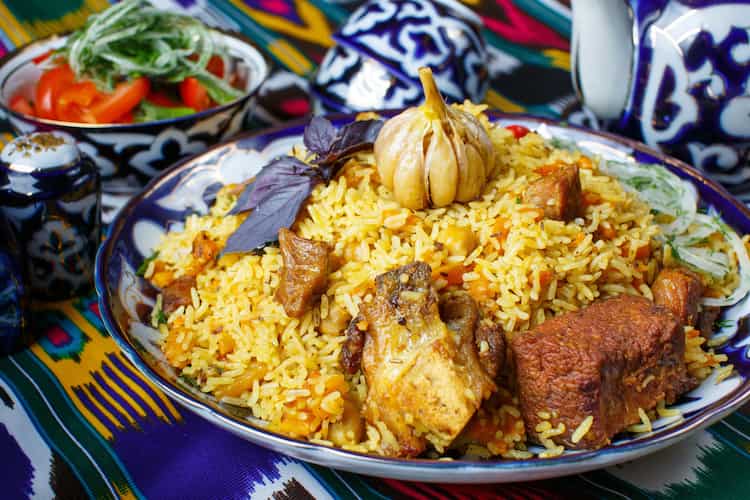
Image Credits: Unsplash
It was not dramatic. Just a quiet, persistent reminder that the body has its own timelines, independent of panel discussions and strategic frameworks. I stepped outside, away from the rooms and the language of systems, into a city that has seen more systems rise and fall than most people in those rooms had stopped to consider. Manila does not foreground its past. It carries it lightly, the way cities that have absorbed repeated upheaval tend to—the weight distributed across centuries of trade, colonisation, conversion and adaptation, so that no single layer presses too hard on the surface. But the past is there if you pay attention. I asked for something local, not curated for visitors, not simplified for the unfamiliar palate, not retrofitted for explanation—something that had its own reasons for existing.
The answer was brief, from a cab driver who easily handled both Tagalog and English with equal gusto. "Pampanga is the place for food," he said. I asked if it was home for him. He answered in the affirmative. "But I am not biased sir," he empathetically emphasised. That is usually how it works, the places that speak least about their food are often the ones that understand it most deeply. I did not travel to Pampanga that night—the province lies north of the capital, inland, and the evening had its own logic but I found a place in the city that had brought its cooking in, and on the table came a dish of yellow rice, laid out on banana leaves, with chicken folded into it, and a smell that reached further back than the room it was being served is they called it bringhe.

Image Credits: Pexels
At first encounter, it offers a convenient explanation of itself. The colour, the structure, the communal presentation—a first glance suggests paella, and in a country shaped so substantially by Spanish colonial history, that is the nearest reference most visitors would reach for. It is not an unreasonable comparison. But convenience is not accuracy and the dish resists the analogy almost immediately once you look more carefully. The colour was not saffron—it was turmeric. The richness did not come from olive oil and stock but from coconut milk, slow-cooked until the rice had absorbed it entirely. The spicing was restrained, layered, without the acidic brightness of a Mediterranean base. The structure was not Iberian. Whatever bringhe was, it was not a colonial inheritance from Spain. I tasted it, it did not announce itself, it did not compete for attention, it sat quietly and held its ground—the quality of a dish that has nothing to prove because it has already been proven, repeatedly, across a very long period of time.
Somewhere in that first mouthful, there was recognition; not precise, not the clear recall of a specific meal at a specific table. But unmistakable, the way certain sensations are—the kind that bypasses the analytical and goes directly to whatever part of memory stores things the body experienced before the mind thought to file them. I had eaten this before, not here, not in this form. But in another kitchen, in another country, in another time. My grandmother's kitchen, in my aunts' homes. A version of rice they made that we called brinji—lightly spiced, fragrant with bay leaves, sometimes enriched with vegetables, occasionally with meat, always restrained. Never the loudest dish on the table. Never the one people spoke about at length. But the one I returned to, consistently, across many years and many tables. Memory does not always return as narrative. It returns as sensation; bringhe carried that sensation.
That is the point at which the question begins—not as idle curiosity, but as something closer to discomfort. Why is something this familiar in a place where it should not exist? Why does a dish from the Pampanga region of the Philippines carry the unmistakable imprint of a rice preparation from the kitchens of South India? And why, if this connection is real, does almost no one in either place speak about it?
***
The answer begins with a name—bringhe. Spoken aloud, the word does not sit naturally within the phonetic architecture of Kapampangan, the language of Pampanga province. It suggests travel. It sounds, if anything, like a word that has already journeyed and been slightly altered by the journey—the kind of transformation that happens not through deliberate change but through the slow friction of daily use in a different mouth.
Also Read:
The academic work of Dr. Tom Hoogervorst provides the necessary framework. His research on pre-modern South Asian linguistic influence across Maritime Southeast Asia traces the rice delicacy back to an earlier form biringyi, and further to a Tamil word—brinji. This is not a tentative etymological connection. The phonetic transformation is consistent, the geographic distribution is coherent, and the culinary markers align in ways that coincidence cannot explain. A dish with a Tamil name, a Tamil spice base, a Tamil structural logic, appearing across the Malay Archipelago and into the Philippines—that is not accidental. It is lineage.
But the word brinji itself did not originate in Tamil Nadu. Before it settled into South Indian kitchens, it had already travelled—from Persian or Central Asian roots for rice preparations, moving through the Arab trade world before finding its way into the vocabulary and cuisine of the Tamil-speaking coast. By the time it appears in South India, it is already part of a moving system. The dish that my grandmother made quietly in her kitchen in Bangalore was carrying unknowingly the trace of a commercial and culinary network that had been in motion for over a thousand years. From Tamil Nadu, it moved east, and this is where the historical machinery becomes visible.
***
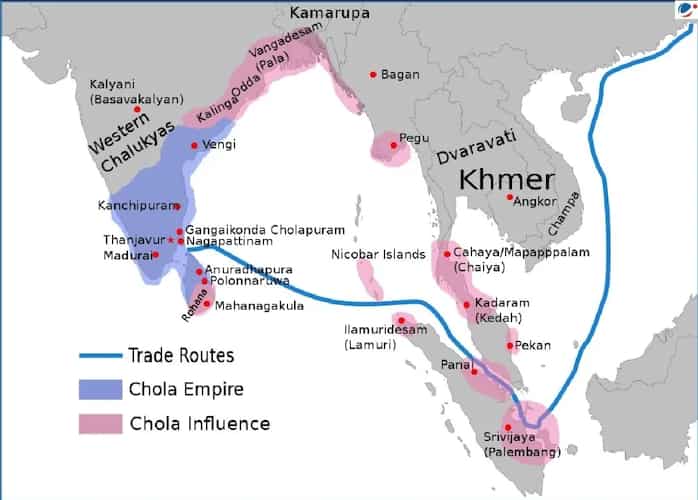
In the 11th century, the Chola Empire under Rajendra Chola, I was engaged in something more ambitious than territorial expansion in the conventional sense. The naval campaigns against the Srivijaya kingdom in 1025 CE are sometimes read in retrospect as early medieval imperialism—which is not entirely wrong—but the more precise description is commercial reconfiguration. Srivijaya had for centuries controlled the Straits of Malacca, the narrow corridor through which all maritime trade between India and China was compressed. Whoever influenced that passage influenced the flow of almost everything that mattered in the medieval world economy—spices, silk, ceramics, cotton and the revenue structures built around them.
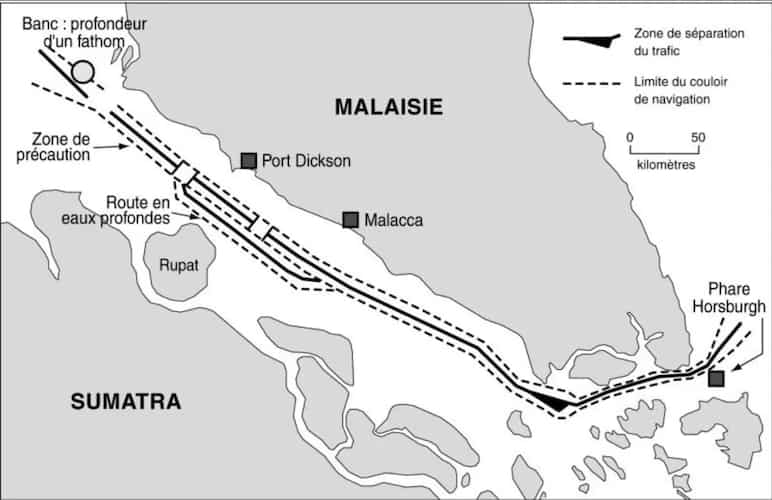
The Chola disruption of Srivijaya did not establish permanent Chola political control in Southeast Asia as it was not designed to. What it created was something more durable—a commercial reorientation that allowed Tamil merchant guilds to expand aggressively into the region. These were not informal networks of independent traders. They were structured, sophisticated organisations—the manigramam and ainurruvar being among the most prominent—with internal governance, capital reserves, legal frameworks, and trade relationships that spanned the entire Indian Ocean. They had been building these networks for generations before the Chola campaigns opened new routes and removed old gatekeepers.
Across the following centuries, Tamil merchant communities established themselves throughout Maritime Southeast Asia—in North Sumatra, in Kedah, along the Malay Peninsula, and eventually into the Philippine archipelago. These were not colonial settlements in the extractive sense. They functioned as nodes in a trading network—points where cultures met, negotiated, transacted and inevitably borrowed from one another. It is through this world that the dish travelled.
By the 15th century, the Malacca Sultanate had become the great commercial hub of Maritime Southeast Asia—a port city of extraordinary ethnic diversity and remarkable administrative sophistication. Among the most significant foreign communities in the city were what Malay records called the Keling—South Indian merchants, predominantly Tamil, who had been embedded in the region's trade networks for generations by this point.
The term itself has a complex history—linked etymologically to Kalinga, the ancient coastal kingdom in what is now Odisha, but applied broadly across Southeast Asia to Hindu merchants of South Indian origin. In Malacca, the Keling were not peripheral participants in the port economy. They were central to it. The Sultanate's governance structure reflected this explicitly: the city employed four shabandars, or harbourmasters, each responsible for a distinct merchant community—managing taxation, warehouse security, and the arbitration of commercial disputes. One of the Keling's leaders held the hereditary title of bendahara, with judicial authority over his community and, in times of military need, command over its armed retinues.
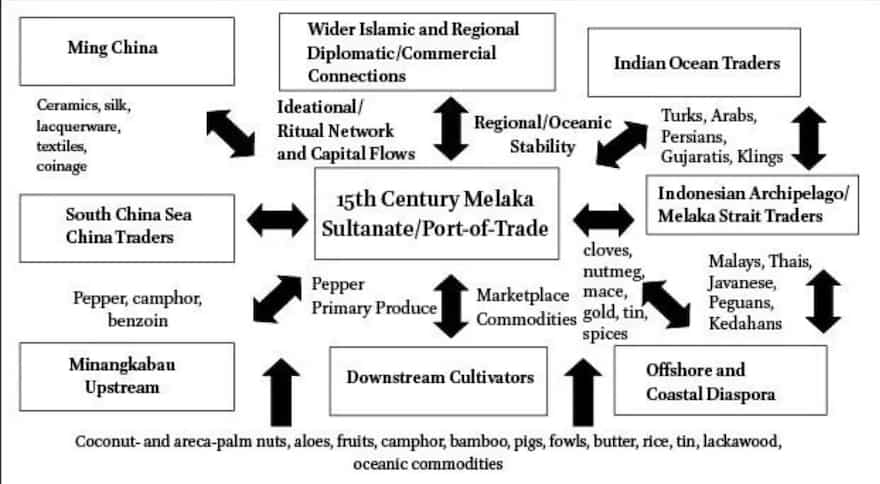
This is a level of integration that goes well beyond trade. It reflects something deeper—trust, dependency, and the kind of cultural influence that follows from being genuinely indispensable. The Keling were not merely trading. They were interpreting. They spoke multiple languages, moved between systems, and translated not just words but practices—commercial, culinary and technological. They were the connective tissue between worlds.
When the Portuguese captured Malacca in 1511, most observers might have expected the established trading communities to withdraw. The Gujarati merchants, who had maintained close relationships with Arab and Turkish commercial networks that were now hostile to the Portuguese, did largely depart. The Keling remained. Under Portuguese administration, they partnered with the Crown to outfit ships across the Archipelago, acted as commercial advisers to Portuguese Captains, dominated the spice trade with the Moluccas, and provided logistical and sometimes military support to the new rulers. Portuguese arsenal records note—with a certain bureaucratic matter-of-factness that makes the detail all the more telling—loans of artillery to Hindu merchants, justified on the grounds that the cargo on the ships concerned belonged to the Crown. These were not marginal participants in an alien system. They were operational partners in a new one.
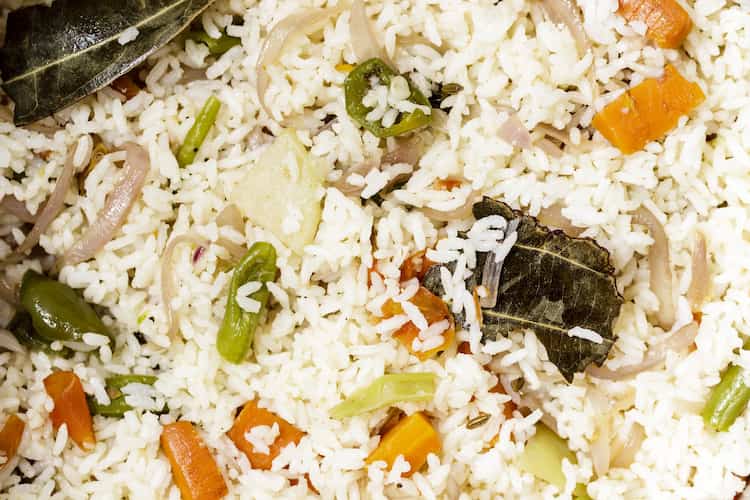
Image Credits: Wikimedia Commons
And through all of this—the Chola disruption, the Sultanate, the Portuguese period, the long centuries of movement and settlement—the merchants carried their food with them. Not as cultural exhibition. Not as a deliberate act of preservation. Simply because people eat, and people eat what they know, and what they know adapts to what is available.
***
The transformation from brinji to bringhe is not a single event. It is a series of quiet substitutions, made across generations, by cooks who were not thinking about history. Ghee is expensive and difficult to obtain far from its source; coconut milk is everywhere in Southeast Asia, and it produces a similar richness with a different register. Long-grain rice gives way to local varieties, sometimes glutinous, which change the texture of the finished dish. The spice ratios shift—turmeric becomes more prominent, other flavourings recede or are replaced by what grows locally. The banana leaf, already present in both South Indian and Southeast Asian food cultures, becomes the serving vessel.
What remains constant through all of this is the underlying logic: the layering of mild spice into rice, the slow absorption of liquid until every grain carries the flavour, the creation of a dish that sits between the everyday and the ceremonial. Bringhe in Pampanga is made for weddings, for fiestas, for occasions that matter. Brinji in a South Indian kitchen appears at celebrations and gatherings, at moments when the cooking is meant to signify something beyond mere sustenance. The occasion has survived the journey, even when the ingredients have been entirely replaced.
The claim that Bringhe derives from Spanish paella, which circulates easily in travel writing and food journalism, does not hold under scrutiny. The linguistic trail predates Spanish influence in the Philippines by several centuries. The culinary markers—the turmeric base, the coconut milk, the spice logic—are Indic-Southeast Asian, not Iberian. Paella is built on a foundation of sofrito, on the browning of rice, on saffron and shellfish and pork. Bringhe is built on none of these things. The resemblance is structural, not genealogical—two rice dishes that have arrived, by entirely different routes, at a similar idea of what rice can be asked to do.
***
On the last evening of the conference, I found myself turning the day's conversations over in a different light. The sessions had been focused, intelligently, on questions of distribution and scale. How do you take a product from one context and make it work in another? How do you retain relevance as you expand? How do you build systems that travel without losing what made them worth building in the first place?
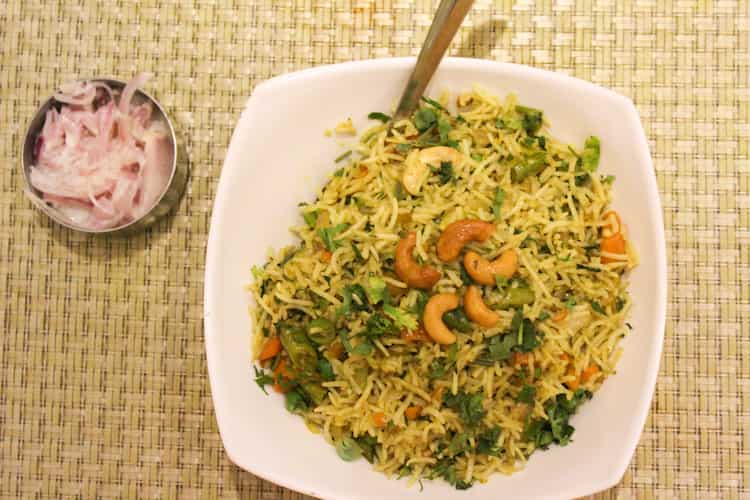
Image Credits: Wikimedia Commons
These are genuinely difficult questions, and the answers offered were sophisticated—data-driven, architecturally complex, dependent on continuous measurement and adjustment. The room was full of people who understand how hard it is to build something that lasts. But the simpler answer had been sitting on a banana leaf on a table in Manila the previous evening.
Brinji did not travel because it was marketed. It did not have a growth strategy. It was not optimised for foreign markets or adapted through focus groups. It travelled because it was adoptable—because it required no inputs that could not be found locally, because it fit into existing patterns of eating and celebration, because it attached itself to occasions that already mattered, and because it was willing to change everything except its essential logic.
That is not a small thing. Most systems, cultural or commercial, fail at precisely this point. They travel well but land badly, because they insist on their original form in conditions that cannot support it. Or they adapt so completely to local conditions that nothing recognisable survives the journey. Brinji did neither. It held its structure—the flavouring of rice, the layering of spice, the connection to celebration—and allowed everything else to become something else. Turmeric for saffron. Coconut for ghee. Banana leaf for the clay pot. The result is not the same dish but it is the same idea.
The Keling merchant guilds were not, in any formal sense, transmitting culture. They were trading, they were settling, they were navigating between political systems—the Sultanate and then the Portuguese—with the kind of pragmatic flexibility that is characteristic of communities that cannot afford the luxury of rigidity. In doing so, simply by living, they carried fragments of their world into other worlds. Some of those fragments were absorbed and forgotten. Some were modified beyond recognition. And some remained—changed in form but unchanged in essence—because they offered something that fit.
Food is among the most durable of those fragments, for reasons that are not difficult to understand. It does not require translation. It does not need a shared language or a shared history to communicate. It needs only to be good, and to arrive at a moment when someone is hungry.
***
There is a detail I have been holding back, because it belongs at the end. In my family, brinji was always vegetarian. My grandmother's version was made without meat—the spices, the bay leaves, the long slow cook of the rice, without lamb or chicken. That was simply how it was done. It was, in retrospect, the South Indian Brahmin version—restrained, fragrant, complete in its own terms. My aunt, however, made a different calculation. Her son would not eat the dish as it was. He was a child with opinions, which is to say he was a child, and the vegetarian version held no interest for him. So she put in some chicken. Not much, just enough so he ate it and was satisfied, and the dish survived another generation in that household because it had been willing to accommodate one small boy's preferences.
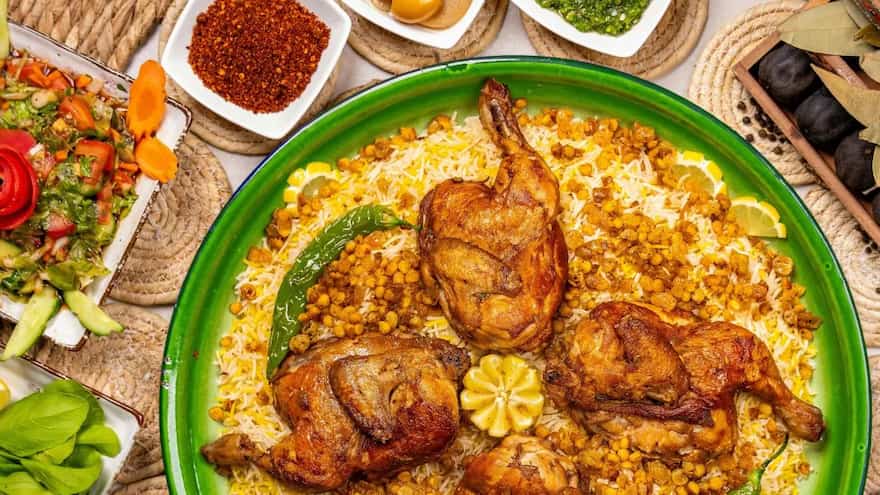
Image Credits: Pexels
I thought about this in Manila, looking at the chicken folded into the bringhe on the banana leaf, and I thought: here it is. Here is the whole story. Not in the Chola campaigns or the Malacca Sultanate or the Portuguese arsenal records, though all of those are real and all of them matter. The whole story is in the small, invisible, practical acts of accommodation—the aunt who added chicken, the cook in Pampanga who reached for coconut milk instead of ghee because that is what was in the kitchen, the Keling merchant who ate what was available and made it work.
The great trade networks are gone. The political structures they operated within are gone. The Srivijaya kingdom is gone. The Malacca Sultanate is gone. Portuguese Malacca is gone. What remains is a yellow rice dish on a banana leaf in a province north of Manila, still being made for weddings and fiestas, still carrying—in its turmeric and its coconut and its logic of slow absorption—the trace of a world in motion.
The conference ended well. Ideas were sharpened. Positions were clarified. Practitioners compared notes on what was working and what was not. It was, by any reasonable measure, a productive few days. But the insight that stayed with me did not come from the stage. It came from recognising that a dish—carried across a thousand years and ten thousand kilometres through the pragmatic, unglamorous work of merchants and migrants and aunts who added chicken—had achieved something that most of the systems discussed in those rooms were still working towards.
It had travelled. It had adapted. It had embedded itself into cultures far from its origin. And it had survived—not by insisting on what it was, but by being clear about what it was for. That is not a small lesson. And it was not served on a stage. It was served on a banana leaf.
The author was a speaker the WAN-IFRA World News Media Congress in Manila.




