This is part 2 of 6 in ‘80 Failures, Fractures and Food-Safety Episodes That the Celebration of Indian Food Must Also Own’, an analysis by Avinash Mudaliar.
Regulatory Architecture and Its Failures
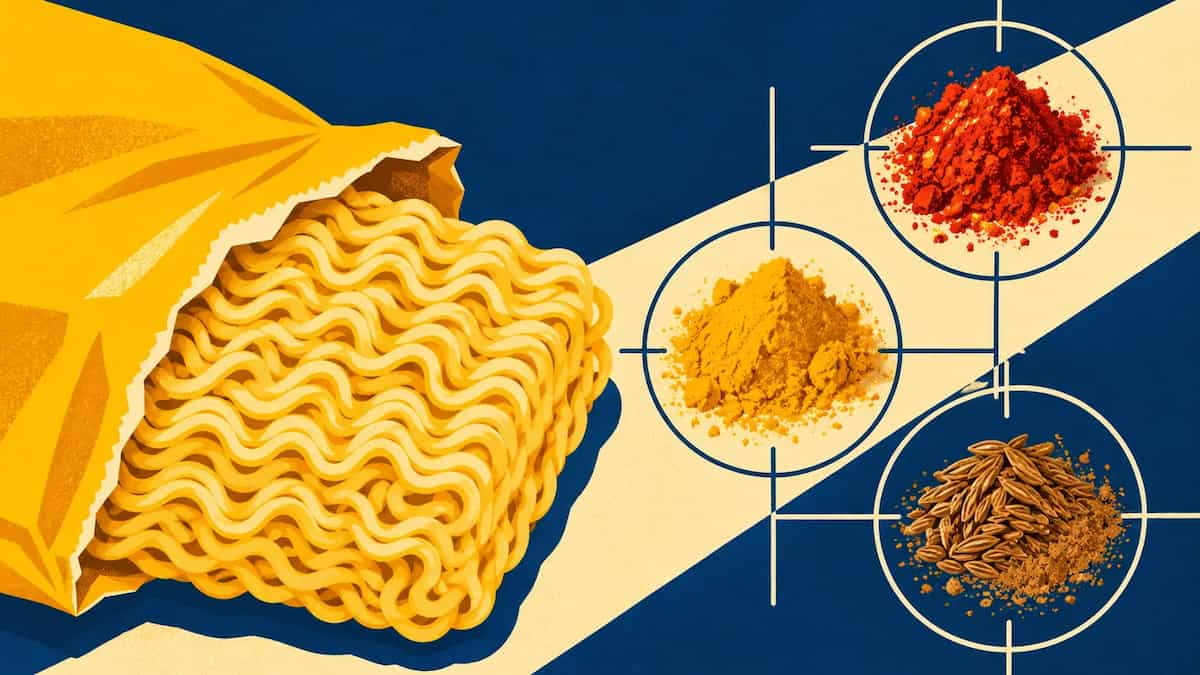
13. The 2015 Maggi crisis was a nationwide recall and a test of the regulator’s evidence. The Food Safety and Standards Authority of India (FSSAI) ordered the recall after citing alleged excess lead, a label that said “No Added MSG” which it considered misleading, and the sale of the oats variant without the requisite approval. Nestlé’s annual report records more than 35,000 tonnes withdrawn and destroyed. The Union government separately sought about ₹640 crore through a consumer complaint, which the National Consumer Disputes Redressal Commission dismissed in April 2024. Consumers deserved vigilance and evidence robust enough to withstand legal and scientific scrutiny.
14. The Maggi ruling went to the validity of the testing and the process. The Bombay High Court found problems with accreditation or statutory recognition at the laboratories relied on, including accreditation to test for lead in the product. It also found procedural defects, set the orders aside and required fresh tests at accredited laboratories before sales could resume. The judgment is specific to the evidence used in that case. It shows how much a regulator’s authority depends on the quality of the testing and the fairness of the process.
15. Enforcement testing finds substantial non-conformity. From 2020–21 through 2022–23, government figures show that 1,05,907 of 4,29,685 samples analysed, or 24.6%, were non-conforming. The count reached 44,626 in 2022–23, the highest across 2020–21 to 2025–26 in the published figures. In 2025–26, the provisional figures put the share at 17.9%, or 40,023 of 2,23,808 samples. Non-conformity covers unsafe findings as well as issues such as composition or labelling. These percentages describe enforcement samples, whose selection differs from a representative survey of all food sold.
16. Uttar Pradesh recorded a particularly high share of non-conforming samples. In the official 2024–25 state table, 16,500 of 30,380 samples analysed in Uttar Pradesh were non-conforming. At 54.3%, that was the highest share among the states and Union territories that reported testing samples in that table. The mix and selection of samples can vary by state, so the figure describes the products tested. For a major food-producing state, the size of that enforcement workload is itself worth attention.
17. Enforcement is only as credible as the cases it can carry to a conclusion. The government’s enforcement tables record 1,265 criminal convictions in food-safety cases in 2024–25 and a provisional 1,918 in 2025–26. They report civil cases decided with penalties separately. Measuring a conviction rate would require the number of criminal cases decided in the same period, including those that ended without conviction. Behind each outcome lies a chain of inspection, sampling, laboratory work and due process. Each stage has to hold up if a case is to be decided on its merits.
18. Grievances about online food delivery rose sharply over five years. A Rajya Sabha reply recorded 21,042 complaints against online food-delivery apps from 2020–21 to 2024–25. The annual count rose from 805 to 7,482. Those are registered grievances across platforms. The numbers come without a breakdown by kitchen type or an order-volume denominator. As delivery grows, the useful accountability question is whether a customer and a regulator can trace the meal back to the business and premises that prepared it.
19. Licence actions show one part of the regulator’s reach. Food-safety authorities reported 4,461 licence suspensions and 11,493 cancellations from 2021–22 to 2025–26. A separate July 2026 government reply listed about 61.8 lakh active registrations, alongside state and central licences. A registration, a licence and a premises are distinct units. The scale of formal registration makes it worth asking how often regulators can inspect, what kind of business comes into view and what follow-up takes place after an order.
The Spice Trade’s Reputation Problem
20. The MDH and Everest recalls put India’s spice trade under scrutiny. In April 2024, Hong Kong’s Centre for Food Safety directed retailers to stop selling specified batches of three MDH spice blends and one Everest product after detecting ethylene oxide. Singapore recalled a batch of Everest Fish Curry Masala, and the Indian government confirmed the batch-specific action in both markets. The International Agency for Research on Cancer classifies ethylene oxide as carcinogenic to humans. The finding in these batches prompted regulators to examine what was reaching their markets and how it was being treated.
21. European alerts had already flagged ethylene oxide in India-linked shipments. A published analysis of the EU’s Rapid Alert System for Food and Feed reported 527 India-linked records from September 2020 to April 2024. Of these, 525 concerned food and two concerned feed. Nuts and sesame seeds made up the largest group, and herbs and spices accounted for a smaller share. The Spices Board’s September 2021 advisory followed a 2020 circular, with further guidelines in 2024. The alerts show which shipments drew attention. How often the problem occurred across exports would require a wider sampling frame.
22. The 2024 spice residue order raised a question about how the rules are explained. On 8 April 2024, FSSAI revised its general methodology for pesticide residues in spices and culinary herbs. For unregistered pesticides, the earlier order had specified a default of 0.01 mg/kg or below the detection limit. The revised order set a 0.1 mg/kg default for specified cases, including unregistered pesticides. The text addresses spices and culinary herbs as a class and cites representations on earlier orders. To understand which limit governs ethylene oxide in a particular consignment, a reader needs the applicable substance, product and market rules.
23. A Gujarat seizure showed how much suspect spice could move through a single operation. In April 2023, the state’s food and drugs authority and police reportedly seized 61,690 kg in Nadiad, including chilli powder, turmeric, coriander powder and pickle masala. Research has detected lead in spice samples sold in Indian markets. Later peer-reviewed work has identified lead chromate in sampled turmeric, a more specific finding about colouring. Spices are concentrated, valuable and judged in part by appearance. Colour can carry a price premium even when a buyer has little means to establish how it was achieved.
24. India’s position in the spice trade enlarges the cost of a lapse. The Spices Board describes India as the world’s leading producer and exporter and puts 2024–25 production at about 12 million tonnes, with around 1.8 million tonnes exported. In May 2024, the UK Food Standards Agency confirmed enhanced scrutiny of spice imports from India following the recalls. In a trade built on many growers and firms, an incident involving a few batches can change what authorities ask all exporters to demonstrate.
Explore the series