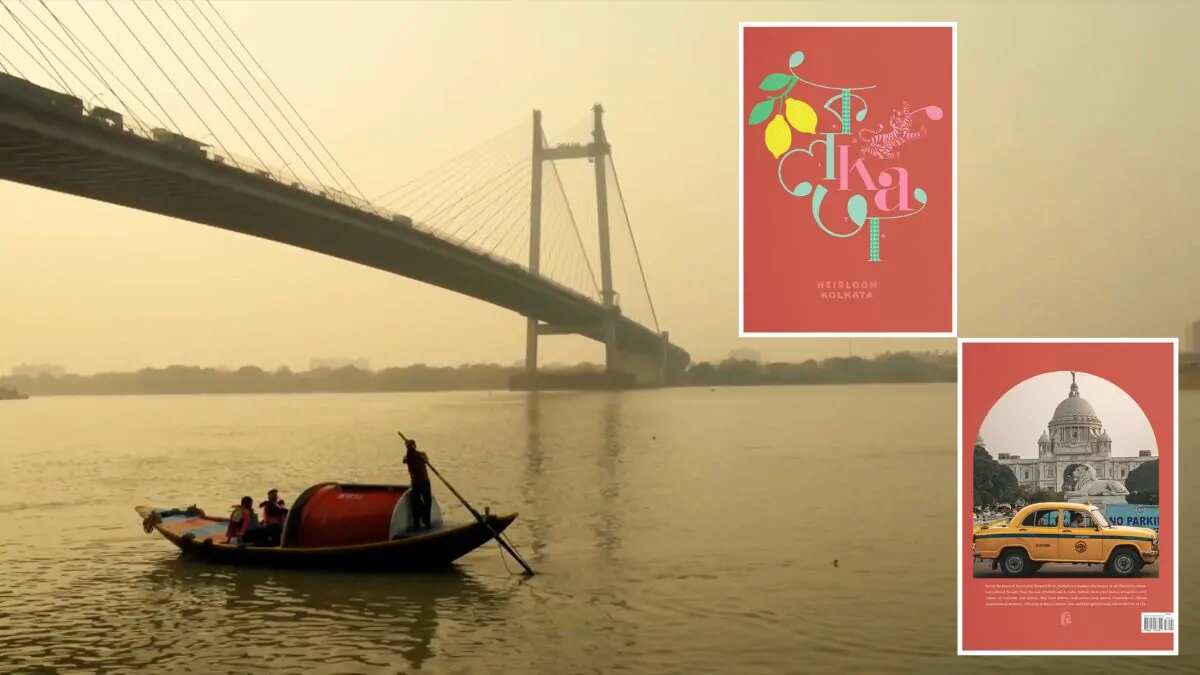
THERE ARE CITIES you visit, and then there is Kolkata — a city you inherit slowly, through its distinct aroma, appetite, spirit and memory. Through the sharp hit of shorsher tel (mustard oil) rising from a home kitchen. Through the sound of the crispy phuchkas sold around the rain-darkened cobblestone tram tracks. Through the evening clamour of New Market and the nightlife in and around the Park Street clubs and eateries. Through bhaat ghum, adda, chop and muri wrapped in newspaper thongas (packets), and the unmistakable comfort of being asked, "Bhaat kheyecho?" — have you eaten rice yet? In Kolkata, food is rarely just food. It is affection, argument, class, migration, nostalgia, survival, and identity all at once.
That layered emotional geography sits at the heart of The Kolkata Book by Heirloom Cities — an ambitious archival project that moves far beyond the structure of a conventional cookbook. Combining culinary history, oral memory, photography, essays, market culture, migration histories, and deeply personal food narratives, the book attempts to document Kolkata not as a static city frozen in nostalgia, but as a living organism shaped by centuries of exchange and reinvention. Across its pages, Mughlai kitchens coexist with Chinese eateries in Tangra, Marwari market culture intersects with Bengali home cooking, and street food becomes as historically important as elite dining rooms.
Slurrp reached out to founder and publisher Sri Bodanapu to talk about memory, migration, disappearing food cultures, the politics of preservation, and why documenting a city through its kitchens may reveal more than monuments ever can. Edited excerpts below:
***
Heirloom Cities doesn’t read like a conventional food book; it feels part archive, part urban memory project, part cultural anthropology. At what moment did you realise this needed to become something larger than simply documenting recipes?
Very early on, I realised that recipes alone could never fully tell the story of a city. Food exists within much larger ecosystems — communities, migration, markets, family histories, and everyday experiences. In cities like Mumbai and Kolkata, food is deeply tied to identity and geography, so documenting only recipes felt incomplete.
The idea for Heirloom Cities really came from noticing a blind gap in how food cultures from India and Asia were being documented visually. There are so many incredible stories here, but very little elevated design-led storytelling coming from the region itself. I wanted to create something that felt thoughtfully designed — a book that documented food cultures more deeply and expansively, rather than simply being a recipe book or an academic document.
Over time, the project evolved into a visual and cultural archive. The stories became as much about the people shaping the city as the food itself — fisherwomen in Koliwada, old Irani cafés, neighbourhood sweet shops, migrant communities, home cooks, market vendors, and the many “wallah” economies that keep cities functioning every day.
The series repeatedly challenges the idea of 'Indian cuisine' as a singular identity, instead presenting cities as layered culinary ecosystems shaped by migration, trade, colonisation, and memory. Why was it important for you to tell these stories through cities rather than states, regions, or communities alone?
Cities felt like the most honest lens through which to tell these stories because cities naturally hold contradiction, overlap, and exchange. A city like Mumbai or Kolkata cannot be reduced to a single cuisine or community. Their food cultures are shaped by centuries of migration, trade, colonisation, religion, and economic change.
I was interested in how all of these forces coexist within everyday food culture. You can see it in a single street or neighbourhood with communities influencing one another over generations while still preserving distinct identities. The city becomes a living archive of these interactions.
Telling the story through cities also allowed us to move away from overly simplistic ideas of “Indian food” and instead show how regional and community-specific traditions continue to evolve within urban environments.
The word heirloom suggests inheritance — something preserved and passed down carefully across generations. But in an era of migration, digital culture, and increasingly fragmented relationships with home, how relevant is the idea of an “heirloom” today?
I actually think the idea of heirloom becomes even more relevant in moments of rapid change. So many people today experience fragmented relationships with home, language, family traditions, and cultural memory. Food often becomes one of the few remaining ways people stay connected to identity and ancestry.
At the same time, many traditions are disappearing quietly through changing lifestyles, urban development, migration, or simply because younger generations no longer have access to the knowledge systems that existed before.
For me, “heirloom” is not about preserving culture in a frozen way. It’s about documenting what exists now, understanding where it came from, and creating records that future generations can return to.
While compiling the Kolkata volume, did you find yourself documenting traditions that are genuinely thriving, or traditions that are quietly disappearing from everyday life? Was the process hopeful or melancholic?
It was honestly both. Kolkata still has strong food traditions and communities that continue to preserve distinct culinary identities. There is enormous pride, continuity, and knowledge that still exists within homes, neighbourhoods, markets, and institutions across the city.
At the same time, there were many moments that felt fragile. Certain recipes are no longer being made regularly, old establishments are struggling, family businesses are changing, and some traditions survive through only a handful of individuals.
But overall, I would say the process felt more hopeful than melancholic. What stayed with me most was the resilience of these food cultures and the people continuing to preserve them despite enormous social and economic change.
One of the most striking aspects of the book is how it treats markets, home kitchens, and neighbourhood eateries almost like living archives. Do you think cities preserve memory through food more powerfully than through monuments or architecture?
In many ways, yes. Food is one of the most immediate forms of cultural memory because people engage with it every day, often across generations.
Markets, kitchens, cafés, and neighbourhood eateries hold stories that may never appear in formal archives or institutions. They reflect migration, trade, and the ways communities have shaped cities over time.
Architecture and monuments are important, but food often offers a more intimate understanding of how people actually lived, gathered, and sustained themselves.
Every city contains multiple parallel realities — old and new money, migrants and locals, elite dining rooms and street vendors. How did you navigate the question of whose Kolkata enters the archive, and what inevitably gets left out?
This was probably one of the most difficult parts of the process because no single book can fully capture a city as large and complex as Kolkata. From the beginning, we knew the archive would inevitably be incomplete.
What we tried to do instead was build a broad and representative cross-section of the city — different neighbourhoods, communities, economic backgrounds, generations, and food systems. We were just as interested in street-side food economies and home kitchens as we were in historically significant institutions or restaurants.
At the same time, there are countless stories that still remain undocumented, and I think acknowledging those gaps honestly is important.
The project balances visual storytelling with intimate oral histories and everyday food memories. Was there ever a concern about romanticising nostalgia while trying to preserve cultural memory?
Absolutely. That was something we discussed constantly throughout the process. There is always a risk of flattening cities into nostalgia, especially when working with memory and heritage.
We tried not to sanitise the cities we were documenting. The goal was never to create a romantic fantasy version of Mumbai or Kolkata, but to present them as living, evolving urban environments shaped by complexity and change.
For us, preservation was less about nostalgia and more about documentation.
Much of India’s culinary inheritance has traditionally survived through undocumented domestic labour, especially through women cooking inside homes rather than professional kitchens. How conscious was the project about recognising and preserving these invisible histories?
This was deeply important to the project. So much of India’s food knowledge has historically been preserved through women working inside homes, often without formal recognition or documentation.
Many recipes, techniques, and regional food practices survive because they were passed through generations of domestic cooking rather than institutions or restaurants. We wanted to acknowledge that these home kitchens are critical cultural spaces and deserve to be treated with the same seriousness as professional culinary environments.
A lot of the emotional and historical depth of the books comes from these conversations inside people’s homes.
At a time when food culture is increasingly shaped by algorithms, short-form content, and rapidly shifting trends, why did it feel important to create something as tactile and archival as a physical book series?
I think physical books encourage a different kind of engagement and attention. Digital content moves quickly and often prioritises speed and trend cycles, whereas books allow for slowness, depth, and permanence.
We wanted these projects to feel collectable and archival — something people could return to over time. The tactile quality of the books was also important because food itself is such a sensory experience. Design, paper, typography, and photography all become part of how the story is experienced.
Looking ahead, do you see Heirloom Cities remaining a publishing project, or evolving into something larger — perhaps a living archive of oral histories, travelling exhibitions, digital preservation work, or even a long-term cultural institution documenting the changing identities of Asian cities?
I definitely see the possibility of Heirloom Cities evolving into something much larger over time. The books are really just one format through which these stories can exist.
What excites me most is finding new ways to bring these cities to life. That could mean experiences, design and photo exhibitions, products, travel, or collaborations that help people connect more deeply with a city and its food culture.
At its core, though, the mission remains the same: documenting and preserving stories that might otherwise disappear, while creating contemporary cultural records that feel relevant to future generations.
***
All images via Heirloom Cities.
Heirloom Cities' Kolkata: The People, Kitchens and Streets of the City of Joy (392 Pages, 2025, Rs 7500) is available for purchase here.