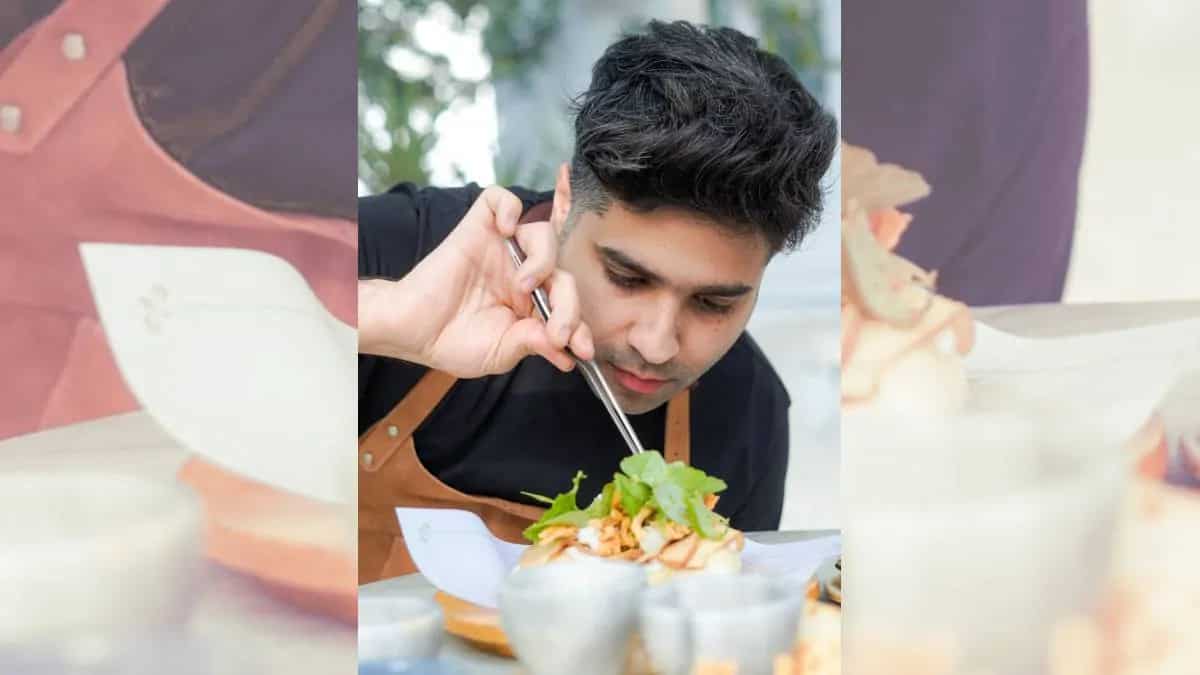
Editor’s note: This is the second piece in our Khapli series. The first — ‘The Honest Flour: Why Chefs Are Reaching for Khapli Atta’ — introduced four chefs and their relationship with this ancient Emmer wheat grain. Here, we go deeper with one of them: Dhruv Oberoi, Executive Chef of Olive Bar & Kitchen, New Delhi, and the technique story behind his signature Duck Khurchan Kulcha.
***
THERE IS A particular kind of chef — and Dhruv Oberoi is one of them — who talks about flour the way a musician talks about an instrument. Not what it looks like on paper, but what it does under your hands. What it asks of you. Whether it rewards the effort.
Khapli wheat, Dhruv will tell you, rewards patience very nicely. And the specific Khapli flour many pro (and home) chefs reach for — Aashirvaad Chakki Khapli Atta — is the product of a process designed precisely to preserve the properties that make it so compelling in a professional kitchen.
“Khapli wheat has a certain honesty to it — it hasn’t been over-refined or bred for yield at the cost of character. When you work with it, you notice a deeper nuttiness, a slightly coarse bite, and a structure that behaves very differently from modern wheat. It absorbs water more slowly, develops gluten more gently, and rewards patience very nicely,” says Dhruv, the Executive Chef for Olive Bar & Kitchen, New Delhi
What Dhruv is describing — the slower water absorption, the gentler gluten development — is a direct consequence of how the grain is processed into flour. For instance, Aashirvaad Chakki Khapli Atta uses a traditional “chakki jaisi pisai” method: stone-like grinding that works the grain slowly, preserving the grain’s natural architecture rather than breaking it down. The result is a flour with a confirmed Water Absorption Percentage of 73% — measurably higher than most wheat flours — which is what gives it that characteristic behaviour in the dough: the resistance, the depth, the demand for patience that chefs like Dhruv find so intriguing.
“What I find most compelling,” he says, “is how it connects technique with memory.” This, for him, is Khapli’s deeper appeal: it is not just a flour that behaves differently, it is a flour that feels like it comes from somewhere. Whether in a simple phulka or a more contemporary preparation, it brings, in his words, “a sense of grounding to the plate.”
His recipe for Duck Khurchan Kulcha is proof of concept for everything he is describing. It is a two-day project — deliberately so. The kulcha dough begins on Day 1 as a biga: just flour, water, honey, and a whisper of yeast, mixed without kneading and left to rest overnight at 18°C. This is the indirect dough method, borrowed from Italian bread-making, applied here to Khapli wheat. The long, cold fermentation develops flavour that kneading cannot produce.
On Day 2, the biga is incorporated into a second dough — more flour, more water, olive oil, salt — added in small batches, rested twice, then worked slowly until elastic. The dough is stretched and folded four or five times over two to three hours, building the gas retention that gives the kulcha its volume and open crumb. The duck leg, meanwhile, is rendered skin-side down in a cold pan, the fat coaxed out slowly before the bird is shredded and returned to the same pan — the duck fat, Dhruv notes, is gold — where it meets a masala of onion, ginger-garlic, spices, and heat. The khurchan stage is the critical one: high heat, the duck allowed to catch slightly on the pan, scraped, tossed, edges crisped, masala clinging tightly. Finished with kasuri methi, lemon, and plum aachar.
The kulcha is stretched on a semolina-dusted surface to an eight-to-ten-inch round with a thick rim, dressed with olive oil and Amul cheese, and baked in a 250°C oven for ninety seconds until it leopard-spots. The duck khurchan and fresh plum go on top, and it is served immediately.
It is not a simple dish. But then, Dhruv’s point was never that Khapli makes things simple. It makes them worth it.
Dhruv Oberoi’s Duck Khurchan Kulcha Recipe
Kulcha made with indirect biga dough, baked with duck leg khurchan and plum kalonji.
Day 1 — The Biga
500g Khapli wheat flour | 300g water | 25g honey | 1g instant yeast
Combine yeast and flour, add honey and water. Mix (do not knead). Rest for 12 hours at 18°C.
Day 2 — The Dough
500g Khapli wheat flour | 450g water | 25g honey | 2g instant yeast | 20g olive oil | 18g salt
In a mixing bowl with honey and water, add the biga in small batches. Rest for 30 minutes. Add flour and yeast, rest again for 30 minutes. Add salt last, then slap the dough slowly until elastic. Rest for 2–3 hours, stretching and folding 4–5 times. Shape into 150g balls, preserve gas. Rest 30 minutes before use.
For the Duck Leg Khurchan
500g duck leg, skin on | 1 small onion, thinly sliced | 1 tbsp ginger-garlic paste | 2 green chillies, slit | ½ tsp turmeric | 1 tsp red chilli powder | 1 tsp coriander powder | ½ tsp cumin powder | Salt to taste | 1 tsp kasuri methi | Juice of 2 lemons | 30g plum pickle | Amul cheese for baking
In a cold pan, place duck leg skin-side down. On medium heat, render fat for 5–7 minutes. Flip, cook 2–3 minutes, remove, rest, shred. Reserve duck fat in pan. Build masala in the same pan: onions, ginger-garlic, cook till light brown. Add spices and salt, cook till fat separates. Add shredded duck on high heat — let it stick slightly, scrape and toss till edges crisp and masala coats tightly. Finish with green chilli, kasuri methi, lemon juice, and plum aachar.
For the Kulcha
Preheat oven to 250°C for 30 minutes. Dust a marble surface with semolina and flour. Stretch dough from centre outwards to an 8–10-inch round with a thick rim. Splash olive oil, add a handful of Amul processed cheese. Slide into the oven on a floured pizza shovel. Bake for 90 seconds or until leopard-spotted. Top with duck khurchan and freshly sliced ripe plum. Serve immediately.
***
Next in the series: Nikhil Merchant on why he switched his everyday rotis to Khapli wheat — and the savoury pancakes with burrata that show just how far from the tawa this flour can travel.
***